
BuddhistCatholicContemplativeEvangelicalGeneral ChristianHinduJewishLatter-day SaintMuslimNew VisionsProgressive Christian
Beliefs
- Buddhist
- Catholic
- Contemplative
- Evangelical
- General Christian
- Hindu
- Jewish
- Latter-day Saint
- More Voices
- Muslim
- New Visions
- Pagan
- Progressive Christian
Topics
- Religion News
- Food and Religion
- Sports and Religion
- Religious Art
- Religious Music and Entertainment
- Religious Events
- History and Religion
- Style and Religion
- Politics and Religion
- Women in Religion
- Recreation Outdoors and Religion
- Business Finance and Religion
- Careers Workplace and Religion
- Education and Religion
- Family Parenting and Religion
- Health Fitness and Religion
- Home and Religion
- Relationships and Religion
- Technology and Religion
- Travel and Religion
Columnists
- Buddhist Columnists
- Business Finance and Religion Columnists
- Careers Workplace and Religion Columnists
- Catholic Columnists
- Contemplative Columnists
- Education and Religion Columnists
- Evangelists Columnists
- Family Parenting and Religion Columnists
- General Christian Columnists
- Health Fitness and Religion Columnists
- Hindu Columnists
- History and Religion Columnists
- Home and Religion Columnists
- Jewish Columnists
- More Voices Columnists
- Latter Day Columnists
- Muslim Columnists
- New Visions Columnists
- Nonreligious Columnists
- Pagan Columnists
- Politics and Religion Columnists
- Progressive Columnists
- Recreation Outdoors and Religion Columnists
- Relationships and Religion Columnists
- Religion News Columnists
- Religious Art Columnists
- Religious Events Columnists
- Religious Music and Entertainment Columnists
- Sports and Religion Columnists
- Style and Religion Columnists
- Technology and Religion Columnists
- Travel and Religion Columnists
- Women in Religion Columnists
Resource Library
- 2026 Calendar
- Library of World Religions
- The 100 Most Holy Places on Earth
- Patheos Answers
- Podcasts
- Videos
- Faith Leaders Database
- Anglican Episcopalian
- Bahai
- Baptist
- Buddhism
- Christianity
- Confucianism
- Eastern Orthodoxy
- Hinduism
- Holiness and Pentecostal
- ISKCON
- Islam
- Judaism
- Lutheran
- Methodist
- The Church of Jesus Christ of Latter-day Saints
- New Age
- Paganism
- Presbytarian and Reformed
- Protestantism
- Religion Behind the Scenes
- Roman Catholic
- Scientology
- Shia Islam
- Sikhism
- Sufism
- Sunni Islam
- Taoism
- Zen
- See all religions
Research Tools
 Ad-Free & Subscriber Log-In Subscription Support
Ad-Free & Subscriber Log-In Subscription Support
Follow Patheos 

- Trending:
- Forgiveness
- |
- Marriage
- |
- Consciousness
- |
- Death Penalty
- |
- Election
- |
- Halloween
 A Catholic Thinker
- Home
- Catholic
- Mother Teresa: The Saint of the Darkness
Mother Teresa: The Saint of the Darkness
Last updated on: April 13, 2016 at 11:40 pm by Tod Worner
Mother Teresa: The Saint of the Darkness 2016-04-13T23:40:36-06:00 Tod Worner
Patheos Explore the world's faith through different perspectives on religion and spirituality! Patheos has the views of the prevalent religions and spiritualities of the world.
“If I ever become a saint, I will surely be one of ‘darkness.’ ”
– Blessed Teresa of Calcutta
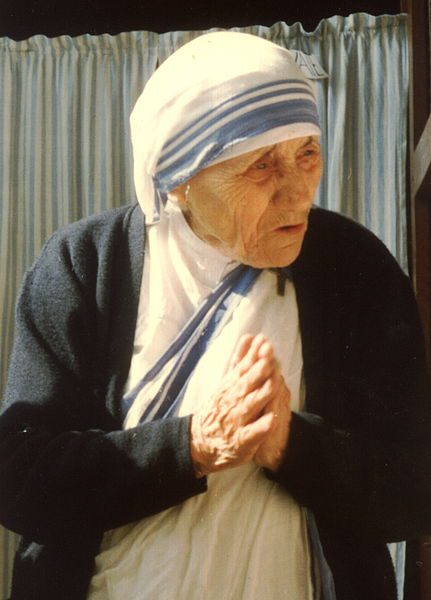
They say she is a saint.
And on September 4th, 2016, Pope Francis and the Catholic Church will canonize her. On that day, Mother Teresa – Blessed Teresa of Calcutta – will become St. Teresa of Calcutta.
They say she is a saint.
But some doubt it.
Oh, it’s not simply that some question the Catholic Church’s overall process of investigating Mother Teresa’s (or any other candidate’s) cause for sainthood (including identifying and verifying two miracles attributed to the proposed saint’s intercession). Nor is it because of cynical detractors who have tried to characterize the diminutive nun as some sort of narcissistic tyrant reveling in the misery around her.
No.
Some doubt that she is a saint…because she doubted.
The world came to know the depth of Blessed Teresa’s spiritual “dark night” when her personal letters, including deeply troubled missives to spiritual advisers, came to light in the posthumously published collection, Mother Teresa: Come Be My Light. From those letters emerged the desperation from years of service in the squalor, the angst and the hopelessness of the Calcutta gutters. From those letters came abandonment, desolation, blackness.
“Darkness is such that I really do not see – neither with my mind nor with my reason – the place of God in my soul is blank – There is no God in me – when the pain of longing is so great – I just long & long for God… The torture and pain I can’t explain.”
“There is so much deep contradiction in my soul. Such deep longing for God – so deep that it is painful – a suffering continual – and yet not wanted by God – repulsed – empty – no faith – no love – no zeal. Souls hold no attraction – Heaven means nothing – to me it looks like an empty place – the thought of it means nothing to me and yet this torturing longing for God. Pray for me please that I keep smiling at Him in spite of everything. For I am only His – so He has every right over me.”
Teresa’s was a dark night that lasted years. A spiritual desert place. A barren land bereft of hope.
Indeed.
Surely, it has been reasoned, this revelation makes Blessed Teresa vulnerable. Surely this bright light of Catholic faith and charity is snuffed out by her embarrassing weakness, by her scandalous hypocrisy. Surely this dark chapter should be whitewashed, or better yet, forgotten.
But we have seen this dark night before.
Mary, the Mother of Christ, gazed at her bloodied, beaten and crucified Son – her Child of the Anunciation, her Boy of the carpenter’s shop, her Son of wisdom and miracles. And surely, she recalled Simeon’s words to her at the Presentation of Christ to the Temple. “And you yourself a sword will pierce”. And a darkness surrounded her.
Peter, the Rock upon which the Church would be built, caught the telling gaze of Christ after denying Him for the third time. He removed himself to an isolated place and wept bitterly. And a darkness engulfed him.
Paul, haughtily “breathing murderous threats” against the disciples of Christ, fell on the road to Damascus. He was struck by a brilliant light and an indicting Voice. In that moment, he found the entirety of his life’s purpose shaken and upended. And for three days, darkness consumed him.
And Jesus Christ, God-made-man, asked for the punishing cup to be taken from Him when in the Garden of Gethsemane. And then, fixed to a cross, he desperately yearned to know why His God had forsaken Him. “It is finished.”, he uttered. And darkness would descend.
St. John of the Cross and St. Therese of Lisieux. G.K. Chesterton and Flannery O’Connor. All had dark nights.
A young Flannery, memorably, wrote in her prayer journal,
“Dear God, I cannot love Thee the way I want to. You are the slim crescent of a moon that I see and my self is the earth’s shadow that keeps me from seeing all the moon. The crescent is very beautiful and perhaps that is all one like I am should or could see; but what I am afraid of, dear God, is that my self shadow will grow so large that it blocks the whole moon, and that I will judge myself by the shadow that is nothing. I do not know You God because I am in the way. Please help me to push myself aside.”
And yet the fruits of prayer, time and experience – and of her dark nights of lupus and spiritual uncertainty – would allow a mature Flannery to offer this advice to a spiritually struggling college student,
“‘Lord I believe. Help my unbelief.’ It is the most natural and most humanizing and most agonizing prayer in the gospels, and I think it is the foundation prayer of faith.”
Yes. Yes.
You see, I’ve discovered that dark nights don’t disqualify saints. They make them. They are the foundation prayer of faith. And the dark nights I have seen in Christ and Mary, Peter and Paul, G.K. and Flannery, and… Blessed Teresa of Calcutta have helped me in dark nights of my own. We don’t need to run away from dark nights of the soul – ours or others. Rather, we should believe and hope and be purified by them. We should know that perhaps some good will come out of them – for us or others. As one wise writer once said, “Faith means believing in advance what only makes sense in reverse.”
Blessed Teresa, haunted by darkness, realized this. And wrote of it.
“If my separation from you brings others to you… I am willing with all my heart to suffer all that I suffer. Your happiness is all I want.”
They say that Blessed Teresa of Calcutta is a saint.
I believe it.
The Saint of the Darkness…who brings others to the Light.
—————————-
Photo Credit: Evert Odekerken at Wikimedia Commons


Next Post
April 21, 2016 The Pope, Amoris Laetitia & the Doggedness of Truth
Browse Our Archives
Select a Category A Catholic Thinker's Story Uncategorized
Select a Month March 2017 February 2017 December 2016 November 2016 October 2016 September 2016 August 2016 July 2016 June 2016 May 2016 April 2016 March 2016 February 2016 January 2016 December 2015 November 2015 October 2015 September 2015 August 2015 July 2015 June 2015 May 2015 April 2015 March 2015 February 2015 January 2015 December 2014 November 2014 October 2014 September 2014 August 2014 July 2014 June 2014 May 2014 April 2014 March 2014 February 2014 January 2014 December 2013 November 2013 October 2013 September 2013 July 2013 June 2013 May 2013 April 2013 March 2013 February 2013 January 2013 December 2012 November 2012 October 2012 September 2012 August 2012 July 2012
Follow Us!
TAKE THE
Religious Wisdom Quiz
Who is considered the ideal wife and mother in Proverbs?
Select your answer to see how you score.
The Proverbs 31 woman Eve Mary Magdalene Martha
Related posts from A Catholic Thinker


"Something Absolutely Modern" - The Insincere Convert from...

Textualism vs. The Living Constitution: Justice Scalia, Judge...

Memento Mori: Hope In a Year Heavy With...
TRENDING AT PATHEOS Catholic

The Parable Of The Sower And The Word...
One of Christ’s most famous parables is that of the sower who...

Rejecting Doom: Christian Hope And Human Action
Christianity is a religion of hope. We are to have hope and...

Why I Choose the Eucharist Over the Sermon
Choose the Eucharist, Not the Sermon What are we supposed to get...

5 Design Elements Found in Spiritually Rooted Homes
Putting Spirituality Into Home Decor Our homes are more than our living...

Credo: A Story of God Told with the...
About 10 years ago, I began to imagine a personal "Credo" that...

The Anatomy of Divine Revelation in Catholic Thought
The claim that God has made Himself known to human beings is...
view all Catholic blogs
Ad-Free & Subscriber Log-In Subscription Support
- About Us
- 2026 Calendar
- Videos
- Podcasts
- Library of World Religions
- Faith In Media Tracker
- Advertise With Us
- Write for Us
- Privacy Policy
- Terms of Service
- Do Not Sell My Data
- Contact Us
- Radiant Digital
- Manage Newsletter Subscriptions
- Unsubscribe From Notifications
- Sitemap
Copyright 2008-2026, Patheos. All rights reserved.
Subscription Support Ad-Free & Subscriber Log-In
Follow Patheos