
BuddhistCatholicContemplativeEvangelicalGeneral ChristianHinduJewishLatter-day SaintMuslimNew VisionsProgressive Christian
Beliefs
- Buddhist
- Catholic
- Contemplative
- Evangelical
- General Christian
- Hindu
- Jewish
- Latter-day Saint
- More Voices
- Muslim
- New Visions
- Pagan
- Progressive Christian
Topics
- Religion News
- Food and Religion
- Sports and Religion
- Religious Art
- Religious Music and Entertainment
- Religious Events
- History and Religion
- Style and Religion
- Politics and Religion
- Women in Religion
- Recreation Outdoors and Religion
- Business Finance and Religion
- Careers Workplace and Religion
- Education and Religion
- Family Parenting and Religion
- Health Fitness and Religion
- Home and Religion
- Relationships and Religion
- Technology and Religion
- Travel and Religion
Columnists
- Buddhist Columnists
- Business Finance and Religion Columnists
- Careers Workplace and Religion Columnists
- Catholic Columnists
- Contemplative Columnists
- Education and Religion Columnists
- Evangelists Columnists
- Family Parenting and Religion Columnists
- General Christian Columnists
- Health Fitness and Religion Columnists
- Hindu Columnists
- History and Religion Columnists
- Home and Religion Columnists
- Jewish Columnists
- More Voices Columnists
- Latter Day Columnists
- Muslim Columnists
- New Visions Columnists
- Nonreligious Columnists
- Pagan Columnists
- Politics and Religion Columnists
- Progressive Columnists
- Recreation Outdoors and Religion Columnists
- Relationships and Religion Columnists
- Religion News Columnists
- Religious Art Columnists
- Religious Events Columnists
- Religious Music and Entertainment Columnists
- Sports and Religion Columnists
- Style and Religion Columnists
- Technology and Religion Columnists
- Travel and Religion Columnists
- Women in Religion Columnists
Resource Library
- 2026 Calendar
- Library of World Religions
- The 100 Most Holy Places on Earth
- Patheos Answers
- Podcasts
- Videos
- Faith Leaders Database
- Anglican Episcopalian
- Bahai
- Baptist
- Buddhism
- Christianity
- Confucianism
- Eastern Orthodoxy
- Hinduism
- Holiness and Pentecostal
- ISKCON
- Islam
- Judaism
- Lutheran
- Methodist
- The Church of Jesus Christ of Latter-day Saints
- New Age
- Paganism
- Presbytarian and Reformed
- Protestantism
- Religion Behind the Scenes
- Roman Catholic
- Scientology
- Shia Islam
- Sikhism
- Sufism
- Sunni Islam
- Taoism
- Zen
- See all religions
Research Tools
 Ad-Free & Subscriber Log-In Subscription Support
Ad-Free & Subscriber Log-In Subscription Support
Follow Patheos 

- Trending:
- Forgiveness
- |
- Marriage
- |
- Consciousness
- |
- Death Penalty
- |
- Election
- |
- Halloween
 A Catholic Thinker
- Home
- Catholic
- Thomas More’s Choice… & Ours
Thomas More’s Choice… & Ours
Last updated on: March 15, 2016 at 11:40 pm by Tod Worner
Thomas More’s Choice… & Ours 2016-03-15T23:40:52-06:00 Tod Worner
Patheos Explore the world's faith through different perspectives on religion and spirituality! Patheos has the views of the prevalent religions and spiritualities of the world.
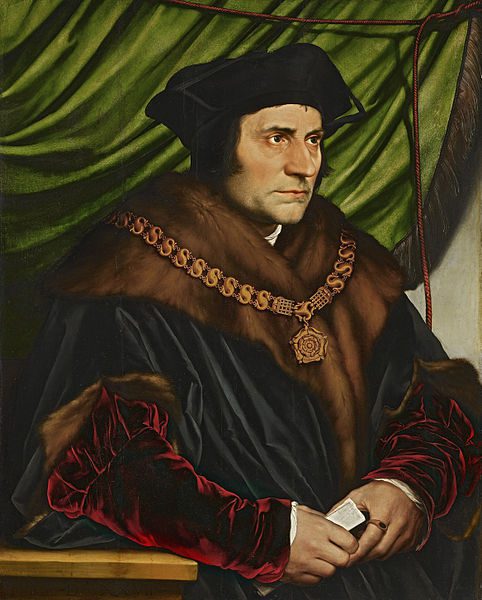
Thomas More by Hans Holbein
“There can be seasonal misrule only within a prevailing architecture of order…Debates and disputations…are possible only within the context of an assured and absolute truth which governs humankind.”
– Peter Ackroyd, author of The Life of Thomas More
He loved his Church. He loved the Law. He loved his King.
Of course he did.
And yet ultimately, Thomas More would have to choose.
The Church, in More’s time, stretched back 1500 years. Its traditions, its sacraments and its tender mercies had nursed and molded his character. For several years, the young Thomas More discerned a vocation as a Carthusian priest spending hours in prayer and fasting in the Charterhouse of London. For many reasons he would choose the law over the priesthood, most notably because he lacked the call to celibacy and feared he would be an “unchaste priest”. And so he would become a devoted husband, a doting father, an honest jurist and a good man. Faith epitomized Thomas More.
The Law was the edifice of English society. It was, effectively, Right Reason codified. And Right Reason codified was man’s faintest apprehension of God’s Eternal Law. As a lawyer, judge and (ultimately) Lord Chancellor, Thomas More saw the faithful application of the law as a sacred duty. While ultimate justice resided in the hands of God, temporal justice could be earnestly, if imperfectly, enacted. But in order for the temporal to do honor to the eternal, man’s law had to draw from the deep wells of tradition and morality. Caprice and selfish appetite had no place in the formation or application of law. The Law defined Thomas More.
The King represented an honored tradition of structure and order. The simple matter of marriage and childbirth could promise magnificent dynasties or tragic collapse. And the character of the King (or Queen) could enhance trade, grow culture and win wars, or it could lead a nation to its ruin. King Henry VIII was intent on the former. And to do this, he depended on his friend and confidant, Lord Chancellor Thomas More.
More was devoted to the Church, the Law and the King.
But what would happened if they were at odds?
Inevitably, they would be.
King Henry VIII sought to change the Law. He sought to alter the Law which was rooted in Scripture and Church Tradition. And he did it to serve his own appetite. Married to Queen Catherine of Aragon, the lusting King’s sought annulment of his marriage in order to marry the young Anne Boleyn. In short order, the Pope denied his request which, in turn, led to a draconian split between King Henry VIII and the Catholic Church. Declaring himself Supreme Head of the Church of England, the King altered doctrine according to his own will, expropriated Church properties and demanded faithful utterance of the Oath of Supremacy and the Oath of Succession. These Oaths renounced allegiance to the Pope and acknowledged the royal bloodline passing through the new Queen Anne Boleyn.
And the King wanted Thomas More to swear to it.
But this caprice was unconscionable to Thomas More. The Church is the custodian of God’s Word on Earth. The Law is man’s steady, enduring conception of God’s Will (understood through reason) enshrined in statute and precedent. The Church and the Law were not to be trifled with. And yet the brazen King would do just that. He not only trifled with them…he upended them.
And so, Thomas More had a choice. The Church and the True Law or the King and his law.
Peter Ackroyd, author of The Life of Thomas More, articulated More’s worldview,
“Religion and law were not to be considered separately; they implied one another. That is why law was to be considered to be perfect in itself, undamaged by the bad judgments of individual practitioners; the same argument, on the merits of the Mass as opposed to the virtue of the priest who offered it, was at the heart of Catholic eucharistic belief. That is why the law was considered to be permanent; it was what was known to be true, withstanding change or decay.”
Thomas More found an illegitimacy in the judgment of King Henry VIII even while he hoped to maintain him as his friend. More perceived a spuriousness in Parliament’s attempt to “legally” uphold the King’s illegitimate judgment. And he found enduring truth in the Church’s respect for the institution of marriage even though the Pope could get ensnared in political sniping and maneuvering. Ackroyd offers this brilliant assessment,
“It is misleading to separate ‘social’ from ‘political’, ‘legal’, or ‘religious’ matters in this period.; they represent the same central concern of fallen man, which lay in understanding and organizing his temporary sojourn on earth.”
Thomas More always knew who and what he served first – His God & Church. He would routinely attend Mass at a small local church and it was not uncommon that the esteemed Lord Chancellor, would serve in the humble role of altar boy or choir member. Chastised by his friend the Duke of Norfolk for stooping to such a lowly role, More twinkled,
“My master the King cannot be displeased at the service I pay to his master God.”
Thomas More greatly respected the Law, but knew the illegitimacy of Parliament to enact law declaring a spiritual truth (the King named Supreme Head of the Church of England). By refusing to take the Oath of Supremacy, he was forced into the dreary Tower of London for fifteen months. He was deprived of basic food, warm clothing, access to family and personal items. While there, he always knew who and what he served first. More, cold, shivering and alone prayed,
Give me the grace, Good Lord
To set the world at naught. To set the mind firmly on You and not to hang upon the words of men’s mouths.
To be content to be solitary. Not to long for worldly pleasures. Little by little utterly to cast off the world and rid my mind of all its business.
Not to long to hear of earthly things, but that the hearing of worldly fancies may be displeasing to me.
Gladly to be thinking of God, piteously to call for His help. To lean into the comfort of God. Busily to labor to love Him…
…………..
To think my worst enemies my best friends, for the brethren of Joseph could never have done him so much good with their love and favor as they did him with their malice and hatred.
These minds are more to be desired of every man than all the treasures of all the princes and kings, Christian and heathen, were it gathered and laid together all in one heap.
Amen
And when on trial, More opted to be silent instead of affirming the Parliament’s illegitimate law. He opted not to grovel for mercy before his capricious King. And he went to his execution affirming what he believed,
“I die the King’s good servant, but God’s first.”
Yes, yes.
Perhaps, in a season of politics and muddled loyalties, we would do well to remember:
Thomas More loved his King, loved the Law and loved his life. He was truly a good servant.
Truly.
But God’s first.
————————————————
Photo courtesy of Wikimedia Commons

Previous Post
March 6, 2016
What This Catholic Saw At the Movie "Risen"
Next Post
March 19, 2016 The Church of Second Chances: Christ & the Wretchedness of Peter
Browse Our Archives
Select a Category A Catholic Thinker's Story Uncategorized
Select a Month March 2017 February 2017 December 2016 November 2016 October 2016 September 2016 August 2016 July 2016 June 2016 May 2016 April 2016 March 2016 February 2016 January 2016 December 2015 November 2015 October 2015 September 2015 August 2015 July 2015 June 2015 May 2015 April 2015 March 2015 February 2015 January 2015 December 2014 November 2014 October 2014 September 2014 August 2014 July 2014 June 2014 May 2014 April 2014 March 2014 February 2014 January 2014 December 2013 November 2013 October 2013 September 2013 July 2013 June 2013 May 2013 April 2013 March 2013 February 2013 January 2013 December 2012 November 2012 October 2012 September 2012 August 2012 July 2012
Follow Us!
TAKE THE
Religious Wisdom Quiz
"Thou preparest a table for me in the presence of mine _____."
Select your answer to see how you score.
Enemies Kinsmen Children Friends
Related posts from A Catholic Thinker

"Something Absolutely Modern" - The Insincere Convert from...

Textualism vs. The Living Constitution: Justice Scalia, Judge...

Memento Mori: Hope In a Year Heavy With...

Advent: The Greatest Resistance Story of All Time
TRENDING AT PATHEOS Catholic

Rejecting Doom: Christian Hope And Human Action
Christianity is a religion of hope. We are to have hope and...

It’s What Comes From Within Which Matters
One of the most difficult things for us to understand is why...

Why I Choose the Eucharist Over the Sermon
Choose the Eucharist, Not the Sermon What are we supposed to get...

5 Design Elements Found in Spiritually Rooted Homes
Putting Spirituality Into Home Decor Our homes are more than our living...

Credo: A Story of God Told with the...
About 10 years ago, I began to imagine a personal "Credo" that...

The Anatomy of Divine Revelation in Catholic Thought
The claim that God has made Himself known to human beings is...
view all Catholic blogs
Ad-Free & Subscriber Log-In Subscription Support
- About Us
- 2026 Calendar
- Videos
- Podcasts
- Library of World Religions
- Faith In Media Tracker
- Advertise With Us
- Write for Us
- Privacy Policy
- Terms of Service
- Do Not Sell My Data
- Contact Us
- Radiant Digital
- Manage Newsletter Subscriptions
- Unsubscribe From Notifications
- Sitemap
Copyright 2008-2026, Patheos. All rights reserved.
Subscription Support Ad-Free & Subscriber Log-In
Follow Patheos