
BuddhistCatholicContemplativeEvangelicalGeneral ChristianHinduJewishLatter-day SaintMuslimNew VisionsProgressive Christian
Beliefs
- Buddhist
- Catholic
- Contemplative
- Evangelical
- General Christian
- Hindu
- Jewish
- Latter-day Saint
- More Voices
- Muslim
- New Visions
- Pagan
- Progressive Christian
Topics
- Religion News
- Food and Religion
- Sports and Religion
- Religious Art
- Religious Music and Entertainment
- Religious Events
- History and Religion
- Style and Religion
- Politics and Religion
- Women in Religion
- Recreation Outdoors and Religion
- Business Finance and Religion
- Careers Workplace and Religion
- Education and Religion
- Family Parenting and Religion
- Health Fitness and Religion
- Home and Religion
- Relationships and Religion
- Technology and Religion
- Travel and Religion
Columnists
- Buddhist Columnists
- Business Finance and Religion Columnists
- Careers Workplace and Religion Columnists
- Catholic Columnists
- Contemplative Columnists
- Education and Religion Columnists
- Evangelists Columnists
- Family Parenting and Religion Columnists
- General Christian Columnists
- Health Fitness and Religion Columnists
- Hindu Columnists
- History and Religion Columnists
- Home and Religion Columnists
- Jewish Columnists
- More Voices Columnists
- Latter Day Columnists
- Muslim Columnists
- New Visions Columnists
- Nonreligious Columnists
- Pagan Columnists
- Politics and Religion Columnists
- Progressive Columnists
- Recreation Outdoors and Religion Columnists
- Relationships and Religion Columnists
- Religion News Columnists
- Religious Art Columnists
- Religious Events Columnists
- Religious Music and Entertainment Columnists
- Sports and Religion Columnists
- Style and Religion Columnists
- Technology and Religion Columnists
- Travel and Religion Columnists
- Women in Religion Columnists
Resource Library
- 2026 Calendar
- Library of World Religions
- The 100 Most Holy Places on Earth
- Patheos Answers
- Podcasts
- Videos
- Faith Leaders Database
- Anglican Episcopalian
- Bahai
- Baptist
- Buddhism
- Christianity
- Confucianism
- Eastern Orthodoxy
- Hinduism
- Holiness and Pentecostal
- ISKCON
- Islam
- Judaism
- Lutheran
- Methodist
- The Church of Jesus Christ of Latter-day Saints
- New Age
- Paganism
- Presbytarian and Reformed
- Protestantism
- Religion Behind the Scenes
- Roman Catholic
- Scientology
- Shia Islam
- Sikhism
- Sufism
- Sunni Islam
- Taoism
- Zen
- See all religions
Research Tools
 Ad-Free & Subscriber Log-In Subscription Support
Ad-Free & Subscriber Log-In Subscription Support
Follow Patheos 

- Trending:
- Forgiveness
- |
- Marriage
- |
- Consciousness
- |
- Death Penalty
- |
- Election
- |
- Halloween
 A Catholic Thinker
- Home
- Catholic
- Thomas Merton & “the Most Remarkable People He Ever Knew”
Thomas Merton & “the Most Remarkable People He Ever Knew”
Last updated on: January 19, 2016 at 7:47 am by Tod Worner
Thomas Merton & “the Most Remarkable People He Ever Knew” 2016-01-19T07:47:25-06:00 Tod Worner
Patheos Explore the world's faith through different perspectives on religion and spirituality! Patheos has the views of the prevalent religions and spiritualities of the world.
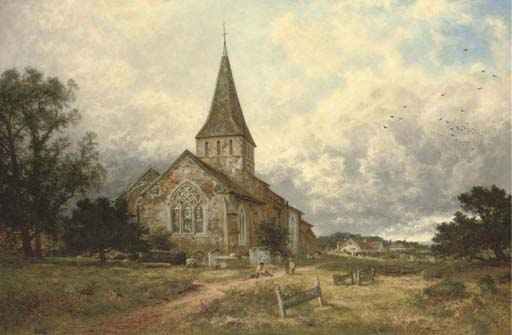
The Village Church by Benjamin Williams Leader
He considered them “among the most remarkable people I ever knew.”
And he met them when he was just twelve.
The Privats came into Thomas Merton’s life by chance. Merton’s father was a widower and itinerant artist. His most recent wanderings landed him in Murat, the rustic, mountainous terrain of central France. And the Privat’s small home was nestled where lush valleys kissed fir tree-lined foothills. As his father found himself in various French locales to paint, he left his son, Thomas, to enjoy weeks at a time with the Privats. It was there that he ate well, recovered from childhood illness, romped through the woods and mountainside. But there was more. At twelve years old with a deceased mother, a roving (almost absentee) father and a hard-edged school experience, time with the Privats provided a rootedness, a foundation. In the town’s statue honoring Our Lady of the Immaculate Conception, in the home’s peaceful remove from the harshness of the city, in the Privat’s quiet honor that enveloped each act of their day, Thomas sensed it. He could tell, though he was only twelve, there was something special here.
As he recalled in his autobiography, The Seven Storey Mountain,
“I no longer possess any details about them. I just remember their kindness and goodness to me, and their peacefulness and utter simplicity. They inspired real reverence, and I think, in a way, they were certainly saints. And they were saints in that most effective and telling way: sanctified by leading ordinary lives in a completely supernatural manner, sanctified by obscurity, by usual skills, by common tasks, by routine, but skills, tasks, routine which received a supernatural form from grace within, and from the habitual union of their souls with God in deep faith and charity. Their farm, their family and their Church were all that occupied these good souls, and their lives were full.”
He sensed it. He knew it.
Deep in their routine, suffusing their lives’ structure and order was holiness. It wasn’t a holiness of perfection. It wasn’t an otherworldly veneer of piety that queerly detached from the trials of daily life. Theirs was an eyes-wide open Catholic faith that saw the supernatural breathe meaning into the common, that grasped the deeply sacred in the midst of the profane.
But it was sitting on the home’s balcony as September’s daylight became dusk that Thomas truly grasped what the Privat’s faith meant to them. Having grown comfortable and feeling urbane and sophisticated, Thomas spoke boldly of religion.
“I gave them the argument that every religion was good: they all led to God, only in different ways, and every man should go according to his own conscience, and settle things according to his own private way of looking at things.”
Their response was striking.
“They did not answer with any argument. They simply looked at one another and shrugged and Monsieur Privat said quietly and sadly,’Mais c’est impossible’.”
“Mais c’est impossible.”
“But, it is impossible.”
The pre-teen was shaken. And shamed. His pride had consequences. His impulsiveness to prove himself and his cocksure drive to argue showed just what a boy he was. The piffling stance of the child met the honest faith of the man and woman. And he sensed how large was their God…how small was his “wisdom”.
But most profoundly, they treated his assertion as grave. Quite grave. As Merton recalled,
“They did not give me the feeling that this was some slight matter, something to be indulged in a child, something that could be left to work itself out in time, of its own accord. I had never met people to whom belief was a matter of such moment…And I thank God from the bottom of my heart that they were concerned, and so deeply and vitally concerned, at my lack of faith.”
The emptiness of the world had spoken through the boy, Thomas. There are no rules. There is no right or wrong. Conscience is the sole determinant of action. The rudderless ship can lead you to your proper destination. Not to worry, the enlightened lad assured. Not to worry.
“Mais c’est impossible.”, they answered. “Mais c’est impossible.”
Before long, young Thomas and his father would move on. And he would never see the Privats again. But their quiet model, their true belief and their willingness to honestly engage, even in the most subtle of ways, on matters of great importance had an unparalleled impact on the boy who would become Catholic and ultimately a Trappist monk.
“Who knows how much I owe to those two wonderful people? Anything I say about it is only a matter of guessing but, knowing their charity, it is to me a matter of moral certitude that I owe many graces to their prayers, and perhaps ultimately the grace of my conversion and even of my religious vocation. Who shall say? But one day I shall know, and it is good to be able to be confident that I will see them again and be able to thank them…After all, going to Murat was a great grace. Did I realize it? I did not know what a grace was.”
The Privats lived their faith simply and honestly. And Thomas Merton sensed it, respected it and was transformed by it.
Perhaps others are watching us, listening to us, sensing something in us.
Perhaps we too, unknowingly, can be a grace to another.
Perhaps.
——————————————
Photo Credit from Wikimedia Commons

Previous Post

January 11, 2016
What This Catholic Dad Saw at Star Wars
Next Post

January 26, 2016 Why Peyton Matters
Browse Our Archives
Select a Category A Catholic Thinker's Story Uncategorized
Select a Month March 2017 February 2017 December 2016 November 2016 October 2016 September 2016 August 2016 July 2016 June 2016 May 2016 April 2016 March 2016 February 2016 January 2016 December 2015 November 2015 October 2015 September 2015 August 2015 July 2015 June 2015 May 2015 April 2015 March 2015 February 2015 January 2015 December 2014 November 2014 October 2014 September 2014 August 2014 July 2014 June 2014 May 2014 April 2014 March 2014 February 2014 January 2014 December 2013 November 2013 October 2013 September 2013 July 2013 June 2013 May 2013 April 2013 March 2013 February 2013 January 2013 December 2012 November 2012 October 2012 September 2012 August 2012 July 2012
Follow Us!
TAKE THE
Religious Wisdom Quiz
What does "Gad" mean in Hebrew?
Select your answer to see how you score.
Chosen One Fortune Warrior Joyful
Related posts from A Catholic Thinker

"Something Absolutely Modern" - The Insincere Convert from...

Textualism vs. The Living Constitution: Justice Scalia, Judge...

Memento Mori: Hope In a Year Heavy With...

Advent: The Greatest Resistance Story of All Time
TRENDING AT PATHEOS Catholic

Rejecting Doom: Christian Hope And Human Action
Christianity is a religion of hope. We are to have hope and...

It’s What Comes From Within Which Matters
One of the most difficult things for us to understand is why...

Why I Choose the Eucharist Over the Sermon
Choose the Eucharist, Not the Sermon What are we supposed to get...

5 Design Elements Found in Spiritually Rooted Homes
Putting Spirituality Into Home Decor Our homes are more than our living...

Credo: A Story of God Told with the...
About 10 years ago, I began to imagine a personal "Credo" that...

The Anatomy of Divine Revelation in Catholic Thought
The claim that God has made Himself known to human beings is...
view all Catholic blogs
Ad-Free & Subscriber Log-In Subscription Support
- About Us
- 2026 Calendar
- Videos
- Podcasts
- Library of World Religions
- Faith In Media Tracker
- Advertise With Us
- Write for Us
- Privacy Policy
- Terms of Service
- Do Not Sell My Data
- Contact Us
- Radiant Digital
- Manage Newsletter Subscriptions
- Unsubscribe From Notifications
- Sitemap
Copyright 2008-2026, Patheos. All rights reserved.
Subscription Support Ad-Free & Subscriber Log-In
Follow Patheos