
BuddhistCatholicContemplativeEvangelicalGeneral ChristianHinduJewishLatter-day SaintMuslimNew VisionsProgressive Christian
Beliefs
- Buddhist
- Catholic
- Contemplative
- Evangelical
- General Christian
- Hindu
- Jewish
- Latter-day Saint
- More Voices
- Muslim
- New Visions
- Pagan
- Progressive Christian
Topics
- Religion News
- Food and Religion
- Sports and Religion
- Religious Art
- Religious Music and Entertainment
- Religious Events
- History and Religion
- Style and Religion
- Politics and Religion
- Women in Religion
- Recreation Outdoors and Religion
- Business Finance and Religion
- Careers Workplace and Religion
- Education and Religion
- Family Parenting and Religion
- Health Fitness and Religion
- Home and Religion
- Relationships and Religion
- Technology and Religion
- Travel and Religion
Columnists
- Buddhist Columnists
- Business Finance and Religion Columnists
- Careers Workplace and Religion Columnists
- Catholic Columnists
- Contemplative Columnists
- Education and Religion Columnists
- Evangelists Columnists
- Family Parenting and Religion Columnists
- General Christian Columnists
- Health Fitness and Religion Columnists
- Hindu Columnists
- History and Religion Columnists
- Home and Religion Columnists
- Jewish Columnists
- More Voices Columnists
- Latter Day Columnists
- Muslim Columnists
- New Visions Columnists
- Nonreligious Columnists
- Pagan Columnists
- Politics and Religion Columnists
- Progressive Columnists
- Recreation Outdoors and Religion Columnists
- Relationships and Religion Columnists
- Religion News Columnists
- Religious Art Columnists
- Religious Events Columnists
- Religious Music and Entertainment Columnists
- Sports and Religion Columnists
- Style and Religion Columnists
- Technology and Religion Columnists
- Travel and Religion Columnists
- Women in Religion Columnists
Resource Library
- 2026 Calendar
- Library of World Religions
- The 100 Most Holy Places on Earth
- Patheos Answers
- Podcasts
- Videos
- Faith Leaders Database
- Anglican Episcopalian
- Bahai
- Baptist
- Buddhism
- Christianity
- Confucianism
- Eastern Orthodoxy
- Hinduism
- Holiness and Pentecostal
- ISKCON
- Islam
- Judaism
- Lutheran
- Methodist
- The Church of Jesus Christ of Latter-day Saints
- New Age
- Paganism
- Presbytarian and Reformed
- Protestantism
- Religion Behind the Scenes
- Roman Catholic
- Scientology
- Shia Islam
- Sikhism
- Sufism
- Sunni Islam
- Taoism
- Zen
- See all religions
Research Tools
 Ad-Free & Subscriber Log-In Subscription Support
Ad-Free & Subscriber Log-In Subscription Support
Follow Patheos 

- Trending:
- Forgiveness
- |
- Marriage
- |
- Consciousness
- |
- Death Penalty
- |
- Election
- |
- Halloween
 A Catholic Thinker
- Home
- Catholic
- On Pilgrimage & Sacramentality – Hilaire Belloc’s “The Four Men”
On Pilgrimage & Sacramentality – Hilaire Belloc’s “The Four Men”
Last updated on: November 9, 2015 at 11:58 pm by Tod Worner
On Pilgrimage & Sacramentality – Hilaire Belloc’s “The Four Men” 2015-11-09T23:58:42-06:00 Tod Worner
Patheos Explore the world's faith through different perspectives on religion and spirituality! Patheos has the views of the prevalent religions and spiritualities of the world.
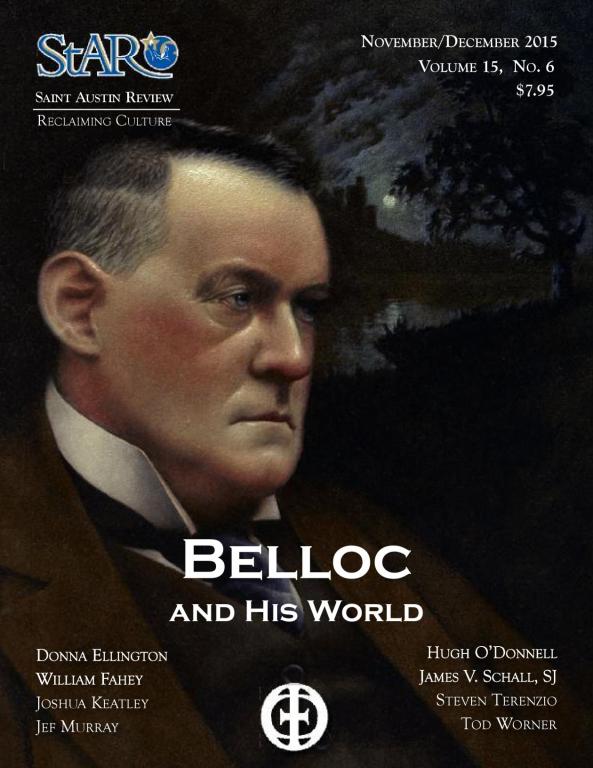
Author’s Note: This piece was written for Joseph Pearce’s St. Austin Review (November/December 2015 edition), please link here to peruse and subscribe.
Recently, upon reading Hilaire Belloc’s classic The Four Men, I came to a new appreciation: the virtue of “re-reading”. The first read, I have learned, always tells you what happened, but each subsequent read tells you what it means. There is no better work to re-read than a book about a pilgrimage. Especially one described by Hilaire Belloc. We care where the pilgrimage takes us. But we care even more what the pilgrimage means.
Belloc opens his extraordinary journey having found himself in a state – a funk – in which we all may find ourselves sooner or later. It is the bittersweet position of taking stock in our life when, in a moment of naked honesty and true poignancy, we find we have strayed from our intended path. Belloc’s moment came on the twenty-ninth of October, 1902 to be exact. He was in an English inn known as the “George” at Robertsbridge. Nursing port and staring at the fire, the intense, brooding Belloc arrived at a harsh conclusion: You are missing what matters.
It seems Hilaire Belloc said it best in his own words,
“What are you doing? You are upon some business that takes you far, not even for ambition or for adventure, but only to earn. And you will cross the sea and earn your money, and you will come back and spend more than you have earned. But all the while your life runs past you like a river, and the things that are of moment to men you do not heed at all…”
Next, Belloc envisioned home. In a picture of unparalleled clarity, he saw the woods, the valley, the ridge and the perfect, beloved river Arun. Home was calling. Home. It was then and there that Belloc castigated himself and became firmly resolved,
“What you are doing is not worth while, and nothing is worth while on this unhappy earth except the fulfillment of a man’s desire. Consider how many years it is since you saw your home, and for how short a time, perhaps, its perfection will remain. Get up and go back to your own place if only for one day…”
And with this almost Providentially appointed mandate, he would go. It is the stuff pilgrimages are made of. A general malaise about the way things are. A deep emotional (if not spiritual) call to set things aright. An irrepressible desire to start forthwith (for there is no time to lose!). Or, put another way, in the midst of uncertainty, melancholy or suffering, there is a Calling. It is a Calling to receive Grace. A Calling to come Home. It is the stuff pilgrimages are made of.
It is this initial dissatisfaction – this spiritual ennui – that would lead Hilaire Belloc on a pilgrimage home to his beloved land of Sussex. And over five days, from October 29th to November 2nd, 1902, days notably traversing the dark broodings of All Hallow’s Eve and bright illumination of All Saints’ Day, Belloc would find himself transformed. But not without help.
The Four Men is aptly titled because, along this pilgrimage, Belloc encounters three men who decide to accompany him for their own reasons. And this company was welcome for Belloc himself admitted,
“All companionship is good, but chance companionship is the best of all.”
And so, on his initial steps from his table in the “George” at Robertsbridge, Belloc would meet his first “chance companion”: a sturdy whiskered elder nicknamed “Grizzlebeard”. And in words that embody the great journey they began together, Belloc said,
“Cutting ourselves quite apart from care and from the world, we set out with our faces westward, to reach at last the valley of the Arun and the things we knew.”
In short order, Belloc (who dubs himself, “Myself”) and Grizzlebeard would encounter “Sailor”, a brash, outspoken sort who immediately takes on his new acquaintances’ pilgrimage as his own. The pair are initially struck by the confidence with which this young buck would travel along. Sailor assures,
“There is no ship waiting for me in Bosham harbor, but I shall fall upon my feet. So have I lived since I began this sort of life, and so I mean to end it.”
In turn, speaking with greater meaning than even the Sailor understands, Grizzlebeard chastens,
“It will not end as you choose.”
And so they walk along as three. Not long thereafter, the motley trio encounter their fourth man. Described as,
“A lanky fellow, moving along in a manner quite particular to men of one sort throughout the world, men whose thoughts are always wool-gathering, and who seem to have no purpose, and yet in some way are by the charity of their fellows kept fed and clothed.”
Grizzlebeard further characterized this strange fellow as someone in possession of the things the other three lack: unpredictability, incaution and impracticality. He was the type not to be trusted with a gun. But Grizzlebeard concludes,
“This man before us, if I mistake not, is of a kind much nearer to God.”
Behold, the Poet.
And so the unlikely quartet was fully joined and would venture together to a place they once knew. Home.
Along the pilgrim’s path (as well as in inns replete with tankards of beer), the four men would talk. Little was done in the way of formal introduction. That was for stuffy and insincere sitting rooms. Instead, they became acquainted through the stories they told, the legends they recited, the songs they sang and the truths they defended.
Mile after mile, meal after meal, drink after drink they talked. Profundities were mixed with superficialities. Humor was mixed with ineffable truth. At one time, one of the men is the sage. At another, the same man is the fool.
It is the curious (and almost singular) gift of Belloc the storyteller and Belloc the poet to have two such rare and admirable gifts. He carries the ability to regale a crowd of half-drunk pub dwellers with a story so funny that even they would be doubled over and breathless from laughter. And yet simultaneously, Belloc possesses the capacity to so tenderly touch a matter precious to the soul that the poignancy lands like the gentlest kiss and moves the reader to welled-up emotion.
So the story of St. Dunstan violently pulling the Devil around by his nose is shortly followed by a thoughtful dissertation on friendship.
“The worst thing in the world is the passing of human affection. No man who has lost a friend need fear death…For the comprehension by one soul of another is something borrowed from whatever lies outside time: it is not under the conditions of time. Then if it passes, it is past – it never grows again; and we lose it as men lose a diamond, or as men lose their honor.”
And the Poet’s insight that,
“There is always some holiness in the rising of rivers, and a great attachment to their springs.”
is soon countered by a bawdy, full-throated but highly theological song by the Sailor to a growing and curious crowd of onlookers. The song title? Song of the Pelagian Heresy for the Strengthening of Men’s Backs and the Very Robust Outthrusting of Doubtful Doctrine and the Uncertain Intellectual.
“Now the Faith is old, and the Devil is bold,
Exceedingly bold indeed;
And the masses of doubt that are floating about
Would smother a mortal creed.
But we that sit in a sturdy youth,
And still can drink strong ale,
Oh – let us put it away to infallible truth,
Which always shall prevail!”
And so it is for five straight days among four wondrous men.
But the days pass quickly and, before long, the four men find themselves enjoying one last meal, one last toast before their agreed upon separation takes place at the borderlands of Home. It is a melancholy parting. Prior to arrival, the Poet had composed his expectation upon reaching their pilgrimage’s end,
“When I get to my own country
I shall lie down and sleep;
I shall watch in the valleys
The long flocks of sheep.
And then I shall dream, for ever and all,
A good dream and deep.”
But Grizzlebeard gently tamed the stilted hopes often expected upon returning Home that “all things are made new,”
“For my part, I have travelled very widely…and, one time and another – altogether forty times – I have come back to the flats of my own country, eastward of the Vale of Glynde. I have seen once more the heavy clouds of home fresh before the wind over the Level, and I have smelt, from the saltings and the innings behind Pevensey, the nearness of the sea. Then indeed I have each time remembered my boyhood, and each time I have been glad to come home. But I never found it to be a final gladness.”
As Belloc, mournfully bids goodbye to his three friends – nay, brothers – they disappeared into the mist. He was home, but not yet Home. And though the Water that would resolve all thirst, the Bread that would sate all hunger and the Home which would grant supreme rest was not yet here, Belloc could rest assured. Though his Final Gladness was yet to be, the pilgrimage was one of deeply sacramental moments.
“To us four men, no one of whom could know the other, and who had met by I could not tell what chance, and would part very soon for ever, these things were given. All four of us together received the sacrament of that wide and silent beauty, and we ourselves went in silence to receive it.”
Previous Post

October 31, 2015
God's Revolutionaries
Next Post
November 12, 2015 Scared to Become a Saint
Browse Our Archives
Select a Category A Catholic Thinker's Story Uncategorized
Select a Month March 2017 February 2017 December 2016 November 2016 October 2016 September 2016 August 2016 July 2016 June 2016 May 2016 April 2016 March 2016 February 2016 January 2016 December 2015 November 2015 October 2015 September 2015 August 2015 July 2015 June 2015 May 2015 April 2015 March 2015 February 2015 January 2015 December 2014 November 2014 October 2014 September 2014 August 2014 July 2014 June 2014 May 2014 April 2014 March 2014 February 2014 January 2014 December 2013 November 2013 October 2013 September 2013 July 2013 June 2013 May 2013 April 2013 March 2013 February 2013 January 2013 December 2012 November 2012 October 2012 September 2012 August 2012 July 2012
Follow Us!
TAKE THE
Religious Wisdom Quiz
What is the number of the beast in Revelation?
Select your answer to see how you score.
777 666 144 1000
Related posts from A Catholic Thinker

"Something Absolutely Modern" - The Insincere Convert from...

Textualism vs. The Living Constitution: Justice Scalia, Judge...

Memento Mori: Hope In a Year Heavy With...

Advent: The Greatest Resistance Story of All Time
TRENDING AT PATHEOS Catholic

Rejecting Doom: Christian Hope And Human Action
Christianity is a religion of hope. We are to have hope and...

It’s What Comes From Within Which Matters
One of the most difficult things for us to understand is why...

Why I Choose the Eucharist Over the Sermon
Choose the Eucharist, Not the Sermon What are we supposed to get...

5 Design Elements Found in Spiritually Rooted Homes
Putting Spirituality Into Home Decor Our homes are more than our living...

Credo: A Story of God Told with the...
About 10 years ago, I began to imagine a personal "Credo" that...

The Anatomy of Divine Revelation in Catholic Thought
The claim that God has made Himself known to human beings is...
view all Catholic blogs
Ad-Free & Subscriber Log-In Subscription Support
- About Us
- 2026 Calendar
- Videos
- Podcasts
- Library of World Religions
- Faith In Media Tracker
- Advertise With Us
- Write for Us
- Privacy Policy
- Terms of Service
- Do Not Sell My Data
- Contact Us
- Radiant Digital
- Manage Newsletter Subscriptions
- Unsubscribe From Notifications
- Sitemap
Copyright 2008-2026, Patheos. All rights reserved.
Subscription Support Ad-Free & Subscriber Log-In
Follow Patheos