
BuddhistCatholicContemplativeEvangelicalGeneral ChristianHinduJewishLatter-day SaintMuslimNew VisionsProgressive Christian
Beliefs
- Buddhist
- Catholic
- Contemplative
- Evangelical
- General Christian
- Hindu
- Jewish
- Latter-day Saint
- More Voices
- Muslim
- New Visions
- Pagan
- Progressive Christian
Topics
- Religion News
- Food and Religion
- Sports and Religion
- Religious Art
- Religious Music and Entertainment
- Religious Events
- History and Religion
- Style and Religion
- Politics and Religion
- Women in Religion
- Recreation Outdoors and Religion
- Business Finance and Religion
- Careers Workplace and Religion
- Education and Religion
- Family Parenting and Religion
- Health Fitness and Religion
- Home and Religion
- Relationships and Religion
- Technology and Religion
- Travel and Religion
Columnists
- Buddhist Columnists
- Business Finance and Religion Columnists
- Careers Workplace and Religion Columnists
- Catholic Columnists
- Contemplative Columnists
- Education and Religion Columnists
- Evangelists Columnists
- Family Parenting and Religion Columnists
- General Christian Columnists
- Health Fitness and Religion Columnists
- Hindu Columnists
- History and Religion Columnists
- Home and Religion Columnists
- Jewish Columnists
- More Voices Columnists
- Latter Day Columnists
- Muslim Columnists
- New Visions Columnists
- Nonreligious Columnists
- Pagan Columnists
- Politics and Religion Columnists
- Progressive Columnists
- Recreation Outdoors and Religion Columnists
- Relationships and Religion Columnists
- Religion News Columnists
- Religious Art Columnists
- Religious Events Columnists
- Religious Music and Entertainment Columnists
- Sports and Religion Columnists
- Style and Religion Columnists
- Technology and Religion Columnists
- Travel and Religion Columnists
- Women in Religion Columnists
Resource Library
- 2026 Calendar
- Library of World Religions
- The 100 Most Holy Places on Earth
- Patheos Answers
- Podcasts
- Videos
- Faith Leaders Database
- Anglican Episcopalian
- Bahai
- Baptist
- Buddhism
- Christianity
- Confucianism
- Eastern Orthodoxy
- Hinduism
- Holiness and Pentecostal
- ISKCON
- Islam
- Judaism
- Lutheran
- Methodist
- The Church of Jesus Christ of Latter-day Saints
- New Age
- Paganism
- Presbytarian and Reformed
- Protestantism
- Religion Behind the Scenes
- Roman Catholic
- Scientology
- Shia Islam
- Sikhism
- Sufism
- Sunni Islam
- Taoism
- Zen
- See all religions
Research Tools
 Ad-Free & Subscriber Log-In Subscription Support
Ad-Free & Subscriber Log-In Subscription Support
Follow Patheos 

- Trending:
- Forgiveness
- |
- Marriage
- |
- Consciousness
- |
- Death Penalty
- |
- Election
- |
- Halloween
 A Catholic Thinker
- Home
- Catholic
- “Unlikely” – The Grace of Hoosiers, St. Matthew & Flannery O’Connor
“Unlikely” – The Grace of Hoosiers, St. Matthew & Flannery O’Connor
Last updated on: May 11, 2015 at 11:41 pm by Tod Worner
“Unlikely” – The Grace of Hoosiers, St. Matthew & Flannery O’Connor 2015-05-11T23:41:10-06:00 Tod Worner
Patheos Explore the world's faith through different perspectives on religion and spirituality! Patheos has the views of the prevalent religions and spiritualities of the world.

He was an unlikely assistant basketball coach. To be sure. Wilbur “Shooter” Flatch was a savant when it came to the game of basketball. Shooter would even confidently quip, “I know everything there is to know about the greatest game ever invented.” And so it seemed. He knew the game of basketball, but he was an unlikely assistant basketball coach. That was because Shooter Flatch was an inveterate alcoholic – some would even deride him as “the town drunk”. But in small town Hickory, Indiana, a controversial coach with unorthodox methods saw something in Shooter – something that Shooter couldn’t even see in himself. This struggling drinker would help Coach Norman Dale coach basketball. But only if he stayed sober.
The Hickory team and its fans had to adapt to a new style in Coach Dale. Despite a rough start, the team developed a successful winning style with a bright postseason future anticipated, if only they could make it. And so it would come down to a pivotal last home game against rival Dugger. There was less than a minute remaining and the score was 58-58 when Coach Dale did the unthinkable. He stormed up to the referee after a particular call, dressed him up and down and then, in sidelong and secretive fashion, asked to be kicked out of the game. Mystified but recognizing that the coach must have his reasons, the ref assents. Coach Dale is tossed out of the game. Sheepishly, amidst a roar of supportive boos, Coach Dale walked back to his bench, leveled his eyes at Shooter and said,
“I’ve done it again…It’s up to you now.”
It was extraordinary. Coach Dale’s eyes widened and seemingly smiled at Shooter. And then Dale walked off the court. The game, the season and the future of the Hickory basketball team rested uncertainly in Shooter’s hands. If you have seen the 1986 movie, Hoosiers, then you don’t need me to explain what happens next. But I will. Shooter, pleadingly looks at his team, unsteady, uncertain. The huddling team, which includes Shooter’s perennially disappointed son, look to their de facto coach for guidance. Haltingly, Shooter provides it. Two directions are given, the huddle breaks, the play ensues and the call Shooter makes works.
One last time out is called. A more emboldened Shooter reaches deep down into his wisdom and passion for the game of basketball – gifts which are usually kicked back down by the shaming vapors of drink and failure – and a flurry of sage strategy is imparted to the boys in the final seconds. The whistle restarts the action. Tension builds. A sweet Hickory shot is sunk. And the team wins the game. There are deafening roars from Hickory fans and chaotic congratulations patting Shooter’s back and shaking his hand, but he only hears one voice. A voice of a boy grown up and proud, for once, of his father. Shooter’s son looks at him, looks up to him if only for a moment, and says,
“You did good, Pop. You did real good.”
How unlikely.
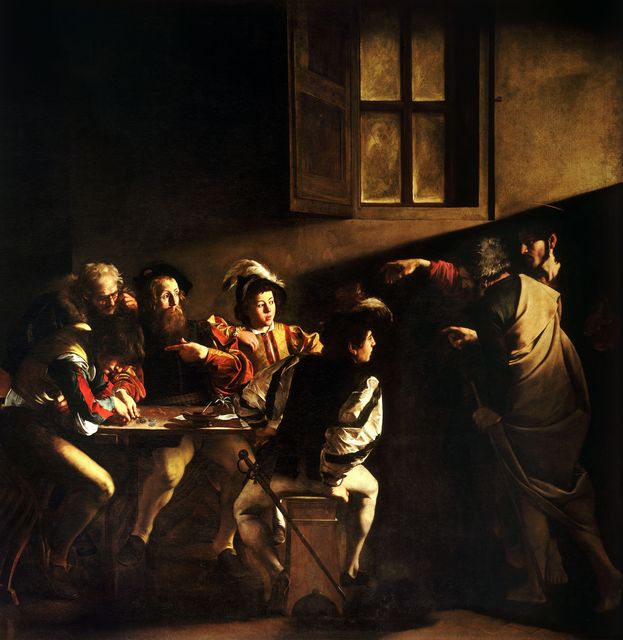
The Calling of St. Matthew by Michelangelo Merisi da Caravaggio
He was an unlikely disciple. Indeed. He was a tax collector. A turncoat who aided and abetted the heathen, pillaging occupiers – the Romans. And beyond simply serving the needs of Israel’s heartless oppressors, Matthew insulted his countrymen and religious brethren by skimming money off the top for himself. He was unloved. Reviled, even. Even the religious elite of the day, the conscience of the community, lumped the tax collectors with sinners. Matthew and his ilk were tainted, spoiled and beyond redemption.
But one day – one day – He came. The New Man. And approaching Matthew with sincere interest instead of fear of taxation or spite over countless wrongdoings, this Man fixed his gaze on him and said,
“Follow me.”
And St. Matthew did…Forever.
How unlikely.
Now just imagine this feeling. You find yourself carrying the blackness of guilt, a deep sense of unworthiness, an uncertainty of the existence of anything true or sound when suddenly, unexpectedly (even jarringly) a gaze is leveled at you. And the eyes say,
“I believe in you.”
And for a moment, you cannot disagree. You simply trust. And follow. And be what you forgot you already were and what you know you can once again fully become.
Simply glorious.
But the first step that Shooter and St. Matthew took was only the first step. Subsequent steps would be hard, trying and would even seem impossible. For Shooter would stumble, drunk, into a future basketball game and St. Matthew would die a vicious martyr’s death. We, too, should understand this – truly grapple with this. If we fail to expect difficulty in the midst of Grace, our hope will be dashed instead of chastened. Flannery O’Connor, the southern Catholic writer whose faith was fiercely tempered by the fires of the lupus which would consume her young life, spoke eloquently on the cost of Grace.
“All human nature vigorously resists grace because grace changes us and the change is painful.”
“What people don’t realize is how much religion costs. They think faith is a big electric blanket, when of course it is the cross.”
For Shooter to say ‘yes’ to assuming the reigns of the team was not only to gloriously grapple with his once lost dignity, but it was also to answer the painful call to accountability. For St. Matthew to push away from the customs post was not only to leave the darkness of sin behind, but it was also to embrace the suffering and death inherent to the faithful life ahead. Truth beckons and brilliantly awaits. But the path is anything but easy.
Could Shooter have answered the call, much less continued to pick himself up after future failings without Grace? Could St. Matthew have walked away from all he knew in order to embrace the fierce Truth and its searing implications without Grace? Could Flannery O’Connor have grasped the sharp outlines of Truth through the blinding pain and debility of lupus without Grace? Can we let go of our darker selves and respond to the brilliant yet costly call of Christ in our lives without Grace?
Unlikely. Unlikely.
But that’s just the thing about God’s Grace. It is ever-present, unfailing and sufficient.
Yes, it is.
Thank God.
————————————–
Photo credits:
The Calling of St. Matthew from Wikimedia Commons

Basketball hoop from courtesy of public domain pictures (http://www.publicdomainpictures.net/view-image.php?image=57325&picture=basketball-in-the-sky)
Previous Post
May 1, 2015
On Being Breathless: My Daughter's First Holy Communion
Next Post

May 17, 2015 Releasing the Control I Want; Accepting the Humility I Need
Browse Our Archives
Select a Category A Catholic Thinker's Story Uncategorized
Select a Month March 2017 February 2017 December 2016 November 2016 October 2016 September 2016 August 2016 July 2016 June 2016 May 2016 April 2016 March 2016 February 2016 January 2016 December 2015 November 2015 October 2015 September 2015 August 2015 July 2015 June 2015 May 2015 April 2015 March 2015 February 2015 January 2015 December 2014 November 2014 October 2014 September 2014 August 2014 July 2014 June 2014 May 2014 April 2014 March 2014 February 2014 January 2014 December 2013 November 2013 October 2013 September 2013 July 2013 June 2013 May 2013 April 2013 March 2013 February 2013 January 2013 December 2012 November 2012 October 2012 September 2012 August 2012 July 2012
Follow Us!
TAKE THE
Religious Wisdom Quiz
True or False: Job lost all his children, wealth, and health in a single day.
Select your answer to see how you score.
FALSE TRUE
Related posts from A Catholic Thinker

"Something Absolutely Modern" - The Insincere Convert from...

Textualism vs. The Living Constitution: Justice Scalia, Judge...

Memento Mori: Hope In a Year Heavy With...

Advent: The Greatest Resistance Story of All Time
TRENDING AT PATHEOS Catholic

Creation, Preservation, and Teleology in Catholic Theology
As I write this, it is very early Monday morning. Like millions...

The Parable Of The Sower And The Word...
One of Christ’s most famous parables is that of the sower who...

Rejecting Doom: Christian Hope And Human Action
Christianity is a religion of hope. We are to have hope and...

Why I Choose the Eucharist Over the Sermon
Choose the Eucharist, Not the Sermon What are we supposed to get...

5 Design Elements Found in Spiritually Rooted Homes
Putting Spirituality Into Home Decor Our homes are more than our living...

Credo: A Story of God Told with the...
About 10 years ago, I began to imagine a personal "Credo" that...
view all Catholic blogs
Ad-Free & Subscriber Log-In Subscription Support
- About Us
- 2026 Calendar
- Videos
- Podcasts
- Library of World Religions
- Faith In Media Tracker
- Advertise With Us
- Write for Us
- Privacy Policy
- Terms of Service
- Do Not Sell My Data
- Contact Us
- Radiant Digital
- Manage Newsletter Subscriptions
- Unsubscribe From Notifications
- Sitemap
Copyright 2008-2026, Patheos. All rights reserved.
Subscription Support Ad-Free & Subscriber Log-In
Follow Patheos