
BuddhistCatholicContemplativeEvangelicalGeneral ChristianHinduJewishLatter-day SaintMuslimNew VisionsProgressive Christian
Beliefs
- Buddhist
- Catholic
- Contemplative
- Evangelical
- General Christian
- Hindu
- Jewish
- Latter-day Saint
- More Voices
- Muslim
- New Visions
- Pagan
- Progressive Christian
Topics
- Religion News
- Food and Religion
- Sports and Religion
- Religious Art
- Religious Music and Entertainment
- Religious Events
- History and Religion
- Style and Religion
- Politics and Religion
- Women in Religion
- Recreation Outdoors and Religion
- Business Finance and Religion
- Careers Workplace and Religion
- Education and Religion
- Family Parenting and Religion
- Health Fitness and Religion
- Home and Religion
- Relationships and Religion
- Technology and Religion
- Travel and Religion
Columnists
- Buddhist Columnists
- Business Finance and Religion Columnists
- Careers Workplace and Religion Columnists
- Catholic Columnists
- Contemplative Columnists
- Education and Religion Columnists
- Evangelists Columnists
- Family Parenting and Religion Columnists
- General Christian Columnists
- Health Fitness and Religion Columnists
- Hindu Columnists
- History and Religion Columnists
- Home and Religion Columnists
- Jewish Columnists
- More Voices Columnists
- Latter Day Columnists
- Muslim Columnists
- New Visions Columnists
- Nonreligious Columnists
- Pagan Columnists
- Politics and Religion Columnists
- Progressive Columnists
- Recreation Outdoors and Religion Columnists
- Relationships and Religion Columnists
- Religion News Columnists
- Religious Art Columnists
- Religious Events Columnists
- Religious Music and Entertainment Columnists
- Sports and Religion Columnists
- Style and Religion Columnists
- Technology and Religion Columnists
- Travel and Religion Columnists
- Women in Religion Columnists
Resource Library
- 2026 Calendar
- Library of World Religions
- The 100 Most Holy Places on Earth
- Patheos Answers
- Podcasts
- Videos
- Faith Leaders Database
- Anglican Episcopalian
- Bahai
- Baptist
- Buddhism
- Christianity
- Confucianism
- Eastern Orthodoxy
- Hinduism
- Holiness and Pentecostal
- ISKCON
- Islam
- Judaism
- Lutheran
- Methodist
- The Church of Jesus Christ of Latter-day Saints
- New Age
- Paganism
- Presbytarian and Reformed
- Protestantism
- Religion Behind the Scenes
- Roman Catholic
- Scientology
- Shia Islam
- Sikhism
- Sufism
- Sunni Islam
- Taoism
- Zen
- See all religions
Research Tools
 Ad-Free & Subscriber Log-In Subscription Support
Ad-Free & Subscriber Log-In Subscription Support
Follow Patheos 

- Trending:
- Forgiveness
- |
- Marriage
- |
- Consciousness
- |
- Death Penalty
- |
- Election
- |
- Halloween
 A Belief Observed
- Home
- Catholic
- Right Where We Are Wrong: My Ongoing Conversion
Right Where We Are Wrong: My Ongoing Conversion
Last updated on: February 23, 2018 at 12:52 pm by credo
Right Where We Are Wrong: My Ongoing Conversion 2018-02-23T12:52:52-05:00 credo
Patheos Explore the world's faith through different perspectives on religion and spirituality! Patheos has the views of the prevalent religions and spiritualities of the world.
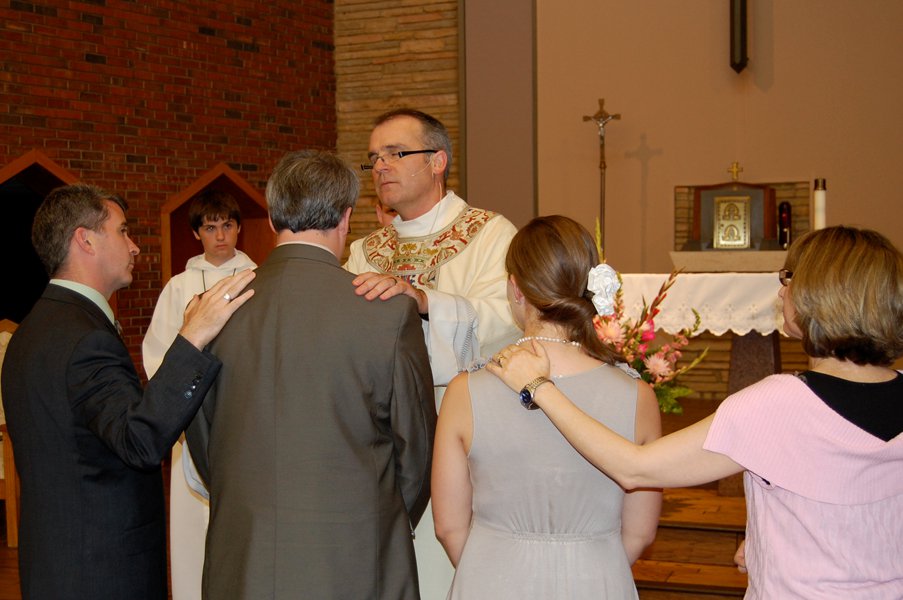
My wife and I at our Confirmation into the Catholic Church in 2011.
“I believe and profess all that the holy Catholic Church teaches, believes and proclaims to be revealed by God.”
I stood with my wife before the altar of God, in the sight of the people of God and said those weighty words.
Right Where I Was Right
My Conversion to Catholicism brought with it many shifts that I did not expect. I was confirmed in the Catholic Church on May 21st, 2011 because I had become convinced that She was right. I fit with the theology of the Catholic Church more fully than I ever did anywhere else. I came to believe not only that She was right, but that every other expression of Christianity was incomplete. I say this not to cause conflict, but only to say that if I had found another home that I thought would have sufficed, I would not have become Catholic.
There is something weighty in the decision to become Catholic. One knows that it is somehow intrinsically different than joining any denomination. There would not have been trepidation before leaving my Methodist congregation to become a Baptist or a Non-Denominational, or an Anglican. Yet there were gasps and cautions expressed when I talked about becoming a Catholic. Even so, I came to the Catholic Church because I was convinced She was right. The One, Holy, Catholic, and Apostolic Church had drawn me in because I found a place where I fit. Certainly there were a few beliefs She propagated that I didn’t quite understand, but I made the choice to submit to the Church, to trust Her, and to learn from Her.
An Uncomfortable Realization
Then a strange thing happened, I discovered that I didn’t fit as well as I had first thought. G.K. Chesterton best summed up this next (and ongoing) period in his essay about becoming Catholic himself. He says,
The Catholic Church is the only thing which saves a man from the degrading slavery of being a child of his age. I have compared it with the New Religions; but this is exactly where it differs from the New Religions. The New Religions are in many ways suited to the new conditions; but they are only suited to the new conditions. When those conditions shall have changed in only a century or so, the points upon which alone they insist at present will have become almost pointless. If the Faith has all the freshness of a new religion, it has all the richness of an old religion; it has especially all the reserves of an old religion. So far as that is concerned, its antiquity is alone a great advantage, and especially a great advantage for purposes of renovation and youth. It is only by the analogy of animal bodies that we suppose that old things must be stiff. It is a mere metaphor from bones and arteries. In an intellectual sense old things are flexible. Above all, they are various and have many alternatives to offer. There is a sort of rotation of crops in religious history; and old fields can lie fallow for a while and then be worked again. But when the new religion or any such notion has sown its one crop of wild oats, which the wind generally blows away, it is barren. A thing as old as the Catholic Church has an accumulated armoury and treasury to choose from; it can pick and choose among the centuries and brings one age to the rescue of another. It can call in the old world to redress the balance of the new.
Anyhow, the New Religions are suited to the new world; and this is their most damning defect. Each religion is produced by contemporary causes that can be clearly pointed out. Socialism is a reaction against Capitalism. Spiritualism is a reaction against Materialism; it is also in its intensified form merely the trail of the tragedy of the Great War. But there is a somewhat more subtle sense in which the very fitness of the new creeds makes them unfit; their very acceptability makes them inacceptable. Thus they all profess to be progressive because the peculiar boast of their peculiar period was progress; they claim to be democratic because our political system still rather pathetically claims to be democratic. They rushed to a reconciliation with science, which was often only a premature surrender to science. They hastily divested themselves of anything considered dowdy or old-fashioned in the way of vesture or symbol. They claimed to have bright services and cheery sermons; the churches competed with the cinemas; the churches even became cinemas. In its more moderate form the mood was merely one of praising natural pleasures, such as the enjoyment of nature and even the enjoyment of human nature. These are excellent things and this is an excellent liberty; and yet it has its limitations.
We do not really want a religion that is right where we are right. What we want is a religion that is right where we are wrong. In these current fashions it is not really a question of the religion allowing us liberty; but (at the best) of the liberty allowing us a religion. These people merely take the modern mood, with much in it that is amiable and much that is anarchical and much that is merely dull and obvious, and then require any creed to be cut down to fit that mood. But the mood would exist even without the creed. They say they want a religion to be social, when they would be social without any religion. They say they want a religion to be practical, when they would be practical without any religion. They say they want a religion acceptable to science, when they would accept the science even if they did not accept the religion. They say they want a religion like this because they are like this already. They say they want it, when they mean that they could do without it.
It is a very different matter when a religion, in the real sense of a binding thing, binds men to their morality when it is not identical with their mood. It is very different when some of the saints preached social reconciliation to fierce and raging factions who could hardly bear the sight of each others’ faces. It was a very different thing when charity was preached to pagans who really did not believe in it; just as it is a very different thing now, when chastity is preached to new pagans who do not believe in it. It is in those cases that we get the real grapple of religion; and it is in those cases that we get the peculiar and solitary triumph of the Catholic faith. It is not in merely being right when we are right, as in being cheerful or hopeful or humane. It is in having been right when we were wrong, and in the fact coming back upon us afterwards like a boomerang. One word that tells us what we do not know outweighs a thousand words that tell us what we do know. And the thing is all the more striking if we not only did not know it but could not believe it. It may seem a paradox to say that the truth teaches us more by the words we reject than by the words we receive.
– The Catholic Church and Conversion (1926)
My Own Standard
I, like Chesterton, came to find that the Church was not only right where I was right. In my youth, a church was selected not because of its intrinsic authority, but because of how well its theology aligned with our own. We went to the church that was right where we were right. As such, our own theology became the standard (the magisterium, if you will) for the rightness of the church in question. But I’ve never been comfortable with myself as a standard. I’m too flimsy to be a good foundation. Even using Sacred Scripture as a standard is insufficient because the foundation of Scripture will waver and vary depending on the hermeneutic by which we understand what Sacred Scripture is communicating (This is why there are so many different schisms, so many different denominations, so many different theologies springing from only one library of Sacred Scripture – We all read it just a little differently).
But once I was confirmed in the Catholic Church, that foundational attitude in me changed. I submitted to an authority and standard outside of my own understanding. I declared that submission on the day of my confirmation by saying, “I believe and profess all that the holy Catholic Church teaches, believes and proclaims to be revealed by God.” Of course, I didn’t understand everything She taught, but I declared my trust in Her to teach rightly and declared my submission to Her teaching.
Then I found out that She was not only right where I was right, She was also right where I was wrong. I came from a very conservative family (both politically and theologically), and there were a number of ‘religious’ beliefs I held because of my political platform, rather than through my thorough reading of scripture. This is the weakness of Scripture as the sole standard, (not to diminish the importance of Scripture) it depends on ‘how’ we read it — and we humans are perfectly capable of justifying our beliefs and finding the scripture to back it up.
Ch-Ch-Changes
As a Catholic, determined to receive the words of my bishop and pope with a ‘spirit of docility’ (CCC 87), I was faced with words I had never considered. I was faced with positions on important issues that I had long dismissed as “liberal.” It started with Immigration. I don’t remember how it shifted, but I began to look at the issue seriously and without the guides of political talking points. I discovered that my own beloved Bishop Edward Slattery had written a pastoral letter on the topic called The Suffering Faces of the Poor are the Suffering Faces of Christ. I fleshed out my own evolution of thought on this in an episode of Outside the Walls in an interview with fellow Patheos Blogger, Sam Rocha. Afterward, I was surprised to look back and see just how quickly I had changed my mind.
I had been wrong. The Church was right where I was wrong. I submitted.
Next came the death penalty. As I worked more and more to educate people about the lasting horrors of abortion, I came to understand that we bear the Image of God, not because of our innocence or merit, but because God made us. That intrinsic worth should not be snuffed out, no matter how depraved a person may become. By executing them we take away any possibility of their repentance. And so the words of the Church sunk down deep into my inmost being. I came to see that even if the State executes criminals justly, it does so unnecessarily.
My next domino to fall was economics. I am still trying to wrap my mind around Distributism with its dual Catholic principles of Subsidiarity and Solidarity constantly held in tension.
Lastly (so far), came science. Suddenly, I no longer shudder at my children reading books that talk about evolution, or watching shows that talk about dinosaurs living millions of years ago. It was a Catholic Priest, after all, who first postulated the Big Bang. I had so long associated evolution with the removal of God from the process. I assumed that all evolutionists believed that the world happened by mere chance, rather than with careful guidance by a creative God. I still fully believe in creation. I believe that God created by his word (that single utterance of God, Jesus – through whom all things were made, and without whom was not anything made that was made). But at the same time, both my seminary background and the Catechism remind me to read Sacred Scripture according to the genre in which it was written. Reading passages of poetry (like Genesis 1-11) as if they were a science textbook misses the authors point. It will always come up short. Sacred Scripture conveys Truth, and deep Truth, but not always in the journalistic, factual way that Westerners crave.
The Ongoing Conversion
And so here I find myself, having what is wrong in me being made right (a quite uncomfortable process). As I survey my surroundings, I find that I am more at home in my faith than ever before, but less comfortable in the American Christian subculture. I have found a deeply satisfying home in faith, but have become politically homeless. One party won’t take me because I stand for the sanctity of Life (abortion, contraception IVF, surrogacy, et. al.), the indissolubility of marriage, the complementarity of men and women, among other things. The other party won’t take me because of my views on the sanctity of Life (the death penalty, contraception, IVF, surrogacy, et. al.), economics, immigration, certain scientific stances.
I find myself a sojourner in a strange land, no longer content with the nationalism of the American church. I seek a broader home farther up and further in. I seek to submit to a beautiful Mother Church who conveys to me the heart of my Father, a Church that is right where I’m wrong.
Previous Post
October 16, 2016
To Sam: A Letter on Letters. 'Love, Henri' and other gems.
Next Post

January 19, 2017 Lessons From Our First Ambulance Ride: Gratitude and Empathy
Browse Our Archives
Select a Category Guest Post I Concur Outside The Walls Radio Show Personal Story The Way I See It Uncategorized
Select a Month May 2018 April 2018 March 2018 February 2018 January 2018 October 2017 February 2017 January 2017 December 2016 October 2016 September 2016 August 2016 July 2016 June 2016 May 2016 April 2016 January 2016
Follow Us!
TAKE THE
Religious Wisdom Quiz
Who rebelled with 250 men against Moses and Aaron?
Select your answer to see how you score.
Dathan Abihu Nadab Korah
Related posts from A Belief Observed
K. Albert Little talks about his conversion and...
Dr. David Russell Mosley Reflects on His First...
Relics of the Saints, Treasures of the Church

All Lives Matter: The Universal Dignity of the...
TRENDING AT PATHEOS Catholic

Rejecting Doom: Christian Hope And Human Action
Christianity is a religion of hope. We are to have hope and...

It’s What Comes From Within Which Matters
One of the most difficult things for us to understand is why...

Why I Choose the Eucharist Over the Sermon
Choose the Eucharist, Not the Sermon What are we supposed to get...

5 Design Elements Found in Spiritually Rooted Homes
Putting Spirituality Into Home Decor Our homes are more than our living...

Credo: A Story of God Told with the...
About 10 years ago, I began to imagine a personal "Credo" that...

The Anatomy of Divine Revelation in Catholic Thought
The claim that God has made Himself known to human beings is...
view all Catholic blogs
Ad-Free & Subscriber Log-In Subscription Support
- About Us
- 2026 Calendar
- Videos
- Podcasts
- Library of World Religions
- Faith In Media Tracker
- Advertise With Us
- Write for Us
- Privacy Policy
- Terms of Service
- Do Not Sell My Data
- Contact Us
- Radiant Digital
- Manage Newsletter Subscriptions
- Unsubscribe From Notifications
- Sitemap
Copyright 2008-2026, Patheos. All rights reserved.
Subscription Support Ad-Free & Subscriber Log-In
Follow Patheos