
BuddhistCatholicContemplativeEvangelicalGeneral ChristianHinduJewishLatter-day SaintMuslimNew VisionsProgressive Christian
Beliefs
- Buddhist
- Catholic
- Contemplative
- Evangelical
- General Christian
- Hindu
- Jewish
- Latter-day Saint
- More Voices
- Muslim
- New Visions
- Pagan
- Progressive Christian
Topics
- Religion News
- Food and Religion
- Sports and Religion
- Religious Art
- Religious Music and Entertainment
- Religious Events
- History and Religion
- Style and Religion
- Politics and Religion
- Women in Religion
- Recreation Outdoors and Religion
- Business Finance and Religion
- Careers Workplace and Religion
- Education and Religion
- Family Parenting and Religion
- Health Fitness and Religion
- Home and Religion
- Relationships and Religion
- Technology and Religion
- Travel and Religion
Columnists
- Buddhist Columnists
- Business Finance and Religion Columnists
- Careers Workplace and Religion Columnists
- Catholic Columnists
- Contemplative Columnists
- Education and Religion Columnists
- Evangelists Columnists
- Family Parenting and Religion Columnists
- General Christian Columnists
- Health Fitness and Religion Columnists
- Hindu Columnists
- History and Religion Columnists
- Home and Religion Columnists
- Jewish Columnists
- More Voices Columnists
- Latter Day Columnists
- Muslim Columnists
- New Visions Columnists
- Nonreligious Columnists
- Pagan Columnists
- Politics and Religion Columnists
- Progressive Columnists
- Recreation Outdoors and Religion Columnists
- Relationships and Religion Columnists
- Religion News Columnists
- Religious Art Columnists
- Religious Events Columnists
- Religious Music and Entertainment Columnists
- Sports and Religion Columnists
- Style and Religion Columnists
- Technology and Religion Columnists
- Travel and Religion Columnists
- Women in Religion Columnists
Resource Library
- 2026 Calendar
- Library of World Religions
- The 100 Most Holy Places on Earth
- Patheos Answers
- Podcasts
- Videos
- Faith Leaders Database
- Anglican Episcopalian
- Bahai
- Baptist
- Buddhism
- Christianity
- Confucianism
- Eastern Orthodoxy
- Hinduism
- Holiness and Pentecostal
- ISKCON
- Islam
- Judaism
- Lutheran
- Methodist
- The Church of Jesus Christ of Latter-day Saints
- New Age
- Paganism
- Presbytarian and Reformed
- Protestantism
- Religion Behind the Scenes
- Roman Catholic
- Scientology
- Shia Islam
- Sikhism
- Sufism
- Sunni Islam
- Taoism
- Zen
- See all religions
Research Tools
 Ad-Free & Subscriber Log-In Subscription Support
Ad-Free & Subscriber Log-In Subscription Support
Follow Patheos 

- Trending:
- Forgiveness
- |
- Marriage
- |
- Consciousness
- |
- Death Penalty
- |
- Election
- |
- Halloween
 A Belief Observed
- Home
- Catholic
- Oh Be Careful Little Eyes – A Review of the Little Prince
Oh Be Careful Little Eyes – A Review of the Little Prince
Last updated on: February 23, 2018 at 12:54 pm by Guest Contributor
Oh Be Careful Little Eyes – A Review of the Little Prince 2018-02-23T12:54:28-05:00 Guest Contributor
Patheos Explore the world's faith through different perspectives on religion and spirituality! Patheos has the views of the prevalent religions and spiritualities of the world.
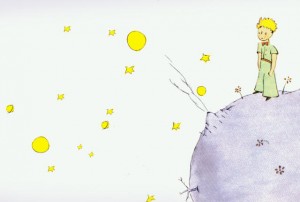
Image Credit: Antoine de Saint-Exupéry – used in this review in accordance with fair use principles.
Let’s Start With The Book
Childhood in “The Little Prince” is not viewed through the good, the beautiful or the true. “Wait!” I can hear your objections, “The little prince is all about the beauty of his planet and his rose, and seeing that things have value beyond their physical usefulness! How is that not good, beautiful or true?” Well, I am glad you asked!
What the book identifies as “good, beautiful and true” is shown by the juxtaposition of the Little Prince and the various adults he meets along the way. However, the Little Prince suffers from many of the same attitudes that he disdains in the adults. The “goodness” and “beauty” is flat, lacking in joy and true wonder. This makes more sense when you reach the end of the book and realize that the values presented throughout the story are intentionally crafted to make you accept the Prince’s departure. (More on that later.)
The adults in the story are vain, greedy, prideful, busy and too serious. They are also incapable of understanding what is really important in life from the Prince’s point of view.
Yet the Prince is consumed with his own portion of seriousness; like most adults, he judges his serious to be more important than everyone else’s seriousness. The Rose is vain and manipulating; this is excused because she is childish and immature. The fox is seeking to be tamed for his own self-fulfillment, but in his taking what he wants from the relationship, he offers the central value of the book:
“One sees clearly only with the heart. Anything essential is invisible to the eyes.”
It is after this revelation that the Prince finds the Aviator and demands a sheep. He asks endless questions but never answers any in return. His seriousness is the only kind that matters. Anyone who protests is just a silly adult, who understands nothing.
This is all crafted to make the end of the story seem beautiful and right. This is the greatest deception and biggest danger of this book. The reader is subtly, but quite clearly, endeared to suicide through the Prince’s “departure.”
The Prince could have hitched a ride on a flight of migrant birds again, or really, any other magical way of traveling would not have been out of place in this story. But the Author chooses to buy into the gnostic worldview that the Prince’s physical body is only an unimportant shell that is a hindrance to his journey, and that the five hundred million stars will all be like bells pealing with the prince’s laughter when he has gone. The Prince even states, “It will be fun!”
The Prince intentionally considers, plots and follows through with his suicide. Unlike many other vague notions in the book, his suicide is thought through in alarming detail. When the Prince is making his plans with the snake, he seeks assurance that the poison won’t hurt too much and that he won’t suffer. When the Aviator insists on coming with the Prince, the boy is only considers it after he realizes that the snake only has enough poison for one bite. The Aviator witnesses the snake bite the Little Prince and watches him fall to the sand, lifeless. And then the book recovers the illusion that it was only a means of the Prince traveling home, “But I know he did get back to his planet because at daybreak I didn’t find his body. It wasn’t such a heavy body…and at night I love listening to the stars. It’s like five-hundred million little bells…”
The language surrounding his death is all so lovely that it softens the reality that the Prince committed suicide. The description of the stars is a coping mechanism colored by such whimsy that the reader can almost be convinced that the Prince really did make it back to his little planet with his sheep and his rose. This lovely, captivating whimsey is only a cheap imitation of the Good, Beautiful and True. Like the phrase “death with dignity,” it makes any who reject it seem heartless.
You Said This Was A Movie Review.
Previous Post

August 12, 2016
On Outside the Walls: Rebecca Bratten Weiss on Not Unfriending.
Next Post

August 22, 2016 My take on Mark Shea and Uncharitability
Browse Our Archives
Select a Category Guest Post I Concur Outside The Walls Radio Show Personal Story The Way I See It Uncategorized
Select a Month May 2018 April 2018 March 2018 February 2018 January 2018 October 2017 February 2017 January 2017 December 2016 October 2016 September 2016 August 2016 July 2016 June 2016 May 2016 April 2016 January 2016
Follow Us!
TAKE THE
Religious Wisdom Quiz
What does Jesus say will set you free?
Select your answer to see how you score.
Power Money Fame The truth
Related posts from A Belief Observed
Dr. David Russell Mosley Reflects on His First...
Relics of the Saints, Treasures of the Church
The Pope in a Media Obsessed Culture: Don't...

One Five-Year-Old, One Thousand Embryos, and One Category...
TRENDING AT PATHEOS Catholic

Creation, Preservation, and Teleology in Catholic Theology
As I write this, it is very early Monday morning. Like millions...

The Parable Of The Sower And The Word...
One of Christ’s most famous parables is that of the sower who...

Rejecting Doom: Christian Hope And Human Action
Christianity is a religion of hope. We are to have hope and...

Why I Choose the Eucharist Over the Sermon
Choose the Eucharist, Not the Sermon What are we supposed to get...

5 Design Elements Found in Spiritually Rooted Homes
Putting Spirituality Into Home Decor Our homes are more than our living...

Credo: A Story of God Told with the...
About 10 years ago, I began to imagine a personal "Credo" that...
view all Catholic blogs
Ad-Free & Subscriber Log-In Subscription Support
- About Us
- 2026 Calendar
- Videos
- Podcasts
- Library of World Religions
- Faith In Media Tracker
- Advertise With Us
- Write for Us
- Privacy Policy
- Terms of Service
- Do Not Sell My Data
- Contact Us
- Radiant Digital
- Manage Newsletter Subscriptions
- Unsubscribe From Notifications
- Sitemap
Copyright 2008-2026, Patheos. All rights reserved.
Subscription Support Ad-Free & Subscriber Log-In
Follow Patheos