
BuddhistCatholicContemplativeEvangelicalGeneral ChristianHinduJewishLatter-day SaintMuslimNew VisionsProgressive Christian
Beliefs
- Buddhist
- Catholic
- Contemplative
- Evangelical
- General Christian
- Hindu
- Jewish
- Latter-day Saint
- More Voices
- Muslim
- New Visions
- Pagan
- Progressive Christian
Topics
- Religion News
- Food and Religion
- Sports and Religion
- Religious Art
- Religious Music and Entertainment
- Religious Events
- History and Religion
- Style and Religion
- Politics and Religion
- Women in Religion
- Recreation Outdoors and Religion
- Business Finance and Religion
- Careers Workplace and Religion
- Education and Religion
- Family Parenting and Religion
- Health Fitness and Religion
- Home and Religion
- Relationships and Religion
- Technology and Religion
- Travel and Religion
Columnists
- Buddhist Columnists
- Business Finance and Religion Columnists
- Careers Workplace and Religion Columnists
- Catholic Columnists
- Contemplative Columnists
- Education and Religion Columnists
- Evangelists Columnists
- Family Parenting and Religion Columnists
- General Christian Columnists
- Health Fitness and Religion Columnists
- Hindu Columnists
- History and Religion Columnists
- Home and Religion Columnists
- Jewish Columnists
- More Voices Columnists
- Latter Day Columnists
- Muslim Columnists
- New Visions Columnists
- Nonreligious Columnists
- Pagan Columnists
- Politics and Religion Columnists
- Progressive Columnists
- Recreation Outdoors and Religion Columnists
- Relationships and Religion Columnists
- Religion News Columnists
- Religious Art Columnists
- Religious Events Columnists
- Religious Music and Entertainment Columnists
- Sports and Religion Columnists
- Style and Religion Columnists
- Technology and Religion Columnists
- Travel and Religion Columnists
- Women in Religion Columnists
Resource Library
- 2026 Calendar
- Library of World Religions
- The 100 Most Holy Places on Earth
- Patheos Answers
- Podcasts
- Videos
- Faith Leaders Database
- Anglican Episcopalian
- Bahai
- Baptist
- Buddhism
- Christianity
- Confucianism
- Eastern Orthodoxy
- Hinduism
- Holiness and Pentecostal
- ISKCON
- Islam
- Judaism
- Lutheran
- Methodist
- The Church of Jesus Christ of Latter-day Saints
- New Age
- Paganism
- Presbytarian and Reformed
- Protestantism
- Religion Behind the Scenes
- Roman Catholic
- Scientology
- Shia Islam
- Sikhism
- Sufism
- Sunni Islam
- Taoism
- Zen
- See all religions
Research Tools
 Ad-Free & Subscriber Log-In Subscription Support
Ad-Free & Subscriber Log-In Subscription Support
Follow Patheos 

- Trending:
- Forgiveness
- |
- Marriage
- |
- Consciousness
- |
- Death Penalty
- |
- Election
- |
- Halloween
 1More Film Blog
- Home
- Religious Music & Entertainment
- Whiplash (Chazelle, 2014)
Whiplash (Chazelle, 2014)
Last updated on: January 26, 2015 at 12:42 am by Kenneth R. Morefield
Whiplash (Chazelle, 2014) 2015-01-26T00:42:52-05:00 Kenneth R. Morefield
Patheos Explore the world's faith through different perspectives on religion and spirituality! Patheos has the views of the prevalent religions and spiritualities of the world.
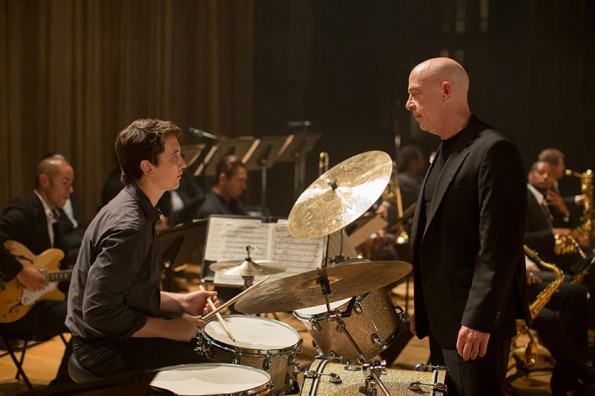
There are a lot of lies in play in Whiplash (★★★★), Damien Chazelle’s Oscar-nominated water-cooler fable about a music conservatory drummer (Miles Teller) and the sadistic instructor (J. K. Simmons) he is drawn to like a junkie jonesing for his next fix.
One mark of the film’s greatness: even after a second viewing, I am still not sure how many of those lies the film itself–or any of its characters–believe.
Teller plays Andrew, the precocious drummer with just the right mix of aspiration and neediness to be ripe to fall hard for the manipulative machinations of someone, anyone who holds out the promise (no matter how small) of potential greatness.
That someone is Fletcher (Simmons, in a career-defining performance), one of those legendary teachers who only exist in the movies. He prowls the halls of the conservatory, vampire-like, at all hours, instilling hope and dread in students and colleagues alike. Fletcher is at the peak of his profession, and his own accomplishments as a conductor apparently bring the conservatory enough glory that he is given free reign to extend practices to all hours, cherry-pick students from others’ classes, break equipment, strike students, and use the sorts of personal insults that might make a drill instructor blush.
A lot of ink has been spilled to this point about whether or not the film’s portrayal of the conservatory life is at all credible. I imagine not; it’s hard to imagine Flectcher not having been fired long ago. Yet such criticisms disinterest me. I’m not sure the film is going for social realism. It’s at heart a fable, and while its surface details sometimes smell false, the truths it lays bare about the human soul strike me as spot-on.
It’s important to note, for example, that Andrew is very-much a participant in his destructive, downward spiral. Whiplash is not so much a film about a bully with a scorched-human-earth policy towards uncovering greatness as it is about an angry young man who continually chooses abuse over love and the potential for greatness over the potential for happiness. The core of the film illustrates a horrific, painful, and dysfunctional teacher-student relationship–one that is the antithesis of everything I’ve learned about teaching in a career of developing students in the liberal arts. But that relationship is, in the final analysis, a symbiotic one. Much like the Navy Seals in American Sniper or G. I. Jane, the musicians who subject themselves to the abuses of Fletcher’s classroom do so in the conviction that if they can make it there, they’ll make it anywhere. And they know that even if they do nothing else in their entire lives, their refusal to quit such intense initiations will be at least one taste of greatness that ordinary mortals will never get to savor.
Maybe they are right. I’ve never really believed that the ends justify the means, and I’ve certainly never found that fear and intimidation are conducive to the best learning environments. They are good motivators, though. Plus, I don’t recall Fletcher ever even claiming that he was teaching the students anything; he says his job is to push them. What’s appealing about that? Well, not everyone has the talent to be exceptional, so there is something about reducing success to enduring (regardless of what one is enduring) that will make people take a lot more abuse than they ever would if that abuse were supposed to produce something other than a winner.
Despite my repugnance at Andrew for making an exchange of self-respect and dignity for opportunity, for making a wager of his sanity and felicity on the sort of long-shot that would make the hard-core addict in The Gambler take pause, I confess I found the film incredibly moving and our protagonist remarkably sympathetic. The key to film, for me, takes place away from the stage or even the rehearsal hall. It happens around a dinner table where Andrew, like so many artists, is demeaned and dismissed for having a skill and a passion that doesn’t happen to coincide with his culture’s current obsessions: sports, wealth, or prestige. If Andrew longs for Fletcher’s smile of approval, it’s not because of the extrinsic rewards the conductor can clear a pathway towards. It is because Fletcher may be the only one whose obsession rivals his own, the only one demanding enough to justify the sacrifices Andrew longs to make.
I’m a Christian film-critic (as well as a teacher), so, yes, I tend to see spiritual allegories where others may see only social ones. What’s spot-on about Whiplash is the way it recognizes and taps into the deep-seated longing for eternal significance, as well as the desperation and futility of its pursuit in a universe devoid of a loving God, where such significance can only be achieved through accomplishment. Fletcher’s classroom is essentially a miniature Darwinian-Hegelian universe, with competition fueling evolving talent, which finds its antithesis in greater challenges, world-without-end, amen.
That’s why I find the end of Whiplash so depressingly perfect. Like another of my favorite films, Rounders, it participates in the most tired conventions of its genre–that of a final competition to underscore its protagonist’s victory. But like the Matt Damon poker film, it perhaps leaves astute viewers more drained than comforted, as we know the underlying void that is pushing its protagonist to such exhilarating heights can never be satisfied. All human [accomplishment] is vanity, and a pursuit after the wind.
There is another way of reading the film’s finale, though. There can be moments of transcendent joy that few experience–that few, in fact, can recognize. In the culmination of Whiplash the audience fades away. To a certain extent the rest of the band fades away. Fletcher doesn’t. He and Andrew share what my former drama instructor used to call a “moment.” Life, for some, is made up of such moments. The vast spaces in between them are just existing, and the person who trades hours, nay years of the latter for a few more of the former may be an idiot…but I’m not sure, in the end, if he’s not a holy idiot. I’m not sure he doesn’t catch a rare glimpse of something–God willing something that’s awaiting us in abundance in the next world–that few of us grinders ever get close enough to recognize.
Previous Post

January 24, 2015
Still Life (Pasolini, 2013)
Next Post

January 26, 2015 Foxcatcher (Bennett Miller, 2014)
Browse Our Archives
Select a Category 10 Years Later 1999 Top 5 2007 Top 10 2008 Favorite Discoveries 2008 Top 10 2009 Favorite Discoveries 2009 Top 10 2010 Favorite Discoveries 2010 Top 10 2011 Top 10 2012 Top Ten 2013 Top Ten 2014 Top Ten Best Picture Winners Christian Spotlight on Entertainment Christianity Today Coming Soon Disclosure Disclosure--AS Disclosure--Book Disclosure--DVDS Disclosure--SEOL Disclosure--Travel Dissenting Opinion Elsewhere Emergenetics Essays Featured Film Fest DC--2014 Film Festivals Full Frame Documentary Film Festival 2010 Full Frame Documentary Film Festival 2011 Full Frame Documentary Film Festival 2012 Full Frame Documentary Film Festival 2013 Full Frame Documentary Film Festival 2014 Headline Interviews Laura on the Oscar Winners Podcasts Quick Impressions Reviews RiverRun Film Festival 2014 Television The Criterion Collection The Thin Place To Stream or Not to Stream? Top 10s and Other Lists Toronto International Film Festival 2009 Toronto International Film Festival 2010 Toronto International Film Festival 2011 Toronto International Film Festival 2012 Toronto International Film Festival 2013 Toronto International Film Festival 2014 Uncategorized Video Virginia Film Festival 2011 Virginia Film Festival 2013 Women's Film Festival 2012
Select a Month February 2016 January 2016 December 2015 November 2015 October 2015 September 2015 August 2015 July 2015 June 2015 May 2015 April 2015 March 2015 February 2015 January 2015 December 2014 November 2014 October 2014 September 2014 August 2014 July 2014 June 2014 May 2014 April 2014 March 2014 February 2014 January 2014 December 2013 November 2013 October 2013 September 2013 August 2013 July 2013 June 2013 May 2013 April 2013 March 2013 February 2013 January 2013 December 2012 November 2012 October 2012 September 2012 August 2012 July 2012 June 2012 May 2012 April 2012 March 2012 February 2012 January 2012 December 2011 November 2011 October 2011 September 2011 August 2011 July 2011 June 2011 May 2011 April 2011 March 2011 February 2011 January 2011 December 2010 November 2010 October 2010 September 2010 August 2010 July 2010 June 2010 May 2010 April 2010 March 2010 February 2010 January 2010 December 2009 November 2009 September 2009 August 2009 July 2009 June 2009 May 2009 April 2009
Follow Us!
TAKE THE
Religious Wisdom Quiz
What principle about debt is found in Proverbs?
Select your answer to see how you score.
Never lend Debt is always good Ignore money The borrower is slave to the lender
Related posts from 1More Film Blog

An Inconvenient Truth (Guggenheim, 2006) -- 10 Years...

The Devil Wears Prada (Frankel, 2006) -- 10...

"Telling a Great Story" -- An Interview with...

Is Snow White Still Essential?
TRENDING AT PATHEOS Religious Music & Entertainment

"Les Diabolique" and Transgression
Alongside something like Arrival, Vertigo, or Charade, Les Diaboliques is a...

"The Plague Dogs" and Mortality
So, flashback to the late 70s, early 80s. Walt Disney Studios is...

With the recent and highly successful release of Christopher Nolan’s epic film,...

"L'avventura" and Human Weakness
Today's piece is going to be a little different for a few...

I first want to apologize for not posting or writing anything. I'm...

I've engaged in the multi-year project of reading through the Church Fathers,...
view all Religious Music & Entertainment blogs
Ad-Free & Subscriber Log-In Subscription Support
- About Us
- 2026 Calendar
- Videos
- Podcasts
- Library of World Religions
- Faith In Media Tracker
- Advertise With Us
- Write for Us
- Privacy Policy
- Terms of Service
- Do Not Sell My Data
- Contact Us
- Radiant Digital
- Manage Newsletter Subscriptions
- Unsubscribe From Notifications
- Sitemap
Copyright 2008-2026, Patheos. All rights reserved.
Subscription Support Ad-Free & Subscriber Log-In
Follow Patheos