
BuddhistCatholicContemplativeEvangelicalGeneral ChristianHinduJewishLatter-day SaintMuslimNew VisionsProgressive Christian
Beliefs
- Buddhist
- Catholic
- Contemplative
- Evangelical
- General Christian
- Hindu
- Jewish
- Latter-day Saint
- More Voices
- Muslim
- New Visions
- Pagan
- Progressive Christian
Topics
- Religion News
- Food and Religion
- Sports and Religion
- Religious Art
- Religious Music and Entertainment
- Religious Events
- History and Religion
- Style and Religion
- Politics and Religion
- Women in Religion
- Recreation Outdoors and Religion
- Business Finance and Religion
- Careers Workplace and Religion
- Education and Religion
- Family Parenting and Religion
- Health Fitness and Religion
- Home and Religion
- Relationships and Religion
- Technology and Religion
- Travel and Religion
Columnists
- Buddhist Columnists
- Business Finance and Religion Columnists
- Careers Workplace and Religion Columnists
- Catholic Columnists
- Contemplative Columnists
- Education and Religion Columnists
- Evangelists Columnists
- Family Parenting and Religion Columnists
- General Christian Columnists
- Health Fitness and Religion Columnists
- Hindu Columnists
- History and Religion Columnists
- Home and Religion Columnists
- Jewish Columnists
- More Voices Columnists
- Latter Day Columnists
- Muslim Columnists
- New Visions Columnists
- Nonreligious Columnists
- Pagan Columnists
- Politics and Religion Columnists
- Progressive Columnists
- Recreation Outdoors and Religion Columnists
- Relationships and Religion Columnists
- Religion News Columnists
- Religious Art Columnists
- Religious Events Columnists
- Religious Music and Entertainment Columnists
- Sports and Religion Columnists
- Style and Religion Columnists
- Technology and Religion Columnists
- Travel and Religion Columnists
- Women in Religion Columnists
Resource Library
- 2026 Calendar
- Library of World Religions
- The 100 Most Holy Places on Earth
- Patheos Answers
- Podcasts
- Videos
- Faith Leaders Database
- Anglican Episcopalian
- Bahai
- Baptist
- Buddhism
- Christianity
- Confucianism
- Eastern Orthodoxy
- Hinduism
- Holiness and Pentecostal
- ISKCON
- Islam
- Judaism
- Lutheran
- Methodist
- The Church of Jesus Christ of Latter-day Saints
- New Age
- Paganism
- Presbytarian and Reformed
- Protestantism
- Religion Behind the Scenes
- Roman Catholic
- Scientology
- Shia Islam
- Sikhism
- Sufism
- Sunni Islam
- Taoism
- Zen
- See all religions
Research Tools
 Ad-Free & Subscriber Log-In Subscription Support
Ad-Free & Subscriber Log-In Subscription Support
Follow Patheos 

- Trending:
- Forgiveness
- |
- Marriage
- |
- Consciousness
- |
- Death Penalty
- |
- Election
- |
- Halloween
 1More Film Blog
- Home
- Religious Music & Entertainment
- TIFF 2014: The Sound and the Fury
TIFF 2014: The Sound and the Fury
Last updated on: September 8, 2014 at 10:09 pm by Kenneth R. Morefield
TIFF 2014: The Sound and the Fury 2014-09-08T22:09:33-05:00 Kenneth R. Morefield
Patheos Explore the world's faith through different perspectives on religion and spirituality! Patheos has the views of the prevalent religions and spiritualities of the world.
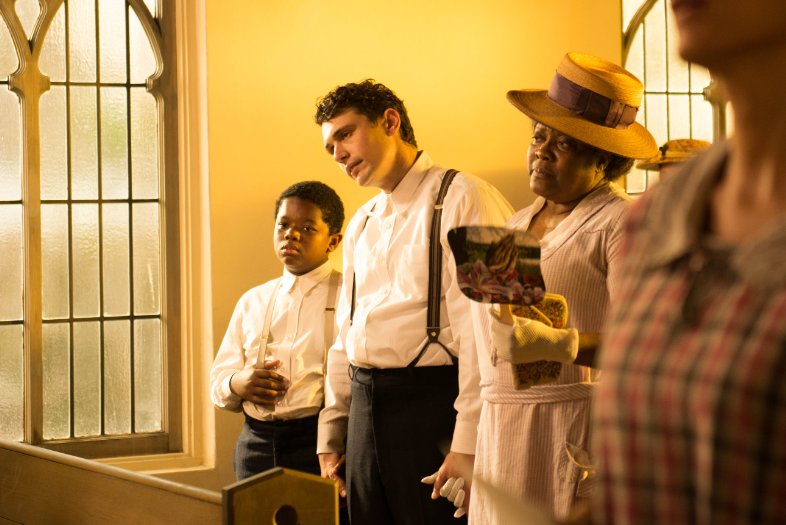
Photo by AKOORIS – © James Franco
Nearly everything in the lead up to The Sound and the Fury‘s (★★★) North American premiere at the Toronto International Film Festival screamed to me to run the other way. Child of God had a melodramatic ripeness that made me wonder if the high profile actor giving himself the role of mentally retarded Benjy Compson in his next movie was a vanity move. Jon Hamm and Seth Rogen got lots of early publicity despite being cast in roles I knew to be minor. Janet Jones (Gretzky) and Scott Haze had worked with Franco on other movies, giving this one the sheen of a project among buddies. Plus, it was The Sound and the Fury, a stream of consciousness novel from William Faulkner that did not appear to lend itself to easy adaptation, even from a well seasoned auteur.
So it a mark of Franco’s achievement that I can honestly say the film was not a disaster. If I was not as enthusiastic about the film as Venice audiences apparently were, that’s as much an admission about my own tastes (both cinematic and literary) as it is a judgment of its quality.
Franco told the audience at TIFF that Faulkner’s novel allowed him to make a “period piece” but pushed him and his crew “to make [it] in a contemporary way.” The stream of consciousness structure, particularly in Benjy’s chapter, will no doubt invite comparisons to Malick’s Tree of Life. I am not a Malick disciple, but I wasn’t nearly as put off by this fractured narrative since I already knew the story. That allowed me to experience the film a bit more aesthetically rather than analytically, and I will concede that Franco helped me see moments of fleeting beauty in the story and renew my appreciation for Faulkner’s prose. “We been ruined since the day we was born,” the Compson pater says, and in the film you understand what he means.
The film will cut from shots of the adult Benjy (played by Franco) to the childhood events he is apparently recalling. That those memories include shots of the child Benjy is probably not formally correct–is he remembering watching himself?–but it works as a concession for an audience that is already being asked to do some heavy lifting.
Sound is important in the film, as the title would suggest, and it is used expertly to create an oppressive environment that allows you to feel rather than merely witness the Compsons’s desperation. Anyone who has grown up around someone who is severely (or sometimes even mildly) mentally challenged can probably relate to the ways in which the cries of that person can create a spiraling anxiety as it reminds those around him (or her) that he (or she) has an inexhaustible ability to ignore or not understand attempts to socialize him. It’s sometimes hard to tell if the speakers are turned up in a particular venue or whether an oppressive loudness is part of a film’s score. I suspect the latter. In Quentin’s section, the inescapable sound is often in the form of a ticking clock rather than the howls of his brother. In Jason’s, it is his own voice, exploding in anger at each new indignity life foists upon him.
As for the content? The novel’s title comes from a line in Macbeth, comparing all life to the mutterings of a fool prattling on the stage, “full of sound and fury” and “signifying nothing.” It’s an article of academic faith to me that if a story seems too dark and nihilistic to justify how much people I respect adore it, it probably isn’t. That said, if there is something here besides early 20th century modernist despair that God is not walking through that door any time soon (and probably never will), I have yet to find it. Something productive can be gleaned from distinguishing between various tribal forms of despair, but there isn’t a one that’s not bleak, Faulkner’s included.
At one point Caddy pays her brother $50 for the privilege of looking at her daughter for one minute. They dicker over price for awhile and about whether she has to pay in advance. They argue over who hates who more and who is more deserving of that hate. It’s all very artistically done, but a movie hasn’t made me feel this miserable about being alive since August: Osage County. Take you pick, Meryl Streep doing another accent or James Franco drooling and biting someone on the buttocks. Both are tales told by master actors, full of spit and venom, signifying that there will be one less nomination spot available next award season.
Toronto International Film Festival 2014
Previous Post
September 6, 2014
Video: TIFF 2014 Reviews -- Gemma Bovery
Next Post

September 8, 2014 Video: TIFF 2014 Reviews -- Backcountry
Browse Our Archives
Select a Category 10 Years Later 1999 Top 5 2007 Top 10 2008 Favorite Discoveries 2008 Top 10 2009 Favorite Discoveries 2009 Top 10 2010 Favorite Discoveries 2010 Top 10 2011 Top 10 2012 Top Ten 2013 Top Ten 2014 Top Ten Best Picture Winners Christian Spotlight on Entertainment Christianity Today Coming Soon Disclosure Disclosure--AS Disclosure--Book Disclosure--DVDS Disclosure--SEOL Disclosure--Travel Dissenting Opinion Elsewhere Emergenetics Essays Featured Film Fest DC--2014 Film Festivals Full Frame Documentary Film Festival 2010 Full Frame Documentary Film Festival 2011 Full Frame Documentary Film Festival 2012 Full Frame Documentary Film Festival 2013 Full Frame Documentary Film Festival 2014 Headline Interviews Laura on the Oscar Winners Podcasts Quick Impressions Reviews RiverRun Film Festival 2014 Television The Criterion Collection The Thin Place To Stream or Not to Stream? Top 10s and Other Lists Toronto International Film Festival 2009 Toronto International Film Festival 2010 Toronto International Film Festival 2011 Toronto International Film Festival 2012 Toronto International Film Festival 2013 Toronto International Film Festival 2014 Uncategorized Video Virginia Film Festival 2011 Virginia Film Festival 2013 Women's Film Festival 2012
Select a Month February 2016 January 2016 December 2015 November 2015 October 2015 September 2015 August 2015 July 2015 June 2015 May 2015 April 2015 March 2015 February 2015 January 2015 December 2014 November 2014 October 2014 September 2014 August 2014 July 2014 June 2014 May 2014 April 2014 March 2014 February 2014 January 2014 December 2013 November 2013 October 2013 September 2013 August 2013 July 2013 June 2013 May 2013 April 2013 March 2013 February 2013 January 2013 December 2012 November 2012 October 2012 September 2012 August 2012 July 2012 June 2012 May 2012 April 2012 March 2012 February 2012 January 2012 December 2011 November 2011 October 2011 September 2011 August 2011 July 2011 June 2011 May 2011 April 2011 March 2011 February 2011 January 2011 December 2010 November 2010 October 2010 September 2010 August 2010 July 2010 June 2010 May 2010 April 2010 March 2010 February 2010 January 2010 December 2009 November 2009 September 2009 August 2009 July 2009 June 2009 May 2009 April 2009
Follow Us!
TAKE THE
Religious Wisdom Quiz
Who carried Jesus' cross after He could no longer?
Select your answer to see how you score.
Pilate John Peter Simon of Cyrene
Related posts from 1More Film Blog

An Inconvenient Truth (Guggenheim, 2006) -- 10 Years...

The Devil Wears Prada (Frankel, 2006) -- 10...

"Telling a Great Story" -- An Interview with...

Is Snow White Still Essential?
TRENDING AT PATHEOS Religious Music & Entertainment

"Les Diabolique" and Transgression
Alongside something like Arrival, Vertigo, or Charade, Les Diaboliques is a...

"The Plague Dogs" and Mortality
So, flashback to the late 70s, early 80s. Walt Disney Studios is...

With the recent and highly successful release of Christopher Nolan’s epic film,...

"L'avventura" and Human Weakness
Today's piece is going to be a little different for a few...

I first want to apologize for not posting or writing anything. I'm...

I've engaged in the multi-year project of reading through the Church Fathers,...
view all Religious Music & Entertainment blogs
Ad-Free & Subscriber Log-In Subscription Support
- About Us
- 2026 Calendar
- Videos
- Podcasts
- Library of World Religions
- Faith In Media Tracker
- Advertise With Us
- Write for Us
- Privacy Policy
- Terms of Service
- Do Not Sell My Data
- Contact Us
- Radiant Digital
- Manage Newsletter Subscriptions
- Unsubscribe From Notifications
- Sitemap
Copyright 2008-2026, Patheos. All rights reserved.
Subscription Support Ad-Free & Subscriber Log-In
Follow Patheos