
BuddhistCatholicContemplativeEvangelicalGeneral ChristianHinduJewishLatter-day SaintMuslimNew VisionsProgressive Christian
Beliefs
- Buddhist
- Catholic
- Contemplative
- Evangelical
- General Christian
- Hindu
- Jewish
- Latter-day Saint
- More Voices
- Muslim
- New Visions
- Pagan
- Progressive Christian
Topics
- Religion News
- Food and Religion
- Sports and Religion
- Religious Art
- Religious Music and Entertainment
- Religious Events
- History and Religion
- Style and Religion
- Politics and Religion
- Women in Religion
- Recreation Outdoors and Religion
- Business Finance and Religion
- Careers Workplace and Religion
- Education and Religion
- Family Parenting and Religion
- Health Fitness and Religion
- Home and Religion
- Relationships and Religion
- Technology and Religion
- Travel and Religion
Columnists
- Buddhist Columnists
- Business Finance and Religion Columnists
- Careers Workplace and Religion Columnists
- Catholic Columnists
- Contemplative Columnists
- Education and Religion Columnists
- Evangelists Columnists
- Family Parenting and Religion Columnists
- General Christian Columnists
- Health Fitness and Religion Columnists
- Hindu Columnists
- History and Religion Columnists
- Home and Religion Columnists
- Jewish Columnists
- More Voices Columnists
- Latter Day Columnists
- Muslim Columnists
- New Visions Columnists
- Nonreligious Columnists
- Pagan Columnists
- Politics and Religion Columnists
- Progressive Columnists
- Recreation Outdoors and Religion Columnists
- Relationships and Religion Columnists
- Religion News Columnists
- Religious Art Columnists
- Religious Events Columnists
- Religious Music and Entertainment Columnists
- Sports and Religion Columnists
- Style and Religion Columnists
- Technology and Religion Columnists
- Travel and Religion Columnists
- Women in Religion Columnists
Resource Library
- 2026 Calendar
- Library of World Religions
- The 100 Most Holy Places on Earth
- Patheos Answers
- Podcasts
- Videos
- Faith Leaders Database
- Anglican Episcopalian
- Bahai
- Baptist
- Buddhism
- Christianity
- Confucianism
- Eastern Orthodoxy
- Hinduism
- Holiness and Pentecostal
- ISKCON
- Islam
- Judaism
- Lutheran
- Methodist
- The Church of Jesus Christ of Latter-day Saints
- New Age
- Paganism
- Presbytarian and Reformed
- Protestantism
- Religion Behind the Scenes
- Roman Catholic
- Scientology
- Shia Islam
- Sikhism
- Sufism
- Sunni Islam
- Taoism
- Zen
- See all religions
Research Tools
 Ad-Free & Subscriber Log-In Subscription Support
Ad-Free & Subscriber Log-In Subscription Support
Follow Patheos 

- Trending:
- Forgiveness
- |
- Marriage
- |
- Consciousness
- |
- Death Penalty
- |
- Election
- |
- Halloween
 1More Film Blog
- Home
- Religious Music & Entertainment
- Three Monkeys
Three Monkeys
Last updated on: July 27, 2014 at 8:49 pm by Kenneth R. Morefield
Three Monkeys 2014-07-27T20:49:56-05:00 Kenneth R. Morefield
Patheos Explore the world's faith through different perspectives on religion and spirituality! Patheos has the views of the prevalent religions and spiritualities of the world.
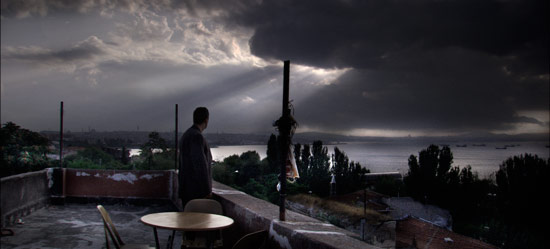
Nuri Bilge Ceylan’s Three Monkeys was one of my Top 10 of 2008. It is streaming for free at The Auteurs on Sunday, April 26, 2009.
This review originally appeared at Looking Closer Journal.
What little buzz I heard about Nuri Bilge Ceylan’s Three Monkeys coming out of this year’s Cannes Film Festival was that it was as much of a letdown as a film that wins its director a festival award for best director can be. It’s all about expectations, I guess.
Coming off of two accomplished and highly lauded features (Distant [2002] and Climates [2006]) the Turkish writer and director faced that inevitable problem confronting any artist who is hot in the Internet age. Reputation spreads so quickly as viewers and critics try so hard to stay ahead of the curve that, much like emerging professional athletes, directors find their successes extrapolated, the hype surrounding them intensified, and the expectations about their subsequent work burdened with double digit inflation.
All of which is a shame, really, because I suspect the very things that might marginally disappoint the avant-garde minded viewers or critics are the things that could very well make Three Monkeys a better bet for the casual or new cinephile than his less accessible earlier works.
By that, I guess I mean first and foremost that Three Monkeys has a narrative arc that is a bit more clearly defined than Ceylan’s earlier two works, which were primarily character and relationship studies. Three Monkeys does delve into character issues, but it does so within the context of a more traditional (if still opaque by Hollywood standards) plot. The action is set in motion when Servet (Ercan Kesal), a politician on the eve of elections, hits a pedestrian with his car while driving in the darkness of early morning. (In a wonderfully subtle and revealing detail, we are never told for certain if the person hit was killed.) Servet agrees to pay his chauffer Eyüp (Yavuz Bingöl) a lump sum on top of his regular salary if he will take responsibility and say he was driving the car. Eyüp agrees and begins serving a year in jail.
Once Eyüp is in prison, the focus shifts to his wife Hacer (Hatice Aslan) and son Ismail (Rifat Sungar) who must survive in his absence. Much as does Graham Greene’s classic The Tenth Man, this section of Three Monkeys examines the nebulous boundary that often exists between sacrifice and selfishness. Seldom is any sacrifice we make entirely personal, and there are often hidden (or not so hidden, just not immediately obvious) costs to them that are borne by the very people we claim that we are making them for.
Ismail wants his mother to get an advance on the payment from Servet in order to get a car, in part to help make some money while his father is in prison. Later, through an accidental circumstance, he begins to question whether or not there is a pre-existent relationship between his mother and Servet or whether she has had to bend to circumstances in order to survive. He also wonders whether he should tell his father what he knows (or suspects).
The basic narrative structure of the film, then, revolves around the accumulation of secrets and silences—the title refers to the proverbial monkeys who see, hear, and speak no evil. Whether or not the viewer thinks that there is a thematic point behind the examination of damages caused by looking the other way will, I imagine, go a long way towards determining the extent to which she or he warms to the film. The resolution of the plot suggests a somewhat fatalistic or determined attitude towards human nature—that we fall into the same patterns of behavior and don’t learn much from mistakes, whether our own or that of others. On the other hand, the film lingers slightly after the climax, and the mise en scène of the dénouement hints that clouds can gather only so long before a storm breaks. This ending is thematically thought-provoking in that the contrast between impulse and considered action is a major theme in the film and in at least one key incident, a repressed or stifled impulse is later—possibly—enacted as a calculated decision. We are left to contemplate, then, whether or not the consequences of each character’s mistakes have been avoided or only just deferred.
And I guess in some ways, I tend to focus more on what the film is trying to communicate visually, through setting and reaction shots, than through its plot devices. To focus exclusively or even primarily on narrative elements in a Ceylan film is a bit like discussing the symbolism in the flower selection of a Van Gogh. There is a distinctive style to Ceylan’s films that is beguilingly simple yet deeply rich. The direction can be a bit of an adjustment to those calibrated to commercial narrative film (with its preponderance of medium length shots and conversational cross-cutting). Ceylan will often shoot contrary to expectations, keeping a long shot where we might expect a more intimate framing (such as in a key scene between Hacer and Servet) or keeping the camera on the character who is watching rather than on the action he or she is watching (such as when Eyüp sees his wife on a ledge contemplating suicide and we see the scene play out in and on his face rather than on the ledge).
As is often the case with films by directors who convey information visually as much as through dialogue, there is a lot of ambiguity in Three Monkeys. The aforementioned scene between Servet and Hacer ends with a shot from a different angle, from between some branches, and we are left to decide for ourselves if this is a point-of-view shot and someone is watching. Occasionally (such as when Servet and Hacer are driving in a car) we will hear the voice of a character who is not in the frame, but when the camera pans to him the actor is not speaking, and we are left to contemplate which parts of the dialogue were real and whether this device represents words considered but left unsaid.
Christian viewers sensitive to problematic content should be aware that, as with Climates, there is strong sexual content in the film (though the actual nudity is moderate by Hollywood standards), and it is disturbing in that Ceylan will depict sex as a form of aggression or anger in which the goal is the humiliation of the woman or an assertion of power or control over her. The (unconsummated) sexual encounter between Hacer and Eyüp is not as violent nor as sustained as the one in Climates, in part because Eyüp, unlike the male protagonist in Climates seems to be struggling against those misogynist parts of his psyche that make women an easy scapegoat for one’s own failings and an easier target for one’s own unreleased anger.
I’m probably the ideal sort of viewer for Three Monkeys in that I’m not yet so experimental in my film tastes as to sniff at its conventional narrative frame (for those viewers I recommend Denis’s Thirty-Five Rhums) nor so dependent on a work’s self-exposition to balk at its ambiguity (for those viewers there’s always Nick and Norah’s Infinite Playlist). That said, I seriously wonder if the film will end up being the cinematic equivalent of a politician who changes his approach just enough to tick off his base without doing so enough to draw in new voters. I think those who like Ceylan’s films will be respectful towards Three Monkeys, and it might even cement his reputation amongst those who are familiar with his work but on the fence about their attitude towards him. I just don’t expect to see it on the shelves at Blockbuster or playing at any but the most niche-marketed theater houses any time soon.
My Grade: A-
Previous Post

April 24, 2009
Séraphine (Provost, 2008)
Next Post

April 26, 2009 2008 Top Ten
Browse Our Archives
Select a Category 10 Years Later 1999 Top 5 2007 Top 10 2008 Favorite Discoveries 2008 Top 10 2009 Favorite Discoveries 2009 Top 10 2010 Favorite Discoveries 2010 Top 10 2011 Top 10 2012 Top Ten 2013 Top Ten 2014 Top Ten Best Picture Winners Christian Spotlight on Entertainment Christianity Today Coming Soon Disclosure Disclosure--AS Disclosure--Book Disclosure--DVDS Disclosure--SEOL Disclosure--Travel Dissenting Opinion Elsewhere Emergenetics Essays Featured Film Fest DC--2014 Film Festivals Full Frame Documentary Film Festival 2010 Full Frame Documentary Film Festival 2011 Full Frame Documentary Film Festival 2012 Full Frame Documentary Film Festival 2013 Full Frame Documentary Film Festival 2014 Headline Interviews Laura on the Oscar Winners Podcasts Quick Impressions Reviews RiverRun Film Festival 2014 Television The Criterion Collection The Thin Place To Stream or Not to Stream? Top 10s and Other Lists Toronto International Film Festival 2009 Toronto International Film Festival 2010 Toronto International Film Festival 2011 Toronto International Film Festival 2012 Toronto International Film Festival 2013 Toronto International Film Festival 2014 Uncategorized Video Virginia Film Festival 2011 Virginia Film Festival 2013 Women's Film Festival 2012
Select a Month February 2016 January 2016 December 2015 November 2015 October 2015 September 2015 August 2015 July 2015 June 2015 May 2015 April 2015 March 2015 February 2015 January 2015 December 2014 November 2014 October 2014 September 2014 August 2014 July 2014 June 2014 May 2014 April 2014 March 2014 February 2014 January 2014 December 2013 November 2013 October 2013 September 2013 August 2013 July 2013 June 2013 May 2013 April 2013 March 2013 February 2013 January 2013 December 2012 November 2012 October 2012 September 2012 August 2012 July 2012 June 2012 May 2012 April 2012 March 2012 February 2012 January 2012 December 2011 November 2011 October 2011 September 2011 August 2011 July 2011 June 2011 May 2011 April 2011 March 2011 February 2011 January 2011 December 2010 November 2010 October 2010 September 2010 August 2010 July 2010 June 2010 May 2010 April 2010 March 2010 February 2010 January 2010 December 2009 November 2009 September 2009 August 2009 July 2009 June 2009 May 2009 April 2009
Follow Us!
TAKE THE
Religious Wisdom Quiz
Look to the LORD and his strength; seek his face, ____________.
Select your answer to see how you score.
Eternally Forever Every Time Always
Related posts from 1More Film Blog

2015 Arts & Faith Ecumenical Jury Awards

Favorite 2015 Discoveries -- Evan Cogswell's List

Josh Wartel: My Year in Movies

TRENDING AT PATHEOS Religious Music & Entertainment

"Les Diabolique" and Transgression
Alongside something like Arrival, Vertigo, or Charade, Les Diaboliques is a...

"The Plague Dogs" and Mortality
So, flashback to the late 70s, early 80s. Walt Disney Studios is...

With the recent and highly successful release of Christopher Nolan’s epic film,...

"L'avventura" and Human Weakness
Today's piece is going to be a little different for a few...

I first want to apologize for not posting or writing anything. I'm...

I've engaged in the multi-year project of reading through the Church Fathers,...
view all Religious Music & Entertainment blogs
Ad-Free & Subscriber Log-In Subscription Support
- About Us
- 2026 Calendar
- Videos
- Podcasts
- Library of World Religions
- Faith In Media Tracker
- Advertise With Us
- Write for Us
- Privacy Policy
- Terms of Service
- Do Not Sell My Data
- Contact Us
- Radiant Digital
- Manage Newsletter Subscriptions
- Unsubscribe From Notifications
- Sitemap
Copyright 2008-2026, Patheos. All rights reserved.
Subscription Support Ad-Free & Subscriber Log-In
Follow Patheos