
BuddhistCatholicContemplativeEvangelicalGeneral ChristianHinduJewishLatter-day SaintMuslimNew VisionsProgressive Christian
Beliefs
- Buddhist
- Catholic
- Contemplative
- Evangelical
- General Christian
- Hindu
- Jewish
- Latter-day Saint
- More Voices
- Muslim
- New Visions
- Pagan
- Progressive Christian
Topics
- Religion News
- Food and Religion
- Sports and Religion
- Religious Art
- Religious Music and Entertainment
- Religious Events
- History and Religion
- Style and Religion
- Politics and Religion
- Women in Religion
- Recreation Outdoors and Religion
- Business Finance and Religion
- Careers Workplace and Religion
- Education and Religion
- Family Parenting and Religion
- Health Fitness and Religion
- Home and Religion
- Relationships and Religion
- Technology and Religion
- Travel and Religion
Columnists
- Buddhist Columnists
- Business Finance and Religion Columnists
- Careers Workplace and Religion Columnists
- Catholic Columnists
- Contemplative Columnists
- Education and Religion Columnists
- Evangelists Columnists
- Family Parenting and Religion Columnists
- General Christian Columnists
- Health Fitness and Religion Columnists
- Hindu Columnists
- History and Religion Columnists
- Home and Religion Columnists
- Jewish Columnists
- More Voices Columnists
- Latter Day Columnists
- Muslim Columnists
- New Visions Columnists
- Nonreligious Columnists
- Pagan Columnists
- Politics and Religion Columnists
- Progressive Columnists
- Recreation Outdoors and Religion Columnists
- Relationships and Religion Columnists
- Religion News Columnists
- Religious Art Columnists
- Religious Events Columnists
- Religious Music and Entertainment Columnists
- Sports and Religion Columnists
- Style and Religion Columnists
- Technology and Religion Columnists
- Travel and Religion Columnists
- Women in Religion Columnists
Resource Library
- 2026 Calendar
- Library of World Religions
- The 100 Most Holy Places on Earth
- Patheos Answers
- Podcasts
- Videos
- Faith Leaders Database
- Anglican Episcopalian
- Bahai
- Baptist
- Buddhism
- Christianity
- Confucianism
- Eastern Orthodoxy
- Hinduism
- Holiness and Pentecostal
- ISKCON
- Islam
- Judaism
- Lutheran
- Methodist
- The Church of Jesus Christ of Latter-day Saints
- New Age
- Paganism
- Presbytarian and Reformed
- Protestantism
- Religion Behind the Scenes
- Roman Catholic
- Scientology
- Shia Islam
- Sikhism
- Sufism
- Sunni Islam
- Taoism
- Zen
- See all religions
Research Tools
 Ad-Free & Subscriber Log-In Subscription Support
Ad-Free & Subscriber Log-In Subscription Support
Follow Patheos 

- Trending:
- Forgiveness
- |
- Marriage
- |
- Consciousness
- |
- Death Penalty
- |
- Election
- |
- Halloween
 1More Film Blog
- Home
- Religious Music & Entertainment
- The Trial (Welles, 1962)
The Trial (Welles, 1962)
Last updated on: August 9, 2015 at 9:09 pm by Guest Contributor
The Trial (Welles, 1962) 2015-08-09T21:09:12-05:00 Guest Contributor
Patheos Explore the world's faith through different perspectives on religion and spirituality! Patheos has the views of the prevalent religions and spiritualities of the world.
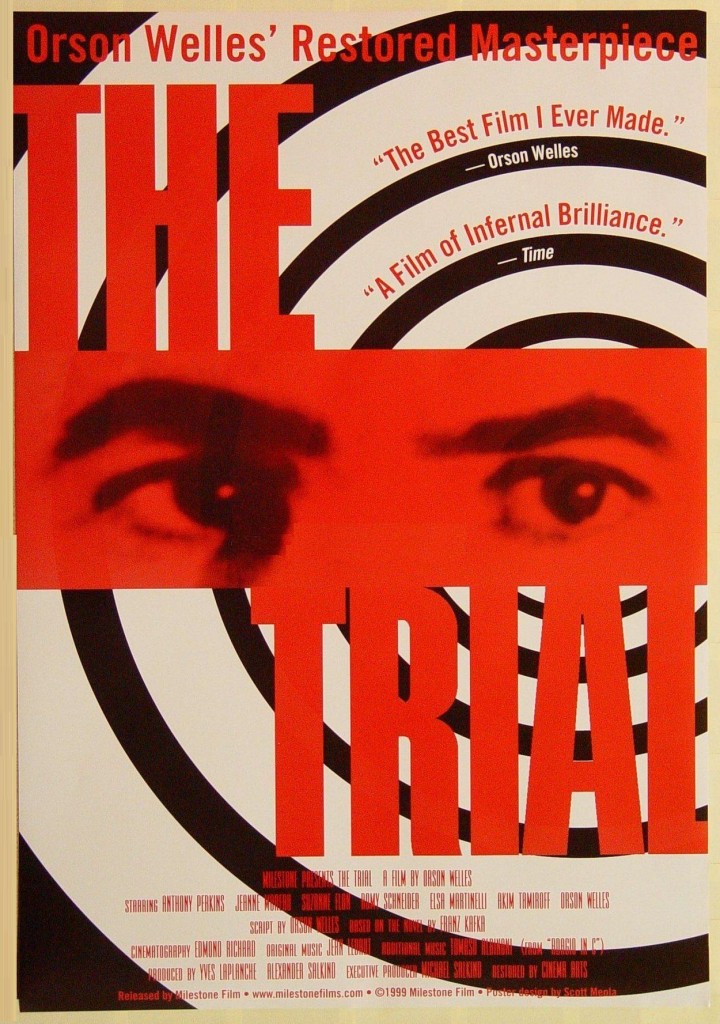 The unsolvable riddles of human existence are the primary preoccupation of Orson Welles’s films, the first of which is Citizen Kane (in which a human life is depicted as, to quote Borges, a “centreless labyrinth”) and the last of which is F for Fake (in which art itself becomes yet another “centreless labyrinth”). How fitting then that Welles adapted Kafka’s The Trial, an obtuse and peculiar narrative about man, society, and the law. As Welles disembodied voice intones during the film’s prologue, The Trial follows the logic of the nightmare; it begins and ends in the abyss.
Welles was incapable of making a film that did not somehow yield to his own distinctive vision (even his hackwork displays his unique flair), but in the broad outline, The Trial adheres to that of Kafka’s novel: protagonist Josef K. (portrayed in the film by Anthony Perkins) awakes to find that he has been arrested, but the details of the charge are withheld from him. The remainder of the story follows his misadventures as he navigates a society that seems designed to thwart his every move as he vainly attempts to establish his innocence.
A parable, taken from one of the novel’s later chapters, serves as the film’s preface. The parable tells of a man seeking admittance to the Law. He stands before the guarded gate of the Law, asking for entry. The entry is refused to him, and, so, intimidated by the guard, he waits. He pleads with the guard, even attempting to bribe his way in, but the guard never relents. After having spent the entirety of his life waiting, the seeker asks the guard why no other individuals have come to the door of the Law. The guard informs him that the door was made only for the seeker and that the seeker alone could have entered it. The guard then shuts the door.
The parable, like the film itself, defies any solution. Like a Lewis Carroll riddle disguised as a Bible passage, it tantalizingly dangles points of interpretive entry only to reveal all entry points as dead ends. Late in the film, the ostensible villain of the film, the law advocate Albert Hastler (played with relish by Welles himself) wields the parable as a weapon against Josef K., demanding Josef’s ultimate subservience and slavery to the system that desires to crush him. Josef K. rejects the parable and, by extension, the world that follows its illogic, but he cannot transcend the nightmare. He, too, is a product of the world.
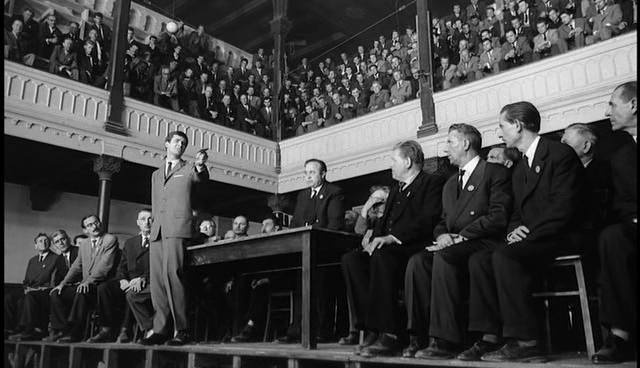 This world is as spatially confused as it is relationally and ideologically confused. Scenes and segments jump from one to the other with disorienting effect, often revealing that two locations other scenes indicated were far apart are actually parts of the same space. By the end of the film, it appears that every location—from the opera house to the hearing room to the cathedral—is united, just different facets of the same oppressive realm, a labyrinth with no exit. (Welles achieved this effect by filming the majority of The Trial in an abandoned train station, so that each of these locations really were different chambers in the same building.)
Welles’s films are about places as much as they are about people, and therefore pay special attention to architecture. Nowhere is this attention more profoundly and lovingly displayed than in Welles’ monologue about Chartres in F for Fake, but it’s present as early as Citizen Kane, where every setting is a mirror image of the people inhabiting that space.
This attention to setting and its effects made Welles especially well-suited to film noir pieces, where his expressionism could run wild. The different environments of The Lady from Shanghai (aquariums, court rooms, Chinese theaters, funhouses) transform a convoluted, thin story into one of the most vivid noir features. Touch of Evil’s iconic opening shot–an extended single take in which the camera floats over rooftops and down city streets–turns its decaying border town into the film’s star. Welles’ chiaroscuro lighting has the effect of bleeding characters into these spaces, as occurs in the clocktower finale of The Stranger.
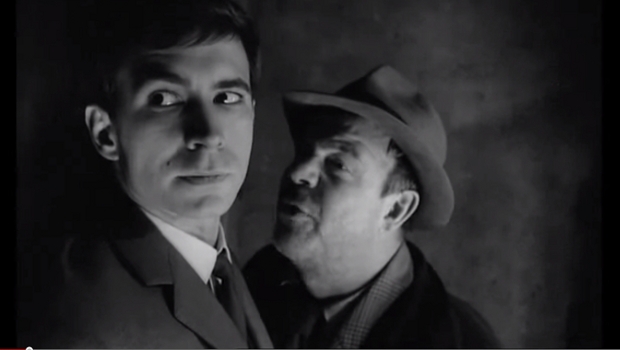 Both stylistically and narratively, The Trial follows after Welles’ noir pictures. Jean Collet pointed out the special relationship that exists between The Trial and the film that preceded it in Welles’ filmography, Touch of Evil, “a meditation on the abuses of the police state.” But the injustices of The Trial are more expansive, and the villains are not just authority figures, but an entire society that regards Josef K. with contempt, that is all too willing to condemn him for an unknown crime.
In this, the specter of the Holocaust raises its head and permeates the film. Welles does not have to twist the narrative to reflect the injustices of World War II. He does not have to: The Trial’s rooms and landscapes are enough to suggest postwar Europe, where crumbling buildings serves a reminders of a passed European golden age that was ravaged by war, and new, imposing modernist structures rise amongst the ruins.
Welles further skewers the rise of the corporation, which is depicted in The Trial as being every bit as dehumanizing as the government. Welles’ vivid depictions of soulless drone workers slaving away paved the way for films like Brazil and The Double, but where those films relied on claustrophobic spaces to suggest oppression, Welles makes enormous spaces unbearable. Josef K.’s arrival at work ranks among the film’s most memorable sequences; he passes hundreds of people sitting at hundreds of desks all typing on hundreds of typewriters, the deafening roar of typewriter keys filling the entirety of the cavernous space. The world of The Trial is always either big enough or small enough that Josef K. can be lost in it.
Josef K.’s relationships in the film–if they can be called that, given that nearly everyone in the film seems to lack the ability or desire to communicate–consist mostly of aborted encounters with women. The lure of eroticism snakes throughout the film, tying the archetype of the femme fatale to the promises of the society that surrounds it: death cloaked in false promises.
Kafka’s Josef K. meets his inevitable end passively, at the end of a knife blade. Welles embellishes upon Kafka’s novel to allow Josef K. a final futile gesture, an act of defiance against the world around him. Left in a rubble pit with a some dynamite, Josef K. laughs wildly as he lifts the dynamite to hurl it at his assailants. He does not throw it in time and is dissolved in the blast.
Even so, Josef K.’s death is not the death of a heroic martyr. The film allows for the possibility that Josef K. is not altogether innocent. Without the nature of the charge having been made clear, how could his guilt ever be truly dismissed? Certainly, Josef K. is not very likable; he’s sniveling, arrogant, and deeply insecure. But the society that surrounds Josef K. is not interested in his innocence or his guilt. The Trial offers no real trial at all. This is a nightmare where an accusation alone is enough to condemn.
—
Ryan Holt manages the film blog I’ve Seen That Movie Too. He can be followed on Twitter under the handle @_SeenThatMovie.
Previous Post

August 5, 2015
Kahlil Gibran's The Prophet (2015)
Next Post
August 10, 2015 The Churchmen -- Season 1, Episode 3 Recap
Browse Our Archives
Select a Category 10 Years Later 1999 Top 5 2007 Top 10 2008 Favorite Discoveries 2008 Top 10 2009 Favorite Discoveries 2009 Top 10 2010 Favorite Discoveries 2010 Top 10 2011 Top 10 2012 Top Ten 2013 Top Ten 2014 Top Ten Best Picture Winners Christian Spotlight on Entertainment Christianity Today Coming Soon Disclosure Disclosure--AS Disclosure--Book Disclosure--DVDS Disclosure--SEOL Disclosure--Travel Dissenting Opinion Elsewhere Emergenetics Essays Featured Film Fest DC--2014 Film Festivals Full Frame Documentary Film Festival 2010 Full Frame Documentary Film Festival 2011 Full Frame Documentary Film Festival 2012 Full Frame Documentary Film Festival 2013 Full Frame Documentary Film Festival 2014 Headline Interviews Laura on the Oscar Winners Podcasts Quick Impressions Reviews RiverRun Film Festival 2014 Television The Criterion Collection The Thin Place To Stream or Not to Stream? Top 10s and Other Lists Toronto International Film Festival 2009 Toronto International Film Festival 2010 Toronto International Film Festival 2011 Toronto International Film Festival 2012 Toronto International Film Festival 2013 Toronto International Film Festival 2014 Uncategorized Video Virginia Film Festival 2011 Virginia Film Festival 2013 Women's Film Festival 2012
Select a Month February 2016 January 2016 December 2015 November 2015 October 2015 September 2015 August 2015 July 2015 June 2015 May 2015 April 2015 March 2015 February 2015 January 2015 December 2014 November 2014 October 2014 September 2014 August 2014 July 2014 June 2014 May 2014 April 2014 March 2014 February 2014 January 2014 December 2013 November 2013 October 2013 September 2013 August 2013 July 2013 June 2013 May 2013 April 2013 March 2013 February 2013 January 2013 December 2012 November 2012 October 2012 September 2012 August 2012 July 2012 June 2012 May 2012 April 2012 March 2012 February 2012 January 2012 December 2011 November 2011 October 2011 September 2011 August 2011 July 2011 June 2011 May 2011 April 2011 March 2011 February 2011 January 2011 December 2010 November 2010 October 2010 September 2010 August 2010 July 2010 June 2010 May 2010 April 2010 March 2010 February 2010 January 2010 December 2009 November 2009 September 2009 August 2009 July 2009 June 2009 May 2009 April 2009
Follow Us!
TAKE THE
Religious Wisdom Quiz
What occupation did Peter, Andrew, James, and John have before following Jesus?
Select your answer to see how you score.
Scribes Fishermen Tax collectors Politicians
Related posts from 1More Film Blog

An Inconvenient Truth (Guggenheim, 2006) -- 10 Years...

The Devil Wears Prada (Frankel, 2006) -- 10...

"Telling a Great Story" -- An Interview with...

Is Snow White Still Essential?
TRENDING AT PATHEOS Religious Music & Entertainment

"Les Diabolique" and Transgression
Alongside something like Arrival, Vertigo, or Charade, Les Diaboliques is a...

"The Plague Dogs" and Mortality
So, flashback to the late 70s, early 80s. Walt Disney Studios is...

With the recent and highly successful release of Christopher Nolan’s epic film,...

"L'avventura" and Human Weakness
Today's piece is going to be a little different for a few...

I first want to apologize for not posting or writing anything. I'm...

I've engaged in the multi-year project of reading through the Church Fathers,...
view all Religious Music & Entertainment blogs
Ad-Free & Subscriber Log-In Subscription Support
- About Us
- 2026 Calendar
- Videos
- Podcasts
- Library of World Religions
- Faith In Media Tracker
- Advertise With Us
- Write for Us
- Privacy Policy
- Terms of Service
- Do Not Sell My Data
- Contact Us
- Radiant Digital
- Manage Newsletter Subscriptions
- Unsubscribe From Notifications
- Sitemap
Copyright 2008-2026, Patheos. All rights reserved.
Subscription Support Ad-Free & Subscriber Log-In
Follow Patheos