
BuddhistCatholicContemplativeEvangelicalGeneral ChristianHinduJewishLatter-day SaintMuslimNew VisionsProgressive Christian
Beliefs
- Buddhist
- Catholic
- Contemplative
- Evangelical
- General Christian
- Hindu
- Jewish
- Latter-day Saint
- More Voices
- Muslim
- New Visions
- Pagan
- Progressive Christian
Topics
- Religion News
- Food and Religion
- Sports and Religion
- Religious Art
- Religious Music and Entertainment
- Religious Events
- History and Religion
- Style and Religion
- Politics and Religion
- Women in Religion
- Recreation Outdoors and Religion
- Business Finance and Religion
- Careers Workplace and Religion
- Education and Religion
- Family Parenting and Religion
- Health Fitness and Religion
- Home and Religion
- Relationships and Religion
- Technology and Religion
- Travel and Religion
Columnists
- Buddhist Columnists
- Business Finance and Religion Columnists
- Careers Workplace and Religion Columnists
- Catholic Columnists
- Contemplative Columnists
- Education and Religion Columnists
- Evangelists Columnists
- Family Parenting and Religion Columnists
- General Christian Columnists
- Health Fitness and Religion Columnists
- Hindu Columnists
- History and Religion Columnists
- Home and Religion Columnists
- Jewish Columnists
- More Voices Columnists
- Latter Day Columnists
- Muslim Columnists
- New Visions Columnists
- Nonreligious Columnists
- Pagan Columnists
- Politics and Religion Columnists
- Progressive Columnists
- Recreation Outdoors and Religion Columnists
- Relationships and Religion Columnists
- Religion News Columnists
- Religious Art Columnists
- Religious Events Columnists
- Religious Music and Entertainment Columnists
- Sports and Religion Columnists
- Style and Religion Columnists
- Technology and Religion Columnists
- Travel and Religion Columnists
- Women in Religion Columnists
Resource Library
- 2026 Calendar
- Library of World Religions
- The 100 Most Holy Places on Earth
- Patheos Answers
- Podcasts
- Videos
- Faith Leaders Database
- Anglican Episcopalian
- Bahai
- Baptist
- Buddhism
- Christianity
- Confucianism
- Eastern Orthodoxy
- Hinduism
- Holiness and Pentecostal
- ISKCON
- Islam
- Judaism
- Lutheran
- Methodist
- The Church of Jesus Christ of Latter-day Saints
- New Age
- Paganism
- Presbytarian and Reformed
- Protestantism
- Religion Behind the Scenes
- Roman Catholic
- Scientology
- Shia Islam
- Sikhism
- Sufism
- Sunni Islam
- Taoism
- Zen
- See all religions
Research Tools
 Ad-Free & Subscriber Log-In Subscription Support
Ad-Free & Subscriber Log-In Subscription Support
Follow Patheos 

- Trending:
- Forgiveness
- |
- Marriage
- |
- Consciousness
- |
- Death Penalty
- |
- Election
- |
- Halloween
 1More Film Blog
- Home
- Religious Music & Entertainment
- The Dude Abides (Falsani, 2009)
The Dude Abides (Falsani, 2009)
Last updated on: November 10, 2014 at 10:43 pm by Mark DiPietro
The Dude Abides (Falsani, 2009) 2014-11-10T22:43:24-05:00 Mark DiPietro
Patheos Explore the world's faith through different perspectives on religion and spirituality! Patheos has the views of the prevalent religions and spiritualities of the world.

The Dude Abides by Cathleen Falsani
In 1984, a violent little homage to film noir heralded the arrival of filmmaking brothers, Joel and Ethan Coen. Blood Simple was personally significant to me because, at 19, I was between colleges and jobs, and for the first time seriously exploring my Catholic faith. The Coens’ film cooked up a little scheme in my brain that I could design a joint course of study to combine film studies and theology.
Who knew a couple of Jews from Minnesota could so potently illustrate to a Catholic kid the link between religion and the movies? And not in the secular, Woody Allen-esque vision of the cinema as church surrogate, a place of awe and reverence. The imagery and storyline of Blood Simple – its title alone apparently evoking a succinct explanation of Christian theology –awakened the idea in me that film could be a powerful medium for exploring religious themes in a nontraditional way.
It was the knife they drove through M. Emmett Walsh’s hand that did it.
That gruesome act of violence at the climax of Blood Simple surely conveyed obvious symbolism linking the crucifixion of Christ to the atrocities committed in the Coens’ sin-filled landscape. True, Marty Visser, the psychotic avenger played by Walsh, was hardly a Christ figure. But perhaps the blood of Visser would redeem his killer, an adulterous wife played by Frances McDormand?
I was overreaching, for sure. I never did attend film school or seminary, or design my own college major combining my two primary interests. And 25 years later, I’m not convinced Blood Simple is any more spiritually significant than any other noir-ish thriller that visits biblically proportioned consequences on the black hearts of its protagonists.
But God bless Cathleen Falsani for trying to convince me it is. Not only is Falsani confident that Blood Simple “is a meditation on free will” – illustrating theologian Frederick Buechner’s observation that “all moments are key moments” – she also finds spiritual undertones in every single film in the “Coeniverse,” as she dubs their filmography. Even Intolerable Cruelty! Even the intolerably cruel Burn After Reading! Even the one film by the Coens I have purposely avoided, The Ladykillers!
Falsani’s new book is called The Dude Abides: The Gospel According to the Coen Brothers. It gets my vote for the sharpest, coolest book title of the year, even if it’s a bit misleading, and even though she ultimately fails to persuade that the brothers’ films are inherently spiritual. Published by Zondervan, the book is aimed at a Christian audience but is likely to disappoint readers looking for a Christian-specific analysis of the “Coeniverse.” Falsani is eminently egalitarian in her approach to the spiritual precepts she believes are present in the Coens’ films, and this is both a strength and a weakness of her book. At times, she overreaches even farther than my 1984 analysis of Blood Simple, finding elements of Christianity, Zen Buddhism and Judaism present in the Coens’ films, but ultimately coming up with a mélange of generic spirituality.
Falsani, a religion columnist for The Chicago Sun-Times, writes in an easy-going, accessible style, and she humbly concedes that hers is not the final word on whether the Coens’ films contain deep, spiritual insights:
What I see may not be what you see, and that is at it should be. As you travel with me on this tour of the Coen brothers’ moral universes, I hope you’ll disagree with conclusions that don’t ring true and draw your own. As the great slacker saint of Los Angeles, Jeffrey “The Dude” Lebowski, so eloquently put it in the end, “That’s just, like, your opinion, man.”
To be sure, Falsani isn’t trying to pound a particular worldview into anyone’s skull. Her book presents a straightforward meditation on her own view of the theological and spiritual values she believes are embedded in the Coens’ films. At times, though, I found myself wishing she’d adhere less to the laid-back, “Dudeist” philosophy of Jeffrey Lebowski and opt instead for the tactics of his buddy Walter Sobchak (memorably played by John Goodman), the “ardent legalist,” Jewish convert, and “theological opposite” of the Dude in The Big Lebowski.
Part of the problem is that Falsani tries to mine a spiritual lesson from all 14 of the films written and directed by the Coens. (She includes their latest, A Serious Man, about a Jewish physics professor who is a contemporary stand-in for Job, which is set to release in October 2009.) It’s a noble but ultimately ill-advised approach, because some of the theories she posits are as thin as an unleavened wafer.
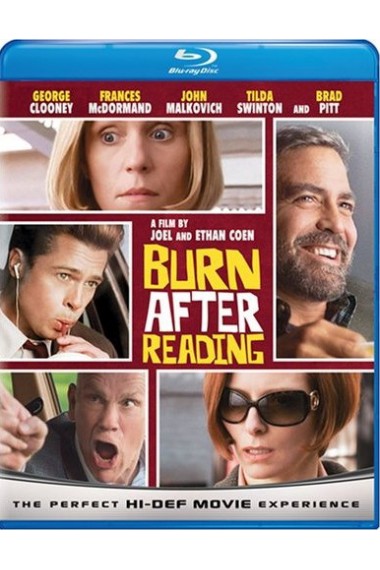
Burn After Reading, for example, is “a sobering tale of what happens when we don’t follow God’s laws,” a story that follows in the tradition of King David, King Saul and Judas Iscariot. Even less convincing: “The title of the film could be accurately interpreted as a description of what humankind has done with God’s Word.” In The Hudsucker Proxy, Falsani writes, the deus ex machina that stops Norville Barnes (Tim Robbins) from falling to his death is “the unseen hand of God (granting) Barnes an undeserved second chance.”
Other interpretations seem too pat, and not particularly theological. Falsani calls The Man Who Wasn’t There, for example, a cautionary tale about “living your life” without merely being a spectator; Intolerable Cruelty teaches that “marriage is sacred; and love, even a deeply imperfect love, is good.”
Another issue is the structure she uses. Each chapter, dedicated to one film, is compartmentalized into subheadings titled “The Forest” (a brief description of the narrative); “The Trees” (a painstakingly detailed reconstruction of the film’s plot); and “The Moral of the Story” (an all-too-brief description of the spiritual truth or lesson Falsani derives from the film).
Falsani spends too much time painting a verbal portrait of “the trees.” Many readers are likely to get lost in the descriptive intricacies of, say, Miller’s Crossing or Barton Fink. It’s not because Falsani’s writing isn’t entertaining and engaging, but because many of these passages have the effect of dulling the films’ power instead of enhancing it. It’s awfully hard for any author to convey a film’s spirituality solely by describing the plot, without sufficiently examining the filmmakers’ use of music, cinematography, lighting and other cinematic tools.
(On a related note, since Falsani focuses exclusively on narrative, it seems inconsistent to include The Ladykillers and No Country for Old Men, since the Coens adapted both screenplays from other authors’ source material. No Country for Old Men is arguably the most spiritually significant of the brothers’ films, barring A Serious Man; but the central theme of theodicy – if God exists and is good, why does evil persist in the world? – is the creation of the novel’s author, Cormac McCarthy, not the Coens.)
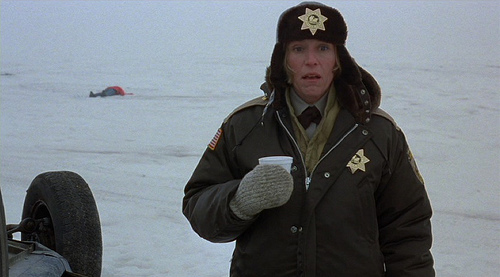
Fargo’s Marge Gunderson
Where Falsani succeeds most is where she steps out of the confines of the book’s structure and addresses specific theological precepts. In her chapter on Fargo – one of her most convincing – she references H. Richard Niebuhr’s five paradigms for how faith functions in the world. Marge Gunderson, the pregnant sheriff played by Frances McDormand, represents Niebuhr’s paradigm of “Christ transforming culture,” Falsani posits. In other words, Marge is the personification of the idea that “Christianity has the power (and the responsibility) to convert culture to a more godly orientation and that it’s possible to make the world a better place in this lifetime and not just in the hereafter.”
She comes back to this, quite convincingly, in her chapter on The Ladykillers (perhaps the most critically hated of the Coens’ films, and the first that was based on material by another author). Ms. Munson (Irma P. Hall), a pious church lady and would-be victim of a group of imbecilic villains (is there any other kind of villain in the “Coeniverse”?), “clearly demonstrates Niebuhr’s ‘Christ against culture’ model, seeing the world as a corrupt and dying place full of treachery and backsliding, hanging by a gossamer thread over the fiery pit ….” It’s a powerful and well-articulated observation.

One of God’s own angels in disguise.
Equally strong is Falsani’s chapter on The Big Lebowski. She opens with the Genesis telling of the destruction of Sodom and Gomorrah, which, Falsani explains, gave rise to the kabbalistic lore of the lamed-vavniks – 36 righteous people believed to exist at any given time in history. Jeffrey “The Dude” Lebowski (played by Jeff Bridges), she theorizes, is one of God’s own angels in disguise, one of the “righteous souls with whom the eventual healing of the world abides.”
Falsani also has a knack for salting various facts into the narrative that illuminate her views. In her chapter on Barton Fink, for example, she relates her experiences with Buddhist meditation and the effect it had on “a sometimes churchgoing Catholic-turned-Baptist-turned-freelance Episcopalian.” The experience helps her to conclude that Barton Fink is a reflection of Zen Buddhism’s belief that reality can be known, but only if one is “wide awake.”
Likewise, she theorizes that Frances McDormand’s personal background as the daughter of a Disciples of Christ minister informed the actress’s Oscar-winning performance as the Christ surrogate Marge Gunderson in Fargo.
Fans of the Coens know the brothers are famously cagey about their themes and intentions. Falsani includes an anecdote from actor Gabriel Byrne, who played gangster Tom Reagan in Miller’s Crossing. Byrne says he once asked Joel Coen if Tom’s hat, which repeatedly blows off his head in the film, is significant. “Mmmm hmmm,” Joel answered, without elaboration.
Those inclined to believe the hat represents some unseen spiritual longing are likely to relate closely to Falsani’s interpretation of the “Coeniverse.” Others, more skeptical, might recall the closing scene in Burn After Reading, where, after a disparate collection of idiots kills, maims and psychologically scars one another, CIA director Gardner Chubb (J.K. Simmons) asks an underling what they’ve learned from all the mayhem and death. “I don’t know, sir,” says the agent. “I don’t f—ing know, either,” Chubb says. “I guess we learned not to do it again…. Although I’m f—ed if I know what we did.”
Detractors of the Coens believe the brothers are pulling a big, snarky joke on us all; that their films poke merciless fun at the human belief that all this life and love and sin matters in the least. Falsani clearly is in a different camp, and her love of the Coens’ material – and of cinema in general – is laudable, even contagious. She didn’t convince me the brothers intend their films to be spiritual road maps, but then, that wasn’t her point. It only matters what she, you or I see when we watch, wide awake.
Mark DiPietro, a former newspaper editor, is a public relations executive and freelance writer.
Previous Post

September 21, 2009
TIFF 2009 Summary: Chalk
Next Post
November 1, 2009 Johnny Guitar (Ray, 1954)
Browse Our Archives
Select a Category 10 Years Later 1999 Top 5 2007 Top 10 2008 Favorite Discoveries 2008 Top 10 2009 Favorite Discoveries 2009 Top 10 2010 Favorite Discoveries 2010 Top 10 2011 Top 10 2012 Top Ten 2013 Top Ten 2014 Top Ten Best Picture Winners Christian Spotlight on Entertainment Christianity Today Coming Soon Disclosure Disclosure--AS Disclosure--Book Disclosure--DVDS Disclosure--SEOL Disclosure--Travel Dissenting Opinion Elsewhere Emergenetics Essays Featured Film Fest DC--2014 Film Festivals Full Frame Documentary Film Festival 2010 Full Frame Documentary Film Festival 2011 Full Frame Documentary Film Festival 2012 Full Frame Documentary Film Festival 2013 Full Frame Documentary Film Festival 2014 Headline Interviews Laura on the Oscar Winners Podcasts Quick Impressions Reviews RiverRun Film Festival 2014 Television The Criterion Collection The Thin Place To Stream or Not to Stream? Top 10s and Other Lists Toronto International Film Festival 2009 Toronto International Film Festival 2010 Toronto International Film Festival 2011 Toronto International Film Festival 2012 Toronto International Film Festival 2013 Toronto International Film Festival 2014 Uncategorized Video Virginia Film Festival 2011 Virginia Film Festival 2013 Women's Film Festival 2012
Select a Month February 2016 January 2016 December 2015 November 2015 October 2015 September 2015 August 2015 July 2015 June 2015 May 2015 April 2015 March 2015 February 2015 January 2015 December 2014 November 2014 October 2014 September 2014 August 2014 July 2014 June 2014 May 2014 April 2014 March 2014 February 2014 January 2014 December 2013 November 2013 October 2013 September 2013 August 2013 July 2013 June 2013 May 2013 April 2013 March 2013 February 2013 January 2013 December 2012 November 2012 October 2012 September 2012 August 2012 July 2012 June 2012 May 2012 April 2012 March 2012 February 2012 January 2012 December 2011 November 2011 October 2011 September 2011 August 2011 July 2011 June 2011 May 2011 April 2011 March 2011 February 2011 January 2011 December 2010 November 2010 October 2010 September 2010 August 2010 July 2010 June 2010 May 2010 April 2010 March 2010 February 2010 January 2010 December 2009 November 2009 September 2009 August 2009 July 2009 June 2009 May 2009 April 2009
Follow Us!
TAKE THE
Religious Wisdom Quiz
What is the main lesson of the Parable of the Rich Fool?
Select your answer to see how you score.
Laziness is bad Life does not consist in possessions Money solves problems Eat, drink and be merry
Related posts from 1More Film Blog



A Serious Man (Coen & Coen, 2009)

TRENDING AT PATHEOS Religious Music & Entertainment

"Les Diabolique" and Transgression
Alongside something like Arrival, Vertigo, or Charade, Les Diaboliques is a...

"The Plague Dogs" and Mortality
So, flashback to the late 70s, early 80s. Walt Disney Studios is...

With the recent and highly successful release of Christopher Nolan’s epic film,...

"L'avventura" and Human Weakness
Today's piece is going to be a little different for a few...

I first want to apologize for not posting or writing anything. I'm...

I've engaged in the multi-year project of reading through the Church Fathers,...
view all Religious Music & Entertainment blogs
Ad-Free & Subscriber Log-In Subscription Support
- About Us
- 2026 Calendar
- Videos
- Podcasts
- Library of World Religions
- Faith In Media Tracker
- Advertise With Us
- Write for Us
- Privacy Policy
- Terms of Service
- Do Not Sell My Data
- Contact Us
- Radiant Digital
- Manage Newsletter Subscriptions
- Unsubscribe From Notifications
- Sitemap
Copyright 2008-2026, Patheos. All rights reserved.
Subscription Support Ad-Free & Subscriber Log-In
Follow Patheos