
BuddhistCatholicContemplativeEvangelicalGeneral ChristianHinduJewishLatter-day SaintMuslimNew VisionsProgressive Christian
Beliefs
- Buddhist
- Catholic
- Contemplative
- Evangelical
- General Christian
- Hindu
- Jewish
- Latter-day Saint
- More Voices
- Muslim
- New Visions
- Pagan
- Progressive Christian
Topics
- Religion News
- Food and Religion
- Sports and Religion
- Religious Art
- Religious Music and Entertainment
- Religious Events
- History and Religion
- Style and Religion
- Politics and Religion
- Women in Religion
- Recreation Outdoors and Religion
- Business Finance and Religion
- Careers Workplace and Religion
- Education and Religion
- Family Parenting and Religion
- Health Fitness and Religion
- Home and Religion
- Relationships and Religion
- Technology and Religion
- Travel and Religion
Columnists
- Buddhist Columnists
- Business Finance and Religion Columnists
- Careers Workplace and Religion Columnists
- Catholic Columnists
- Contemplative Columnists
- Education and Religion Columnists
- Evangelists Columnists
- Family Parenting and Religion Columnists
- General Christian Columnists
- Health Fitness and Religion Columnists
- Hindu Columnists
- History and Religion Columnists
- Home and Religion Columnists
- Jewish Columnists
- More Voices Columnists
- Latter Day Columnists
- Muslim Columnists
- New Visions Columnists
- Nonreligious Columnists
- Pagan Columnists
- Politics and Religion Columnists
- Progressive Columnists
- Recreation Outdoors and Religion Columnists
- Relationships and Religion Columnists
- Religion News Columnists
- Religious Art Columnists
- Religious Events Columnists
- Religious Music and Entertainment Columnists
- Sports and Religion Columnists
- Style and Religion Columnists
- Technology and Religion Columnists
- Travel and Religion Columnists
- Women in Religion Columnists
Resource Library
- 2026 Calendar
- Library of World Religions
- The 100 Most Holy Places on Earth
- Patheos Answers
- Podcasts
- Videos
- Faith Leaders Database
- Anglican Episcopalian
- Bahai
- Baptist
- Buddhism
- Christianity
- Confucianism
- Eastern Orthodoxy
- Hinduism
- Holiness and Pentecostal
- ISKCON
- Islam
- Judaism
- Lutheran
- Methodist
- The Church of Jesus Christ of Latter-day Saints
- New Age
- Paganism
- Presbytarian and Reformed
- Protestantism
- Religion Behind the Scenes
- Roman Catholic
- Scientology
- Shia Islam
- Sikhism
- Sufism
- Sunni Islam
- Taoism
- Zen
- See all religions
Research Tools
 Ad-Free & Subscriber Log-In Subscription Support
Ad-Free & Subscriber Log-In Subscription Support
Follow Patheos 

- Trending:
- Forgiveness
- |
- Marriage
- |
- Consciousness
- |
- Death Penalty
- |
- Election
- |
- Halloween
 1More Film Blog
- Home
- Religious Music & Entertainment
- The Criterion Collection: Don’t Look Now
The Criterion Collection: Don’t Look Now
Last updated on: July 14, 2015 at 3:29 pm by Evan Cogswell
The Criterion Collection: Don’t Look Now 2015-07-14T15:29:46-05:00 Evan Cogswell
Patheos Explore the world's faith through different perspectives on religion and spirituality! Patheos has the views of the prevalent religions and spiritualities of the world.
Ken’s Note: As most cinephiles could tell you, July is one of the month that The Criterion Collection offers its semi-annual 50% off sale. Given the label’s array of titles, taking advantage of that sale can be daunting. I’ve asked friends and colleagues to make write up one of their favorite or newly acquired Criterion discs. First up is Evan Cogswell:
—
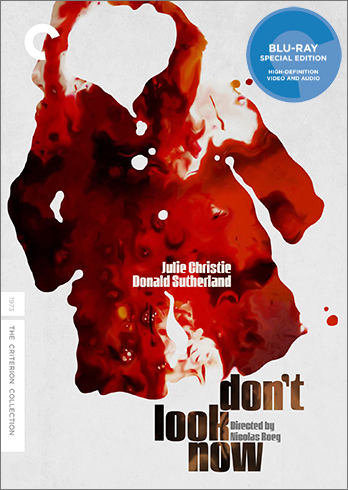 Don’t Look Now (★★★★½) is one of the rarest types of films. Not only is it an unnerving thriller saturated with supernatural themes concerning grief, deceptive appearances, ESP, and acceptance of death, but it is also one of the few films to improve on its excellent source material, the 1971 short story of the same title by Daphne du Maurier.
The film is a pretty faithful, if slightly fleshed out, adaptation of du Maurier’s short story about a British couple staying in Venice after the death of their young daughter, Christine (Sharon Williams). While there, the wife Laura (Julie Christie) befriends two sisters (Hilary Mason and Clelia Matania), the first of whom is blind and claims to have second sight. She informs Laura that Christine is with them and warns them to leave Venice, much to the skepticism of Laura’s husband, John (Donald Sutherland). Both the film and the story are infused with an aura of dread and mystery, but the film heightens that aura through its masterful use of color schemes, cinematography, and editing.
In the new Criterion release from this past February, Nicolas Roeg’s 1973 horror film looks absolutely gorgeous. The Blu-ray transfer highlights Roeg’s decision to use almost no red at all in the sets and costumes, other than the little girl’s raincoats worn by Christine when she drowns and by the child John chases through the streets of Venice. According to a critical essay by David Thompson included with the Criterion release, the use of red was Roeg’s idea. However, it was so effective that in a 1987 republishing of the short story with watercolor illustrations by Michael Foreman, the red raincoat was reused.
The opening shots of the film bring the tragedy and horror to the center. The camera zooms in on rain falling on a pond, drawing the viewer’s attention to the water which will drown Christine and the water which will surround John and Laura in Venice as they cope with Christine’s death. Following the close-up of the pond, the film dissolves to the darkened interior of a church, suggesting the air of supernatural mystery which haunts John and Laura. The next scene develops Roeg’s use of red. As John examines a photo of a church with a girl in a red coat sitting in a pew, he spills a glass of water on it, and a close-up of the photo reveals the red ink bleeding over the photo. Simultaneously, Christine falls into a pond and drowns, clearly connecting the color red to danger.
The brilliant editing by Graeme Clifford brings all the themes together in an eerie atmospheric film. The juxtaposition of certain images and the cross cutting between scenes weave parallels throughout the film that are not found in the more linear written presentation of the story. Clifford and Roeg’s choice to alternate the shots of young Christine happily running in a bright red raincoat before she drowns with the shots of John chasing the child in a bright red raincoat by the Venetian canals adds unity to the film, gives credence to the supernatural visions of the blind sister, and makes the final reveal all the more tragic and shocking. Additionally, the chronological jumping adds a sense of uncertainty to the film, making the sense of horror and tragedy more overwhelming.
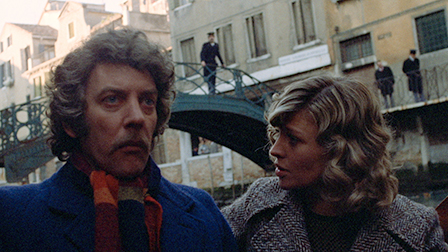
Donald Sutherland and Julie Christie in Don’t Look Now
As the British couple who have suffered the death of their daughter, Donald Sutherland and Julie Christie are very convincing in their portrayal of a couple deeply in love, yet suffering from grief. Those mixed emotions come to a climax in a frequently discussed scene in which John and Laura renew their marital union. Underscored by the same music which accompanied Christine’s carefree playing before her death, and intercut with shots of them getting dressed afterward, the portrayal is one of a couple deeply in love trying to normalize their lives after a tragedy. An interview with Roeg which is included on the Criterion blu-ray reveals that Daphne du Maurier, upon seeing the film, sent Roeg a letter complimenting him on the casting of Sutherland and Christie, specifically praising the way they portrayed the troubled couple in love that she created.
As part of the Criterion edition of Don’t Look Now, interviews with Roeg, Sutherland, Christie, editor Graeme Clifford, cinematographer Anthony Richmond, co-screenwriter Allan Scott, and composer Pino Donaggio are all included as bonus features, a couple of which have a red-hooded figure in the background as a reference to the film. A major focus of several interviews is Clifford’s editing, which he believes is the best of his career, and considering how his superb editing makes Don’t Look Now as good as it is, it is difficult to argue with that sentiment. Another topic of the interviews is Roeg’s interest in what he considers a major theme of the movie: nothing is what it seems.
That theme is highlighted by the carefully controlled editing by which Roeg and Clifford manipulate what the viewer sees and does not see, and it is even referenced by the title, which appears in quotes during the opening credits. John selectively looks at what he sees, unaware of anything beyond the ordinary. Sutherland reveals in his interview that he initially did not care for the ending of the film. What he possibly failed to realize was that his character is too caught up with remembering the past and not looking at what is before him.
The Criterion release of Don’t Look Now preserves the beauty of Roeg’s film, and the bonus features provide worthwhile insight into the process of adapting du Maurier’s short story. The detail that went into Roeg’s presentation of this supernatural, grief-ridden story is incredible, and knowing that detail makes the film even more rewarding.
—
Evan Cogswell blogs about film at Catholic Cinephile.
Previous Post

July 8, 2015
Pureflix Sets Release Date for God's Not Dead 2: He is Surely Alive
Next Post
July 13, 2015 Can't Stand Losing You: Surviving The Police (Grieve, 2012)
Browse Our Archives
Select a Category 10 Years Later 1999 Top 5 2007 Top 10 2008 Favorite Discoveries 2008 Top 10 2009 Favorite Discoveries 2009 Top 10 2010 Favorite Discoveries 2010 Top 10 2011 Top 10 2012 Top Ten 2013 Top Ten 2014 Top Ten Best Picture Winners Christian Spotlight on Entertainment Christianity Today Coming Soon Disclosure Disclosure--AS Disclosure--Book Disclosure--DVDS Disclosure--SEOL Disclosure--Travel Dissenting Opinion Elsewhere Emergenetics Essays Featured Film Fest DC--2014 Film Festivals Full Frame Documentary Film Festival 2010 Full Frame Documentary Film Festival 2011 Full Frame Documentary Film Festival 2012 Full Frame Documentary Film Festival 2013 Full Frame Documentary Film Festival 2014 Headline Interviews Laura on the Oscar Winners Podcasts Quick Impressions Reviews RiverRun Film Festival 2014 Television The Criterion Collection The Thin Place To Stream or Not to Stream? Top 10s and Other Lists Toronto International Film Festival 2009 Toronto International Film Festival 2010 Toronto International Film Festival 2011 Toronto International Film Festival 2012 Toronto International Film Festival 2013 Toronto International Film Festival 2014 Uncategorized Video Virginia Film Festival 2011 Virginia Film Festival 2013 Women's Film Festival 2012
Select a Month February 2016 January 2016 December 2015 November 2015 October 2015 September 2015 August 2015 July 2015 June 2015 May 2015 April 2015 March 2015 February 2015 January 2015 December 2014 November 2014 October 2014 September 2014 August 2014 July 2014 June 2014 May 2014 April 2014 March 2014 February 2014 January 2014 December 2013 November 2013 October 2013 September 2013 August 2013 July 2013 June 2013 May 2013 April 2013 March 2013 February 2013 January 2013 December 2012 November 2012 October 2012 September 2012 August 2012 July 2012 June 2012 May 2012 April 2012 March 2012 February 2012 January 2012 December 2011 November 2011 October 2011 September 2011 August 2011 July 2011 June 2011 May 2011 April 2011 March 2011 February 2011 January 2011 December 2010 November 2010 October 2010 September 2010 August 2010 July 2010 June 2010 May 2010 April 2010 March 2010 February 2010 January 2010 December 2009 November 2009 September 2009 August 2009 July 2009 June 2009 May 2009 April 2009
Follow Us!
TAKE THE
Religious Wisdom Quiz
True or False: Paul instructed Titus that the grace of God teaches us to say 'No' to ungodliness and worldly passions.
Select your answer to see how you score.
FALSE TRUE
Related posts from 1More Film Blog

An Inconvenient Truth (Guggenheim, 2006) -- 10 Years...

The Devil Wears Prada (Frankel, 2006) -- 10...

"Telling a Great Story" -- An Interview with...

Is Snow White Still Essential?
TRENDING AT PATHEOS Religious Music & Entertainment

"Les Diabolique" and Transgression
Alongside something like Arrival, Vertigo, or Charade, Les Diaboliques is a...

"The Plague Dogs" and Mortality
So, flashback to the late 70s, early 80s. Walt Disney Studios is...

With the recent and highly successful release of Christopher Nolan’s epic film,...

"L'avventura" and Human Weakness
Today's piece is going to be a little different for a few...

I first want to apologize for not posting or writing anything. I'm...

I've engaged in the multi-year project of reading through the Church Fathers,...
view all Religious Music & Entertainment blogs
Ad-Free & Subscriber Log-In Subscription Support
- About Us
- 2026 Calendar
- Videos
- Podcasts
- Library of World Religions
- Faith In Media Tracker
- Advertise With Us
- Write for Us
- Privacy Policy
- Terms of Service
- Do Not Sell My Data
- Contact Us
- Radiant Digital
- Manage Newsletter Subscriptions
- Unsubscribe From Notifications
- Sitemap
Copyright 2008-2026, Patheos. All rights reserved.
Subscription Support Ad-Free & Subscriber Log-In
Follow Patheos