
BuddhistCatholicContemplativeEvangelicalGeneral ChristianHinduJewishLatter-day SaintMuslimNew VisionsProgressive Christian
Beliefs
- Buddhist
- Catholic
- Contemplative
- Evangelical
- General Christian
- Hindu
- Jewish
- Latter-day Saint
- More Voices
- Muslim
- New Visions
- Pagan
- Progressive Christian
Topics
- Religion News
- Food and Religion
- Sports and Religion
- Religious Art
- Religious Music and Entertainment
- Religious Events
- History and Religion
- Style and Religion
- Politics and Religion
- Women in Religion
- Recreation Outdoors and Religion
- Business Finance and Religion
- Careers Workplace and Religion
- Education and Religion
- Family Parenting and Religion
- Health Fitness and Religion
- Home and Religion
- Relationships and Religion
- Technology and Religion
- Travel and Religion
Columnists
- Buddhist Columnists
- Business Finance and Religion Columnists
- Careers Workplace and Religion Columnists
- Catholic Columnists
- Contemplative Columnists
- Education and Religion Columnists
- Evangelists Columnists
- Family Parenting and Religion Columnists
- General Christian Columnists
- Health Fitness and Religion Columnists
- Hindu Columnists
- History and Religion Columnists
- Home and Religion Columnists
- Jewish Columnists
- More Voices Columnists
- Latter Day Columnists
- Muslim Columnists
- New Visions Columnists
- Nonreligious Columnists
- Pagan Columnists
- Politics and Religion Columnists
- Progressive Columnists
- Recreation Outdoors and Religion Columnists
- Relationships and Religion Columnists
- Religion News Columnists
- Religious Art Columnists
- Religious Events Columnists
- Religious Music and Entertainment Columnists
- Sports and Religion Columnists
- Style and Religion Columnists
- Technology and Religion Columnists
- Travel and Religion Columnists
- Women in Religion Columnists
Resource Library
- 2026 Calendar
- Library of World Religions
- The 100 Most Holy Places on Earth
- Patheos Answers
- Podcasts
- Videos
- Faith Leaders Database
- Anglican Episcopalian
- Bahai
- Baptist
- Buddhism
- Christianity
- Confucianism
- Eastern Orthodoxy
- Hinduism
- Holiness and Pentecostal
- ISKCON
- Islam
- Judaism
- Lutheran
- Methodist
- The Church of Jesus Christ of Latter-day Saints
- New Age
- Paganism
- Presbytarian and Reformed
- Protestantism
- Religion Behind the Scenes
- Roman Catholic
- Scientology
- Shia Islam
- Sikhism
- Sufism
- Sunni Islam
- Taoism
- Zen
- See all religions
Research Tools
 Ad-Free & Subscriber Log-In Subscription Support
Ad-Free & Subscriber Log-In Subscription Support
Follow Patheos 

- Trending:
- Forgiveness
- |
- Marriage
- |
- Consciousness
- |
- Death Penalty
- |
- Election
- |
- Halloween
 1More Film Blog
- Home
- Religious Music & Entertainment
- The Armstrong Lie (Gibney, 2013)
The Armstrong Lie (Gibney, 2013)
Last updated on: September 29, 2014 at 4:56 pm by Claudia Mundy
The Armstrong Lie (Gibney, 2013) 2014-09-29T16:56:19-05:00 Claudia Mundy
Patheos Explore the world's faith through different perspectives on religion and spirituality! Patheos has the views of the prevalent religions and spiritualities of the world.
Allow me to present to you a hypothetical situation.
A person–doesn’t have to be a friend of yours necessarily, just someone you know or have heard of–is diagnosed with cancer. This person decides not to undergo any type of chemotherapy treatment or ingest any available medicines—because he equates treatment to “cheating.” Would you not think this an asinine response?
What he sees as cheating death, you see as cheating life. What he sees as giving him an unfair advantage over other cancer patients, you see doing everything he can to succeed. What he sees as having negative secondary effects, you see as ignoring the primary reason he is in the hospital.
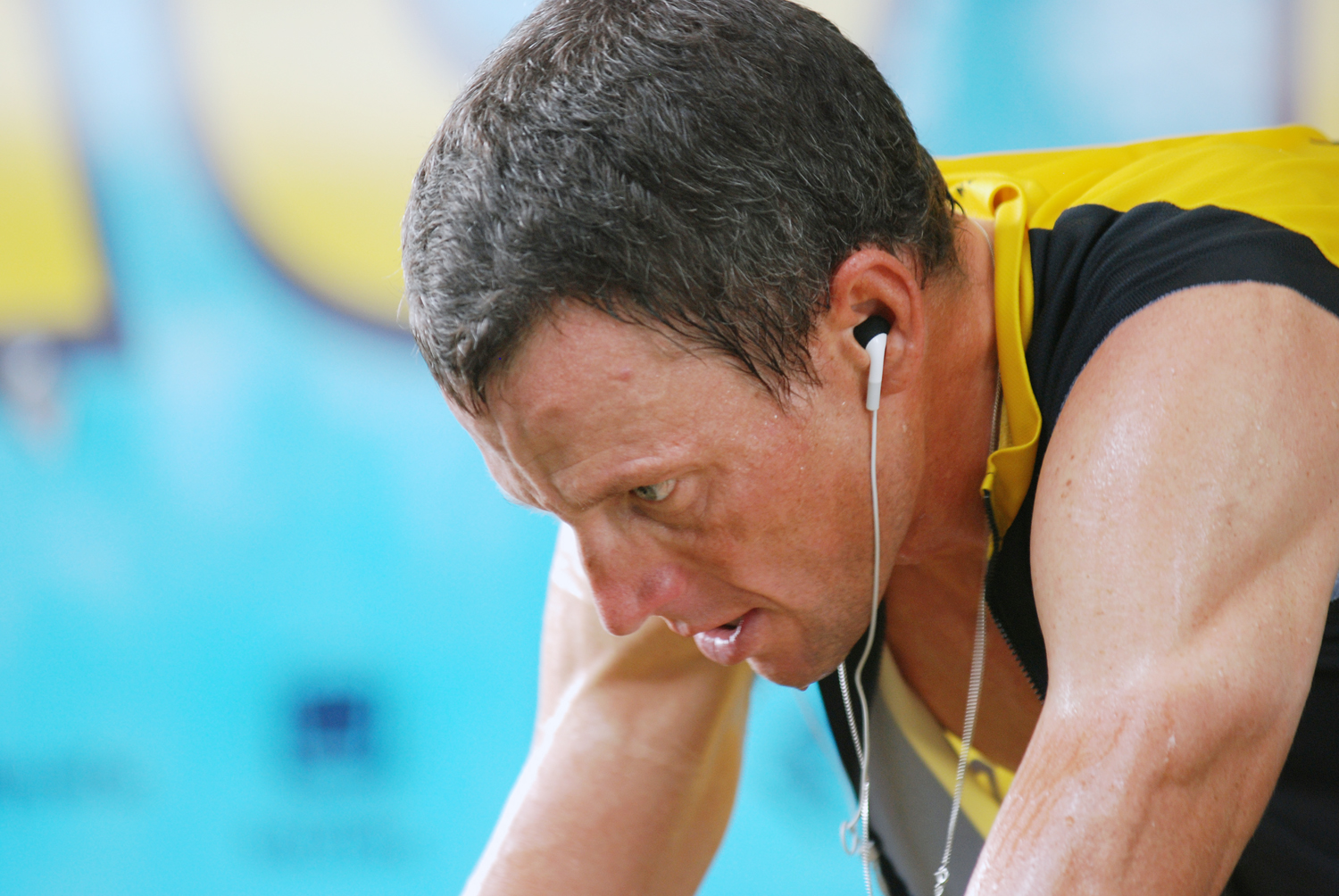
And that’s the real argument I see being made in Alex Gibney’s documentary The Armstrong Lie.
Gibney, playing the part of narrator, tells the audience that the documentary had been in gestation for a long time. He admits that he, a long-time Armstrong fan, originally wanted the movie to document Lance’s return to cycling in 2009, after having spent four years in retirement. But allegations of doping, which had existed since Lance peaked in the cycling scene, reached a high point at this time, and they forced Gibney to alsmot abandon his documentary.
In this way the narration plays a key role in the audience perception of the documentary as Gibney walks the fine line between providing an in-depth, mature account of the facts and faces of the case and acting like a self-proclaimed Armstrong fan-boy.
Yet, with all the negative hype and attention brought to the Sestina Affair, I can’t seem to blame Lance Armstrong. Here are a couple of reasons the documentary presents which explain why:
- I wasn’t aware of this before the film, but blood-doping was an issue before Lance even put himself on the line at the Tour de France. In fact, the Tour de France’s commissioning body was looking for something, or someone, to help the public regain faith in the tour after the 1998 Tour ended with a number of the top riders testing positive for performance-enhancing drugs.
- Lance took the brunt of the blame but was hardly the only one doping. Those not really knowledgeable about the sport of professional cycling, which I am not, though the movie does supplement nicely, may not be aware that at least 58 professional cyclists were either indicted on charges of or banned from professional sports governed by USADA and/or WADA for using illegal/banned/performance-enhancing supplements.
- Lance was going to win—one way or another. He was just made that way. His prowess and drive were evident from the beginning of his athletic career. He wanted to win, and entered into competition with this goal, and this goal alone. It logically follows then that if it took blood-doping to win, he was going to do it.
Here then I invoke my initial hypothetical. Lance’s fight with cancer shaped his outlook on life. His battle with testicular cancer wasn’t one in which “losing” in the conventional athletic sense was an option. To lose would mean to die.
So for Lance, simply winning the battle wouldn’t be enough. He sought out the most cutting edge treatments for testicular cancer—a type of chemo-therapy treatment that would treat him, but not do so at the expense of scarring his lungs, allowing him to return to cycling after the ordeal. He did not want simply to live, but to live well.
He went on to apply this ideology to his racing—why simply race when you can race well? It would not be enough to simply engage in the battle, he would have to win the war. And so, just as he sought out the best medical doctors in ontology, he would also seek out the best doctors in physiology—Dr. Mikele Ferari.
I can’t seem to blame Lance Armstrong, as it didn’t seem like he had a choice. As he put it, how can it be considered “cheating” when the word “cheating” means to have an unfair advantage over the rest of the field? If the top 58 cyclists are all taking testosterone and cortisone then, weren’t they all, in a way, leveling their own playing field? I’m not saying that moral relativism is ever a legitimate argument for the normative fallacy, (which is to say that just because it’s happening doesn’t mean you can say because it is happening it ought to happen), but I am saying that I can’t blame Lance Armstrong. It would have been athletic suicide to go into a race against the best and deny the scientific advancements available to you.
I feel like I am echoing Lil Wayne, who when asked about legalizing steroids in professional baseball said, in a nut-shell, “I don’t care—let them all hit home-runs.”
—
Claudia Mundy is a senior English major at Campbell University and a writing intern for 1More Film Blog.
Previous Post

November 21, 2013
It's Better to Jump (Angelone, 2013)
Next Post

November 25, 2013 The Hunger Games: Catching Fire (Lawrence, 2013)
Browse Our Archives
Select a Category 10 Years Later 1999 Top 5 2007 Top 10 2008 Favorite Discoveries 2008 Top 10 2009 Favorite Discoveries 2009 Top 10 2010 Favorite Discoveries 2010 Top 10 2011 Top 10 2012 Top Ten 2013 Top Ten 2014 Top Ten Best Picture Winners Christian Spotlight on Entertainment Christianity Today Coming Soon Disclosure Disclosure--AS Disclosure--Book Disclosure--DVDS Disclosure--SEOL Disclosure--Travel Dissenting Opinion Elsewhere Emergenetics Essays Featured Film Fest DC--2014 Film Festivals Full Frame Documentary Film Festival 2010 Full Frame Documentary Film Festival 2011 Full Frame Documentary Film Festival 2012 Full Frame Documentary Film Festival 2013 Full Frame Documentary Film Festival 2014 Headline Interviews Laura on the Oscar Winners Podcasts Quick Impressions Reviews RiverRun Film Festival 2014 Television The Criterion Collection The Thin Place To Stream or Not to Stream? Top 10s and Other Lists Toronto International Film Festival 2009 Toronto International Film Festival 2010 Toronto International Film Festival 2011 Toronto International Film Festival 2012 Toronto International Film Festival 2013 Toronto International Film Festival 2014 Uncategorized Video Virginia Film Festival 2011 Virginia Film Festival 2013 Women's Film Festival 2012
Select a Month February 2016 January 2016 December 2015 November 2015 October 2015 September 2015 August 2015 July 2015 June 2015 May 2015 April 2015 March 2015 February 2015 January 2015 December 2014 November 2014 October 2014 September 2014 August 2014 July 2014 June 2014 May 2014 April 2014 March 2014 February 2014 January 2014 December 2013 November 2013 October 2013 September 2013 August 2013 July 2013 June 2013 May 2013 April 2013 March 2013 February 2013 January 2013 December 2012 November 2012 October 2012 September 2012 August 2012 July 2012 June 2012 May 2012 April 2012 March 2012 February 2012 January 2012 December 2011 November 2011 October 2011 September 2011 August 2011 July 2011 June 2011 May 2011 April 2011 March 2011 February 2011 January 2011 December 2010 November 2010 October 2010 September 2010 August 2010 July 2010 June 2010 May 2010 April 2010 March 2010 February 2010 January 2010 December 2009 November 2009 September 2009 August 2009 July 2009 June 2009 May 2009 April 2009
Follow Us!
TAKE THE
Religious Wisdom Quiz
What is the Bible's teaching on contentment?
Select your answer to see how you score.
Be content with what you have Always want more Never rest Complain
Related posts from 1More Film Blog

An Inconvenient Truth (Guggenheim, 2006) -- 10 Years...

The Devil Wears Prada (Frankel, 2006) -- 10...

"Telling a Great Story" -- An Interview with...

Is Snow White Still Essential?
TRENDING AT PATHEOS Religious Music & Entertainment

"Les Diabolique" and Transgression
Alongside something like Arrival, Vertigo, or Charade, Les Diaboliques is a...

"The Plague Dogs" and Mortality
So, flashback to the late 70s, early 80s. Walt Disney Studios is...

With the recent and highly successful release of Christopher Nolan’s epic film,...

"L'avventura" and Human Weakness
Today's piece is going to be a little different for a few...

I first want to apologize for not posting or writing anything. I'm...

I've engaged in the multi-year project of reading through the Church Fathers,...
view all Religious Music & Entertainment blogs
Ad-Free & Subscriber Log-In Subscription Support
- About Us
- 2026 Calendar
- Videos
- Podcasts
- Library of World Religions
- Faith In Media Tracker
- Advertise With Us
- Write for Us
- Privacy Policy
- Terms of Service
- Do Not Sell My Data
- Contact Us
- Radiant Digital
- Manage Newsletter Subscriptions
- Unsubscribe From Notifications
- Sitemap
Copyright 2008-2026, Patheos. All rights reserved.
Subscription Support Ad-Free & Subscriber Log-In
Follow Patheos