
BuddhistCatholicContemplativeEvangelicalGeneral ChristianHinduJewishLatter-day SaintMuslimNew VisionsProgressive Christian
Beliefs
- Buddhist
- Catholic
- Contemplative
- Evangelical
- General Christian
- Hindu
- Jewish
- Latter-day Saint
- More Voices
- Muslim
- New Visions
- Pagan
- Progressive Christian
Topics
- Religion News
- Food and Religion
- Sports and Religion
- Religious Art
- Religious Music and Entertainment
- Religious Events
- History and Religion
- Style and Religion
- Politics and Religion
- Women in Religion
- Recreation Outdoors and Religion
- Business Finance and Religion
- Careers Workplace and Religion
- Education and Religion
- Family Parenting and Religion
- Health Fitness and Religion
- Home and Religion
- Relationships and Religion
- Technology and Religion
- Travel and Religion
Columnists
- Buddhist Columnists
- Business Finance and Religion Columnists
- Careers Workplace and Religion Columnists
- Catholic Columnists
- Contemplative Columnists
- Education and Religion Columnists
- Evangelists Columnists
- Family Parenting and Religion Columnists
- General Christian Columnists
- Health Fitness and Religion Columnists
- Hindu Columnists
- History and Religion Columnists
- Home and Religion Columnists
- Jewish Columnists
- More Voices Columnists
- Latter Day Columnists
- Muslim Columnists
- New Visions Columnists
- Nonreligious Columnists
- Pagan Columnists
- Politics and Religion Columnists
- Progressive Columnists
- Recreation Outdoors and Religion Columnists
- Relationships and Religion Columnists
- Religion News Columnists
- Religious Art Columnists
- Religious Events Columnists
- Religious Music and Entertainment Columnists
- Sports and Religion Columnists
- Style and Religion Columnists
- Technology and Religion Columnists
- Travel and Religion Columnists
- Women in Religion Columnists
Resource Library
- 2026 Calendar
- Library of World Religions
- The 100 Most Holy Places on Earth
- Patheos Answers
- Podcasts
- Videos
- Faith Leaders Database
- Anglican Episcopalian
- Bahai
- Baptist
- Buddhism
- Christianity
- Confucianism
- Eastern Orthodoxy
- Hinduism
- Holiness and Pentecostal
- ISKCON
- Islam
- Judaism
- Lutheran
- Methodist
- The Church of Jesus Christ of Latter-day Saints
- New Age
- Paganism
- Presbytarian and Reformed
- Protestantism
- Religion Behind the Scenes
- Roman Catholic
- Scientology
- Shia Islam
- Sikhism
- Sufism
- Sunni Islam
- Taoism
- Zen
- See all religions
Research Tools
 Ad-Free & Subscriber Log-In Subscription Support
Ad-Free & Subscriber Log-In Subscription Support
Follow Patheos 

- Trending:
- Forgiveness
- |
- Marriage
- |
- Consciousness
- |
- Death Penalty
- |
- Election
- |
- Halloween
 1More Film Blog
- Home
- Religious Music & Entertainment
- Persepolis (Paronnaud, 2007)
Persepolis (Paronnaud, 2007)
Last updated on: July 26, 2014 at 2:13 pm by Kenneth R. Morefield
Persepolis (Paronnaud, 2007) 2014-07-26T14:13:04-05:00 Kenneth R. Morefield
Patheos Explore the world's faith through different perspectives on religion and spirituality! Patheos has the views of the prevalent religions and spiritualities of the world.
A lot of films can break your heart–a precious few can enlarge and renovate it.
A lot of films can break your heart–a precious few can enlarge and renovate it.
Vincent Paronnaud’s and Marjane Satrapi’s animated film of the latter’s graphic novel is one of those precious few. It invites comparison to great, iconic works of art—The Adventures of Huckleberry Finn, Portrait of the Artist as a Young Man, Pan’s Labyrinth, and Maus were all associations I made during the screening–but in the end, Persepolis retains a distinctive voice that allows it to take its place amidst those masterpieces rather than simply reference them as part of its thematic genealogy.
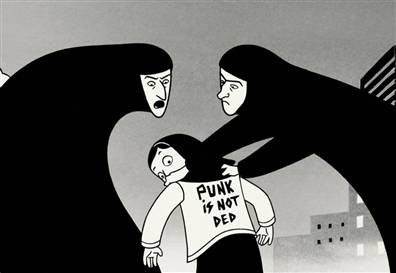
Animated in a simple yet rich style that adds sound and movement to the artwork of the graphic novel while retaining its flavor, Persopolistells the story of twenty plus years in the country of Iran (and some of the history that informs it) as mediated through the personal experiences and witness of the eponymous child, Marjane. The film opens on the eve of the Islamic revolution of that country and ends with the adult Marjane leaving her homeland for the second time. In between we see the history of a culture, but we see it not just as events that surround the protagonist or provide a backdrop for her story. The personal narrative and the cultural narrative are so deeply entwined as to be inextricable, and it is through their union rather than through either strand that we best see the horrible costs of war, violence, and oppression on a personal as well as political scale.
 If all this makes the film sound preachy or forced, it’s not. Marjane is no Victory Henry (from The Winds of War) or Forrest Gump; she is not merely a device that the story uses to let the viewer witness the spectacles that make up world history. The film, first and foremost, cares deeply about Marjane as a person, and, thus, so do we. It does not, however, idealize or idolize her. Satrapi is capable of conveying the innocence of childhood not only through its losses but also through its confusion. One of the best, most honest moments is when one child envies another whose family member was imprisoned longer because that will lead to more prestige and attention for her. We see how easily children can adopt rhetoric they don’t understand but which they quickly learn how to exploit.
In another great scene, Marjane boasts to her indignant grandmother that she has falsely accused a man of making inappropriate remarks to her because she knew she could manipulate the prejudices of the police who might otherwise arrest her for her dress or makeup. When her grandmother explodes in anger at Marjane for adding to the sufferings of an innocent bystander, her rebuke stings more than a hundred insults offered by countless nameless men because Marjane knows this time the horrific name she is called is deserved. Ironically, though, the sum effect of this scene is to make us like Marjane the better because she can still learn and still feel shame. The anger and fear that led to her error are real, but unlike some she will not use them to blind or numb her conscience to her own responsibility to her neighbors.
Perhaps one reason why these last two examples resonated with me so deeply is because they illustrated practices that I’ve witnessed in repressive and unhealthy fundamentalist Christian environments. Although I’m not claiming the consequences are parallel, I have, for example, seen Christian students use professed scandal or offense at some work of art to try to escape or deflect unpleasant situations of their own not because they were genuinely offended but because they found it expedient to use an argument they knew the sources of power to which they were appealing would be sympathetic towards. If Persepolis has a moral ideology, it is that of personal integrity; the message is less about the abstract embrace or disavowal of a particular ideology so much it is a call for authenticity in human relationships, and this is an ideology that Christians can learn from every bit as much as non-Christians.

Marjane imagines speaking to God…
In that sense, like The War Within, I found Persepolisto be a very ecumenical film in its vision of humanity if not its theology. The adolescent Marjane has a hero in Bruce Lee and wants to be a great prophet. These childhood dreams inspire her actions and shape her questions. Like Lee, she becomes a fighter of great courage, elegance, and skill (though her fights are more spiritual than physical). Like other prophets, she becomes a questioner and seeker, often experiencing the deep loneliness and alienation, even from God (or at least the God of her limited conception) that is seen in the histories of figures such as Elijah or Jonah.
I remember reading once that trauma or some forms of addiction can arrest emotional development. If so, it is interesting to contemplate the fact that such a large percentage of the current population of Iran is under thirty and has grown up in a crucible of suffering, oppression, and fear. The God of Marjane’s dreams is a benign one who allows her to approach Him with her dreams and questions and, above all, her doubts. In one of her imaginative trips to clouds to see Him, Marjane also witnesses Karl Marx, who pops up on another cloud to urge her to “keep up the fight.” “Yes,” God echoes, somewhat wearily as Marjane takes leave, “keep up the fight.”

Marjane wants to be a prophet…or maybe Bruce Lee….
Of course, I like to think “the fight” means different things in both these speeches. From the former it perhaps connoted the political fight to adopt and implement the right ideology to rule men’s lives. For the later, I fancy it meant (especially, coming as it did in the midst of the character’s clinical depression and emotional alienation) the fight to have our own lives, to get up each morning, to face a threatening and soul-crushing world, to stare down despair, to live. I like that the God of Marjane’s dreams did not reject Marx’s rhetorical call for political action or social justice as inherently bad. He merely sounded weary of those who cared only for the masses and never for the individual. If He was on anyone’s side, He was on the side of the hurting, and there is something comforting in the contemplation of the fact that the prayers and hopes of those who live in worlds so very different from me may be the same as my own.
Persepolis is a film so rich, I have not even discussed how it conveys with poignancy the immigrant experience (V.S. Naipul’s “One of Many” was another work I was reminded of while screening the film), its observations about the soul’s thirst for art that will not be denied, or its deep, complex musings about family and marriage. It was encouraging to see at The Toronto International Film Festival that it was being distributed by Sony Pictures Classic. I can only hope that having a major studio behind the film will help it get the promotion as well as the distribution it so richly deserves.
My Grade: A
This review originally appeared at Looking Closer; all rights reserved.
Toronto International Film Festival
Previous Post

June 6, 2009
Land of the Pharoahs (Hawks, 1955)
Next Post

June 23, 2009 Charlie Chaplin: A King in New York
Browse Our Archives
Select a Category 10 Years Later 1999 Top 5 2007 Top 10 2008 Favorite Discoveries 2008 Top 10 2009 Favorite Discoveries 2009 Top 10 2010 Favorite Discoveries 2010 Top 10 2011 Top 10 2012 Top Ten 2013 Top Ten 2014 Top Ten Best Picture Winners Christian Spotlight on Entertainment Christianity Today Coming Soon Disclosure Disclosure--AS Disclosure--Book Disclosure--DVDS Disclosure--SEOL Disclosure--Travel Dissenting Opinion Elsewhere Emergenetics Essays Featured Film Fest DC--2014 Film Festivals Full Frame Documentary Film Festival 2010 Full Frame Documentary Film Festival 2011 Full Frame Documentary Film Festival 2012 Full Frame Documentary Film Festival 2013 Full Frame Documentary Film Festival 2014 Headline Interviews Laura on the Oscar Winners Podcasts Quick Impressions Reviews RiverRun Film Festival 2014 Television The Criterion Collection The Thin Place To Stream or Not to Stream? Top 10s and Other Lists Toronto International Film Festival 2009 Toronto International Film Festival 2010 Toronto International Film Festival 2011 Toronto International Film Festival 2012 Toronto International Film Festival 2013 Toronto International Film Festival 2014 Uncategorized Video Virginia Film Festival 2011 Virginia Film Festival 2013 Women's Film Festival 2012
Select a Month February 2016 January 2016 December 2015 November 2015 October 2015 September 2015 August 2015 July 2015 June 2015 May 2015 April 2015 March 2015 February 2015 January 2015 December 2014 November 2014 October 2014 September 2014 August 2014 July 2014 June 2014 May 2014 April 2014 March 2014 February 2014 January 2014 December 2013 November 2013 October 2013 September 2013 August 2013 July 2013 June 2013 May 2013 April 2013 March 2013 February 2013 January 2013 December 2012 November 2012 October 2012 September 2012 August 2012 July 2012 June 2012 May 2012 April 2012 March 2012 February 2012 January 2012 December 2011 November 2011 October 2011 September 2011 August 2011 July 2011 June 2011 May 2011 April 2011 March 2011 February 2011 January 2011 December 2010 November 2010 October 2010 September 2010 August 2010 July 2010 June 2010 May 2010 April 2010 March 2010 February 2010 January 2010 December 2009 November 2009 September 2009 August 2009 July 2009 June 2009 May 2009 April 2009
Follow Us!
TAKE THE
Religious Wisdom Quiz
What city was Job from?
Select your answer to see how you score.
Susa Edom Uz Shiloh
Related posts from 1More Film Blog

2015 Arts & Faith Ecumenical Jury Awards

Favorite 2015 Discoveries -- Evan Cogswell's List

Josh Wartel: My Year in Movies

TRENDING AT PATHEOS Religious Music & Entertainment

"Les Diabolique" and Transgression
Alongside something like Arrival, Vertigo, or Charade, Les Diaboliques is a...

"The Plague Dogs" and Mortality
So, flashback to the late 70s, early 80s. Walt Disney Studios is...

With the recent and highly successful release of Christopher Nolan’s epic film,...

"L'avventura" and Human Weakness
Today's piece is going to be a little different for a few...

I first want to apologize for not posting or writing anything. I'm...

I've engaged in the multi-year project of reading through the Church Fathers,...
view all Religious Music & Entertainment blogs
Ad-Free & Subscriber Log-In Subscription Support
- About Us
- 2026 Calendar
- Videos
- Podcasts
- Library of World Religions
- Faith In Media Tracker
- Advertise With Us
- Write for Us
- Privacy Policy
- Terms of Service
- Do Not Sell My Data
- Contact Us
- Radiant Digital
- Manage Newsletter Subscriptions
- Unsubscribe From Notifications
- Sitemap
Copyright 2008-2026, Patheos. All rights reserved.
Subscription Support Ad-Free & Subscriber Log-In
Follow Patheos