
BuddhistCatholicContemplativeEvangelicalGeneral ChristianHinduJewishLatter-day SaintMuslimNew VisionsProgressive Christian
Beliefs
- Buddhist
- Catholic
- Contemplative
- Evangelical
- General Christian
- Hindu
- Jewish
- Latter-day Saint
- More Voices
- Muslim
- New Visions
- Pagan
- Progressive Christian
Topics
- Religion News
- Food and Religion
- Sports and Religion
- Religious Art
- Religious Music and Entertainment
- Religious Events
- History and Religion
- Style and Religion
- Politics and Religion
- Women in Religion
- Recreation Outdoors and Religion
- Business Finance and Religion
- Careers Workplace and Religion
- Education and Religion
- Family Parenting and Religion
- Health Fitness and Religion
- Home and Religion
- Relationships and Religion
- Technology and Religion
- Travel and Religion
Columnists
- Buddhist Columnists
- Business Finance and Religion Columnists
- Careers Workplace and Religion Columnists
- Catholic Columnists
- Contemplative Columnists
- Education and Religion Columnists
- Evangelists Columnists
- Family Parenting and Religion Columnists
- General Christian Columnists
- Health Fitness and Religion Columnists
- Hindu Columnists
- History and Religion Columnists
- Home and Religion Columnists
- Jewish Columnists
- More Voices Columnists
- Latter Day Columnists
- Muslim Columnists
- New Visions Columnists
- Nonreligious Columnists
- Pagan Columnists
- Politics and Religion Columnists
- Progressive Columnists
- Recreation Outdoors and Religion Columnists
- Relationships and Religion Columnists
- Religion News Columnists
- Religious Art Columnists
- Religious Events Columnists
- Religious Music and Entertainment Columnists
- Sports and Religion Columnists
- Style and Religion Columnists
- Technology and Religion Columnists
- Travel and Religion Columnists
- Women in Religion Columnists
Resource Library
- 2026 Calendar
- Library of World Religions
- The 100 Most Holy Places on Earth
- Patheos Answers
- Podcasts
- Videos
- Faith Leaders Database
- Anglican Episcopalian
- Bahai
- Baptist
- Buddhism
- Christianity
- Confucianism
- Eastern Orthodoxy
- Hinduism
- Holiness and Pentecostal
- ISKCON
- Islam
- Judaism
- Lutheran
- Methodist
- The Church of Jesus Christ of Latter-day Saints
- New Age
- Paganism
- Presbytarian and Reformed
- Protestantism
- Religion Behind the Scenes
- Roman Catholic
- Scientology
- Shia Islam
- Sikhism
- Sufism
- Sunni Islam
- Taoism
- Zen
- See all religions
Research Tools
 Ad-Free & Subscriber Log-In Subscription Support
Ad-Free & Subscriber Log-In Subscription Support
Follow Patheos 

- Trending:
- Forgiveness
- |
- Marriage
- |
- Consciousness
- |
- Death Penalty
- |
- Election
- |
- Halloween
 1More Film Blog
- Home
- Religious Music & Entertainment
- Pain & Gain (Bay, 2013)
Pain & Gain (Bay, 2013)
Last updated on: July 26, 2014 at 2:11 pm by Kenneth R. Morefield
Pain & Gain (Bay, 2013) 2014-07-26T14:11:30-05:00 Kenneth R. Morefield
Patheos Explore the world's faith through different perspectives on religion and spirituality! Patheos has the views of the prevalent religions and spiritualities of the world.
“Is it just me, or is Michael Bay giving a deliberate middle finger to the Coen Brothers?”
That question, offered to my companion approximately 90% of the way through a screening of Pain & Gain, was admittedly partially–but only partially–performative critical snark, a sort of “aren’t I clever?” rhetorical observation meant more to help idle away the increasingly dragging minutes until the film limped to its conclusion than to offer a serious critical analysis.
And yet…
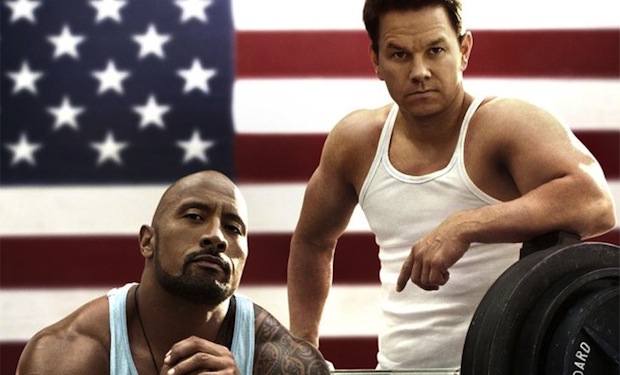
Being convinced (and it would take some convincing) that the answer to that question was “yes” is about the only way I could really enjoy Pain & Gain a potential-laden but ultimately tedious dark comedy whose ingestion is more painful than gainful. Mark Wahlberg, Dwayne Johnson, and Anthony Mackie play a trio of buffed up but none too bright fitness trainers who decide to kidnap and torture one of their clients, getting him to sign over his wealth to them.
There were three things that made me think of this comparison. The first was my own viewing experience which followed a Coen brothers picture pattern: thirty to forty minutes of moderate to mild pleasure at the weirdness of it all; another thirty to forty minutes of anxious restlessness, hoping the film would settle in and get about the business of being about whatever it was about; and, a concluding thirty to sixty minutes of growing restlessness and disappointment as I began to resign myself to the conclusion that it’s all style over substance and that I let my hopes get up again.
Too abstract? The more immediate catalyst for the comparison was the arrival of Ed Harris (Ed DuBois) in a Sheriff Bell-ish role as the retired symbol of law, order, and decency that is rapidly disappearing from the world occupied by our central characters. For my taste, Pain & Gain takes a little too much relish in its first act shenanigans to credibly retreat to a shaking-its-head-“what’s the world coming to?” conclusion, so I do actually think it important that Sheriff Bell opens as well as closes No Country For Old Men. The point-of-view hops around in Pain & Gain, jumping from narrative voice to narrative voice, and this is subtly but importantly different than the juxtaposition of first-person and third-person in Cormac McCarthy’s novel and the Coen’s film. The latter invite you to adopt Bell’s perspective from the get go, or at least announces up front that his perspective is more central to the narrative’s meaning than that of those to whom he is responding. In Bay’s film, it feels as though the switches are more haphazard, executed when the characters have lost their (initial) likability, and DuBois’s appearance reads more like a deux-ex-machina or a moral life preserver for those who have gone along for the ride with the three criminal stooges but need an exit strategy when things start getting really ugly.
Pain & Gain lacks the ability or willingness to poke the audience with its (doesn’t matter if you parse that as “the audience’s” or “the film’s”) own complicity. DuBois blames the police for a haphazard investigation, claiming that its overkill at the end is a compensation for its embarrassing failure to take what was happening seriously. A better movie, then would find a way to link the audience more directly to the police than to DuBois, giving it space to come to its own realizations that this really isn’t meant to be funny. Here though, it is meant to be funny, at least until it’s not, and the transition is reinforced and underlined a little too abruptly. Seldom is one aware on a first viewing of the exact moment a film loses you, but here, for me, it was when a car was set on fire and, more importantly, when we are given a point of view shot of a head underneath a car tire. It’s really not possible to continue to think of what is going on as so stupid you can’t help but laugh any more, yet the film continues on in that vein for quite some time before it trusts that you may be ready to say “okay, this is more sadistic than absurd.” Another moment–one that culminates in death–is shot in such a way as though it is supposed to be a huge shock rather than what it is–an inevitable occurrence that we’ve been waiting for, both in the scene and in the larger narrative.
What’s that got to do with the Coen brothers? I would argue that the more celebrated directorial siblings are making similar dramatic and thematic moves in their narratives, but they are better writers and, hence, able to deliver the bracing shock, the awareness of complicity. That Pain & Gain goes through some of the same moves but misfires so broadly is almost enough to convince me it is deliberate satire not just of the world but of Joel and Ethan Coen’s depictions of it. In both Pain & Gain and No Country for Old Men, the criminals justify themselves with bits of conventional wisdom that they recite like mantras and which, when symbolically tied to criminal acts, are meant (I think) to get us to see the banality and emptiness of what passes for moral thought in our culture and how accepting it as such makes our protagonists an emblem of a brainwashed generation. (My colleague, Todd Truffin, preferred to liken Pain & Gain to American Psycho, largely on these grounds, and I would be okay with both that comparison and it passing for sufficient wisdom to justify the film’s horrific existence were it still 1987.)
Daniel Lugo (Wahlberg) spouts and is motivated by aphorisms about “being a doer” from Johnny Wu’s (Ken Jeong) success seminars. Paul Doyle (Johnson) opts for born again Christian sloganeering, and the ease with which the latter fluctuates between praying for his victim’s soul and bludgeoning his body ups the ante on any Bret Easton Ellis comparisons by indicting not just the conspicuous consumption of American capitalism, but by also insisting that organized religion is similarly, fraudulently empty.
Perhaps it is hard for me not to see No Country for Old Men as just a prettier, more stylish version of American Psycho with religious (or metaphysical) psychobabble substituted for commercial jingles, and for a fleeting moment while watching Pain & Gain, I thought maybe Michael Bay did too. Pain & Gain reminds us at least three times, though, that it really is, honest to goodness, a true story, and that insistence usually signals to me that the artist doesn’t want to be responsible for implying or suggesting any meaning, as though the bald assertion of truth is justification enough–a pointer towards in what direction any meaning might be found if any viewers are of the ilk that they still care to hunt for such things.
The film’s conclusion doesn’t so much make a statement about much of anything, not even about other films or other critiques of the things it might be critiquing. It comes across as saying this is an odd story, and odd enough that its extreme nature must signify…something. What that something is gets reduced more or less to the observation that these guys were really dumb. I can agree with that. Why–besides the fact that it is heroically and epically large–that dumbness must be commemorated and celebrated remains as much a mystery as why audiences think Anton Chigurh was cool.
Previous Post

April 19, 2013
Oblivion (Kosinski, 2013)
Next Post

May 1, 2013 Ballad of Narayama (Kinoshita, 1958)
Browse Our Archives
Select a Category 10 Years Later 1999 Top 5 2007 Top 10 2008 Favorite Discoveries 2008 Top 10 2009 Favorite Discoveries 2009 Top 10 2010 Favorite Discoveries 2010 Top 10 2011 Top 10 2012 Top Ten 2013 Top Ten 2014 Top Ten Best Picture Winners Christian Spotlight on Entertainment Christianity Today Coming Soon Disclosure Disclosure--AS Disclosure--Book Disclosure--DVDS Disclosure--SEOL Disclosure--Travel Dissenting Opinion Elsewhere Emergenetics Essays Featured Film Fest DC--2014 Film Festivals Full Frame Documentary Film Festival 2010 Full Frame Documentary Film Festival 2011 Full Frame Documentary Film Festival 2012 Full Frame Documentary Film Festival 2013 Full Frame Documentary Film Festival 2014 Headline Interviews Laura on the Oscar Winners Podcasts Quick Impressions Reviews RiverRun Film Festival 2014 Television The Criterion Collection The Thin Place To Stream or Not to Stream? Top 10s and Other Lists Toronto International Film Festival 2009 Toronto International Film Festival 2010 Toronto International Film Festival 2011 Toronto International Film Festival 2012 Toronto International Film Festival 2013 Toronto International Film Festival 2014 Uncategorized Video Virginia Film Festival 2011 Virginia Film Festival 2013 Women's Film Festival 2012
Select a Month February 2016 January 2016 December 2015 November 2015 October 2015 September 2015 August 2015 July 2015 June 2015 May 2015 April 2015 March 2015 February 2015 January 2015 December 2014 November 2014 October 2014 September 2014 August 2014 July 2014 June 2014 May 2014 April 2014 March 2014 February 2014 January 2014 December 2013 November 2013 October 2013 September 2013 August 2013 July 2013 June 2013 May 2013 April 2013 March 2013 February 2013 January 2013 December 2012 November 2012 October 2012 September 2012 August 2012 July 2012 June 2012 May 2012 April 2012 March 2012 February 2012 January 2012 December 2011 November 2011 October 2011 September 2011 August 2011 July 2011 June 2011 May 2011 April 2011 March 2011 February 2011 January 2011 December 2010 November 2010 October 2010 September 2010 August 2010 July 2010 June 2010 May 2010 April 2010 March 2010 February 2010 January 2010 December 2009 November 2009 September 2009 August 2009 July 2009 June 2009 May 2009 April 2009
Follow Us!
TAKE THE
Religious Wisdom Quiz
How many Psalms are attributed to David?
Select your answer to see how you score.
40 100 50 73
Related posts from 1More Film Blog

An Inconvenient Truth (Guggenheim, 2006) -- 10 Years...

The Devil Wears Prada (Frankel, 2006) -- 10...

"Telling a Great Story" -- An Interview with...

Is Snow White Still Essential?
TRENDING AT PATHEOS Religious Music & Entertainment

"Les Diabolique" and Transgression
Alongside something like Arrival, Vertigo, or Charade, Les Diaboliques is a...

"The Plague Dogs" and Mortality
So, flashback to the late 70s, early 80s. Walt Disney Studios is...

With the recent and highly successful release of Christopher Nolan’s epic film,...

"L'avventura" and Human Weakness
Today's piece is going to be a little different for a few...

I first want to apologize for not posting or writing anything. I'm...

I've engaged in the multi-year project of reading through the Church Fathers,...
view all Religious Music & Entertainment blogs
Ad-Free & Subscriber Log-In Subscription Support
- About Us
- 2026 Calendar
- Videos
- Podcasts
- Library of World Religions
- Faith In Media Tracker
- Advertise With Us
- Write for Us
- Privacy Policy
- Terms of Service
- Do Not Sell My Data
- Contact Us
- Radiant Digital
- Manage Newsletter Subscriptions
- Unsubscribe From Notifications
- Sitemap
Copyright 2008-2026, Patheos. All rights reserved.
Subscription Support Ad-Free & Subscriber Log-In
Follow Patheos