
BuddhistCatholicContemplativeEvangelicalGeneral ChristianHinduJewishLatter-day SaintMuslimNew VisionsProgressive Christian
Beliefs
- Buddhist
- Catholic
- Contemplative
- Evangelical
- General Christian
- Hindu
- Jewish
- Latter-day Saint
- More Voices
- Muslim
- New Visions
- Pagan
- Progressive Christian
Topics
- Religion News
- Food and Religion
- Sports and Religion
- Religious Art
- Religious Music and Entertainment
- Religious Events
- History and Religion
- Style and Religion
- Politics and Religion
- Women in Religion
- Recreation Outdoors and Religion
- Business Finance and Religion
- Careers Workplace and Religion
- Education and Religion
- Family Parenting and Religion
- Health Fitness and Religion
- Home and Religion
- Relationships and Religion
- Technology and Religion
- Travel and Religion
Columnists
- Buddhist Columnists
- Business Finance and Religion Columnists
- Careers Workplace and Religion Columnists
- Catholic Columnists
- Contemplative Columnists
- Education and Religion Columnists
- Evangelists Columnists
- Family Parenting and Religion Columnists
- General Christian Columnists
- Health Fitness and Religion Columnists
- Hindu Columnists
- History and Religion Columnists
- Home and Religion Columnists
- Jewish Columnists
- More Voices Columnists
- Latter Day Columnists
- Muslim Columnists
- New Visions Columnists
- Nonreligious Columnists
- Pagan Columnists
- Politics and Religion Columnists
- Progressive Columnists
- Recreation Outdoors and Religion Columnists
- Relationships and Religion Columnists
- Religion News Columnists
- Religious Art Columnists
- Religious Events Columnists
- Religious Music and Entertainment Columnists
- Sports and Religion Columnists
- Style and Religion Columnists
- Technology and Religion Columnists
- Travel and Religion Columnists
- Women in Religion Columnists
Resource Library
- 2026 Calendar
- Library of World Religions
- The 100 Most Holy Places on Earth
- Patheos Answers
- Podcasts
- Videos
- Faith Leaders Database
- Anglican Episcopalian
- Bahai
- Baptist
- Buddhism
- Christianity
- Confucianism
- Eastern Orthodoxy
- Hinduism
- Holiness and Pentecostal
- ISKCON
- Islam
- Judaism
- Lutheran
- Methodist
- The Church of Jesus Christ of Latter-day Saints
- New Age
- Paganism
- Presbytarian and Reformed
- Protestantism
- Religion Behind the Scenes
- Roman Catholic
- Scientology
- Shia Islam
- Sikhism
- Sufism
- Sunni Islam
- Taoism
- Zen
- See all religions
Research Tools
 Ad-Free & Subscriber Log-In Subscription Support
Ad-Free & Subscriber Log-In Subscription Support
Follow Patheos 

- Trending:
- Forgiveness
- |
- Marriage
- |
- Consciousness
- |
- Death Penalty
- |
- Election
- |
- Halloween
 1More Film Blog
- Home
- Religious Music & Entertainment
- My All American (Pizzo, 2015)
My All American (Pizzo, 2015)
Last updated on: November 12, 2015 at 8:27 pm by Kenneth R. Morefield
My All American (Pizzo, 2015) 2015-11-12T20:27:27-05:00 Kenneth R. Morefield
Patheos Explore the world's faith through different perspectives on religion and spirituality! Patheos has the views of the prevalent religions and spiritualities of the world.
When I was a graduate school teaching assistant working off a standardized syllabus, we had to teach the “modes” in Rhetoric and Composition I (a.k.a “RhetComp”; a.k.a. “Freshman English”). The first assignment on the syllabus was a personal narrative, and it didn’t take me long to institute a prohibition against dead grandparent/parent/best friend papers. There were a lot of reasons for suggesting students steer clear of this topic, but the two most obvious were these:
- Death is such a powerful experience, grief is such a powerful emotion, that what feels unique and world-altering to the person telling the story often comes across as generic to the more experienced reader. Such a fate is common to all men.
- It is hard for any writer/artist to take feedback. It is especially hard to do so when one is emotionally invested in one’s topic to the degree that death usually invests a writer. “I’m not giving your dead friend/relative/hero a ‘C,’ I’m giving your essay about him a ‘C.'” No matter how many times I said those words to a wounded, aggrieved writer, it seemed particularly hard for him or her to believe that I wasn’t passing judgment on his emotions or her experience.
I get that. I really do. I’ve experienced death and grief at an early age, and I’ve written elsewhere that it took me a long time to be able to develop the critical, emotional, and artistic vocabulary to address some of my seminal life experiences. So please believe me when I say that
When I was a graduate school teaching assistant working off a standardized syllabus, we had to teach the “modes” in Rhetoric and Composition I (a.k.a “RhetComp”; a.k.a. “Freshman English”). The first assignment on the syllabus was a personal narrative, and it didn’t take me long to institute a prohibition against dead grandparent/parent/best friend papers. There were a lot of reasons for suggesting students steer clear of this topic, but the two most obvious were these:
- Death is such a powerful experience, grief is such a powerful emotion, that what feels unique and world-altering to the person telling the story often comes across as generic to the more experienced reader. Such a fate is common to all men.
- It is hard for any writer/artist to take feedback. It is especially hard to do so when one is emotionally invested in one’s topic to the degree that death usually invests a writer. “I’m not giving your dead friend/relative/hero a ‘C,’ I’m giving your essay about him a ‘C.'” No matter how many times I said those words to a wounded, aggrieved writer, it seemed particularly hard for him or her to believe that I wasn’t passing judgment on his emotions or her experience.
I get that. I really do. I’ve experienced death and grief at an early age, and I’ve written elsewhere that it took me a long time to be able to develop the critical, emotional, and artistic vocabulary to address some of my seminal life experiences. So please believe me when I say that I’m not giving Freddie Steinmark a “C.” I’m giving the movie about his life and death a “C.”
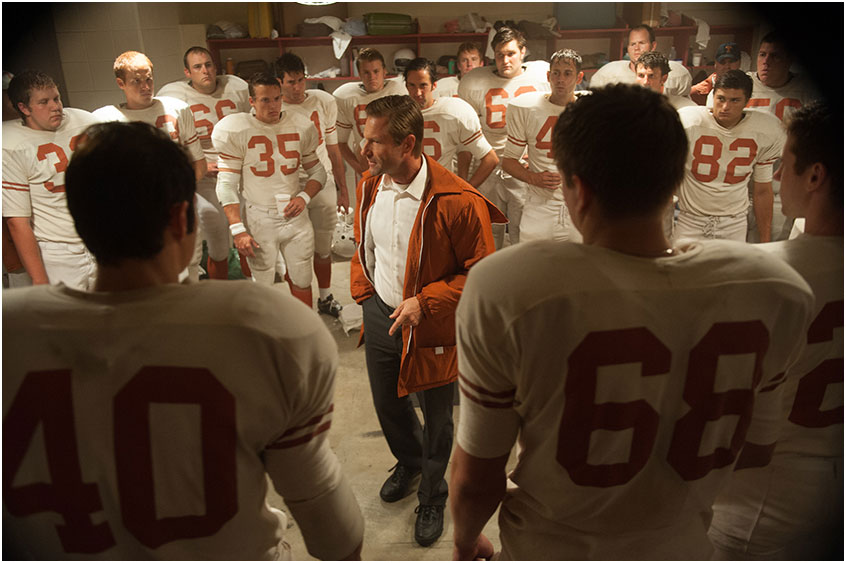
Steinmark (Finn Wittrock) is the Camille figure to coach Darrell Royal’s (Aaron Eckhart) grieving narrator. The film is framed around Royal being interviewed by a student journalist who asks him which player he’s coached made the biggest impact? Earl Campbell? Some future NFLer? No, Royal says, it was Freddie Steinmark. She protests that she’s never heard of Steinmark, and off we go….
There’s nothing really wrong with My All American (★★½). Not a blessed thing. It’s just unexceptional in every way. As a death and grief story, it may not have the reach of Brian’s Song or Love Story but only because the latter have more star power. As a “Christian” film (or one aimed at faith-audiences), it is less overtly faith-centered than Woodlawn but highlights its characters’ religion more than The Blind Side. Unless you are a fan of Notre Dame, Arkansas, or the Viet Cong, there are no villains here other than cancer.
The one place My All American flirts with being probing rather than transparent is after Freddie has been diagnosed. The doctor wants him to stay in the hospital rather than roam the sidelines of the team’s bowl game. Freddie pushes and pushes and finally gets the doctor to admit that a recovery is unlikely in any event. There’s a serious discussion to be had about quality of life and a terminal patient’s right to face death on his own terms. But if that’s the movie you want, you might as well watch How to Die in Oregon.
There is another way, besides arriving so soon on the heels of Woodlawn, that My All American suffers from bad timing. Freddie, like most athletes in general and football players in particular, puts off going to the doctor and getting his pain checked out. No, football doesn’t cause cancer, but it does contribute to the cultural norms of masculinity that make men slower to seek medical attention. Yeah, when Coach Royal frets “did I do this to you?” the literal answer is “no,” but the way the film honors Freddie most of all for playing through pain is at best problematic in a post-Head Games-NFL-concussion-lawsuit world.
But if the film is reluctant to probe or question in a way that might threaten its status as hagiography, it at least avoids the smugness of Job’s comforters. An early scene where Freddie comforts a mourner is the film’s best moment. He doesn’t claim to have all the answers. He’s willing to pray for the doubter/skeptic rather than insisting on making it an evangelistic moment. I can’t always endorse the film’s implied instructions about how to be a great football player, but I do appreciate its recognition that being a great Christian starts with simply being a decent human being.
Steinmark (Finn Wittrock) is the Camille figure to coach Darrell Royal’s (Aaron Eckhart) grieving narrator. The film is framed around Royal being interviewed by a student journalist who asks him which player he’s coached made the biggest impact? Earl Campbell? Some future NFLer? No, Royal says, it was Freddie Steinmark. She protests that she’s never heard of Steinmark, and off we go….
There’s nothing really wrong with My All American (★★½). Not a blessed thing. It’s just unexceptional in every way. As a death and grief story, it may not have the reach of Brian’s Song or Love Story but only because the latter have more star power. As a “Christian” film (or one aimed at faith-audiences), it is less overtly faith-centered than Woodlawn but highlights its characters’ religion more than The Blind Side. Unless you are a fan of Notre Dame, Arkansas, or the Viet Cong, there are no villains here other than cancer.
The one place My All American flirts with being probing rather than transparent is after Freddie has been diagnosed. The doctor wants him to stay in the hospital rather than roam the sidelines of the team’s bowl game. Freddie pushes and pushes and finally gets the doctor to admit that a recovery is unlikely in any event. There’s a serious discussion to be had about quality of life and a terminal patient’s right to face death on his own terms. But if that’s the movie you want, you might as well watch How to Die in Oregon.
There is another way, besides arriving so soon on the heels of Woodlawn, that My All American suffers from bad timing. Freddie, like most athletes in general and football players in particular, puts off going to the doctor and getting his pain checked out. No, football doesn’t cause cancer, but it does contribute to the cultural norms of masculinity that make men slower to seek medical attention. Yeah, when Coach Royal frets “did I do this to you?” the literal answer is “no,” but the way the film honors Freddie most of all for playing through pain is at best problematic in a post-Head Games-NFL-concussion-lawsuit world.
But if the film is reluctant to probe or question in a way that might threaten its status as hagiography, it at least avoids the smugness of Job’s comforters. An early scene where Freddie comforts a mourner is the film’s best moment. He doesn’t claim to have all the answers. He’s willing to pray for the doubter/skeptic rather than insisting on making it an evangelistic moment. I can’t always endorse the film’s implied instructions about how to be a great football player, but I do appreciate its recognition that being a great Christian starts with simply being a decent human being.
Previous Post

November 11, 2015
2015 Arts & Faith Ecumenical Jury
Next Post
November 12, 2015 Spotlight (McCarthy, 2015)
Browse Our Archives
Select a Category 10 Years Later 1999 Top 5 2007 Top 10 2008 Favorite Discoveries 2008 Top 10 2009 Favorite Discoveries 2009 Top 10 2010 Favorite Discoveries 2010 Top 10 2011 Top 10 2012 Top Ten 2013 Top Ten 2014 Top Ten Best Picture Winners Christian Spotlight on Entertainment Christianity Today Coming Soon Disclosure Disclosure--AS Disclosure--Book Disclosure--DVDS Disclosure--SEOL Disclosure--Travel Dissenting Opinion Elsewhere Emergenetics Essays Featured Film Fest DC--2014 Film Festivals Full Frame Documentary Film Festival 2010 Full Frame Documentary Film Festival 2011 Full Frame Documentary Film Festival 2012 Full Frame Documentary Film Festival 2013 Full Frame Documentary Film Festival 2014 Headline Interviews Laura on the Oscar Winners Podcasts Quick Impressions Reviews RiverRun Film Festival 2014 Television The Criterion Collection The Thin Place To Stream or Not to Stream? Top 10s and Other Lists Toronto International Film Festival 2009 Toronto International Film Festival 2010 Toronto International Film Festival 2011 Toronto International Film Festival 2012 Toronto International Film Festival 2013 Toronto International Film Festival 2014 Uncategorized Video Virginia Film Festival 2011 Virginia Film Festival 2013 Women's Film Festival 2012
Select a Month February 2016 January 2016 December 2015 November 2015 October 2015 September 2015 August 2015 July 2015 June 2015 May 2015 April 2015 March 2015 February 2015 January 2015 December 2014 November 2014 October 2014 September 2014 August 2014 July 2014 June 2014 May 2014 April 2014 March 2014 February 2014 January 2014 December 2013 November 2013 October 2013 September 2013 August 2013 July 2013 June 2013 May 2013 April 2013 March 2013 February 2013 January 2013 December 2012 November 2012 October 2012 September 2012 August 2012 July 2012 June 2012 May 2012 April 2012 March 2012 February 2012 January 2012 December 2011 November 2011 October 2011 September 2011 August 2011 July 2011 June 2011 May 2011 April 2011 March 2011 February 2011 January 2011 December 2010 November 2010 October 2010 September 2010 August 2010 July 2010 June 2010 May 2010 April 2010 March 2010 February 2010 January 2010 December 2009 November 2009 September 2009 August 2009 July 2009 June 2009 May 2009 April 2009
Follow Us!
TAKE THE
Religious Wisdom Quiz
What food was eaten during the first Passover?
Select your answer to see how you score.
Unleavened bread, bitter herbs, and lamb Fish and figs Roasted quail and dates Barley and honey
Related posts from 1More Film Blog

An Inconvenient Truth (Guggenheim, 2006) -- 10 Years...

The Devil Wears Prada (Frankel, 2006) -- 10...

"Telling a Great Story" -- An Interview with...

Is Snow White Still Essential?
TRENDING AT PATHEOS Religious Music & Entertainment

"Les Diabolique" and Transgression
Alongside something like Arrival, Vertigo, or Charade, Les Diaboliques is a...

"The Plague Dogs" and Mortality
So, flashback to the late 70s, early 80s. Walt Disney Studios is...

With the recent and highly successful release of Christopher Nolan’s epic film,...

"L'avventura" and Human Weakness
Today's piece is going to be a little different for a few...

I first want to apologize for not posting or writing anything. I'm...

I've engaged in the multi-year project of reading through the Church Fathers,...
view all Religious Music & Entertainment blogs
Ad-Free & Subscriber Log-In Subscription Support
- About Us
- 2026 Calendar
- Videos
- Podcasts
- Library of World Religions
- Faith In Media Tracker
- Advertise With Us
- Write for Us
- Privacy Policy
- Terms of Service
- Do Not Sell My Data
- Contact Us
- Radiant Digital
- Manage Newsletter Subscriptions
- Unsubscribe From Notifications
- Sitemap
Copyright 2008-2026, Patheos. All rights reserved.
Subscription Support Ad-Free & Subscriber Log-In
Follow Patheos