
BuddhistCatholicContemplativeEvangelicalGeneral ChristianHinduJewishLatter-day SaintMuslimNew VisionsProgressive Christian
Beliefs
- Buddhist
- Catholic
- Contemplative
- Evangelical
- General Christian
- Hindu
- Jewish
- Latter-day Saint
- More Voices
- Muslim
- New Visions
- Pagan
- Progressive Christian
Topics
- Religion News
- Food and Religion
- Sports and Religion
- Religious Art
- Religious Music and Entertainment
- Religious Events
- History and Religion
- Style and Religion
- Politics and Religion
- Women in Religion
- Recreation Outdoors and Religion
- Business Finance and Religion
- Careers Workplace and Religion
- Education and Religion
- Family Parenting and Religion
- Health Fitness and Religion
- Home and Religion
- Relationships and Religion
- Technology and Religion
- Travel and Religion
Columnists
- Buddhist Columnists
- Business Finance and Religion Columnists
- Careers Workplace and Religion Columnists
- Catholic Columnists
- Contemplative Columnists
- Education and Religion Columnists
- Evangelists Columnists
- Family Parenting and Religion Columnists
- General Christian Columnists
- Health Fitness and Religion Columnists
- Hindu Columnists
- History and Religion Columnists
- Home and Religion Columnists
- Jewish Columnists
- More Voices Columnists
- Latter Day Columnists
- Muslim Columnists
- New Visions Columnists
- Nonreligious Columnists
- Pagan Columnists
- Politics and Religion Columnists
- Progressive Columnists
- Recreation Outdoors and Religion Columnists
- Relationships and Religion Columnists
- Religion News Columnists
- Religious Art Columnists
- Religious Events Columnists
- Religious Music and Entertainment Columnists
- Sports and Religion Columnists
- Style and Religion Columnists
- Technology and Religion Columnists
- Travel and Religion Columnists
- Women in Religion Columnists
Resource Library
- 2026 Calendar
- Library of World Religions
- The 100 Most Holy Places on Earth
- Patheos Answers
- Podcasts
- Videos
- Faith Leaders Database
- Anglican Episcopalian
- Bahai
- Baptist
- Buddhism
- Christianity
- Confucianism
- Eastern Orthodoxy
- Hinduism
- Holiness and Pentecostal
- ISKCON
- Islam
- Judaism
- Lutheran
- Methodist
- The Church of Jesus Christ of Latter-day Saints
- New Age
- Paganism
- Presbytarian and Reformed
- Protestantism
- Religion Behind the Scenes
- Roman Catholic
- Scientology
- Shia Islam
- Sikhism
- Sufism
- Sunni Islam
- Taoism
- Zen
- See all religions
Research Tools
 Ad-Free & Subscriber Log-In Subscription Support
Follow Patheos 

- Trending:
- Advent
- |
- Forgiveness
- |
- Thanksgiving
- |
- Election
- |
- Seasonal Holidays
- |
- Marriage
 1More Film Blog
- Home
- Religious Music & Entertainment
- Munich (Spielberg, 2005) — Ten Years Later
Munich (Spielberg, 2005) — Ten Years Later
Last updated on: June 25, 2015 at 10:47 pm by Kenneth R. Morefield
Munich (Spielberg, 2005) — Ten Years Later 2015-06-25T22:47:55-05:00 Kenneth R. Morefield
Patheos Explore the world's faith through different perspectives on religion and spirituality! Patheos has the views of the prevalent religions and spiritualities of the world.
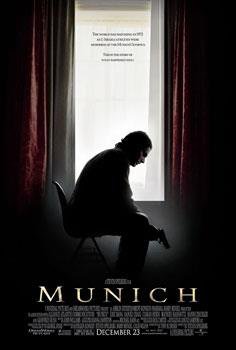 What’s so dispiriting about revisiting Steven Spielberg’s Munich ten years after its initial release is not how good or bad the film looks but how inessential it feels. Given its subject matter and the many ways in which we are daily confronted with ever expanding violence, much of it fueled by race hatred or justified by past victimizations, Munich ought to be feel fresh.
It doesn’t. It feels stale, as though subsequent developments have rendered it…not naive, exactly, but certainly shallower than I remembered it.
I’ve often maintained that Speilberg is the perfect modern, mass-audience director because his films reveal so much of themselves on a first viewing. Maybe that’s why his serious dramas, while garnering critical acclaim, don’t engender the same devotion as E.T. or Raiders of the Lost Ark. Entertainments can be consumed endlessly. Serious art can prompt new and different conversations and trains of thought. But lectures–even good ones–aren’t something you want to go back to again and again.
What I Said Then
(comments originally published at Viewpoint, a precursor to this blog)
If there is one knock against Steven Speilberg that I accept, it is that he has never presented moral ambiguity or complexity very realistically. His villains are Nazis or slave owners or mindless animals–sharks, dinosaurs, martians–misogynist men (The Color Purple), Thugee cult members, or faceless truck drivers. Much has been made prior to the release of Munich about how Tony Kushner’s script gives the Palestinians their say (before it kills them), and it does, but this is a film that thinks it is marinated in ambivalence when it is really only braised. To decide whether you will think the film is subtly nuanced or typically heavy-handed you need only ask whether you are the sort of film watcher who found the final shot–of the New York skyline in 1979 with two towers just off center–pregnantly symbolic or whether you are the sort who was already fishing for your car keys and didn’t even see it.
If you are in the latter of these two categories then you probably won’t mind that the conversation between Avner and the Arab about home is given an exclamation point later in the film as Louis, Avner’s information broker, looks in a store window at a home furnishing store and tells Avner that kitchens are expensive. You probably won’t mind a second scene between Avner and his mother where she exonerates him for sins unconfessed just in case you were using the restroom during the first one. You may even think that Golda Meier’s prominently featured admonition that “every civilization finds it necessary to negotiate compromises with its own values” is something anything more than a slightly eloquent book-end for Avner’s own conclusion that “I believe anyone is capable of anything.”
Even the most docile viewer, though, must feel led by the nose when Speilberg intercuts scenes of the terrorist attacks into Avner’s daydreams. Much like those at the end of Dead Man Walking, these images can be effective at getting the audience to see the intimate relationship between remote causes and immediate effects, but they also seem oddly out of place. For one, Avner is envisioning events he could not possibly have seen, so their inclusion to juxtapose Avner’s anguish is a bit of a cheat–used more to increase the audience’s moral oscillations than represent his own. For another, shouldn’t Avner be more haunted by his own violence? Structurally these scenes [of Israeli athletes massacred at the airport] needed to be at the beginning of the film. Yes, they might have less dramatic effect there, but the whole thrust of film’s moral trajectory is a movement from righteous certainty towards wilderness doubt as the actual events that prompt vengeance recede from memory, gradually replaced by our growing awareness of our own flawed humanity.
What I Say Now
The film hasn’t changed. Prior to re-watching the film, I remembered being put off by the 9/11 comparison and mentioning it in my review. But I didn’t remember some of the other illustrations I had blogged about the film’s bluntness.
The Munich DVD comes with a short introduction by Steven Spielberg. I’ve written some extended thoughts elsewhere about DVD commentary tracks as epitexts. I think this introduction could be looked at the same way. Certainly introductions are one example given by Gerard Genette of paratexts. Spielberg’s comments are informal and tonally conversational, but I have to believe they are carefully scripted. As such, they may or may not say anything about how the film but they certainly provide insight into how the director wants the film to be interpreted.
Looked at in that light, Spielberg’s introduction pulls into focus some of my dissatisfaction with the film. First he says, “I am not attacking Israel.” I’m not saying he should (attack Israel), but by categorically saying he is not, is he not undercutting all of the (many) subsequent claims of that this is a complicated issue about which reasonable people could disagree?
Arguments about moral equivalence are dicey, and attempts to differentiate similar acts–in this case acts of violence–are always harder than attempts to conflate them. In the film Avner claims “there’s no peace at the end of this” and questions whether or not the Israeli assassinations have made things worse (by ceding the moral high ground or provoking even more rounds of reprisals). Yet while the film gestures at these questions, it never fully convinces me that it grapples with them. It merely has people *say* they have grappled with them as a way of differentiating themselves from others who have used similar methods. Spielberg says, “What’s relevant is the need to go through a careful process” and “highlighting some of the dilemmas that need to be discussed.” Does the latter mean that the film will prompt discussion of some of those dilemmas? More importantly, if what is relevant is “the need to go through a careful process” why is so much of that process truncated and abbreviated in favor of…oh arguments about whether or not leave the woman’s robe open or generic suspense through timing. (When the girl answers the phone can they stop the bomb in time?) The “careful process”? There are some cabinet level discussions and Golda Meir says “today I am hearing with new ears” and that’s that. In that regard Munich suffers slightly, I think, in comparison to Zero Dark Thirty, which takes Munich‘s structural order (twenty minutes of deliberation followed by two and half hours of the mission) and reverses it (two hours of deliberation and thirty minutes of mission).
But the comparison to Zero Dark Thirty, while telling, is also a red herring. Because while I esteem Bigelow’s film more than I do Spielberg’s, I still see find it too carefully constructed, too confined by its own moral seriousness Neither film gives me what I’m so thirsty for, which is a hand in thinking through some issues and arriving at a conclusion. A point of view. A statement. Because the careful process is important, but only if it leads somewhere. Is Spielberg’s point really that the difference between Israel and the Palestinians that Israel went through a careful process? And if so, does that careful process help the actual agents who execute the plan or just the government and citizens who countenance it?
That last question is somewhat cynical and suspicious, and I would esteem Munich more if I felt Spielberg was aware of it…that Avner’s doubts were more deeply felt and not simply rhetorical exercises in devil’s advocacy. There’s a braver, less feel good version of the movie in here somewhere that would be more willing to draw conclusions from Avner’s doubts and psychological scars rather than simply exploit them for pathos.
The Final Word
Maybe it’s not up to artists to answer the unanswerable questions. But I like it when they try, even if I am not sure their answer is right. Because in trying to arrive at an answer, they encourage me to keep trying, that there is value in the process not just because a process dilutes my accountability but because a careful consideration can lead to insight. In a world that is increasingly filled with news stories that raise my fears and break my heart, I don’t want or need art that simply mirrors our own moral confusion back to me. I want films that communicate something useful to me.
That doesn’t necessarily mean films with happy endings. And it doesn’t mean that all films must be serious. There is plenty of room for entertainments and mindless diversions. But if a film is going to be serious, let it be serious in the best way. Let it not bathe in the seriousness of its subject matter without engaging with its own ideas and demanding (at the very, very, very least inviting) us to do so as well.
What are the films that are essential? I think they may differ for many of us, but by essential I don’t mean “for everyone.” I mean that *I* need them, because when my spirit is brought low by a shooting or a news story, or a postmodern malaise I am comforted less by a mindless distraction than I am by a display of artistic curisoity. The Man Who Planted Trees isn’t going to give me a blue print for dismantling agribusiness and stopping fracking and reducing carbon emissions, but it never fails to inspire me and remind me that one person being faithful in small things over large periods of time can have a huge impact on the world around him. Ragtime isn’t going to make people who don’t understand why the confederate flag is hurtful magnanimous towards people who do, but it never fails to remind me that a seventeen year-old, white suburban boy can see a black man praying on screen, asking God why He has put such a *rage* in his heart and realize for the first time, “we are the same, you and I.” The End of the Affair isn’t going to bring anyone I love back from the dead, but it never fails to remind me that love most emphatically does not end when you stop seeing someone. Those movies may or may not be better, more artful, more accomplished films than Munich, but they are some of the ones I turn to when I am in need in a way I’ve never turned to a Spielberg film.
That’s a high bar, I know. But please understand, I am not saying that any film that doesn’t clear that bar is worthless, or bad, or a waste of time. I’m just saying its not essential. I gave Munich a B+ when I reviewed it ten years ago. Today, I think it’s a better movie than that, but I would probably grade it slightly lower. Is that a double standard? Of course it is. But when something deals with religious identity or terrorism or any of the most serious questions that haunt and plague us, simply being a good movie doesn’t feel quite good enough.
Previous Post

June 20, 2015
3 1/2 Minutes, 10 Bullets -- Lucia McBath Interview
Next Post

June 27, 2015 24 Observations About The Terminator on the Eve of Genisys
Browse Our Archives
Select a Category 10 Years Later 1999 Top 5 2007 Top 10 2008 Favorite Discoveries 2008 Top 10 2009 Favorite Discoveries 2009 Top 10 2010 Favorite Discoveries 2010 Top 10 2011 Top 10 2012 Top Ten 2013 Top Ten 2014 Top Ten Best Picture Winners Christian Spotlight on Entertainment Christianity Today Coming Soon Disclosure Disclosure--AS Disclosure--Book Disclosure--DVDS Disclosure--SEOL Disclosure--Travel Dissenting Opinion Elsewhere Emergenetics Essays Featured Film Fest DC--2014 Film Festivals Full Frame Documentary Film Festival 2010 Full Frame Documentary Film Festival 2011 Full Frame Documentary Film Festival 2012 Full Frame Documentary Film Festival 2013 Full Frame Documentary Film Festival 2014 Headline Interviews Laura on the Oscar Winners Podcasts Quick Impressions Reviews RiverRun Film Festival 2014 Television The Criterion Collection The Thin Place To Stream or Not to Stream? Top 10s and Other Lists Toronto International Film Festival 2009 Toronto International Film Festival 2010 Toronto International Film Festival 2011 Toronto International Film Festival 2012 Toronto International Film Festival 2013 Toronto International Film Festival 2014 Uncategorized Video Virginia Film Festival 2011 Virginia Film Festival 2013 Women's Film Festival 2012
Select a Month February 2016 January 2016 December 2015 November 2015 October 2015 September 2015 August 2015 July 2015 June 2015 May 2015 April 2015 March 2015 February 2015 January 2015 December 2014 November 2014 October 2014 September 2014 August 2014 July 2014 June 2014 May 2014 April 2014 March 2014 February 2014 January 2014 December 2013 November 2013 October 2013 September 2013 August 2013 July 2013 June 2013 May 2013 April 2013 March 2013 February 2013 January 2013 December 2012 November 2012 October 2012 September 2012 August 2012 July 2012 June 2012 May 2012 April 2012 March 2012 February 2012 January 2012 December 2011 November 2011 October 2011 September 2011 August 2011 July 2011 June 2011 May 2011 April 2011 March 2011 February 2011 January 2011 December 2010 November 2010 October 2010 September 2010 August 2010 July 2010 June 2010 May 2010 April 2010 March 2010 February 2010 January 2010 December 2009 November 2009 September 2009 August 2009 July 2009 June 2009 May 2009 April 2009
Follow Us!
TAKE THE
Religious Wisdom Quiz
Who said, "The just shall live by faith"?
Select your answer to see how you score.
John Peter Jesus Paul
Related posts from 1More Film Blog

An Inconvenient Truth (Guggenheim, 2006) -- 10 Years...

The Devil Wears Prada (Frankel, 2006) -- 10...

"Telling a Great Story" -- An Interview with...

Is Snow White Still Essential?
TRENDING AT PATHEOS Religious Music & Entertainment

A Christian, a Narnia Fan, and a Filmmaker...
Watching The Narnia Trailer As A Fan And A Filmmaker Ever since...

Great Spiritual Horror Films of the 20th Century...
For the Christian, horror movies are often troubling—and many would say that...

"Les Diabolique" and Transgression
Alongside something like Arrival, Vertigo, or Charade, Les Diaboliques is a...

"The Plague Dogs" and Mortality
So, flashback to the late 70s, early 80s. Walt Disney Studios is...

With the recent and highly successful release of Christopher Nolan’s epic film,...

"L'avventura" and Human Weakness
Today's piece is going to be a little different for a few...
view all Religious Music & Entertainment blogs
Ad-Free & Subscriber Log-In Subscription Support
- About Us
- 2026 Calendar
- Videos
- Podcasts
- Library of World Religions
- Faith In Media Tracker
- Advertise With Us
- Write for Us
- Privacy Policy
- Terms of Service
- Do Not Sell My Data
- Contact Us
- Radiant Digital
- Manage Newsletter Subscriptions
- Unsubscribe From Notifications
- Sitemap
Copyright 2008-2026, Patheos, part of the Radiant Digital network of media brands. All rights reserved.
Subscription Support Ad-Free & Subscriber Log-In
Follow Patheos