
BuddhistCatholicContemplativeEvangelicalGeneral ChristianHinduJewishLatter-day SaintMuslimNew VisionsProgressive Christian
Beliefs
- Buddhist
- Catholic
- Contemplative
- Evangelical
- General Christian
- Hindu
- Jewish
- Latter-day Saint
- More Voices
- Muslim
- New Visions
- Pagan
- Progressive Christian
Topics
- Religion News
- Food and Religion
- Sports and Religion
- Religious Art
- Religious Music and Entertainment
- Religious Events
- History and Religion
- Style and Religion
- Politics and Religion
- Women in Religion
- Recreation Outdoors and Religion
- Business Finance and Religion
- Careers Workplace and Religion
- Education and Religion
- Family Parenting and Religion
- Health Fitness and Religion
- Home and Religion
- Relationships and Religion
- Technology and Religion
- Travel and Religion
Columnists
- Buddhist Columnists
- Business Finance and Religion Columnists
- Careers Workplace and Religion Columnists
- Catholic Columnists
- Contemplative Columnists
- Education and Religion Columnists
- Evangelists Columnists
- Family Parenting and Religion Columnists
- General Christian Columnists
- Health Fitness and Religion Columnists
- Hindu Columnists
- History and Religion Columnists
- Home and Religion Columnists
- Jewish Columnists
- More Voices Columnists
- Latter Day Columnists
- Muslim Columnists
- New Visions Columnists
- Nonreligious Columnists
- Pagan Columnists
- Politics and Religion Columnists
- Progressive Columnists
- Recreation Outdoors and Religion Columnists
- Relationships and Religion Columnists
- Religion News Columnists
- Religious Art Columnists
- Religious Events Columnists
- Religious Music and Entertainment Columnists
- Sports and Religion Columnists
- Style and Religion Columnists
- Technology and Religion Columnists
- Travel and Religion Columnists
- Women in Religion Columnists
Resource Library
- 2026 Calendar
- Library of World Religions
- The 100 Most Holy Places on Earth
- Patheos Answers
- Podcasts
- Videos
- Faith Leaders Database
- Anglican Episcopalian
- Bahai
- Baptist
- Buddhism
- Christianity
- Confucianism
- Eastern Orthodoxy
- Hinduism
- Holiness and Pentecostal
- ISKCON
- Islam
- Judaism
- Lutheran
- Methodist
- The Church of Jesus Christ of Latter-day Saints
- New Age
- Paganism
- Presbytarian and Reformed
- Protestantism
- Religion Behind the Scenes
- Roman Catholic
- Scientology
- Shia Islam
- Sikhism
- Sufism
- Sunni Islam
- Taoism
- Zen
- See all religions
Research Tools
 Ad-Free & Subscriber Log-In Subscription Support
Ad-Free & Subscriber Log-In Subscription Support
Follow Patheos 

- Trending:
- Forgiveness
- |
- Marriage
- |
- Consciousness
- |
- Death Penalty
- |
- Election
- |
- Halloween
 1More Film Blog
- Home
- Religious Music & Entertainment
- Masters of Sex Episode 2.12 Recap: The Revolution Will Not Be Televised
Masters of Sex Episode 2.12 Recap: The Revolution Will Not Be Televised
Last updated on: June 3, 2015 at 10:08 pm by Kenneth R. Morefield
Masters of Sex Episode 2.12 Recap: The Revolution Will Not Be Televised 2015-06-03T22:08:15-05:00 Kenneth R. Morefield
Patheos Explore the world's faith through different perspectives on religion and spirituality! Patheos has the views of the prevalent religions and spiritualities of the world.
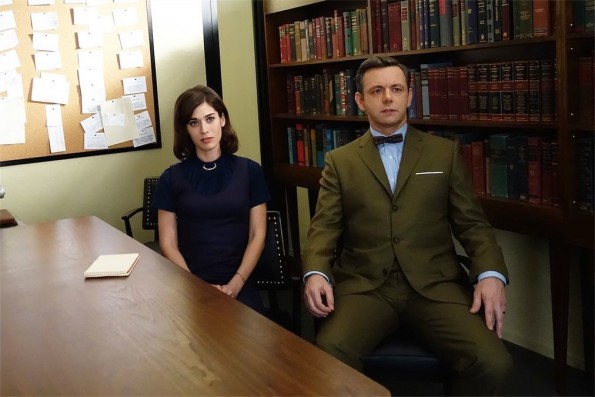
Season Two of Masters of Sex drew to a conclusion last night, so this will be the last episode recap barring a dramatic (but unexpected) turnaround in Season Three.
I can only imagine the difficulties in writing a weekly television serial about sex. So I’ve tried to be patient with some of the series’ awkward eccentricities: the tendency towards expository dialogue, the abrupt comings and goings of major characters (hey, look, it’s Barton!), the weak attempts to integrate humor (Austin realizing he’s a dumb blonde), and the increased focus on the characters’ (increasingly fictionalized) private lives.
Media critics who scrupulously insist upon fidelity to source material can be dull to those who don’t have a preexisting attachment to the narrative’s antecedent. Okay, not everyone is going to have read (or be interested in reading) Thomas Maier’s biography of Bill Masters and Virginia Johnson. I accept that some deviations are necessary. But in Season One, the elements that were added made some kind of sense. They reinforced elements of the story the series was trying to tell rather than distracting from it.
Episode 2.12–and Season Two–drew to a close exactly where Season Two should have begun. With Masters & Johnson explaining their treatment protocol to the first set of patients: Barb and Lester. I was puzzled throughout the season by the series’ difficulty in getting from point “A” (research) to point “B” (application), particularly since the hospital hopping and reluctance to present the research in publicly accessible forms seemed like manufactured conflicts that weren’t particularly consistent with Season One or the biography. My best guess? The show writers didn’t trust the audience to be actually interested in the work itself. But by dumbing the show down they didn’t just make it more accessible; they robbed it of one of its distinctives.
Aside from finally getting us from research to practice, Season Two’s finale only served to remind us just how strongly the focus has shifted from a work emphasis to a domestic emphasis. Austin has been kicked out of the house (and given an expository speech in which he explains to Flo and us what their relationship is all about). Libby has acknowledged to her lover that she knows Bill is having an affair (and given an expository speech in which she opines that a woman must have something more to live for than her kids). Virginia has protected the study by giving up custody of her kids. Barton drops in out of nowhere to explain how Bill managed to kill the CBS story (and to give an expository speech in which he underlines how this incident is consistent with Bill’s blackmailing his former boss). I complained last week about the show’s tendency to show rather than tell. If anything, that tendency is getting worse.
And it’s not as though the things it is “telling” are complex ideas or connections we couldn’t or wouldn’t make on our own. Of course we’re going to think of Bill and Barton when Virginia uses the word “blackmail” to describe her ex-husband’s custody play. If we are thoughtful viewers, we might even think about some of the differences between those two situations before George Johnson points them out to Ginny. (He did try to persuade her first; he only got a lawyer in response to her making a show of force.) When Virginia peevishly decides to keep the kids on George’s weekend, the writers can’t resist having George verbalize what we’ve already understood: she is punishing him for bringing it up.
In Ginny’s custody battle and Libby’s affair with James, the show also demonstrates a skittishness about its characters’ likability. One of the ways Season One was superior is that it seemed to more evenly distribute the flaws of various characters. Having spent most of Season Two pointing out how destructive (to self and others) affairs are when men engage in them, the show seems strangely in favor of Libby’s own liaison: Bill did it first, it shows she is not racist, and (most of all) it creates a false and absolute either/or choice between countenancing adultery and accepting patriarchy and subordination.
A word, too, about the nudity and sexual content. Masters of Sex has always made ample use of its cable home to show the human body and the act of sex in ways that would not fly on network broadcast television. But the sex (and nudity) felt more integrated in Season One, and it’s always easier to accept “R” rated content (at least it is for me) if the subject matter is treated with moral and artistic seriousness. Because so much of the sex was in the lab in Season One, much of it was de-eroticized, at least on a formal level. The shift from the lab to the bedroom (or, more accurately, the hotel room) has removed the major element that differentiated the show from soft porn. How is Libby’s roll on the floor different from anything we would see in The L Word or Sex in the City? It’s not. Sex has gone from something people observe in order to understand how to help people to something people do in order to find personal fulfillment or pleasure. It’s my contention that watching people do the former (watching other people) and watching people do the latter is a markedly different exercise. I suspect that there will be a subset of viewers, albeit a small one, who are okay with the first season’s viewing experience and find the second season’s veering towards the unacceptably titillating.
Let me put it another way. Bill’s central argument for engaging in sex with Virginia is that the ends justify the means. The work is important enough and will help enough people that it warrants potentially hurting its participants (him, Virginia) and their families (his wife, her children, his children). To her and the show’s credit, Virginia is having reservations about this argument, particularly now that she is seeing how participation in the work makes her vulnerable. But her argument that once the research was public she could get the kids back because the court (and court of public opinion) would see that it is not what it sounds like evidences the point that she too (ultimately) rejects the argument that George makes. You can’t be blackmailed unless it is something you don’t want known. Virginia (and the show) appears to hold the position that it is a shame that people will draw the wrong conclusions because the subject is taboo, but she never makes a persuasive argument that those assumptions–such as that the kids might be better off with at least one full-time parent, or that having sex with your married boss, even for therapeutic purposes, is something you ought to be ashamed of–are wrong. Even her own lawyer warns her that George’s initial requests are “reasonable” and that by refusing them she risks coming across as caring about something more than or other than the best interest of the children.
Like Bill and Virginia, I’m not sure the show itself has ever articulated a convincing argument for why what it is doing is important. It has just asserted that it was. For most of Season One I agreed. After Season Two I am not so sure.
Previous Recaps:
2.11 One for the Money, Two for the Show
2.8 Mirror, Mirror
2.7 Asterion
2.5 Giants
2.4 Dirty Jobs
2.3 Fight
2.2 Kyrie Eleison
Season One
Previous Post

September 25, 2014
The Thin Place #50: The Equalizer, King David, and Righteous Anger
Next Post

September 30, 2014 Gotham Episode 1.2 Recap: Selina Kyle
Browse Our Archives
Select a Category 10 Years Later 1999 Top 5 2007 Top 10 2008 Favorite Discoveries 2008 Top 10 2009 Favorite Discoveries 2009 Top 10 2010 Favorite Discoveries 2010 Top 10 2011 Top 10 2012 Top Ten 2013 Top Ten 2014 Top Ten Best Picture Winners Christian Spotlight on Entertainment Christianity Today Coming Soon Disclosure Disclosure--AS Disclosure--Book Disclosure--DVDS Disclosure--SEOL Disclosure--Travel Dissenting Opinion Elsewhere Emergenetics Essays Featured Film Fest DC--2014 Film Festivals Full Frame Documentary Film Festival 2010 Full Frame Documentary Film Festival 2011 Full Frame Documentary Film Festival 2012 Full Frame Documentary Film Festival 2013 Full Frame Documentary Film Festival 2014 Headline Interviews Laura on the Oscar Winners Podcasts Quick Impressions Reviews RiverRun Film Festival 2014 Television The Criterion Collection The Thin Place To Stream or Not to Stream? Top 10s and Other Lists Toronto International Film Festival 2009 Toronto International Film Festival 2010 Toronto International Film Festival 2011 Toronto International Film Festival 2012 Toronto International Film Festival 2013 Toronto International Film Festival 2014 Uncategorized Video Virginia Film Festival 2011 Virginia Film Festival 2013 Women's Film Festival 2012
Select a Month February 2016 January 2016 December 2015 November 2015 October 2015 September 2015 August 2015 July 2015 June 2015 May 2015 April 2015 March 2015 February 2015 January 2015 December 2014 November 2014 October 2014 September 2014 August 2014 July 2014 June 2014 May 2014 April 2014 March 2014 February 2014 January 2014 December 2013 November 2013 October 2013 September 2013 August 2013 July 2013 June 2013 May 2013 April 2013 March 2013 February 2013 January 2013 December 2012 November 2012 October 2012 September 2012 August 2012 July 2012 June 2012 May 2012 April 2012 March 2012 February 2012 January 2012 December 2011 November 2011 October 2011 September 2011 August 2011 July 2011 June 2011 May 2011 April 2011 March 2011 February 2011 January 2011 December 2010 November 2010 October 2010 September 2010 August 2010 July 2010 June 2010 May 2010 April 2010 March 2010 February 2010 January 2010 December 2009 November 2009 September 2009 August 2009 July 2009 June 2009 May 2009 April 2009
Follow Us!
TAKE THE
Religious Wisdom Quiz
Where was Paul's hometown?
Select your answer to see how you score.
Tarsus Damascus Jerusalem Antioch
Related posts from 1More Film Blog
The Churchmen -- Season 1, Episode 7 Recap
The Churchmen -- Season 1, Episode 5 Recap
The Churchmen -- Season 1, Episode 1 Recap

Signed, Sealed, Delivered: From Paris With Love (Fair,...
TRENDING AT PATHEOS Religious Music & Entertainment

"Les Diabolique" and Transgression
Alongside something like Arrival, Vertigo, or Charade, Les Diaboliques is a...

"The Plague Dogs" and Mortality
So, flashback to the late 70s, early 80s. Walt Disney Studios is...

With the recent and highly successful release of Christopher Nolan’s epic film,...

"L'avventura" and Human Weakness
Today's piece is going to be a little different for a few...

I first want to apologize for not posting or writing anything. I'm...

I've engaged in the multi-year project of reading through the Church Fathers,...
view all Religious Music & Entertainment blogs
Ad-Free & Subscriber Log-In Subscription Support
- About Us
- 2026 Calendar
- Videos
- Podcasts
- Library of World Religions
- Faith In Media Tracker
- Advertise With Us
- Write for Us
- Privacy Policy
- Terms of Service
- Do Not Sell My Data
- Contact Us
- Radiant Digital
- Manage Newsletter Subscriptions
- Unsubscribe From Notifications
- Sitemap
Copyright 2008-2026, Patheos. All rights reserved.
Subscription Support Ad-Free & Subscriber Log-In
Follow Patheos