
BuddhistCatholicContemplativeEvangelicalGeneral ChristianHinduJewishLatter-day SaintMuslimNew VisionsProgressive Christian
Beliefs
- Buddhist
- Catholic
- Contemplative
- Evangelical
- General Christian
- Hindu
- Jewish
- Latter-day Saint
- More Voices
- Muslim
- New Visions
- Pagan
- Progressive Christian
Topics
- Religion News
- Food and Religion
- Sports and Religion
- Religious Art
- Religious Music and Entertainment
- Religious Events
- History and Religion
- Style and Religion
- Politics and Religion
- Women in Religion
- Recreation Outdoors and Religion
- Business Finance and Religion
- Careers Workplace and Religion
- Education and Religion
- Family Parenting and Religion
- Health Fitness and Religion
- Home and Religion
- Relationships and Religion
- Technology and Religion
- Travel and Religion
Columnists
- Buddhist Columnists
- Business Finance and Religion Columnists
- Careers Workplace and Religion Columnists
- Catholic Columnists
- Contemplative Columnists
- Education and Religion Columnists
- Evangelists Columnists
- Family Parenting and Religion Columnists
- General Christian Columnists
- Health Fitness and Religion Columnists
- Hindu Columnists
- History and Religion Columnists
- Home and Religion Columnists
- Jewish Columnists
- More Voices Columnists
- Latter Day Columnists
- Muslim Columnists
- New Visions Columnists
- Nonreligious Columnists
- Pagan Columnists
- Politics and Religion Columnists
- Progressive Columnists
- Recreation Outdoors and Religion Columnists
- Relationships and Religion Columnists
- Religion News Columnists
- Religious Art Columnists
- Religious Events Columnists
- Religious Music and Entertainment Columnists
- Sports and Religion Columnists
- Style and Religion Columnists
- Technology and Religion Columnists
- Travel and Religion Columnists
- Women in Religion Columnists
Resource Library
- 2026 Calendar
- Library of World Religions
- The 100 Most Holy Places on Earth
- Patheos Answers
- Podcasts
- Videos
- Faith Leaders Database
- Anglican Episcopalian
- Bahai
- Baptist
- Buddhism
- Christianity
- Confucianism
- Eastern Orthodoxy
- Hinduism
- Holiness and Pentecostal
- ISKCON
- Islam
- Judaism
- Lutheran
- Methodist
- The Church of Jesus Christ of Latter-day Saints
- New Age
- Paganism
- Presbytarian and Reformed
- Protestantism
- Religion Behind the Scenes
- Roman Catholic
- Scientology
- Shia Islam
- Sikhism
- Sufism
- Sunni Islam
- Taoism
- Zen
- See all religions
Research Tools
 Ad-Free & Subscriber Log-In Subscription Support
Ad-Free & Subscriber Log-In Subscription Support
Follow Patheos 

- Trending:
- Forgiveness
- |
- Marriage
- |
- Consciousness
- |
- Death Penalty
- |
- Election
- |
- Halloween
 1More Film Blog
- Home
- Religious Music & Entertainment
- Love in the Afternoon (Rohmer, 1972)
Love in the Afternoon (Rohmer, 1972)
Last updated on: August 21, 2014 at 9:14 pm by Kenneth R. Morefield
Love in the Afternoon (Rohmer, 1972) 2014-08-21T21:14:28-05:00 Kenneth R. Morefield
Patheos Explore the world's faith through different perspectives on religion and spirituality! Patheos has the views of the prevalent religions and spiritualities of the world.

Favorite Rohmer film? Whichever one I saw last.
My favorite of Eric Rohmer’s Six Moral Tales is probably whichever one I’ve seen most recently, so at one point or another my list of favorite discoveries of 2008 probably had five Rohmer films on it.
I wrote some notes about Love in the Afternoon last March, comparing some of its themes to Kubrick’s Eyes Wide Shut.
Pauline Kael once famously compared screening a Rohmer film to watching paint dry. Yeah, paint on the wall of the Sistine Chapel, maybe.
************************************
Okay, I just finished Love in the Afternoon and I’m a little tipsy on Rohmer having just finished my first run through the Six Moral Tales. I suppose watching paint dry can be pretty interesting if the paint makes a beautiful, nuanced picture. It’s certainly more interesting than watching a car explode.
The Criterion DVD had an interview with Neil Labute talking about how Rohmer influenced him, but I confess that towards the end of Love in the Afternoon, the film I kept thinking about was Kubrick’s Eyes Wide Shut.
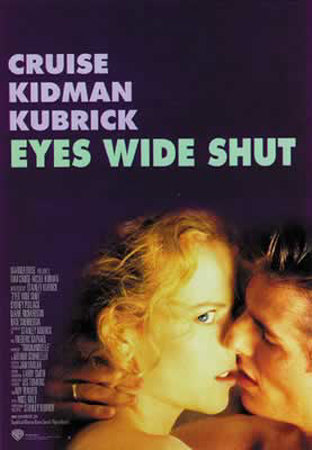
Kubrik’s film explores many of the same themes as Rohmer’s.
When Frederic leaves Chloe’s apartment I thought, “Wow, there really is a thematic parallel with Eyes Wide Shut,” particularly in the way the film plays off the ambiguity between what the characters say they want/believe and the actual choices they make. Then when Frederic calls his wife on the phone right after he leaves Chloe’s apartment, I thought, “Okay, if he [or she] says ‘And it’s really important for us to fuck right now now'” it really is going to play for me like the end of Eyes Wide Shut.” Neither character uses that line, but darned if the final scene with Helene isn’t, essentially a much more ambiguous parallel to the final scene between Bill and Alice in Kubrick’s film.
I also made a connection to Eyes Wide Shut at the very beginning of the film. Love in the Afternoon opens with Frederic walking in on a nude Helene in the bathroom, and this scene made me think of the opening scenes of Eyes Wide Shut and how Kubrick juxtaposes the more voyeuristic opening shot of Kidman which seems to be about woman as object of the male gaze with the shots of Alice in the bathroom while Bill is getting ready for the party which are all about familiarity, suggesting the ways he is and isn’t looking at her. This Bill’s indifference to Alice echoes Frederic’s indifference to Helene.
Finally, I see a third parallel in the penultimate scene of Love in the Afternoon and a central scene of Eyes Wide Shut. In the climactic scene of Love in the Afternoon, it looks like Chloe and Frederic are moving towards a consummation. Chloe is undressed and moves to the bed (from whence we get the iconic shot of her on the bed that is in some of the movie posters). Frederic begins to undress and in the process of pulling his shirt off catches a glimpse of himself in the mirror.
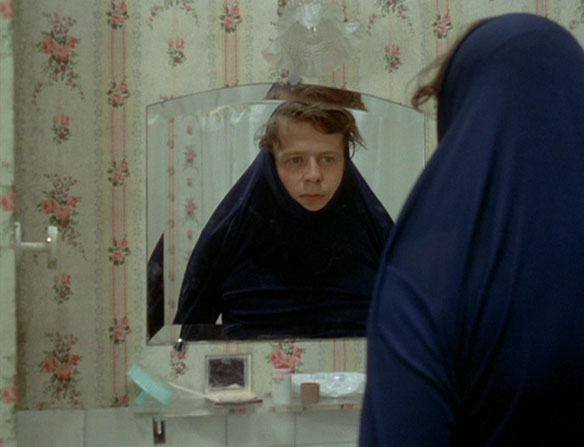
He sees himself, but what does he see?
The image of the shirt over his head is a visual echo to an earlier scene in which Frederic was playing a game with his daughter, and while ultimately ambiguous, I don’t think it a stretch to suggest that Frederic is remembering that earlier moment himself. It is immediately after that glimpse that he leaves Chloe’s apartment.
This scene reminds me of the scene (structurally earlier) in Eyes Wide Shut where Bill visits the prostitute and gets a call at a key moment on his cell phone that reminds him of his family, causing him to leave her apartment. (It is later suggested/reported in Eyes Wide Shut that the prostitute was HIV positive and so there is yet more ambiguity about this scene. Is it meant to be providential or coincidental? In my meditation on Eyes Wide Shut when it first came out, I wrote that while on the surface it may appear that Bill would have consummated the adultery had not he received a well timed interruption, it was at least plausible to think that given the fact that he can never seem to seal the deal, that something is always interrupting, the structure of the film invites us to contemplate whether or not there is some deeper seated reason Bill cannot (or at least doesn’t) sleep with someone else.
Returning to Love in the Afternoon, I remember feeling a bit surprised at the shirt/glimpse in the mirror scene. It seemed uncharacteristic to me of Rohmer’s style in the other tales, a bit more underlined. Neil Labute said in his commentary interview that one thing he appreciated about Rohmer in the Moral Tales is that he didn’t judge the protagonists. He allowed you to do so, to be sure. In fact, he almost forces you to do so by withholding his own judgment. This scene, then (or the shot anyway), was one of the few times in the tales where I felt Rohmer was editorializing–or at least spotlighting–telling you what to pay attention to.
The comparison to Eyes Wide Shut, though, made me wonder if this scene weren’t more ambiguous than I was giving it credit for being. Labute said he found Rohmer’s men to be the great self-justifiers, and while I agree up to a point, the tales seem to me to have a lot of ambiguity in that there is often a tension or a discrepancy between who and what they claim to be and what their actions reveal them to be. Just as in Eyes Wide Shut where a central question (for me) was how to reconcile who and what Bill said he was and what he wanted with what he actually did (or didn’t do), so too in Chloe, I felt like there was a bit more self deception going on, that maybe the glance was not a providential reminder that pulls him back from the edge but the moment in which he really sees himself (not the image he is trying to protect) and what he really wants. [Of course, it is also equally plausible that Chloe’s well timed gossip sort of backfires and rouses him not to reciprocal hurt but recognition of possessive love…hmmm…that is another connection to Eyes Wide Shut, isn’t it? It is Alice’s “confession” about the fantasy with the naval officer that prompts Bill to want to start a journey of revenge but ends with him being shaken out of his complacency and familiarity with her and a realization (I think) that he doesn’t want to hurt her back, he wants to have her back.]
Anyway, I’m fascinated by the Tales, because while I’m sympathetic to the naysayers who might say “It’s the same movie over and over” I do think exploring the same themes allows Rohmer to make nuanced comparisons that articulate the important (or meaningless) distinctions between similar characters. To me, these films are more like classical music with variations on a theme than pop music with a lyric/medley being repeated over and over again.
Postscript: I’m adding a link to the Eyes Wide Shut review here and in the text above. I realized after writing this post that my review was from when I had the blog at a different web address and thus was no longer available.
This post originally appeared at All Things Ken.
Previous Post

May 3, 2009
Taxi to the Dark Side (Gibney, 2007)
Next Post
May 5, 2009 Eyes Wide Shut (Kubrick, 1999)
Browse Our Archives
Select a Category 10 Years Later 1999 Top 5 2007 Top 10 2008 Favorite Discoveries 2008 Top 10 2009 Favorite Discoveries 2009 Top 10 2010 Favorite Discoveries 2010 Top 10 2011 Top 10 2012 Top Ten 2013 Top Ten 2014 Top Ten Best Picture Winners Christian Spotlight on Entertainment Christianity Today Coming Soon Disclosure Disclosure--AS Disclosure--Book Disclosure--DVDS Disclosure--SEOL Disclosure--Travel Dissenting Opinion Elsewhere Emergenetics Essays Featured Film Fest DC--2014 Film Festivals Full Frame Documentary Film Festival 2010 Full Frame Documentary Film Festival 2011 Full Frame Documentary Film Festival 2012 Full Frame Documentary Film Festival 2013 Full Frame Documentary Film Festival 2014 Headline Interviews Laura on the Oscar Winners Podcasts Quick Impressions Reviews RiverRun Film Festival 2014 Television The Criterion Collection The Thin Place To Stream or Not to Stream? Top 10s and Other Lists Toronto International Film Festival 2009 Toronto International Film Festival 2010 Toronto International Film Festival 2011 Toronto International Film Festival 2012 Toronto International Film Festival 2013 Toronto International Film Festival 2014 Uncategorized Video Virginia Film Festival 2011 Virginia Film Festival 2013 Women's Film Festival 2012
Select a Month February 2016 January 2016 December 2015 November 2015 October 2015 September 2015 August 2015 July 2015 June 2015 May 2015 April 2015 March 2015 February 2015 January 2015 December 2014 November 2014 October 2014 September 2014 August 2014 July 2014 June 2014 May 2014 April 2014 March 2014 February 2014 January 2014 December 2013 November 2013 October 2013 September 2013 August 2013 July 2013 June 2013 May 2013 April 2013 March 2013 February 2013 January 2013 December 2012 November 2012 October 2012 September 2012 August 2012 July 2012 June 2012 May 2012 April 2012 March 2012 February 2012 January 2012 December 2011 November 2011 October 2011 September 2011 August 2011 July 2011 June 2011 May 2011 April 2011 March 2011 February 2011 January 2011 December 2010 November 2010 October 2010 September 2010 August 2010 July 2010 June 2010 May 2010 April 2010 March 2010 February 2010 January 2010 December 2009 November 2009 September 2009 August 2009 July 2009 June 2009 May 2009 April 2009
Follow Us!
TAKE THE
Religious Wisdom Quiz
What was Moses' father's name?
Select your answer to see how you score.
Amram Arron Abiathar Apollos
Related posts from 1More Film Blog

An Inconvenient Truth (Guggenheim, 2006) -- 10 Years...

The Devil Wears Prada (Frankel, 2006) -- 10...

"Telling a Great Story" -- An Interview with...

Is Snow White Still Essential?
TRENDING AT PATHEOS Religious Music & Entertainment

"Les Diabolique" and Transgression
Alongside something like Arrival, Vertigo, or Charade, Les Diaboliques is a...

"The Plague Dogs" and Mortality
So, flashback to the late 70s, early 80s. Walt Disney Studios is...

With the recent and highly successful release of Christopher Nolan’s epic film,...

"L'avventura" and Human Weakness
Today's piece is going to be a little different for a few...

I first want to apologize for not posting or writing anything. I'm...

I've engaged in the multi-year project of reading through the Church Fathers,...
view all Religious Music & Entertainment blogs
Ad-Free & Subscriber Log-In Subscription Support
- About Us
- 2026 Calendar
- Videos
- Podcasts
- Library of World Religions
- Faith In Media Tracker
- Advertise With Us
- Write for Us
- Privacy Policy
- Terms of Service
- Do Not Sell My Data
- Contact Us
- Radiant Digital
- Manage Newsletter Subscriptions
- Unsubscribe From Notifications
- Sitemap
Copyright 2008-2026, Patheos. All rights reserved.
Subscription Support Ad-Free & Subscriber Log-In
Follow Patheos