
BuddhistCatholicContemplativeEvangelicalGeneral ChristianHinduJewishLatter-day SaintMuslimNew VisionsProgressive Christian
Beliefs
- Buddhist
- Catholic
- Contemplative
- Evangelical
- General Christian
- Hindu
- Jewish
- Latter-day Saint
- More Voices
- Muslim
- New Visions
- Pagan
- Progressive Christian
Topics
- Religion News
- Food and Religion
- Sports and Religion
- Religious Art
- Religious Music and Entertainment
- Religious Events
- History and Religion
- Style and Religion
- Politics and Religion
- Women in Religion
- Recreation Outdoors and Religion
- Business Finance and Religion
- Careers Workplace and Religion
- Education and Religion
- Family Parenting and Religion
- Health Fitness and Religion
- Home and Religion
- Relationships and Religion
- Technology and Religion
- Travel and Religion
Columnists
- Buddhist Columnists
- Business Finance and Religion Columnists
- Careers Workplace and Religion Columnists
- Catholic Columnists
- Contemplative Columnists
- Education and Religion Columnists
- Evangelists Columnists
- Family Parenting and Religion Columnists
- General Christian Columnists
- Health Fitness and Religion Columnists
- Hindu Columnists
- History and Religion Columnists
- Home and Religion Columnists
- Jewish Columnists
- More Voices Columnists
- Latter Day Columnists
- Muslim Columnists
- New Visions Columnists
- Nonreligious Columnists
- Pagan Columnists
- Politics and Religion Columnists
- Progressive Columnists
- Recreation Outdoors and Religion Columnists
- Relationships and Religion Columnists
- Religion News Columnists
- Religious Art Columnists
- Religious Events Columnists
- Religious Music and Entertainment Columnists
- Sports and Religion Columnists
- Style and Religion Columnists
- Technology and Religion Columnists
- Travel and Religion Columnists
- Women in Religion Columnists
Resource Library
- 2026 Calendar
- Library of World Religions
- The 100 Most Holy Places on Earth
- Patheos Answers
- Podcasts
- Videos
- Faith Leaders Database
- Anglican Episcopalian
- Bahai
- Baptist
- Buddhism
- Christianity
- Confucianism
- Eastern Orthodoxy
- Hinduism
- Holiness and Pentecostal
- ISKCON
- Islam
- Judaism
- Lutheran
- Methodist
- The Church of Jesus Christ of Latter-day Saints
- New Age
- Paganism
- Presbytarian and Reformed
- Protestantism
- Religion Behind the Scenes
- Roman Catholic
- Scientology
- Shia Islam
- Sikhism
- Sufism
- Sunni Islam
- Taoism
- Zen
- See all religions
Research Tools
 Ad-Free & Subscriber Log-In Subscription Support
Ad-Free & Subscriber Log-In Subscription Support
Follow Patheos 

- Trending:
- Forgiveness
- |
- Marriage
- |
- Consciousness
- |
- Death Penalty
- |
- Election
- |
- Halloween
 1More Film Blog
- Home
- Religious Music & Entertainment
- Film History Spotlight: Max Ophuls
Film History Spotlight: Max Ophuls
Last updated on: May 24, 2015 at 4:09 pm by Kenneth R. Morefield
Film History Spotlight: Max Ophuls 2015-05-24T16:09:55-05:00 Kenneth R. Morefield
Patheos Explore the world's faith through different perspectives on religion and spirituality! Patheos has the views of the prevalent religions and spiritualities of the world.
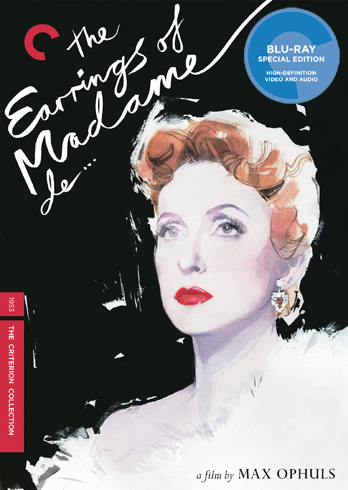 The films of Max Ophuls are surprisingly accessible. That doesn’t mean they are shallow. Indeed, one of the selling points of The Earrings of Madame de… and Caught is that they both take familiar narrative frames and manage to craft memorable stories that elicit complex emotions within them. But if you are the sort of amateur cinephile who likes to know what artists influenced your favorite directors or to have an informed opinion in discussions of the film canon, Ophuls is a good director to check out. His films are not so alien to modern, narrative sensibilities as to require large amounts of explanation, yet they are filled with touches and techniques that make them stand out in comparison to other films of their era.
It helps amateur film students, too, that Ophuls is widely associated with a specific signature element: the tracking shot. One thing that makes older films look fresh is when they employ techniques that come to be more broadly used in subsequent generations. Andrew Sarris mentions that Ophuls influenced Stanley Kubrick and Jacques Demy; the latter dedicated his first film to Ophuls (Interviews with Directors 354). Paul Thomas Anderson introduces The Criterion copy of The Earrings of Madame de…, citing Ophuls’s reputation for tracking shots as what attracted him to the director: You can see Anderson use this technique in Boogie Nights; check out the third item in this wonderful compilation by Patrick Chamberlain.
If everyone agrees that Ophuls’s tracking shots are wonderful, not everyone agrees on what they mean. Sarris details getting a letter from fellow film critic Ronald Caro purporting not to understand their purpose in Letter from an Unkown Woman. This leads to one of his more problematic claims: “For Ophuls, the track is less a method of treating individual scenes than the instinctive epxression of a personal vision” (353). There is vague quality to that claim that makes it unsatisfying. Besides, Caro only claims to be puzzled by the tracking shots in one film. He says their purpose in Lola Montes is fairly evident (the camera circles the character to emphasize her entrapment). Some of the tracking shots in Caught feel equally simple to understand.
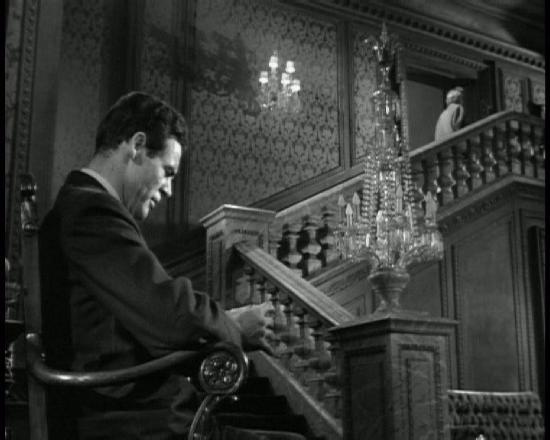 In that film Barbara Bel Geddes plays Leonora, a woman who parlays a charm school education into a job as a department store model for mink coats and who finds herself the subject of a freakish and flukish marriage proposal from a multimillionaire, Smith Ohlrig (Robert Ryan, allegedly caricaturizing Howard Hughes). His jealousy and emotional cruelty evidence mental illness, and she flees her gilded mansion cage, landing a job as a receptionist for a pediatrician (James Mason) and an obstetrician. The different locations in the film have different looks, with the mansion scenes connoting Leonora’s isolation through long shots with relatively empty frames and little movement. In one famous scene, Leonora is literally sitting facing a wall on the stairs as Smith paces back an forth. The camera tracks Smith, and each time it passes beyond the corner of the stairwell, taking Leonora out of the picture, we are viscerally reminded that he does not see her. She is a spectator to his monologues, not a participant in his arguments.
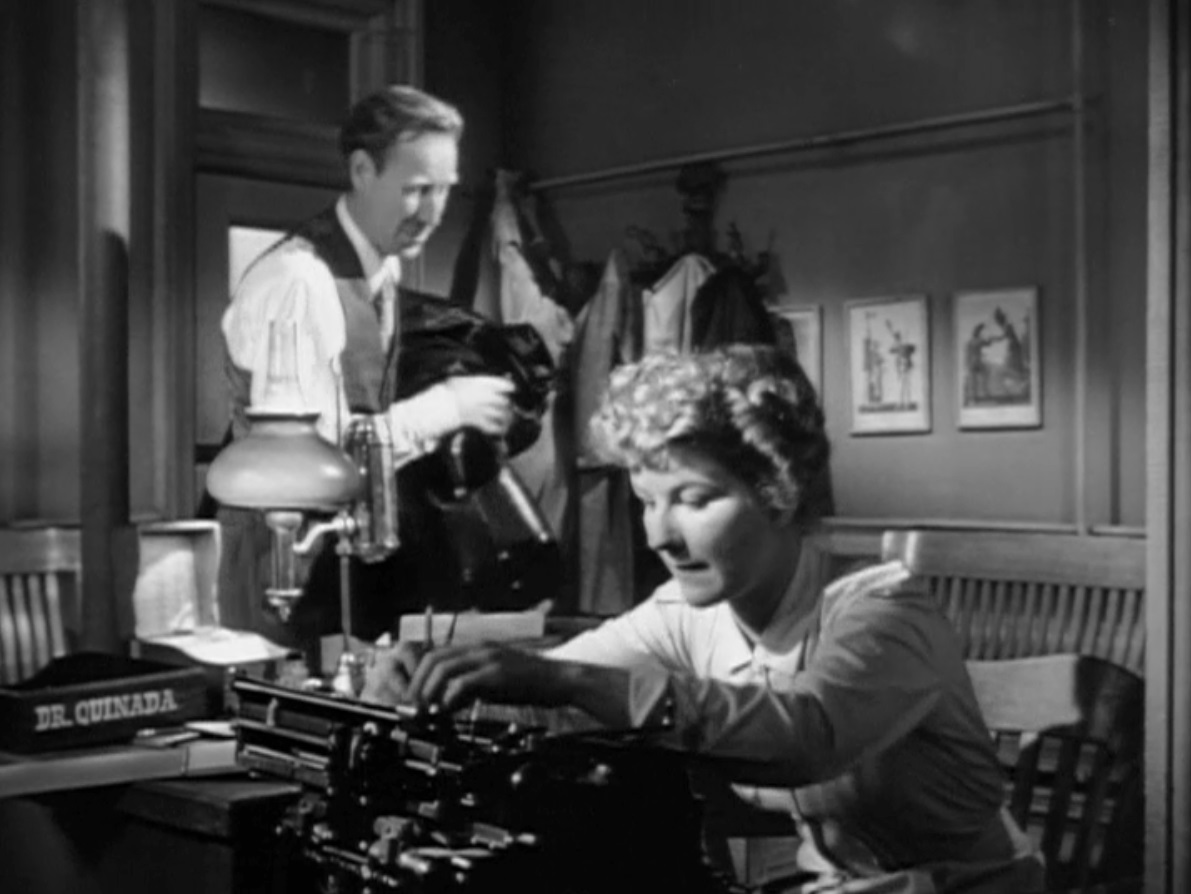 By contrast, the scenes shot in the doctors’ office, while more cluttered, paradoxically allow freer movement. Several times we see Ophuls’s signature panning shots as a character moves through a door and the camera glides along the axis parallel to the invisible fourth wall, moving us, without a cut, from one room to another. The ease of movement here represents Leonara’s relative freedom. Her life may be shabby in comparison to her existence at Smith’s mansion, but she is free to come and go as she pleases.
Ophuls takes great liberties with Libbie Block’s novel. One senses that Hollywood sensibilities in the 1940s did not allow the auteur to fully explore the conflict between the pull of passion and that of financial security. Leonara insists that she loved Smith and not his money, even though he proposes after one date. Ryan is creepy as the monstrous Smith, but the film’s first act, with Leonara paying for an education on how to land a man suggest a much deeper infatuation with money than Bel Geddes is allowed to show. A subsequent pregnancy–and Smith’s offer of divorce only if he can have custody of the child–give Leonara a reason for staying in a loveless marriage; when her doctor beau (Mason) attributes her hesitancy to leave Smith as being financially motivated, that also hints at a darker story that couldn’t be told.
Perhaps it was the greater freedom to own the conflict between money and security that makes The Earrings of Madame de… the better film. Both films begin with shots not of the female protagonist but of the trappings of riches. In Caught, Leonora is flipping through a catalog with her girlfriend discussing which luxury items they most covet. In Earrings, Louise (Danielle Darrieux) is rummaging through her possessions, trying to decide what to sell to a pawnbroker. “I’d rather die than give this up” she says of one item. “I adore my cross,” she says, ironically, about another piece of jewelry. When she decides to pawn the titular earrings, she stops at the church to pray: “Dear Saint, please make him buy them.”
M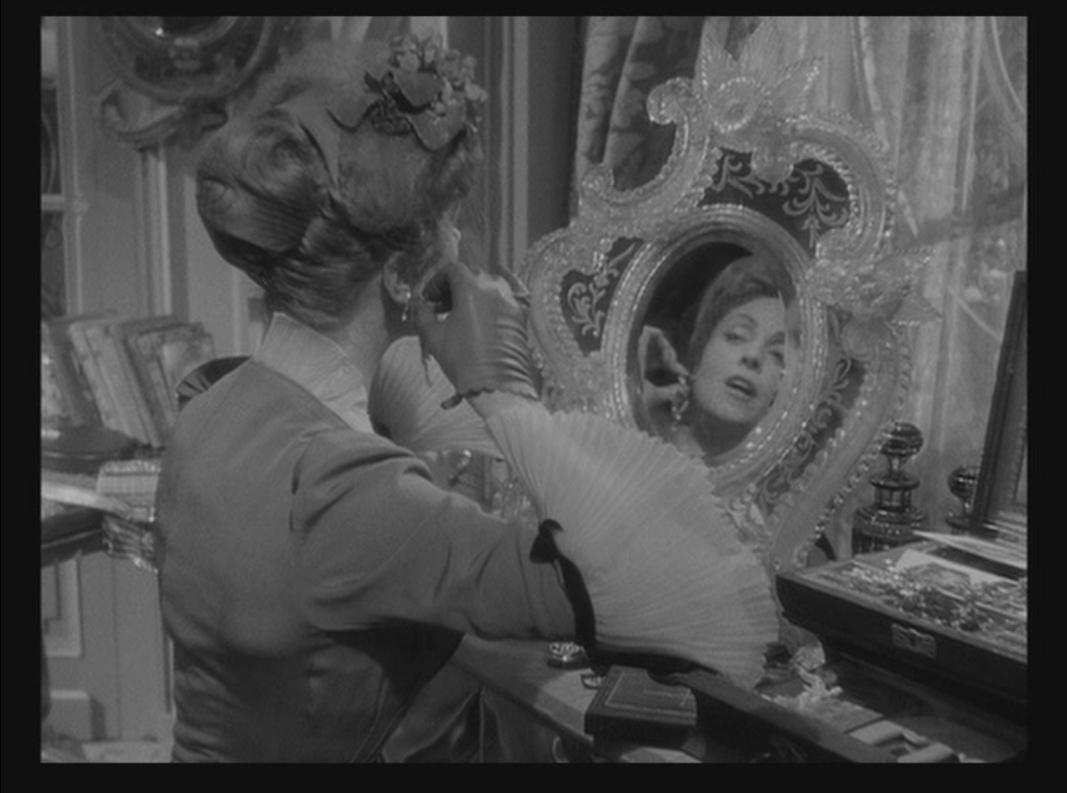 ore disturbing than the sale itself is the elaborate lie she comes up with to explain the jewelry’s absence to her husband. Because a lady can’t be contradicted, her claims to have lost the earrings at the opera necessitate an elaborate search (by her husband) and a police report. The potential damage created by her deceit is emphasized when the jeweler tells her husband that Louise sold the earrings. Since they have been reported stolen, if they are found in his possession, his shop could be ruined. Andrew (Charles Boyer) buys them and gives them to his mistress as a parting gesture.
How the earrings make their way back to Louise–and acquire a different value–comprises the bulk of the story. Here again, Ophuls uses mise-en-scene and tracking to suggest (relative) entrapment and freedom. Characters seem forever trapped in mirrors, faces devoid of expression and someone symbolically separated from the wealth that surrounds them. Dance as a symbol of emotional abandonment is a bit of a cliche, but the tracking shots give Louise’s dance with her lover (Vittorio de Sica) the requisite feeling of lightness to make us understand her choices.
Without getting into spoiler territory, it’s worth mentioning that Boyer is given a speech fairly late in the film that complicates our allegiances. I’ve commented in these pages before that the Hollywood melodrama seems forever stacked in favor of love over marriage–as though the two were indeed opposites. The unrepentant, monstrous Smith Ohlrig who forces the viewer to root for the adulterous relationship in Caught is replaced in Earrings with an admittedly flawed husband who is equally put upon and perhaps more willing to make some concessions than his wife. We know nothing in the film of their courtship or Louise’s life before marriage, but the opening scenes give us a fairly damning portrait of a woman who wants her cake twice over and to eat it too. There will be another trip to church before the film is over. Whether you read what happens there as an empty gesture or a desperate one will go a long way towards informing your opinion of Louise.
That it can be read as either one is part of Ophuls’s skill.
Caught is currently available on Amazon (free for Prime subscribers). The Earrings of Madame de… is a Criterion Blu-Ray disc, but it can also be seen by Hulu Plus scubscribers.
Previous Post

May 20, 2015
An Open Secret (Berg, 2014)
Next Post
May 27, 2015 I Am Big Bird: The Caroll Spinney Story (LaMattina, 2014)
Browse Our Archives
Select a Category 10 Years Later 1999 Top 5 2007 Top 10 2008 Favorite Discoveries 2008 Top 10 2009 Favorite Discoveries 2009 Top 10 2010 Favorite Discoveries 2010 Top 10 2011 Top 10 2012 Top Ten 2013 Top Ten 2014 Top Ten Best Picture Winners Christian Spotlight on Entertainment Christianity Today Coming Soon Disclosure Disclosure--AS Disclosure--Book Disclosure--DVDS Disclosure--SEOL Disclosure--Travel Dissenting Opinion Elsewhere Emergenetics Essays Featured Film Fest DC--2014 Film Festivals Full Frame Documentary Film Festival 2010 Full Frame Documentary Film Festival 2011 Full Frame Documentary Film Festival 2012 Full Frame Documentary Film Festival 2013 Full Frame Documentary Film Festival 2014 Headline Interviews Laura on the Oscar Winners Podcasts Quick Impressions Reviews RiverRun Film Festival 2014 Television The Criterion Collection The Thin Place To Stream or Not to Stream? Top 10s and Other Lists Toronto International Film Festival 2009 Toronto International Film Festival 2010 Toronto International Film Festival 2011 Toronto International Film Festival 2012 Toronto International Film Festival 2013 Toronto International Film Festival 2014 Uncategorized Video Virginia Film Festival 2011 Virginia Film Festival 2013 Women's Film Festival 2012
Select a Month February 2016 January 2016 December 2015 November 2015 October 2015 September 2015 August 2015 July 2015 June 2015 May 2015 April 2015 March 2015 February 2015 January 2015 December 2014 November 2014 October 2014 September 2014 August 2014 July 2014 June 2014 May 2014 April 2014 March 2014 February 2014 January 2014 December 2013 November 2013 October 2013 September 2013 August 2013 July 2013 June 2013 May 2013 April 2013 March 2013 February 2013 January 2013 December 2012 November 2012 October 2012 September 2012 August 2012 July 2012 June 2012 May 2012 April 2012 March 2012 February 2012 January 2012 December 2011 November 2011 October 2011 September 2011 August 2011 July 2011 June 2011 May 2011 April 2011 March 2011 February 2011 January 2011 December 2010 November 2010 October 2010 September 2010 August 2010 July 2010 June 2010 May 2010 April 2010 March 2010 February 2010 January 2010 December 2009 November 2009 September 2009 August 2009 July 2009 June 2009 May 2009 April 2009
Follow Us!
TAKE THE
Religious Wisdom Quiz
What is the name for a Christian adult education class, especially for converts?
Select your answer to see how you score.
Exegesis Catechism Martyrdom Ecumenism
Related posts from 1More Film Blog

An Inconvenient Truth (Guggenheim, 2006) -- 10 Years...

The Devil Wears Prada (Frankel, 2006) -- 10...


My Best Picture Choice: Mad Max: Fury Road
TRENDING AT PATHEOS Religious Music & Entertainment

"Les Diabolique" and Transgression
Alongside something like Arrival, Vertigo, or Charade, Les Diaboliques is a...

"The Plague Dogs" and Mortality
So, flashback to the late 70s, early 80s. Walt Disney Studios is...

With the recent and highly successful release of Christopher Nolan’s epic film,...

"L'avventura" and Human Weakness
Today's piece is going to be a little different for a few...

I first want to apologize for not posting or writing anything. I'm...

I've engaged in the multi-year project of reading through the Church Fathers,...
view all Religious Music & Entertainment blogs
Ad-Free & Subscriber Log-In Subscription Support
- About Us
- 2026 Calendar
- Videos
- Podcasts
- Library of World Religions
- Faith In Media Tracker
- Advertise With Us
- Write for Us
- Privacy Policy
- Terms of Service
- Do Not Sell My Data
- Contact Us
- Radiant Digital
- Manage Newsletter Subscriptions
- Unsubscribe From Notifications
- Sitemap
Copyright 2008-2026, Patheos. All rights reserved.
Subscription Support Ad-Free & Subscriber Log-In
Follow Patheos