
BuddhistCatholicContemplativeEvangelicalGeneral ChristianHinduJewishLatter-day SaintMuslimNew VisionsProgressive Christian
Beliefs
- Buddhist
- Catholic
- Contemplative
- Evangelical
- General Christian
- Hindu
- Jewish
- Latter-day Saint
- More Voices
- Muslim
- New Visions
- Pagan
- Progressive Christian
Topics
- Religion News
- Food and Religion
- Sports and Religion
- Religious Art
- Religious Music and Entertainment
- Religious Events
- History and Religion
- Style and Religion
- Politics and Religion
- Women in Religion
- Recreation Outdoors and Religion
- Business Finance and Religion
- Careers Workplace and Religion
- Education and Religion
- Family Parenting and Religion
- Health Fitness and Religion
- Home and Religion
- Relationships and Religion
- Technology and Religion
- Travel and Religion
Columnists
- Buddhist Columnists
- Business Finance and Religion Columnists
- Careers Workplace and Religion Columnists
- Catholic Columnists
- Contemplative Columnists
- Education and Religion Columnists
- Evangelists Columnists
- Family Parenting and Religion Columnists
- General Christian Columnists
- Health Fitness and Religion Columnists
- Hindu Columnists
- History and Religion Columnists
- Home and Religion Columnists
- Jewish Columnists
- More Voices Columnists
- Latter Day Columnists
- Muslim Columnists
- New Visions Columnists
- Nonreligious Columnists
- Pagan Columnists
- Politics and Religion Columnists
- Progressive Columnists
- Recreation Outdoors and Religion Columnists
- Relationships and Religion Columnists
- Religion News Columnists
- Religious Art Columnists
- Religious Events Columnists
- Religious Music and Entertainment Columnists
- Sports and Religion Columnists
- Style and Religion Columnists
- Technology and Religion Columnists
- Travel and Religion Columnists
- Women in Religion Columnists
Resource Library
- 2026 Calendar
- Library of World Religions
- The 100 Most Holy Places on Earth
- Patheos Answers
- Podcasts
- Videos
- Faith Leaders Database
- Anglican Episcopalian
- Bahai
- Baptist
- Buddhism
- Christianity
- Confucianism
- Eastern Orthodoxy
- Hinduism
- Holiness and Pentecostal
- ISKCON
- Islam
- Judaism
- Lutheran
- Methodist
- The Church of Jesus Christ of Latter-day Saints
- New Age
- Paganism
- Presbytarian and Reformed
- Protestantism
- Religion Behind the Scenes
- Roman Catholic
- Scientology
- Shia Islam
- Sikhism
- Sufism
- Sunni Islam
- Taoism
- Zen
- See all religions
Research Tools
 Ad-Free & Subscriber Log-In Subscription Support
Ad-Free & Subscriber Log-In Subscription Support
Follow Patheos 

- Trending:
- Forgiveness
- |
- Marriage
- |
- Consciousness
- |
- Death Penalty
- |
- Election
- |
- Halloween
 1More Film Blog
- Home
- Religious Music & Entertainment
- Bride & Prejudice (Chadha, 2004)
Bride & Prejudice (Chadha, 2004)
Last updated on: August 21, 2014 at 9:36 pm by Kenneth R. Morefield
Bride & Prejudice (Chadha, 2004) 2014-08-21T21:36:28-05:00 Kenneth R. Morefield
Patheos Explore the world's faith through different perspectives on religion and spirituality! Patheos has the views of the prevalent religions and spiritualities of the world.

Not sure if you’re ready to try Jodhaa Akhbar? Bride & Prejudice can ease you into Bollywood…
Where to start? Well, I finally understand those singing puppets in the Fandango commercials.
They are a wink at Bollywood, a growing genre of films from India that combine elements of the traditional Hollywood musical with soap operas, romantic comedies, and a dash of travelogue. Try to picture a cross between Moulin Rouge, General Hospital, and A Passage to India, and you’ll get a rough idea of a Bollywood production.
Bride & Prejudice is director Gurinder Chadha’s (Bend It Like Beckham) attempt to bring Bollywood into the American mainstream, and while I doubt it will create a sudden market for the more typical, three hour long and subtitled Bollywood pictures, it will give the more adventurous cinematic tourist an opportunity to dip his toe into the water and see if the temperature is to his liking.
The use of Jane Austen’s Pride and Prejudice as source material for the plot is a double edged sword. The title may attract fans of the Austen novel who find themselves antagonized by the liberties taken with the plot before they realize that Bride, like most Bollywood films (or martial arts films, for that matter), relies only on the barest bones of plot, anyway. Musicals aren’t generally known for their intricate plots or fresh characters, so if the opportunity to see a familiar and beloved story retold is the main attraction, Austen fans may be disappointed. On the other hand, the parallels to Austen help the movie make the necessary point that certain human conflicts and themes–marrying for love or money, the dangers of relying too heavily on superficial first impressions–are universal, so one need not have an advanced degree in Anthropology or Cultural Studies before one can appreciate or enjoy another culture’s art.
The story, such as it is, centers around Laleta Bakshi, the second eldest of four daughters of a respectable but not wealthy Indian family. When Balraj Bingley (Naveen Andrews, recognizable to American audiences from the television program Lost) brings his American friend, a rich hotel magnate named Will Darcy to India with him to attend a wedding, Darcy notices Laleta’s charm, beauty, and intelligence, but is put off by her matchmaking mother (played by Nadira Babbar, who manages to humanize a nearly impossible role). Various miscommunications and misunderstandings threaten to keep the would-be lovers apart, including an aggressive but crude Indian suitor for Laleta’s hand and a handsome but mysterious former servant of Darcy’s who poisons the well of Laleta’s good will by spreading false gossip about her new American acquaintance.
The main thing that threatens to keep Darcy and Laleta apart, however, are those pesky but nebulous cultural differences. The tone of the genre keeps those conflicts from ever being particularly sharp or penetrating. Personal expressions of religious belief, for example, are absent from the film, and their absence is one obvious way in which the world that is created is a fantasy one. What little dramatic tension there is comes more from miscommunications and misunderstandings than from true differences that are negotiated or resolved. Laleta accuses Darcy of thinking that Indians (and their customs) are lacking in the sophistication and advantages of Western practices. Since those characters, such as Mr. Kholi, who have immigrated or adopted Western practices are portrayed in the most negative light, the film seems to favor Indian culture and practices over American ones. That this attitude would be extended to include the superiority of the Hindu religion to Christianity could be assumed, although it is never overtly stated. One of the weaknesses of the film in comparison to the more complex Austen material which it echoes is that the reevaluation of first impressions is strictly one sided. While Darcy must come to appreciate the qualities of Laleta and the culture from which she springs, there is no reciprocal deepening of respect or understanding on her part for Darcy’s character and way of life. This alteration from the source material is understandable given the fact that Bride is more fairy tale than social commentary, but it may irritate some American viewers nevertheless. It is disappointing, though not surprising, that a film that lectures us about the evils of cultural stereotyping practices so much of it, but then again genre pieces are normally filled with stock characters rather than complex personalities, and what are stock characters if not, basically, stereotypes?
On a more positive note, there are several broad themes in the film on which Christians can profitably reflect. When asked what he likes about India, Darcy points to the commitment he has seen to the nuclear and extended family, a commitment that is often lacking in a dispersed American culture that can be overly preoccupied with making money and getting ahead. Although Mrs. Bakshi is portrayed as an unmannered gold-digger, the film (true to the Austen roots here) portrays a society in which parental and generational authority is taken seriously enough that its heroine does not practice contempt towards her parents, however embarrassed she might be by her mother’s behavior. There is a nice, quiet scene between Laleta and a friend who has admitted to marrying Mr. Kholi without much affection in which Laleta places compassion for her friend’s feelings above her own pride.
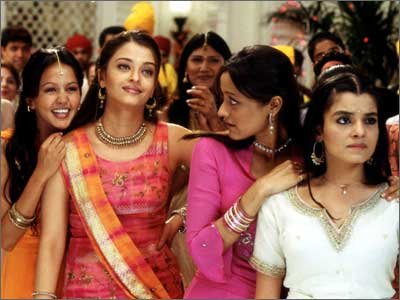
“Life’s great / Let’s celebrate…”
The Bollywood ingredient that was the most interesting to me, though, was its relentless and unabashed exuberance. There are three weddings in the film, and each is used as a stage for elaborate musical set pieces that merge music, dance, costume, and story to allow the characters to express their joy at the pleasures life sometimes affords and to optimistically hope for the day when they will participate in them directly rather than vicariously. There is a genuine happiness for the welfare of others that is so contrary to the spirit of envy that permeates much of contemporary life and film that it is hard not to root for these characters to have good things happen to them. In fact, in a year in which all five films nominated for the Academy Awards’ best picture feature depressed and depressing characters who act as poster children for Thomas Hobbes’s claim that life is solitary, poor, nasty, brutish, and short, it is more than a bit refreshing to see a movie with a palette that uses more colors than black, white, and gray, and whose lyrics, as hammy as they are, can include a wedding party singing, “Life’s great / let’s celebrate!” It has been almost thirty years since Richard Foster wrote in his classic devotional Celebration of Discipline that “the carefree spirit of joyous festivity is absent in contemporary society.” In his chapter on “The Discipline of Celebration” Foster reminds readers: “Joy is part of the fruit of the Spirit (Gal. 5:22) [….] Joy produces energy. Joy makes us strong.”
Bride & Prejudice had a lot of cheesy lyrics. Its tone and style were over-the-top and heavy handed. It was utterly predictable to anyone who is marginally familiar with the genre or the source material. But it was fun, and its refusal to take itself too seriously covered a multitude of artistic sins. Ultimately, if the baseline for judging a comedy is “Did I laugh?” the baseline for a musical might be, simply, “Was I entertained?”
I was.
***************************************
This review originally appeared at Christian Spotlight on Entertainment. I’ve reprinted it here as a good excuse to make a reminder that Rai’s newest film, Jodhaa Akhbar is now available on DVD and making the rounds of arthouse theaters. Don’t let its three and one-half hour running time scare you too much; it, too, is a lot of fun.
Previous Post

May 29, 2009
Up (Docter, 2009)
Next Post

June 3, 2009 The Tragedy of Hamlet (Brook, 2002)
Browse Our Archives
Select a Category 10 Years Later 1999 Top 5 2007 Top 10 2008 Favorite Discoveries 2008 Top 10 2009 Favorite Discoveries 2009 Top 10 2010 Favorite Discoveries 2010 Top 10 2011 Top 10 2012 Top Ten 2013 Top Ten 2014 Top Ten Best Picture Winners Christian Spotlight on Entertainment Christianity Today Coming Soon Disclosure Disclosure--AS Disclosure--Book Disclosure--DVDS Disclosure--SEOL Disclosure--Travel Dissenting Opinion Elsewhere Emergenetics Essays Featured Film Fest DC--2014 Film Festivals Full Frame Documentary Film Festival 2010 Full Frame Documentary Film Festival 2011 Full Frame Documentary Film Festival 2012 Full Frame Documentary Film Festival 2013 Full Frame Documentary Film Festival 2014 Headline Interviews Laura on the Oscar Winners Podcasts Quick Impressions Reviews RiverRun Film Festival 2014 Television The Criterion Collection The Thin Place To Stream or Not to Stream? Top 10s and Other Lists Toronto International Film Festival 2009 Toronto International Film Festival 2010 Toronto International Film Festival 2011 Toronto International Film Festival 2012 Toronto International Film Festival 2013 Toronto International Film Festival 2014 Uncategorized Video Virginia Film Festival 2011 Virginia Film Festival 2013 Women's Film Festival 2012
Select a Month February 2016 January 2016 December 2015 November 2015 October 2015 September 2015 August 2015 July 2015 June 2015 May 2015 April 2015 March 2015 February 2015 January 2015 December 2014 November 2014 October 2014 September 2014 August 2014 July 2014 June 2014 May 2014 April 2014 March 2014 February 2014 January 2014 December 2013 November 2013 October 2013 September 2013 August 2013 July 2013 June 2013 May 2013 April 2013 March 2013 February 2013 January 2013 December 2012 November 2012 October 2012 September 2012 August 2012 July 2012 June 2012 May 2012 April 2012 March 2012 February 2012 January 2012 December 2011 November 2011 October 2011 September 2011 August 2011 July 2011 June 2011 May 2011 April 2011 March 2011 February 2011 January 2011 December 2010 November 2010 October 2010 September 2010 August 2010 July 2010 June 2010 May 2010 April 2010 March 2010 February 2010 January 2010 December 2009 November 2009 September 2009 August 2009 July 2009 June 2009 May 2009 April 2009
Follow Us!
TAKE THE
Religious Wisdom Quiz
What does Paul tell Timothy to do with myths and old wives' tales?
Select your answer to see how you score.
Have nothing to do with them Ignore them Refute them Correct them
Related posts from 1More Film Blog

An Inconvenient Truth (Guggenheim, 2006) -- 10 Years...

The Devil Wears Prada (Frankel, 2006) -- 10...

"Telling a Great Story" -- An Interview with...

Is Snow White Still Essential?
TRENDING AT PATHEOS Religious Music & Entertainment

"Les Diabolique" and Transgression
Alongside something like Arrival, Vertigo, or Charade, Les Diaboliques is a...

"The Plague Dogs" and Mortality
So, flashback to the late 70s, early 80s. Walt Disney Studios is...

With the recent and highly successful release of Christopher Nolan’s epic film,...

"L'avventura" and Human Weakness
Today's piece is going to be a little different for a few...

I first want to apologize for not posting or writing anything. I'm...

I've engaged in the multi-year project of reading through the Church Fathers,...
view all Religious Music & Entertainment blogs
Ad-Free & Subscriber Log-In Subscription Support
- About Us
- 2026 Calendar
- Videos
- Podcasts
- Library of World Religions
- Faith In Media Tracker
- Advertise With Us
- Write for Us
- Privacy Policy
- Terms of Service
- Do Not Sell My Data
- Contact Us
- Radiant Digital
- Manage Newsletter Subscriptions
- Unsubscribe From Notifications
- Sitemap
Copyright 2008-2026, Patheos. All rights reserved.
Subscription Support Ad-Free & Subscriber Log-In
Follow Patheos