
BuddhistCatholicContemplativeEvangelicalGeneral ChristianHinduJewishLatter-day SaintMuslimNew VisionsProgressive Christian
Beliefs
- Buddhist
- Catholic
- Contemplative
- Evangelical
- General Christian
- Hindu
- Jewish
- Latter-day Saint
- More Voices
- Muslim
- New Visions
- Pagan
- Progressive Christian
Topics
- Religion News
- Food and Religion
- Sports and Religion
- Religious Art
- Religious Music and Entertainment
- Religious Events
- History and Religion
- Style and Religion
- Politics and Religion
- Women in Religion
- Recreation Outdoors and Religion
- Business Finance and Religion
- Careers Workplace and Religion
- Education and Religion
- Family Parenting and Religion
- Health Fitness and Religion
- Home and Religion
- Relationships and Religion
- Technology and Religion
- Travel and Religion
Columnists
- Buddhist Columnists
- Business Finance and Religion Columnists
- Careers Workplace and Religion Columnists
- Catholic Columnists
- Contemplative Columnists
- Education and Religion Columnists
- Evangelists Columnists
- Family Parenting and Religion Columnists
- General Christian Columnists
- Health Fitness and Religion Columnists
- Hindu Columnists
- History and Religion Columnists
- Home and Religion Columnists
- Jewish Columnists
- More Voices Columnists
- Latter Day Columnists
- Muslim Columnists
- New Visions Columnists
- Nonreligious Columnists
- Pagan Columnists
- Politics and Religion Columnists
- Progressive Columnists
- Recreation Outdoors and Religion Columnists
- Relationships and Religion Columnists
- Religion News Columnists
- Religious Art Columnists
- Religious Events Columnists
- Religious Music and Entertainment Columnists
- Sports and Religion Columnists
- Style and Religion Columnists
- Technology and Religion Columnists
- Travel and Religion Columnists
- Women in Religion Columnists
Resource Library
- 2026 Calendar
- Library of World Religions
- The 100 Most Holy Places on Earth
- Patheos Answers
- Podcasts
- Videos
- Faith Leaders Database
- Anglican Episcopalian
- Bahai
- Baptist
- Buddhism
- Christianity
- Confucianism
- Eastern Orthodoxy
- Hinduism
- Holiness and Pentecostal
- ISKCON
- Islam
- Judaism
- Lutheran
- Methodist
- The Church of Jesus Christ of Latter-day Saints
- New Age
- Paganism
- Presbytarian and Reformed
- Protestantism
- Religion Behind the Scenes
- Roman Catholic
- Scientology
- Shia Islam
- Sikhism
- Sufism
- Sunni Islam
- Taoism
- Zen
- See all religions
Research Tools
 Ad-Free & Subscriber Log-In Subscription Support
Ad-Free & Subscriber Log-In Subscription Support
Follow Patheos 

- Trending:
- Forgiveness
- |
- Marriage
- |
- Consciousness
- |
- Death Penalty
- |
- Election
- |
- Halloween
 1More Film Blog
- Home
- Religious Music & Entertainment
- Before Midnight (Linklater, 2013)
Before Midnight (Linklater, 2013)
Last updated on: August 6, 2014 at 3:46 pm by Kenneth R. Morefield
Before Midnight (Linklater, 2013) 2014-08-06T15:46:36-05:00 Kenneth R. Morefield
Patheos Explore the world's faith through different perspectives on religion and spirituality! Patheos has the views of the prevalent religions and spiritualities of the world.
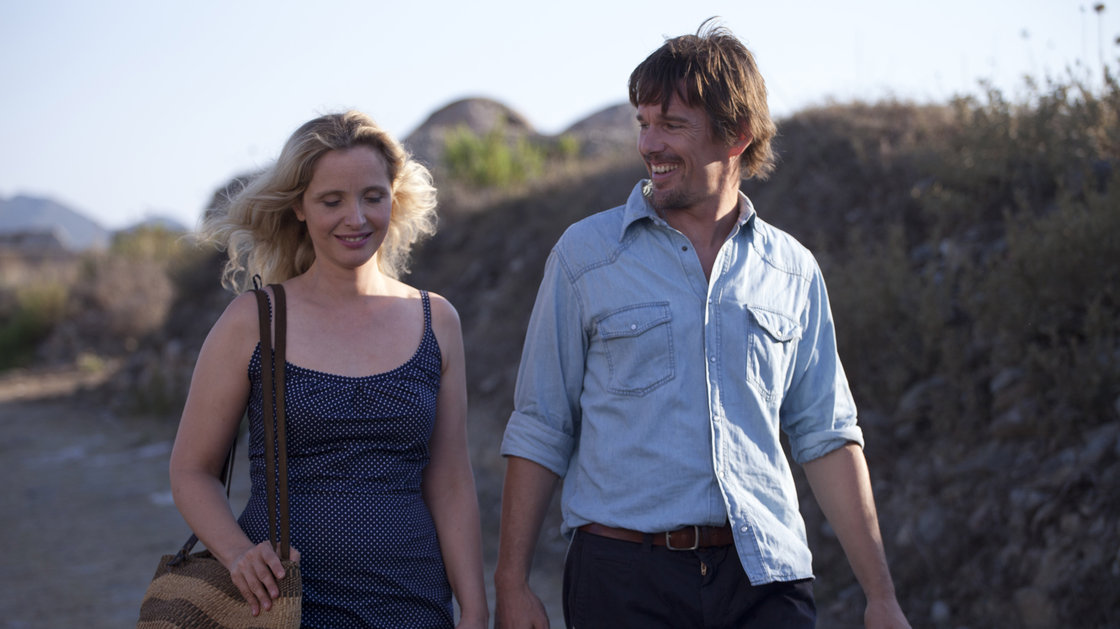
An edited version of this review originally appeared at Christianity Today Movies & TV. All rights reserved.
“We know that we are going to break up eventually.”
So says a young woman in the middle of her first great romantic attachment. The context is a dinner with cross-generational acquaintances at a villa in Greece. Three couples of varying ages are discussing friendship, companionship, commitment, sex—all the things that pass for or indicate love in the modern world—and they all seemingly agree on one thing: nothing relational in this world is permanent. Or, if they don’t agree, nobody is willing to fly publicly in the face of what has graduated from the status of conventional wisdom to that of accepted fact. Men and women want to love and be loved. They want it desperately enough that they must and will keep pairing off even as they loudly and persistently assert that love’s attainment is at best a random, lucky draw, at worst—and most probably—an illusory fairy tale.
I have always thought it significant that when Celine (Delpy) and Jesse (Hawke) met as strangers on a train eighteen years ago (in Before Sunrise), the immediate catalyst was a shared disgust at a publicly bickering (apparently) married couple. There follows an awkward, recycled joke about how married couples lose the ability to hear the pitch in which the opposite gendered partner speaks (“nature’s way of allowing couples to grow old without killing each other”), and Jesse later shares that his parents once said they stayed together only for the sake of the kids. Message to boomers, gen-xers, gen-yers, and millennials received: there’s marriage and then there’s love, and never the twain shall meet.
The dismissal of marriage and the search for what could possibly replace it as a sufficient outward sign that one’s relationship is special, nay unique, is the thread that ties three very different Celine and Jesse movies together. In Before Sunrise the characters speak in emotive, modern spiritual language (the preferred descriptor of their status is that they have a “connection”) to persuade themselves and others that something other than emotional infatuation or physical desire is driving them towards intimacy. How to demonstrate that claim in action, how to differentiate this relationship from a hook up, proves to be a problem beyond their capacity to solve. Celine’s one idea is to refrain from having sex, since that will at least make their relationship, even if she assumes it will still only be a one-night affair, different. The couple is unable to follow through on that resolution (although it is not confirmed that they did sleep together until Before Sunset), but they are able to follow through on the resolution to not exchange addresses of contact information so that a follow up meeting in six months can be entirely voluntary. Even this plan seems more like a rejection of any external, concrete obligation than a positive attempt to forge their own kind of covenant. Commitment, even just a commitment to call, write, or see each other again, is seen as a form of bondage, poison to a love relationship, despite the mutual assurances that continuing the relationship is what they both want.
In Before Sunset we learned that Celine never made that follow up meeting (her grandmother died and she was attending the funeral). Jesse wrote an autobiographical novel about their first encounter and eventually moved on to marry someone else and father a son. In the second film, Celine appears while Jesse is on a book tour and they engage in an afternoon of conversation, ostensibly to catch up but really to test the emotional waters and see if that perfect spark can be rekindled. Jesse’s marriage morally complicates their flirtation, but not as much as one might think (or hope). Love, connections, romance, fantasy, they all trump ceremony and sacrament because the characters, representative of their world, prioritize the emotional bonds created by the former over the societal or moral bonds created by the latter.
When Before Midnight begins—and beyond this point there are unavoidable plot spoilers—Jesse is putting his son on a plane back to his mother in the United States. He and Celine are together, having conceived, birthed, and raised twin girls. It is strongly implied that they are not married, although they have told their daughters that they are. Jesse wants to be more of a presence in his son’s life, which the couple senses would mean moving back to the United States. Celine does not want to give up a recently offered “dream job” merely to have child custody every-other weekend. They discuss their relationship in the car driving back from the airport, at the villa in Greece where they are vacationing, and at a hotel they have booked for a romantic evening that descends into a fight. Conflicts, both recent and simmering, come to a boil all at once.
Bertolt Brecht once famously opined that “art is not a mirror held up to reality, but a hammer with which to shape it.” The separate ends to which art is used, the diversity of things that the audience wants to get from the experience of viewing a film, makes it inevitable that viewers (perhaps especially Christian viewers) will sometimes have love-hate relationships with certain films. As a mirror to reality, Before Midnight is top notch. The patterns of speech, the subjects of argument, the worries the couple face, and the imperfect ways they deal with those worries, should be familiar to most viewers. It is a testament to how rounded and real Linklater, Delpy, and Hawke have made these characters that when one of them says “this is how it ends,” I felt grief akin to what I’ve felt when I’ve heard that actual couples I knew were breaking up. (The film ends, like each in the series, ambiguously, with choices facing the characters but no absolute indication of whether they are, in fact, breaking up or deciding to stay together.)
Yet for all the ways in which Before Midnight accurately depicts the seemingly inescapable frailties of a relationship built on modern notions of romanticized love—Celine’s resentment at Jesse’s family; the couple’s mutual insecurity manifesting itself in a constant, endless need for the specialness of the relationship to be proclaimed; the fear inculcated by the fact that to destroy a relationship each new obstacle need not be insurmountable but only stronger than the partner’s feelings at the current moment; the ways in which sex becomes less of a joyous celebration of union and more a desperate attempt to re-“connect”—there is something maddening about the way the conflicts never lead the characters to question their assumptions, never cause them to wonder if they might be happier and more fulfilled not with a different lover but with a different understanding of what love is.
Perhaps they do but sense that down that road lies madness. Celine scoffs at Jesse in one scene, derisively calling him “a closet Christian.” Jesse evades a question about fidelity by reconstructing it into one he can answer affirmatively (he is completely committed to the relationship, accepts her flaws, and loves her unconditionally). Celine insists that Jesse’s marriage would have ended eventually anyway, even if she had not reentered his life and participated in his adultery. Each of these scenes, along with the aforementioned one where the couple expresses bewilderment about why it is important to their daughters that they be married, hints that the characters have a moral consciousness which, however much they repress it, is not totally placated by their definition of love and their use of it to justify the choices they have made in their lives.
If I were convinced the movie was self-aware about Jesse’s and Celine’s cultivated moral evasiveness, persuaded that the way they habitually raise moral questions only to skirt them was a critique of the worldview (or at least love view) that the first two film’s appeared to champion, I would probably consider Before Midnight a masterpiece. What I think we actually get in the film is a world view that is brilliantly mirrored but never really analyzed. Marriage, to parrot G. K. Chesterton’s famous saying about Christianity, has not been tried and found wanting so much as found hard and left untried. What is increasingly evident in this film is that relationships, whether bound in marriage or not, are hard. While it is certainly true that people do have loving relationships outside of marriage and unloving ones within marriage, the possibility that the institution, the sacrament, might actually provide tangible benefits that while not ensuring the conditions of a happy, permanent relationship can support and promote them is never openly or seriously considered in the film.
Jesse and Celine may be too far gone down the path of lamenting how their relationship has been influenced by past choices to seriously consider whether other (kinds of) choices are yet possible, but is that true of all people at this stage of their life? The fatalism imbuing the characters and the film is certainly representative of what many couples feel in middle-age, a period in which there are as many or more choices behind them as awaiting them and where the quality of a relationship is influenced as much by the fruit of past decisions as the pleasurable contemplation of future ones. Again, though, does the fact that the feelings expressed in the film are so ubiquitous mean they are grounded universally true?
There is little to no serious attempt to compare or contrast the relationship with any others; the film is simply an exquisitely detailed warts-and-all portrait. For all that, no film I’ve seen in recent memory has led to more substantive and productive conversations about what goes into a good relationship. Even if the characters themselves don’t model good choices, even if the film doesn’t appear to value their choices wisely (or even coherently), is it not one of the functions of great art to challenge and provoke rather than assure and placate? Before Midnight is in no way a “Christian” film, but it is an attempt by serious artists to represent faithfully the world we live in, and by doing so it reveals truths about that world and the people that inhabit it. That some of the people in it (or some watching it) may not be able to grasp all those truths or act upon them makes for a viewing experience that is often more painful than it is pleasurable. Still, I would rather be invited to wrestle with some difficult and potentially painful truths than be anesthetized by more vacuous violence, crude comedy, or pseudo-philosophy. Summer is littered with plenty of mindless entertainment. In that landscape, we are not likely to get a more thoughtful or thought provoking film than Before Midnight.
Previous Post

July 1, 2014
Earth to Echo (Green 2014)
Next Post

July 6, 2014 Masters of Sex -- Three Ways the Showtime Series Surprised Me By Being Good
Browse Our Archives
Select a Category 10 Years Later 1999 Top 5 2007 Top 10 2008 Favorite Discoveries 2008 Top 10 2009 Favorite Discoveries 2009 Top 10 2010 Favorite Discoveries 2010 Top 10 2011 Top 10 2012 Top Ten 2013 Top Ten 2014 Top Ten Best Picture Winners Christian Spotlight on Entertainment Christianity Today Coming Soon Disclosure Disclosure--AS Disclosure--Book Disclosure--DVDS Disclosure--SEOL Disclosure--Travel Dissenting Opinion Elsewhere Emergenetics Essays Featured Film Fest DC--2014 Film Festivals Full Frame Documentary Film Festival 2010 Full Frame Documentary Film Festival 2011 Full Frame Documentary Film Festival 2012 Full Frame Documentary Film Festival 2013 Full Frame Documentary Film Festival 2014 Headline Interviews Laura on the Oscar Winners Podcasts Quick Impressions Reviews RiverRun Film Festival 2014 Television The Criterion Collection The Thin Place To Stream or Not to Stream? Top 10s and Other Lists Toronto International Film Festival 2009 Toronto International Film Festival 2010 Toronto International Film Festival 2011 Toronto International Film Festival 2012 Toronto International Film Festival 2013 Toronto International Film Festival 2014 Uncategorized Video Virginia Film Festival 2011 Virginia Film Festival 2013 Women's Film Festival 2012
Select a Month February 2016 January 2016 December 2015 November 2015 October 2015 September 2015 August 2015 July 2015 June 2015 May 2015 April 2015 March 2015 February 2015 January 2015 December 2014 November 2014 October 2014 September 2014 August 2014 July 2014 June 2014 May 2014 April 2014 March 2014 February 2014 January 2014 December 2013 November 2013 October 2013 September 2013 August 2013 July 2013 June 2013 May 2013 April 2013 March 2013 February 2013 January 2013 December 2012 November 2012 October 2012 September 2012 August 2012 July 2012 June 2012 May 2012 April 2012 March 2012 February 2012 January 2012 December 2011 November 2011 October 2011 September 2011 August 2011 July 2011 June 2011 May 2011 April 2011 March 2011 February 2011 January 2011 December 2010 November 2010 October 2010 September 2010 August 2010 July 2010 June 2010 May 2010 April 2010 March 2010 February 2010 January 2010 December 2009 November 2009 September 2009 August 2009 July 2009 June 2009 May 2009 April 2009
Follow Us!
TAKE THE
Religious Wisdom Quiz
Where does the Bible say, "do to others as you would have them do to you"?
Select your answer to see how you score.
Revelation Leviticus Judges Luke
Related posts from 1More Film Blog
The Hateful Eight (Tarantino, 2015)



Sleeping with Other People (Headland, 2015)
TRENDING AT PATHEOS Religious Music & Entertainment

"Les Diabolique" and Transgression
Alongside something like Arrival, Vertigo, or Charade, Les Diaboliques is a...

"The Plague Dogs" and Mortality
So, flashback to the late 70s, early 80s. Walt Disney Studios is...

With the recent and highly successful release of Christopher Nolan’s epic film,...

"L'avventura" and Human Weakness
Today's piece is going to be a little different for a few...

I first want to apologize for not posting or writing anything. I'm...

I've engaged in the multi-year project of reading through the Church Fathers,...
view all Religious Music & Entertainment blogs
Ad-Free & Subscriber Log-In Subscription Support
- About Us
- 2026 Calendar
- Videos
- Podcasts
- Library of World Religions
- Faith In Media Tracker
- Advertise With Us
- Write for Us
- Privacy Policy
- Terms of Service
- Do Not Sell My Data
- Contact Us
- Radiant Digital
- Manage Newsletter Subscriptions
- Unsubscribe From Notifications
- Sitemap
Copyright 2008-2026, Patheos. All rights reserved.
Subscription Support Ad-Free & Subscriber Log-In
Follow Patheos