
BuddhistCatholicContemplativeEvangelicalGeneral ChristianHinduJewishLatter-day SaintMuslimNew VisionsProgressive Christian
Beliefs
- Buddhist
- Catholic
- Contemplative
- Evangelical
- General Christian
- Hindu
- Jewish
- Latter-day Saint
- More Voices
- Muslim
- New Visions
- Pagan
- Progressive Christian
Topics
- Religion News
- Food and Religion
- Sports and Religion
- Religious Art
- Religious Music and Entertainment
- Religious Events
- History and Religion
- Style and Religion
- Politics and Religion
- Women in Religion
- Recreation Outdoors and Religion
- Business Finance and Religion
- Careers Workplace and Religion
- Education and Religion
- Family Parenting and Religion
- Health Fitness and Religion
- Home and Religion
- Relationships and Religion
- Technology and Religion
- Travel and Religion
Columnists
- Buddhist Columnists
- Business Finance and Religion Columnists
- Careers Workplace and Religion Columnists
- Catholic Columnists
- Contemplative Columnists
- Education and Religion Columnists
- Evangelists Columnists
- Family Parenting and Religion Columnists
- General Christian Columnists
- Health Fitness and Religion Columnists
- Hindu Columnists
- History and Religion Columnists
- Home and Religion Columnists
- Jewish Columnists
- More Voices Columnists
- Latter Day Columnists
- Muslim Columnists
- New Visions Columnists
- Nonreligious Columnists
- Pagan Columnists
- Politics and Religion Columnists
- Progressive Columnists
- Recreation Outdoors and Religion Columnists
- Relationships and Religion Columnists
- Religion News Columnists
- Religious Art Columnists
- Religious Events Columnists
- Religious Music and Entertainment Columnists
- Sports and Religion Columnists
- Style and Religion Columnists
- Technology and Religion Columnists
- Travel and Religion Columnists
- Women in Religion Columnists
Resource Library
- 2026 Calendar
- Library of World Religions
- The 100 Most Holy Places on Earth
- Patheos Answers
- Podcasts
- Videos
- Faith Leaders Database
- Anglican Episcopalian
- Bahai
- Baptist
- Buddhism
- Christianity
- Confucianism
- Eastern Orthodoxy
- Hinduism
- Holiness and Pentecostal
- ISKCON
- Islam
- Judaism
- Lutheran
- Methodist
- The Church of Jesus Christ of Latter-day Saints
- New Age
- Paganism
- Presbytarian and Reformed
- Protestantism
- Religion Behind the Scenes
- Roman Catholic
- Scientology
- Shia Islam
- Sikhism
- Sufism
- Sunni Islam
- Taoism
- Zen
- See all religions
Research Tools
 Ad-Free & Subscriber Log-In Subscription Support
Ad-Free & Subscriber Log-In Subscription Support
Follow Patheos 

- Trending:
- Forgiveness
- |
- Marriage
- |
- Consciousness
- |
- Death Penalty
- |
- Election
- |
- Halloween
 1More Film Blog
- Home
- Religious Music & Entertainment
- Because I Was a Painter (Cognet, 2014)
Because I Was a Painter (Cognet, 2014)
Last updated on: April 24, 2015 at 5:27 am by Andrew Spitznas
Because I Was a Painter (Cognet, 2014) 2015-04-24T05:27:52-05:00 Andrew Spitznas
Patheos Explore the world's faith through different perspectives on religion and spirituality! Patheos has the views of the prevalent religions and spiritualities of the world.
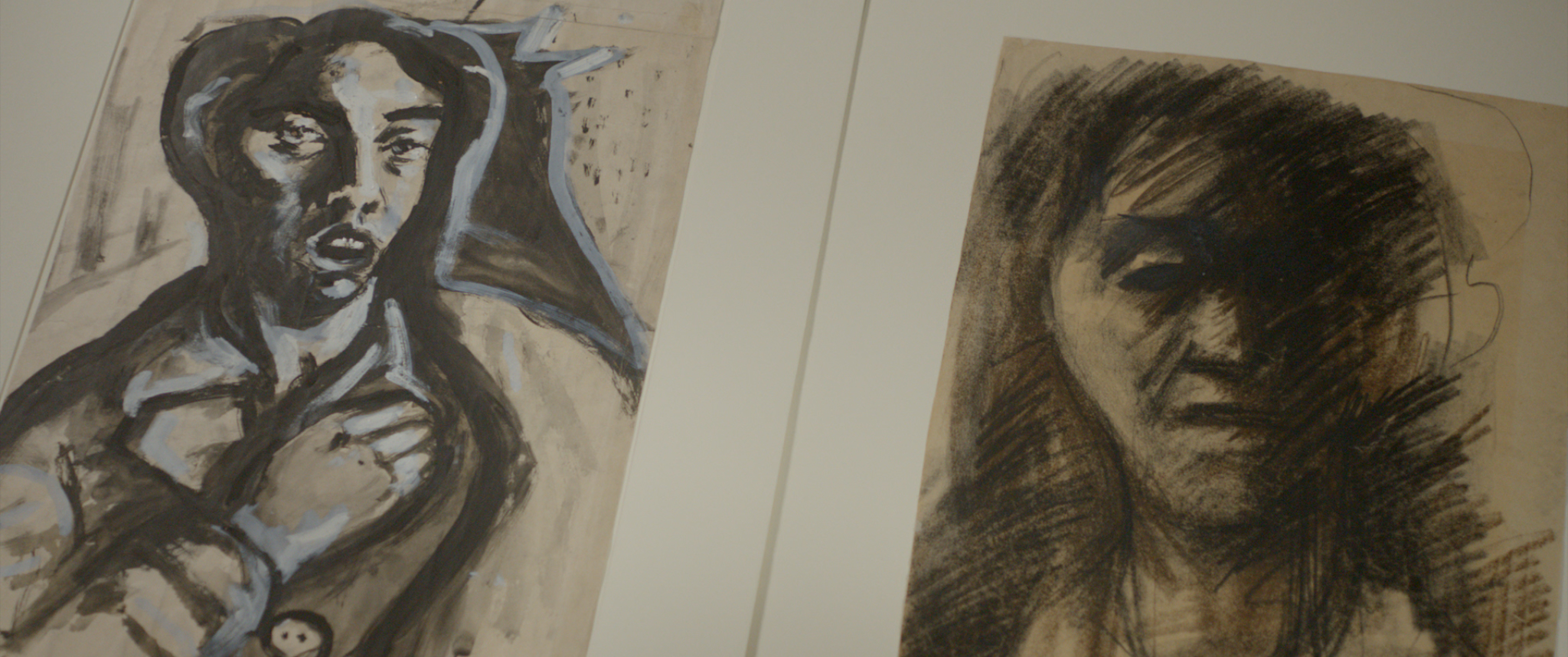
Artwork featured in “Because I Was a Painter”
Can powerful, even beautiful, art emerge from the most horrific of circumstances? What propelled concentration camp prisoners to paint and draw, when faced daily with death, confinement, and cruelty?
These questions are contemplated in Christophe Cognet’s austere yet affecting documentary, Because I Was a Painter: Art that Survived Nazi Camps. Multiple answers are offered through interviews with surviving artists, museum curators, and historians. Meanwhile, necessary context is provided by close examination of the art of 22 prisoners.
The consensus answer to the first question would be a qualified yes. No matter the setting, beauty springs from mastery of technique and form. It also arises from the unquenchable wonder of color and nature, including the human form.
Ever-present death on an incomprehensibly massive scale, of course, was anything but lovely. Citing timeless works like Picasso’s Guernica, one painter/survivor points out, however, that tragedy has long been the soil from which beauty grows. A former Buchenwald prisoner eloquently describes the camp as “a symphony of grays.”
When it comes to the motivations for their artistry, the responses are much more varied. A few ex-captives speak of the unquenchable drive to create, an “atavistic” compulsion heedless of place and time. This is evidenced by the risks the prisoners sometimes took, sketching while on forced marches or stealthily scavenging paper from SS offices.
Others found escape in drawing subjects unrelated to their imprisonment, comfort in conversing about civilized topics in the midst of depravity, or a Proustian return to soothing childhood memories on the wafting scent of turpentine and linseed oil. On occasion, their talents were a ticket to survival, painting portraits of their captors’ children.
Unsurprisingly, many felt the urgency to bear witness and document the events and places surrounding them. A particularly poignant example is a drawing of the Polish extermination camp Sobibor, of which no photographs or other images have survived. Another grim instance comes from the gypsy portraits of Auschwitz, completed only 1-2 hours before their subjects were murdered for Josef Mengele’s ghoulish medical experiments.
It’s no wonder, either, that the styles of the works we see are quite variable (as in the recently reviewed Abandoned Goods, another documentary about art emerging from soul-deadening locales). Some drawings are rough and childlike. Other sketches are more accomplished and would not be out of place in an upper echelon graphic novel.
There’s a haunting abstraction evident in some illustrations, with a man’s gaunt, weary face appearing in the smoke above a crematorium in one drawing. Still other portraits are arrestingly realistic, capturing the core emotion of their subjects, whether dignified determination, fatalism, or despair.
Cognet’s style is perfect for his weighty subject matter. The director invariably uses slow camera movement, whether across artworks or views of the concentration camps as they appear today. Almost completely eschewing narration or musical accompaniment, Cognet employs only straightforward cuts and the occasional fade to white, the simplest of editing techniques.

A contemporary view of a concentration camp, from “Because I Was a Painter”
This simplicity only multiplies the power of Because I Was a Painter. The unhurried movement permits us to see the awful cognitive dissonance inherent to a concentration camp’s daily life. For instance, a skillful overhead sketch of Treblinka is merely admirable, then becomes entirely dreadful once you notice the crane in the background whose maw clasps multiple corpses. A hellish cartoonlike drawing of naked females in a Sachsenhausen shower, scrambling atop one another to stay above the deadly gas, grows even ghastlier when the camera view includes the death’s head Nazi face leering through a window at the mayhem within.
Simultaneously and paradoxically, Cognet’s technique lends a certain detachment to his documentary, so that I’m only feeling the emotional pungency of his material retrospectively. In the balance, though, I think Painter’s director chose wisely. The topic of the Holocaust as depicted in movies now verges on banality, a lazy default topic when moviemakers want to release an “important” film (Life Is Beautiful, anyone?).
In considering the Holocaust from the novel vantage point of its artistic captives, Cognet has made an important contribution to our understanding and visualization of this cataclysm. In its portrayal of the light and darkness of humanity in one of modernity’s most horrific episodes, Because I Was a Painter can honorably keep company with such Holocaust-generated classics of art and philosophy as Victor Frankl’s Man’s Search for Meaning and Simon Wiesenthal’s The Sunflower.
4.5 out of 5 stars
(Parents’ guide: Because I Was a Painter has not been rated by the MPAA. Due to its intense subject matter and graphic visualization, I would encourage viewing by teens and adults only.)
Previous Post

April 21, 2015
24 Days (Arcady, 2014)
Next Post
April 24, 2015 Homeless (Hassler, 2015)
Browse Our Archives
Select a Category 10 Years Later 1999 Top 5 2007 Top 10 2008 Favorite Discoveries 2008 Top 10 2009 Favorite Discoveries 2009 Top 10 2010 Favorite Discoveries 2010 Top 10 2011 Top 10 2012 Top Ten 2013 Top Ten 2014 Top Ten Best Picture Winners Christian Spotlight on Entertainment Christianity Today Coming Soon Disclosure Disclosure--AS Disclosure--Book Disclosure--DVDS Disclosure--SEOL Disclosure--Travel Dissenting Opinion Elsewhere Emergenetics Essays Featured Film Fest DC--2014 Film Festivals Full Frame Documentary Film Festival 2010 Full Frame Documentary Film Festival 2011 Full Frame Documentary Film Festival 2012 Full Frame Documentary Film Festival 2013 Full Frame Documentary Film Festival 2014 Headline Interviews Laura on the Oscar Winners Podcasts Quick Impressions Reviews RiverRun Film Festival 2014 Television The Criterion Collection The Thin Place To Stream or Not to Stream? Top 10s and Other Lists Toronto International Film Festival 2009 Toronto International Film Festival 2010 Toronto International Film Festival 2011 Toronto International Film Festival 2012 Toronto International Film Festival 2013 Toronto International Film Festival 2014 Uncategorized Video Virginia Film Festival 2011 Virginia Film Festival 2013 Women's Film Festival 2012
Select a Month February 2016 January 2016 December 2015 November 2015 October 2015 September 2015 August 2015 July 2015 June 2015 May 2015 April 2015 March 2015 February 2015 January 2015 December 2014 November 2014 October 2014 September 2014 August 2014 July 2014 June 2014 May 2014 April 2014 March 2014 February 2014 January 2014 December 2013 November 2013 October 2013 September 2013 August 2013 July 2013 June 2013 May 2013 April 2013 March 2013 February 2013 January 2013 December 2012 November 2012 October 2012 September 2012 August 2012 July 2012 June 2012 May 2012 April 2012 March 2012 February 2012 January 2012 December 2011 November 2011 October 2011 September 2011 August 2011 July 2011 June 2011 May 2011 April 2011 March 2011 February 2011 January 2011 December 2010 November 2010 October 2010 September 2010 August 2010 July 2010 June 2010 May 2010 April 2010 March 2010 February 2010 January 2010 December 2009 November 2009 September 2009 August 2009 July 2009 June 2009 May 2009 April 2009
Follow Us!
TAKE THE
Religious Wisdom Quiz
Which Christian movement is known for "speaking in tongues" and lively worship?
Select your answer to see how you score.
Pentecostalism Presbyterianism Catholicism Quakerism
Related posts from 1More Film Blog

An Inconvenient Truth (Guggenheim, 2006) -- 10 Years...

The Devil Wears Prada (Frankel, 2006) -- 10...

"Telling a Great Story" -- An Interview with...

Is Snow White Still Essential?
TRENDING AT PATHEOS Religious Music & Entertainment

"Les Diabolique" and Transgression
Alongside something like Arrival, Vertigo, or Charade, Les Diaboliques is a...

"The Plague Dogs" and Mortality
So, flashback to the late 70s, early 80s. Walt Disney Studios is...

With the recent and highly successful release of Christopher Nolan’s epic film,...

"L'avventura" and Human Weakness
Today's piece is going to be a little different for a few...

I first want to apologize for not posting or writing anything. I'm...

I've engaged in the multi-year project of reading through the Church Fathers,...
view all Religious Music & Entertainment blogs
Ad-Free & Subscriber Log-In Subscription Support
- About Us
- 2026 Calendar
- Videos
- Podcasts
- Library of World Religions
- Faith In Media Tracker
- Advertise With Us
- Write for Us
- Privacy Policy
- Terms of Service
- Do Not Sell My Data
- Contact Us
- Radiant Digital
- Manage Newsletter Subscriptions
- Unsubscribe From Notifications
- Sitemap
Copyright 2008-2026, Patheos. All rights reserved.
Subscription Support Ad-Free & Subscriber Log-In
Follow Patheos