
BuddhistCatholicContemplativeEvangelicalGeneral ChristianHinduJewishLatter-day SaintMuslimNew VisionsProgressive Christian
Beliefs
- Buddhist
- Catholic
- Contemplative
- Evangelical
- General Christian
- Hindu
- Jewish
- Latter-day Saint
- More Voices
- Muslim
- New Visions
- Pagan
- Progressive Christian
Topics
- Religion News
- Food and Religion
- Sports and Religion
- Religious Art
- Religious Music and Entertainment
- Religious Events
- History and Religion
- Style and Religion
- Politics and Religion
- Women in Religion
- Recreation Outdoors and Religion
- Business Finance and Religion
- Careers Workplace and Religion
- Education and Religion
- Family Parenting and Religion
- Health Fitness and Religion
- Home and Religion
- Relationships and Religion
- Technology and Religion
- Travel and Religion
Columnists
- Buddhist Columnists
- Business Finance and Religion Columnists
- Careers Workplace and Religion Columnists
- Catholic Columnists
- Contemplative Columnists
- Education and Religion Columnists
- Evangelists Columnists
- Family Parenting and Religion Columnists
- General Christian Columnists
- Health Fitness and Religion Columnists
- Hindu Columnists
- History and Religion Columnists
- Home and Religion Columnists
- Jewish Columnists
- More Voices Columnists
- Latter Day Columnists
- Muslim Columnists
- New Visions Columnists
- Nonreligious Columnists
- Pagan Columnists
- Politics and Religion Columnists
- Progressive Columnists
- Recreation Outdoors and Religion Columnists
- Relationships and Religion Columnists
- Religion News Columnists
- Religious Art Columnists
- Religious Events Columnists
- Religious Music and Entertainment Columnists
- Sports and Religion Columnists
- Style and Religion Columnists
- Technology and Religion Columnists
- Travel and Religion Columnists
- Women in Religion Columnists
Resource Library
- 2026 Calendar
- Library of World Religions
- The 100 Most Holy Places on Earth
- Patheos Answers
- Podcasts
- Videos
- Faith Leaders Database
- Anglican Episcopalian
- Bahai
- Baptist
- Buddhism
- Christianity
- Confucianism
- Eastern Orthodoxy
- Hinduism
- Holiness and Pentecostal
- ISKCON
- Islam
- Judaism
- Lutheran
- Methodist
- The Church of Jesus Christ of Latter-day Saints
- New Age
- Paganism
- Presbytarian and Reformed
- Protestantism
- Religion Behind the Scenes
- Roman Catholic
- Scientology
- Shia Islam
- Sikhism
- Sufism
- Sunni Islam
- Taoism
- Zen
- See all religions
Research Tools
 Ad-Free & Subscriber Log-In Subscription Support
Ad-Free & Subscriber Log-In Subscription Support
Follow Patheos 

- Trending:
- Forgiveness
- |
- Marriage
- |
- Consciousness
- |
- Death Penalty
- |
- Election
- |
- Halloween
 1More Film Blog
- Home
- Religious Music & Entertainment
- About Schmidt (Payne, 2002) — 10 Years Later
About Schmidt (Payne, 2002) — 10 Years Later
Last updated on: March 1, 2015 at 8:41 pm by Kenneth R. Morefield
About Schmidt (Payne, 2002) — 10 Years Later 2015-03-01T20:41:03-05:00 Kenneth R. Morefield
Patheos Explore the world's faith through different perspectives on religion and spirituality! Patheos has the views of the prevalent religions and spiritualities of the world.
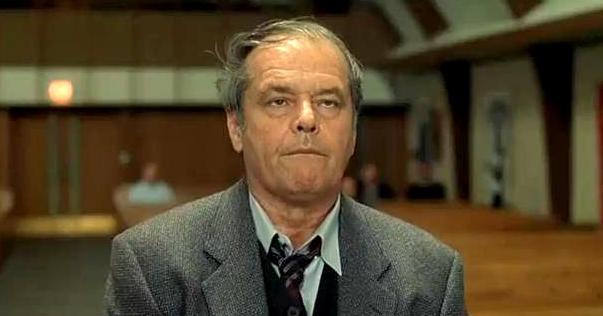
About Schmidt (2002)
In the immediate aftermath of the passing of his wife, Helen, Warren Schmidt (Jack Nicholson) writes the African child he is sponsoring one of his long, confessional letters that serve as the reason-de-voice over for the film. As an insurance actuary, he can chart the probability of his own death and realizes that time is precious. He resolves to cherish life and try to live every moment of every day to its fullest.
Cut to a scene of Warren, mouth open, snoring, sitting in front of a television set with the type “One Week Later” on the screen.
I am not sure what it says about Alexander Payne’s tragicomedy that the first thing I thought of when reviewing that scene was that, beat for beat, it was the same joke and timing from the classic episode of The Simpsons where Homer survives eating what he momentarily thinks is a poison blowfish.
A decade later, on the day I write this, Payne’s 2012 film, The Descendants, has been nominated for best picture of the year, with Payne himself getting a best director nomination to boot. I guess I can’t say then that this auteur’s shtick is wearing thin on anyone but me. Both films feature men who find out their dead (or dying) wives have had affairs. Again, I am not entirely sure what that signifies. A lot of writers have situations they explore from multiple angles or integrate into very different narratives. Both films are based on novels, too, so perhaps it is just a coincidence that the director picked them, a decade apart, as foundations for his projects.
I couldn’t much shake the feeling here, though, as with last year’s revisit of The Royal Tennenbaums, that as quirky and as interesting as this might have seemed ten years ago, the proceeding span would bring me not development but repetition, not new innovations, but continual regurgitaitons.
Is that an explaining by naming fallacy? In the wake of rewatching About Schmidt, I have spent some time questioning myself about the differences between style and shtick. Can I enumerate those differences, or are they just different words to alternately say roughly the same things, one attached to films by auteurs I like (such as Aaron Sorkin who has some definite themes and even lines that get recycled Sports Night to The West Wing to The American President to The Social Network) and the other to those I am less enamored with (even Sideways, the Payne film I recall liking the most, is something I’ve never felt moved to look at again).
My dictionary says that shtick is self-conscious, it is not just something someone does routinely but that he or she does routinely for the purpose of bringing attention to himself. Visually, to be honest, I don’t see that in Payne’s work. He doesn’t have some of the gimmicks of a Lucas or Speilberg–spot shadowing, or allowing the camera to linger on a spot after someone has moved out of frame to ensure that you see what others would leave at the margin for the attentive viewer to catch (or not).
Narratively, however, there is a lot of exposition that is on the nose. The device of the letter writing is a clever way at getting to the voice-over, but voice-over is intrinsically expository and tends to tell rater than show.
Payne’s films also appear to be populated with transparently unlikable people who are exaggerated to the point of buffonishness. What plot there is in About Schmidt deals with the impending marriage of Warren’s daughter (Hope Davis, years before In Treatment!) and a world class loser who thinks that the week after mom-in-law’s death is a good time to approach Warren about a multi-level-marketing opportunity. Kathy Bates was nominated for a Best Supporting Actress statuette for her turn as the crazy in-law to be. She’s terrific in everything she does, but it is hard not to see her much commented upon nude scene through the filter of the scene in Sideways where Paul Giammati has to sneak into a room where fat people are having sex. That the protagonist is arrogant and intolerant allows for an epiphany of self-revelation and self-contempt, but this film never really indicts the viewer for sharing Warren’s low opinion of anything and anyone.
At one point in his cross-country RV trip, Warren stops at a museum over a highway in the Midwest meant to commemorate the pioneer spirit. Warren compares the tenacity, courage, and perseverance of the early settlers to that of the modern man with endless helps yet less achievements. It is here, I suspect, that About Schmidt is meant to make a cultural comment that reaches beyond one man’s personal story. Is Warren the every man who is confronted with a modern sense of uselessness and purposelessness? If so, then I suspect part of my dissatisfaction with the story is the assumption that nothing can be done to alleviate that feeling and so the best we can do is have sympathy towards those who have been stripped of the comforting delusions of love, joy, and purpose that make life bearable.
What if they are not delusions and illusions though? What if a life well lived is not just a pipe dream and value and self worth can be attained by something other than writing a check? It’s moving that as he wonders whether his life makes a difference to anyone that Warren receives a letter from his sponsored child, but, really, doesn’t this scene just fall into the trap of an economically deterministic world view that says, in the end, money (and how we spend it) is the only thing that really matters?
Previous Post

January 20, 2012
Red Tails (Hemingway, 2012)
Next Post

February 2, 2012 Albert Nobbs (Garcia, 2011)
Browse Our Archives
Select a Category 10 Years Later 1999 Top 5 2007 Top 10 2008 Favorite Discoveries 2008 Top 10 2009 Favorite Discoveries 2009 Top 10 2010 Favorite Discoveries 2010 Top 10 2011 Top 10 2012 Top Ten 2013 Top Ten 2014 Top Ten Best Picture Winners Christian Spotlight on Entertainment Christianity Today Coming Soon Disclosure Disclosure--AS Disclosure--Book Disclosure--DVDS Disclosure--SEOL Disclosure--Travel Dissenting Opinion Elsewhere Emergenetics Essays Featured Film Fest DC--2014 Film Festivals Full Frame Documentary Film Festival 2010 Full Frame Documentary Film Festival 2011 Full Frame Documentary Film Festival 2012 Full Frame Documentary Film Festival 2013 Full Frame Documentary Film Festival 2014 Headline Interviews Laura on the Oscar Winners Podcasts Quick Impressions Reviews RiverRun Film Festival 2014 Television The Criterion Collection The Thin Place To Stream or Not to Stream? Top 10s and Other Lists Toronto International Film Festival 2009 Toronto International Film Festival 2010 Toronto International Film Festival 2011 Toronto International Film Festival 2012 Toronto International Film Festival 2013 Toronto International Film Festival 2014 Uncategorized Video Virginia Film Festival 2011 Virginia Film Festival 2013 Women's Film Festival 2012
Select a Month February 2016 January 2016 December 2015 November 2015 October 2015 September 2015 August 2015 July 2015 June 2015 May 2015 April 2015 March 2015 February 2015 January 2015 December 2014 November 2014 October 2014 September 2014 August 2014 July 2014 June 2014 May 2014 April 2014 March 2014 February 2014 January 2014 December 2013 November 2013 October 2013 September 2013 August 2013 July 2013 June 2013 May 2013 April 2013 March 2013 February 2013 January 2013 December 2012 November 2012 October 2012 September 2012 August 2012 July 2012 June 2012 May 2012 April 2012 March 2012 February 2012 January 2012 December 2011 November 2011 October 2011 September 2011 August 2011 July 2011 June 2011 May 2011 April 2011 March 2011 February 2011 January 2011 December 2010 November 2010 October 2010 September 2010 August 2010 July 2010 June 2010 May 2010 April 2010 March 2010 February 2010 January 2010 December 2009 November 2009 September 2009 August 2009 July 2009 June 2009 May 2009 April 2009
Follow Us!
TAKE THE
Religious Wisdom Quiz
Who was the Roman governor who sentenced Jesus to be crucified?
Select your answer to see how you score.
Pontius Pilate Agrippa Herod Felix
Related posts from 1More Film Blog

An Inconvenient Truth (Guggenheim, 2006) -- 10 Years...

The Devil Wears Prada (Frankel, 2006) -- 10...

"Telling a Great Story" -- An Interview with...

Is Snow White Still Essential?
TRENDING AT PATHEOS Religious Music & Entertainment

"Les Diabolique" and Transgression
Alongside something like Arrival, Vertigo, or Charade, Les Diaboliques is a...

"The Plague Dogs" and Mortality
So, flashback to the late 70s, early 80s. Walt Disney Studios is...

With the recent and highly successful release of Christopher Nolan’s epic film,...

"L'avventura" and Human Weakness
Today's piece is going to be a little different for a few...

I first want to apologize for not posting or writing anything. I'm...

I've engaged in the multi-year project of reading through the Church Fathers,...
view all Religious Music & Entertainment blogs
Ad-Free & Subscriber Log-In Subscription Support
- About Us
- 2026 Calendar
- Videos
- Podcasts
- Library of World Religions
- Faith In Media Tracker
- Advertise With Us
- Write for Us
- Privacy Policy
- Terms of Service
- Do Not Sell My Data
- Contact Us
- Radiant Digital
- Manage Newsletter Subscriptions
- Unsubscribe From Notifications
- Sitemap
Copyright 2008-2026, Patheos. All rights reserved.
Subscription Support Ad-Free & Subscriber Log-In
Follow Patheos