
BuddhistCatholicContemplativeEvangelicalGeneral ChristianHinduJewishLatter-day SaintMuslimNew VisionsProgressive Christian
Beliefs
- Buddhist
- Catholic
- Contemplative
- Evangelical
- General Christian
- Hindu
- Jewish
- Latter-day Saint
- More Voices
- Muslim
- New Visions
- Pagan
- Progressive Christian
Topics
- Religion News
- Food and Religion
- Sports and Religion
- Religious Art
- Religious Music and Entertainment
- Religious Events
- History and Religion
- Style and Religion
- Politics and Religion
- Women in Religion
- Recreation Outdoors and Religion
- Business Finance and Religion
- Careers Workplace and Religion
- Education and Religion
- Family Parenting and Religion
- Health Fitness and Religion
- Home and Religion
- Relationships and Religion
- Technology and Religion
- Travel and Religion
Columnists
- Buddhist Columnists
- Business Finance and Religion Columnists
- Careers Workplace and Religion Columnists
- Catholic Columnists
- Contemplative Columnists
- Education and Religion Columnists
- Evangelists Columnists
- Family Parenting and Religion Columnists
- General Christian Columnists
- Health Fitness and Religion Columnists
- Hindu Columnists
- History and Religion Columnists
- Home and Religion Columnists
- Jewish Columnists
- More Voices Columnists
- Latter Day Columnists
- Muslim Columnists
- New Visions Columnists
- Nonreligious Columnists
- Pagan Columnists
- Politics and Religion Columnists
- Progressive Columnists
- Recreation Outdoors and Religion Columnists
- Relationships and Religion Columnists
- Religion News Columnists
- Religious Art Columnists
- Religious Events Columnists
- Religious Music and Entertainment Columnists
- Sports and Religion Columnists
- Style and Religion Columnists
- Technology and Religion Columnists
- Travel and Religion Columnists
- Women in Religion Columnists
Resource Library
- 2026 Calendar
- Library of World Religions
- The 100 Most Holy Places on Earth
- Patheos Answers
- Podcasts
- Videos
- Faith Leaders Database
- Anglican Episcopalian
- Bahai
- Baptist
- Buddhism
- Christianity
- Confucianism
- Eastern Orthodoxy
- Hinduism
- Holiness and Pentecostal
- ISKCON
- Islam
- Judaism
- Lutheran
- Methodist
- The Church of Jesus Christ of Latter-day Saints
- New Age
- Paganism
- Presbytarian and Reformed
- Protestantism
- Religion Behind the Scenes
- Roman Catholic
- Scientology
- Shia Islam
- Sikhism
- Sufism
- Sunni Islam
- Taoism
- Zen
- See all religions
Research Tools
 Ad-Free & Subscriber Log-In Subscription Support
Ad-Free & Subscriber Log-In Subscription Support
Follow Patheos 

- Trending:
- Forgiveness
- |
- Marriage
- |
- Consciousness
- |
- Death Penalty
- |
- Election
- |
- Halloween
 1More Film Blog
- Home
- Religious Music & Entertainment
- Tomorrow We Disappear (Goldblum & Weber, 2014)
Tomorrow We Disappear (Goldblum & Weber, 2014)
Last updated on: August 25, 2015 at 2:42 pm by Alex McKee
Tomorrow We Disappear (Goldblum & Weber, 2014) 2015-08-25T14:42:46-05:00 Alex McKee
Patheos Explore the world's faith through different perspectives on religion and spirituality! Patheos has the views of the prevalent religions and spiritualities of the world.

Documentaries can often feel dishonest and staged and because of that, I often find myself consciously fighting my cynicism when I watch them. This is especially difficult when a documentary depicts a rebellious movement, complete with group meetings involving the “bad guys.” Tomorrow We Disappear does have these elements, but it balances them by showing multiple sides of the issue. It is a well-crafted story that finds a way to break down a heady, philosophical dilemma into tangible bits. Those bits are characters; people who are involved in this story are the ones who tell it and the documentarians don’t let themselves get in the way.
The issue at hand is one of industry in conflict with tradition. The Indian Government wants to modernize and build high-rise apartment,s and the land they want to start developing happens to be the Kathputli colony. The Kathputli colony is government owned land that was settled generations ago by performing artists (magicians, musicians, acrobats, sword-swallowers, puppeteers, Ripley would have a field day.) Since then, the artists have built homes, raised families and created a whole way of life. The Government sold the land to developers who guaranteed flats in the new high-rise for those in Kathputli who cooperate.
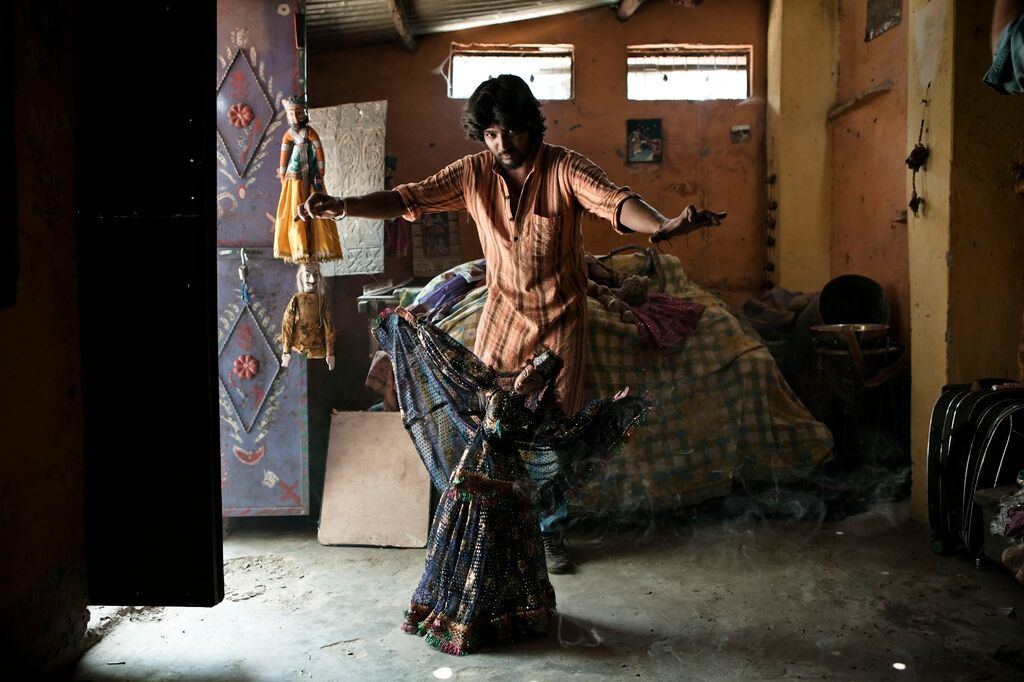 The film follows three artists who end up on three different sides of the issue. This structure allow the audience to experience the full spectrum of who these people are without being completely overwhelmed. Puran Bhatt is a national-award winning puppeteer who feels that the community should fight against the government take-over and resist signing up for the flats. Maya Pawer is a young female acrobat who is actually looking forward to the possibility of change. She sees signing and moving into a flat as an opportunity to pursue her dreams of education. And right in the middle is Rahman Shah, a street magician with young children. He is good friends with Puran and wants to fight against the flats, but his resolve weakens when he is continually kicked off the streets and not allowed to perform for money.
As the inevitable looms closer and closer, Puran explains just what he is fighting for and why he thinks it is important. The Kathputli colony is more than a slum full of poor families, it is a community of heritage. Puran tells the audience that these arts were handed down generation to generation and represent a huge part of India’s cultural heritage. Kings and diplomats were entertained by the ancestors of Kathputli, and this is the tradition that Puran wants to maintain. Puran speaks fondly of his father who taught him the art of puppeteering and looks on history fondly. Maya, on the other hand, speaks of her upbringing almost bitterly. Acrobats in this community are chosen almost at birth and taught to contort their bodies from a young age. She expresses the desire to leave Kathputli and for the colony to abandon these traditions.
Showing us characters with different perspectives makes the documentary as a whole feel less “preachy” and while some of it was clearly staged for dramatic effect, there was a balance to the entire story. It was not a message beaten over the audience’s head of “capitalism: bad, poor people: good.”
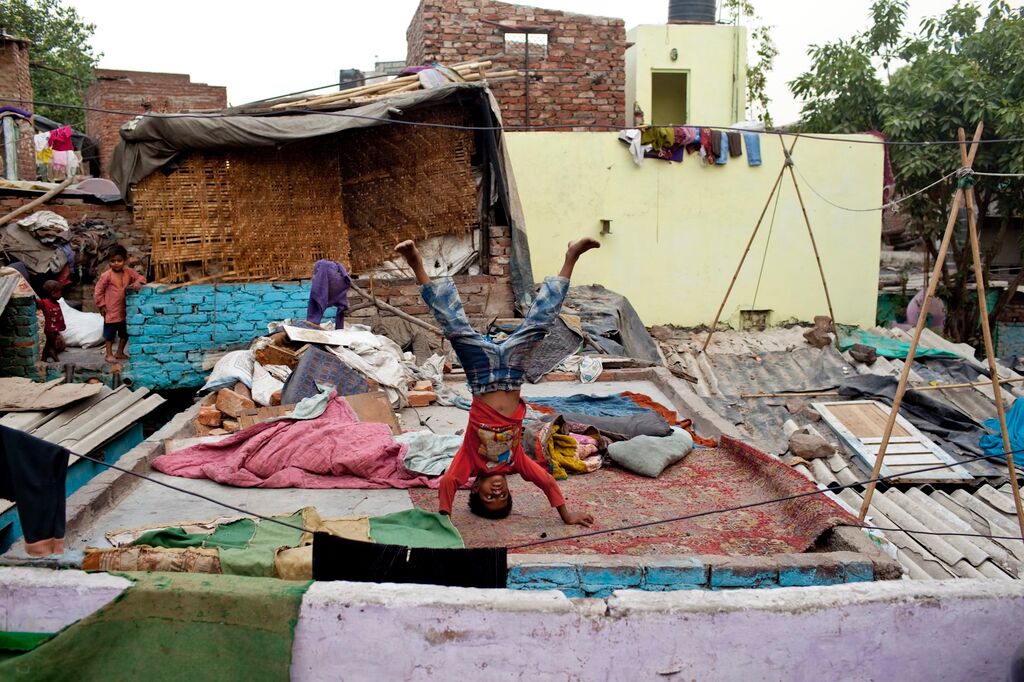 Ultimately the colony is forced to relocate to temporary housing until construction on the high-rise is complete. The documentary leaves us with a defeated Puran walking around a historic exhibit at a museum. The exhibit is basically a recreation of Kathputli, only it is hollow. Puran asks an attendant if he can sit down on it, but the attended politely explains that it will fall apart if he puts any weight on it. It’s a powerful metaphor for the fragility of tradition and the power of memory both to preserve and destroy.
Just as with the hollow recreation of Kathputli, memories can be poor and fragile representations of what has been lost. Throughout the film, the artists are constantly afraid of being forgotten. The title reflects this, and it is a mantra repeated by the elders of the community. The film forces the audience to wonder what have we ourselves created hollow models of? What traditions have we left by the wayside in favor of progress, and, perhaps more importantly, who have we left behind? The documentary is able to ask these questions indirectly, which is a hallmark of good filmmaking. A good documentary finds the story at the heart of an issue and causes the audience to expand that narrative outwards and apply it to their own lives. Tomorrow we Disappear does just that.
Previous Post

August 23, 2015
The Pardon (Anton, 2013)
Next Post

August 26, 2015 Gemma Bovery (Fontaine, 2014)
Browse Our Archives
Select a Category 10 Years Later 1999 Top 5 2007 Top 10 2008 Favorite Discoveries 2008 Top 10 2009 Favorite Discoveries 2009 Top 10 2010 Favorite Discoveries 2010 Top 10 2011 Top 10 2012 Top Ten 2013 Top Ten 2014 Top Ten Best Picture Winners Christian Spotlight on Entertainment Christianity Today Coming Soon Disclosure Disclosure--AS Disclosure--Book Disclosure--DVDS Disclosure--SEOL Disclosure--Travel Dissenting Opinion Elsewhere Emergenetics Essays Featured Film Fest DC--2014 Film Festivals Full Frame Documentary Film Festival 2010 Full Frame Documentary Film Festival 2011 Full Frame Documentary Film Festival 2012 Full Frame Documentary Film Festival 2013 Full Frame Documentary Film Festival 2014 Headline Interviews Laura on the Oscar Winners Podcasts Quick Impressions Reviews RiverRun Film Festival 2014 Television The Criterion Collection The Thin Place To Stream or Not to Stream? Top 10s and Other Lists Toronto International Film Festival 2009 Toronto International Film Festival 2010 Toronto International Film Festival 2011 Toronto International Film Festival 2012 Toronto International Film Festival 2013 Toronto International Film Festival 2014 Uncategorized Video Virginia Film Festival 2011 Virginia Film Festival 2013 Women's Film Festival 2012
Select a Month February 2016 January 2016 December 2015 November 2015 October 2015 September 2015 August 2015 July 2015 June 2015 May 2015 April 2015 March 2015 February 2015 January 2015 December 2014 November 2014 October 2014 September 2014 August 2014 July 2014 June 2014 May 2014 April 2014 March 2014 February 2014 January 2014 December 2013 November 2013 October 2013 September 2013 August 2013 July 2013 June 2013 May 2013 April 2013 March 2013 February 2013 January 2013 December 2012 November 2012 October 2012 September 2012 August 2012 July 2012 June 2012 May 2012 April 2012 March 2012 February 2012 January 2012 December 2011 November 2011 October 2011 September 2011 August 2011 July 2011 June 2011 May 2011 April 2011 March 2011 February 2011 January 2011 December 2010 November 2010 October 2010 September 2010 August 2010 July 2010 June 2010 May 2010 April 2010 March 2010 February 2010 January 2010 December 2009 November 2009 September 2009 August 2009 July 2009 June 2009 May 2009 April 2009
Follow Us!
TAKE THE
Religious Wisdom Quiz
True or False: Jeremiah was known as the weeping prophet.
Select your answer to see how you score.
TRUE FALSE
Related posts from 1More Film Blog

An Inconvenient Truth (Guggenheim, 2006) -- 10 Years...

The Devil Wears Prada (Frankel, 2006) -- 10...

"Telling a Great Story" -- An Interview with...

Is Snow White Still Essential?
TRENDING AT PATHEOS Religious Music & Entertainment

"Les Diabolique" and Transgression
Alongside something like Arrival, Vertigo, or Charade, Les Diaboliques is a...

"The Plague Dogs" and Mortality
So, flashback to the late 70s, early 80s. Walt Disney Studios is...

With the recent and highly successful release of Christopher Nolan’s epic film,...

"L'avventura" and Human Weakness
Today's piece is going to be a little different for a few...

I first want to apologize for not posting or writing anything. I'm...

I've engaged in the multi-year project of reading through the Church Fathers,...
view all Religious Music & Entertainment blogs
Ad-Free & Subscriber Log-In Subscription Support
- About Us
- 2026 Calendar
- Videos
- Podcasts
- Library of World Religions
- Faith In Media Tracker
- Advertise With Us
- Write for Us
- Privacy Policy
- Terms of Service
- Do Not Sell My Data
- Contact Us
- Radiant Digital
- Manage Newsletter Subscriptions
- Unsubscribe From Notifications
- Sitemap
Copyright 2008-2026, Patheos. All rights reserved.
Subscription Support Ad-Free & Subscriber Log-In
Follow Patheos