
BuddhistCatholicContemplativeEvangelicalGeneral ChristianHinduJewishLatter-day SaintMuslimNew VisionsProgressive Christian
Beliefs
- Buddhist
- Catholic
- Contemplative
- Evangelical
- General Christian
- Hindu
- Jewish
- Latter-day Saint
- More Voices
- Muslim
- New Visions
- Pagan
- Progressive Christian
Topics
- Religion News
- Food and Religion
- Sports and Religion
- Religious Art
- Religious Music and Entertainment
- Religious Events
- History and Religion
- Style and Religion
- Politics and Religion
- Women in Religion
- Recreation Outdoors and Religion
- Business Finance and Religion
- Careers Workplace and Religion
- Education and Religion
- Family Parenting and Religion
- Health Fitness and Religion
- Home and Religion
- Relationships and Religion
- Technology and Religion
- Travel and Religion
Columnists
- Buddhist Columnists
- Business Finance and Religion Columnists
- Careers Workplace and Religion Columnists
- Catholic Columnists
- Contemplative Columnists
- Education and Religion Columnists
- Evangelists Columnists
- Family Parenting and Religion Columnists
- General Christian Columnists
- Health Fitness and Religion Columnists
- Hindu Columnists
- History and Religion Columnists
- Home and Religion Columnists
- Jewish Columnists
- More Voices Columnists
- Latter Day Columnists
- Muslim Columnists
- New Visions Columnists
- Nonreligious Columnists
- Pagan Columnists
- Politics and Religion Columnists
- Progressive Columnists
- Recreation Outdoors and Religion Columnists
- Relationships and Religion Columnists
- Religion News Columnists
- Religious Art Columnists
- Religious Events Columnists
- Religious Music and Entertainment Columnists
- Sports and Religion Columnists
- Style and Religion Columnists
- Technology and Religion Columnists
- Travel and Religion Columnists
- Women in Religion Columnists
Resource Library
- 2026 Calendar
- Library of World Religions
- The 100 Most Holy Places on Earth
- Patheos Answers
- Podcasts
- Videos
- Faith Leaders Database
- Anglican Episcopalian
- Bahai
- Baptist
- Buddhism
- Christianity
- Confucianism
- Eastern Orthodoxy
- Hinduism
- Holiness and Pentecostal
- ISKCON
- Islam
- Judaism
- Lutheran
- Methodist
- The Church of Jesus Christ of Latter-day Saints
- New Age
- Paganism
- Presbytarian and Reformed
- Protestantism
- Religion Behind the Scenes
- Roman Catholic
- Scientology
- Shia Islam
- Sikhism
- Sufism
- Sunni Islam
- Taoism
- Zen
- See all religions
Research Tools
 Ad-Free & Subscriber Log-In Subscription Support
Ad-Free & Subscriber Log-In Subscription Support
Follow Patheos 

- Trending:
- Forgiveness
- |
- Marriage
- |
- Consciousness
- |
- Death Penalty
- |
- Election
- |
- Halloween
The Faith Majority: Rethinking Secularism’s Reign in Culture and Coverage
October 16, 2025 by Duncan Pile
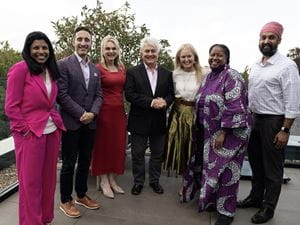
The 2025 Fellows of the Faith and Media Initiative: (left to right) Lip Roy, Elan Babchuck, Lynn Swain, Craig Detweiler, Katrina Lantos Swett, Elonda Clay, Simran Jeet Singh
Is secularism still king?
One of the stats that stood out to me at the Faith & Media Summit held in Oxford last month was that around 75% of the population of the world practice some form of faith. Or in other words, faith plays a part in their lives, their cultures, and their families. If faith shapes the lives of most people around the world, why does so much of the media—whether news, television, or film – ignore the depth and nuance of spiritual practice?
Secularism can be defined as a way of life and thinking that rejects religion. The term was coined in the 1850s and has gradually become a broadly accepted principle in the West. The core principle of secularism is the separation of church and state, which many modern people of faith agree is an essential pillar of a fair society, but in general terms, a secular society is one in which religion does not define or shape the lives of its citizens.
Even in the West, where secularism has been treated as king for decades, it does not reflect the lived reality of most people’s lives. The 2021 census in England and Wales, for example, shows that 63% of people identified as having some kind of faith or belief system. This is mirrored in most Western societies, such as Germany at 52-57%, the US at 93%, Canada at 65%, Australia, at 56%, Spain at 55-60%, and Italy at 75-80%. The percentages of people of faith in Asian, African, and South American populations are significantly higher than most European and North American countries.
Despite these compelling figures, the reason that secularism remains crucially important is that society must function in a way that treats people of all faiths and none equally. Centuries of violence in the name of religion have established that faith should not be a determining factor in the shaping of legislation or the function of government, and in that sense, secularism is still, and should remain, king. That said, secularism in the media skews rather than accurately defines the lives of most people in society, and as such could be seen as out of touch.
As quantified by Rabbi Elan Babchuck, Executive Vice President at Clal, the National Jewish Center for Learning and Leadership, in the opening session of the summit, Gen Z in particular are much more open to faith than previous generations, and even young men are moving away from secularism and back toward the practice of faith.
In the media, however, faith continues to be presented in stereotypical ways. Islam in particular is treated without nuance, and often with prejudice. What do we see of Islam that goes beyond the cliché of dominant men and oppressed women, or programming that leans into the trope of terrorism?
In Saturday’s session on Faith & Entertainment, we looked at the activism of Rizwan (Riz) Ahmed, star of Shifty, Four Lions, The Reluctant Fundamentalist, Rogue One, and many other successful productions.
In 2018, researchers in the UK were inspired by a speech Riz Ahmed gave in the House of Commons about the lack of accurate representation of Muslims in the arts and came up with a method to quantify the nature of Muslim representation in film and TV.
"The Riz Test" has five parts which highlight the stereotypes of Muslim characters in films and on TV:
1. If a character is identifiably Muslim, is the character talking about, the victim of, or the perpetrator of terrorism?
2. Is the character presented as irrationally angry?
3. Is the character presented as superstitious, culturally backward or anti-modern?
4. Is the character presented as a threat to a Western way of life?
5. If the character is male, is he presented as misogynistic? Or if female, is she presented as oppressed by her male counterparts?
It’s easy to think of productions that fail this test – the TV series “24”, the film “American Sniper”, and one of the films Riz himself was cast in, “Four Lions”, which although a parody, portrays Muslim men as both terrorists and idiots.
The biggest movies and TV series of all time
In the same session, Craig Detweiler (FAMI Fellow), Dean of the College of Arts and Media at Grand Canyon University, led a lively discussion on how faith is a core element of the most successful productions of all time. Aside from films directly about Jesus, or Ghandi, or the Exodus, faith and spirituality in general are fundamental to many beloved stories. Take Avatar, for example, which revolves around the spiritual principles of sacrificial love and union with all living things. Or Lord of the Rings, which pits humility and service against domination. And what about Game of Thrones, in which all living beings must unite to resist the forces of evil?
Harry Potter is fundamentally spiritual, with love being the force that overcomes evil. Figures like Gandalf, Dumbledore, John Coffey in The Green Mile, and Yoda in Star Wars speak to an innate human instinct that is faith-forward. We esteem wisdom over foolishness, self-sacrifice over selfishness, humility over pride, and these values stem from faith in its many forms.
Delegates from the Summit met with local organizations in Oxford to discuss the role of faith and media in strengthening community ties and supporting the underprivileged.
The emptiness of nihilism
In Saturday’s session on Faith, Media & Human Dignity, Katrina Swett, President of the Lantos Foundation for Human Rights and Justice, compared secularism in its broadest form (a society in which religion plays no part) to nihilism. When I think about my atheist friends, ‘secularist’ doesn’t feel like an applicable term. In my experience, atheists are courageous, authentic people who have reached a different set of conclusions to those reached by people of faith.
Some core principles, however, are shared. Atheists tend to want all people in society to be treated equally, and typically believe in the freedom of religion, including the freedom to say no to faith without being on the receiving end of state persecution.
Holding to principles of equality is not nihilism; arguably, doing so is a form of non-religious spirituality, in which loving others is the highest calling, without requiring a theological framework. Secularism, on the other hand, if devoid of moral conviction, is nihilism. Nihilism asserts that life has no objective meaning or intrinsic value, and that moral values are baseless, and when secularism steers us away from meaning, morality, and the centrality of love, it sucks the joy out of life.
If meaning and spirituality are avoided by the media, its commentary on our lives is nihilistic, generating despair, disillusionment, and community disintegration. Spirituality, on the other hand, which is practiced by the majority of people, insists on the value of others and can help reweave the torn fabric of society.
Interfaith initiatives occur all over Western countries, helping with the effort to rebuild our communities. Young people are more open to faith these days, perhaps because they live in a time when so many other journeys have been denied them. The social contract has been broken – education doesn’t guarantee a satisfying, well-paid career anymore, and getting on the housing ladder is a distant dream for far too many, but spirituality is free and for everyone. If we want to offer what we have to younger generations, we need to share our spirituality without fear and invite the media to report on events and initiatives we organize.
Now that we’ve examined “the problem” (stereotypical representations of faith in the media) in more detail, the next article will look at influencing the media to present more nuanced and accurate reflections of faith, and even to be faith positive.
I’ll be addressing that on several different levels – what influential people can do, what faith leaders can do, and what you and I can do.
Explore More
Faith & Media Initiative Fellows
The Global Faith and Entertainment Study
The Global Faith and News Study
Coalition For Faith and Media Patheos Column
The Faith Majority: Rethinking Secularism’s Reign in Culture and Coverage
Changing the Narrative: How Vulnerability, Dignity, and Creativity Can Reframe Faith in Media
10/21/2025 12:42:29 AM
featured writer
more at patheos
1

'One of the good ones' obscures a dangerous lie
2

Writing as Ministry: When God Calls You to Write
3

Humility and Love Highlight Sunday's Readings
4

Michael Jackson Biopic: A Fan’s Honest Take on ‘Michael’

About Duncan Pile
Duncan Pile is a writer, author and speaker, living in Derbyshire, England with his wife and stepson. His mystical approach to faith straddles the Evangelical/Progressive divide, and flowing from lived experience, he is passionate about the deconstruction and reconstruction of the Christian faith.
Patheos Explore the world's faith through different perspectives on religion and spirituality! Patheos has the views of the prevalent religions and spiritualities of the world.
Ad-Free & Subscriber Log-In Subscription Support
- About Us
- 2026 Calendar
- Videos
- Podcasts
- Library of World Religions
- Faith In Media Tracker
- Advertise With Us
- Write for Us
- Privacy Policy
- Terms of Service
- Do Not Sell My Data
- Contact Us
- Radiant Digital
- Manage Newsletter Subscriptions
- Unsubscribe From Notifications
- Sitemap
Copyright 2008-2026, Patheos. All rights reserved.
Subscription Support Ad-Free & Subscriber Log-In
Follow Patheos