
BuddhistCatholicContemplativeEvangelicalGeneral ChristianHinduJewishLatter-day SaintMuslimNew VisionsProgressive Christian
Beliefs
- Buddhist
- Catholic
- Contemplative
- Evangelical
- General Christian
- Hindu
- Jewish
- Latter-day Saint
- More Voices
- Muslim
- New Visions
- Pagan
- Progressive Christian
Topics
- Religion News
- Food and Religion
- Sports and Religion
- Religious Art
- Religious Music and Entertainment
- Religious Events
- History and Religion
- Style and Religion
- Politics and Religion
- Women in Religion
- Recreation Outdoors and Religion
- Business Finance and Religion
- Careers Workplace and Religion
- Education and Religion
- Family Parenting and Religion
- Health Fitness and Religion
- Home and Religion
- Relationships and Religion
- Technology and Religion
- Travel and Religion
Columnists
- Buddhist Columnists
- Business Finance and Religion Columnists
- Careers Workplace and Religion Columnists
- Catholic Columnists
- Contemplative Columnists
- Education and Religion Columnists
- Evangelists Columnists
- Family Parenting and Religion Columnists
- General Christian Columnists
- Health Fitness and Religion Columnists
- Hindu Columnists
- History and Religion Columnists
- Home and Religion Columnists
- Jewish Columnists
- More Voices Columnists
- Latter Day Columnists
- Muslim Columnists
- New Visions Columnists
- Nonreligious Columnists
- Pagan Columnists
- Politics and Religion Columnists
- Progressive Columnists
- Recreation Outdoors and Religion Columnists
- Relationships and Religion Columnists
- Religion News Columnists
- Religious Art Columnists
- Religious Events Columnists
- Religious Music and Entertainment Columnists
- Sports and Religion Columnists
- Style and Religion Columnists
- Technology and Religion Columnists
- Travel and Religion Columnists
- Women in Religion Columnists
Resource Library
- 2026 Calendar
- Library of World Religions
- The 100 Most Holy Places on Earth
- Patheos Answers
- Podcasts
- Videos
- Faith Leaders Database
- Anglican Episcopalian
- Bahai
- Baptist
- Buddhism
- Christianity
- Confucianism
- Eastern Orthodoxy
- Hinduism
- Holiness and Pentecostal
- ISKCON
- Islam
- Judaism
- Lutheran
- Methodist
- The Church of Jesus Christ of Latter-day Saints
- New Age
- Paganism
- Presbytarian and Reformed
- Protestantism
- Religion Behind the Scenes
- Roman Catholic
- Scientology
- Shia Islam
- Sikhism
- Sufism
- Sunni Islam
- Taoism
- Zen
- See all religions
Research Tools
 Ad-Free & Subscriber Log-In Subscription Support
Ad-Free & Subscriber Log-In Subscription Support
Follow Patheos 

- Trending:
- Forgiveness
- |
- Marriage
- |
- Consciousness
- |
- Death Penalty
- |
- Election
- |
- Halloween
St John’s Revelation: His ‘Alt’ Account?
January 07, 2025 by Matthew Allen
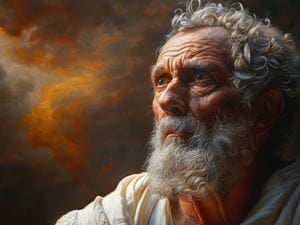
Adobe Stock
In this Kingdom of Sugar Plum Fairies we call the Internet, people wear more masks than the Faceless Men of Braavos. I bet you’re no different, you scallywag: if you’re on any form of social media, then you probably have at least one ‘alt’ account, where you say the spicy things you wouldn’t put on granny’s fridge, as well as a ‘main’, where you put your best foot forward. ‘You get’, as Hannah Montana would say, ‘the best of both worlds’; and what could possibly be more wholesome? Occasionally, though, Dr Jekyll will forget it’s time to turn back into Mr Hyde, and this leads to the phenomenon that scholars have dubbed ‘posting cringe on main’.
Speaking of scholars, the question theologians have long wrestled with is: ‘Did St John post cringe on main when he wrote the book of Revelation? Did he get a bit excitable after one too many Bacardi Breezers?’ After all, we’re used to ‘the disciple Jesus loved’ uploading all the most heartfelt sentiments: ‘For God so loved the world, that he gave his only begotten Son’ (John 3.16). Why, then, so much fire and brimstone in the Book of Revelation? John’s piano students on Patmos mustn’t have practised their minor scales that week, or am I projecting?
Actually, there are more similarities between John’s Gospel and Revelation than you might have thought. One aspect of John’s writing stye where we see this is his reliance on ‘light vs dark’ imagery to convey the struggle between good (light) and evil (darkness). If you were at a service of Nine Lessons and Carols over the Christmas period, like we had in our church, you’ll have recently heard the ninth lesson, John 1.1-14: ‘The light shines in the darkness, and the darkness has not overcome it’ (v. 5). Babylon’s fall in Revelation is captured in all its finality, too, by the vivid use of light imagery: ‘the light of a lamp shall shine in thee no more’ (18.23).
Light, in both John’s Gospel and Revelation, is associated with Christ: ‘In him was life; and the life was the light of men’ (John 1.4); ‘and his face was like the sun shining in full strength’ (Revelation 1.16). John, even more so than his fellow Gospel-writers (Matthew, Mark and Luke), was determined that readers never forget Our Lord’s power and glory, despite the vulnerable face he showed while on Earth. Light imagery, then, is more common in John’s prose than the phrase, “double my wardrobe and halve my rent”, is on gay Tinder. Incidentally, there are more horsemen on gay Tinder, I find, than in all of Rohan. It’s why we need more LGBT Christians: cavalry support for the King of Kings when the Battle of Armageddon starts!
Christ, indeed, is the most significant character in both texts. Everybody knows that all four Gospels, John’s included, are sustained accounts of what Jesus did, said and taught when he moved among us. Revelation foretells the cosmic role of Our Lord in the last days, when he will come ‘to judge the quick and the dead’: from breaking the seven seals to his triumph over the devil. Christ himself called on John to pen the book of Revelation (1.19). I can’t recall a similar instance in the Bible, where Christ issues an express command for a book to be written.
John’s Gospel is not without its own allusions to the last days, even if not as well fleshed-out as those to be found in Revelation. Take, for example, John 11, where Christ raises Lazarus from the dead. Martha, the sister of Lazarus, believes that her brother ‘will rise again in the resurrection at the last day’ (v. 24). Jesus, famously, responds with, ‘I am the resurrection and the life’ (v. 25). John confirms this in Revelation by depicting all that Christ will do to secure the final triumph of life over death, like throwing the devil down to his eternal doom (20.10).
John appreciated, as I do, good metaphors. I’ll admit, his are better… It’s hard to compete with divine inspiration. I have better similes, though: ‘braver than an artic skinny-dipper’; ‘squarer than a pixelated SpongeBob’; and, my personal favourite, ‘thinner than a threadworm on hunger strike’; to name but a few. Not even these literary jewels, however, could rival ‘the Bread of Life’ (John 6.35); ‘a woman clothed with the sun’ (Revelation 12.1); or ‘the True Vine’ (John 15.1). John, as Gospel-writer and as Apocalypse-writer, was a true master of symbolism.
Given the similarities we’ve covered, we can be confident that St John did not, in fact, post on ‘alt’ when he wrote Revelation. He was logged onto ‘main’, expanding on themes introduced in his Gospel. Anglicans like me have long accepted Revelation’s place in the Bible. Chapter 12.7-12 is read at Holy Communion on the Feast of St Michael and All Angels. Chapter 7.9-17 is read at Holy Communion on the Feast of All Saints. ‘All the Books of the New Testament, as they are commonly received, we do receive’ (Article 6 in the 39 Articles), Revelation included.
John’s Gospel and Revelation, of course, have their differences. From their tone and mood to their setting and structure, the contrasts are obvious. Nevertheless, one author held the sacred pen, St John; and he had one intention in both texts: to muster the horsemen on gay Tinder for battle… Oops, that’s not right… It was to proclaim that Christ is Lord of all Creation.
1/7/2025 5:44:11 AM
featured writer
more at patheos
1

Another glimpse of my glamorous life as an apologist
2

I Almost Won at PGA's Doral in '66. This Week, Faith Did Win
3
How Faith and Religion Shaped America's First 250 Years
4

On Eagle's Wings Is 50. The Story Behind the Hymn.

About Matthew Allen
Matthew Allen is a writer and musician based in Northern Ireland. He is a graduate of Queen’s University, Belfast, where he studied Theology and Liberal Arts.
Patheos Explore the world's faith through different perspectives on religion and spirituality! Patheos has the views of the prevalent religions and spiritualities of the world.
Ad-Free & Subscriber Log-In Subscription Support
- About Us
- 2026 Calendar
- Videos
- Podcasts
- Library of World Religions
- Faith In Media Tracker
- Advertise With Us
- Write for Us
- Privacy Policy
- Terms of Service
- Do Not Sell My Data
- Contact Us
- Radiant Digital
- Manage Newsletter Subscriptions
- Unsubscribe From Notifications
- Sitemap
Copyright 2008-2026, Patheos. All rights reserved.
Subscription Support Ad-Free & Subscriber Log-In
Follow Patheos