
BuddhistCatholicContemplativeEvangelicalGeneral ChristianHinduJewishLatter-day SaintMuslimNew VisionsProgressive Christian
Beliefs
- Buddhist
- Catholic
- Contemplative
- Evangelical
- General Christian
- Hindu
- Jewish
- Latter-day Saint
- More Voices
- Muslim
- New Visions
- Pagan
- Progressive Christian
Topics
- Religion News
- Food and Religion
- Sports and Religion
- Religious Art
- Religious Music and Entertainment
- Religious Events
- History and Religion
- Style and Religion
- Politics and Religion
- Women in Religion
- Recreation Outdoors and Religion
- Business Finance and Religion
- Careers Workplace and Religion
- Education and Religion
- Family Parenting and Religion
- Health Fitness and Religion
- Home and Religion
- Relationships and Religion
- Technology and Religion
- Travel and Religion
Columnists
- Buddhist Columnists
- Business Finance and Religion Columnists
- Careers Workplace and Religion Columnists
- Catholic Columnists
- Contemplative Columnists
- Education and Religion Columnists
- Evangelists Columnists
- Family Parenting and Religion Columnists
- General Christian Columnists
- Health Fitness and Religion Columnists
- Hindu Columnists
- History and Religion Columnists
- Home and Religion Columnists
- Jewish Columnists
- More Voices Columnists
- Latter Day Columnists
- Muslim Columnists
- New Visions Columnists
- Nonreligious Columnists
- Pagan Columnists
- Politics and Religion Columnists
- Progressive Columnists
- Recreation Outdoors and Religion Columnists
- Relationships and Religion Columnists
- Religion News Columnists
- Religious Art Columnists
- Religious Events Columnists
- Religious Music and Entertainment Columnists
- Sports and Religion Columnists
- Style and Religion Columnists
- Technology and Religion Columnists
- Travel and Religion Columnists
- Women in Religion Columnists
Resource Library
- 2026 Calendar
- Library of World Religions
- The 100 Most Holy Places on Earth
- Patheos Answers
- Podcasts
- Videos
- Faith Leaders Database
- Anglican Episcopalian
- Bahai
- Baptist
- Buddhism
- Christianity
- Confucianism
- Eastern Orthodoxy
- Hinduism
- Holiness and Pentecostal
- ISKCON
- Islam
- Judaism
- Lutheran
- Methodist
- The Church of Jesus Christ of Latter-day Saints
- New Age
- Paganism
- Presbytarian and Reformed
- Protestantism
- Religion Behind the Scenes
- Roman Catholic
- Scientology
- Shia Islam
- Sikhism
- Sufism
- Sunni Islam
- Taoism
- Zen
- See all religions
Research Tools
 Ad-Free & Subscriber Log-In Subscription Support
Ad-Free & Subscriber Log-In Subscription Support
Follow Patheos 

- Trending:
- Forgiveness
- |
- Marriage
- |
- Consciousness
- |
- Death Penalty
- |
- Election
- |
- Halloween
Ramblings of a Sunday School Teacher
February 10, 2022 by Matthew Allen
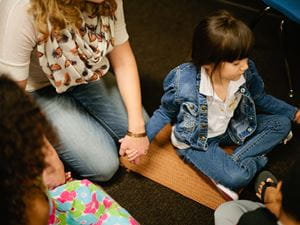
Lightstock.com
The mistake that we Sunday School teachers often fall into lies in thinking that what we do differs in degree, rather than in essence, from what happens in church itself. In most Reformed settings, the sermon is the centrepiece of worship. And so, it’s natural that the Sunday School teacher aspires to craft a lesson in the likeness of a sermon. But a sermon or homily takes a biblical text and explores its meaning and surrounding context. On the other hand, a good Sunday School session is a simple though compelling presentation of a Bible story that a child will remember. It isn’t a diluted sermon at all.
Saint Augustine, whose On Christian Teaching is a kind of early theological handbook, lights on a similar point. In this important work, Augustine outlines the process of studying the Bible. ‘The first rule in this laborious task is,’ he writes, ‘to know these books; not necessarily to understand them but to read them so as to commit them to memory or at least make them not totally unfamiliar’ (2.30). Nobody can apprehend what is completely alien. Before all else, then, a budding theologian has to be well up on the Bible’s overall story. Just as learning to paint with primary colours is prior to mixing a broader palette.
Exposure to the biblical narrative is the goal in Sunday School; it’s not a theology lecture adapted for kids. (Lord, have mercy!) They’ll have time enough to wander in the winding labyrinth of analytical theology — should any so choose — later on, as adults. For now, let’s not scare the poor kids away from Christianity with a crash course in systematics. That should all be somewhere down the track. Even still, I suspect a sizeable cohort of Sunday School types across the world of exactly this fallacy, trying to run a graduate seminar on doctrinal orthodoxy for toddlers. Take it easy!
Capturing children’s imaginations with ancient stories, using every tool available, is objective number one. And what’s more, the stories themselves do pretty much all the work. A Sunday School teacher’s job is easy; the biblical tales don’t require assistance to grip a child’s curiosity. They do that all by themselves. All the same, a creative approach to biblical storytelling is the recipe for a dynamic Sunday School. But over-complicating stuff to the point of tedium is the danger. Pass on the holy mysteries, as the Church understands them, to your adorable audience and you’ll have done all you can.
The cyclical nature of liturgy, remember, means the same texts will come up when today’s kids in Sunday School are tomorrow’s adults in the pews. And a person is in a better position to think about something more deeply when the material was part of a childhood Sunday School programme. Processing of surface details — names, places, events — has already taken place many decades prior. As a Sunday School teacher, then, you’re giving kids an introduction to stories they will hopefully be digesting all their lives. But encountering all the many personalities, locations and occurrences in the Bible is where the journey begins.
Then the work of attending to the challenges within a text is possible. That’s where theology starts! Augustine alludes that such is the next way-station on a theological journey; ‘The wisdom of what a person says is in direct proportion to his progress in learning the holy scriptures — and I am not speaking of intensive reading or memorization,’ the Saint reasons, ‘but real understanding and careful investigation of their meaning’ (On Christian Teaching, 4.19). Going beyond a cursory reading of any text, and actually coming to grips with all the wisdom it imparts, is the path of spiritual growth.
But it is tempting, however, to try cramming a lifetime’s worth of Christian formation into an hour of Sunday School. There is the Sunday School teacher who really means business and strides in the door of a morning like a latter-day Moses checking in from Sinai. None shall escape until all can intone John 3:16 from the New King James Version in various regional accents and at a volume unrepresented on the decibel scale. Naturally, the verse-drill concludes with a potted soteriology: Give it all to Jesus! (As if a child actually gets this.) No. Keep it simple. Keep it enjoyable.
A typical Sunday lesson goes as follows with my kids: “Right. We’ve got a Bible story from Genesis today.” [Reads Noah’s Ark or something.] “Now then. Who’s for a word search?” You should see the way they help each other when we do these puzzles. It’s incredibly cute, a model of Christian charity that Winthrop himself would have approved. Equally sweet is the way they need your permission to do something as innocuous as colour in the title of a worksheet; as though asking to read a heretical book off a banned index — as if I were His Holiness dispensing some indulgence.
After puzzles, it’s time to draw. Because I reckon that after presenting something biblical in a lively way, my next role is quite straightforwardly to keep everyone entertained. One week we took turns drawing SpongeBob SquarePants characters. (That show’s older than I am; it’s a minor miracle that it’s on the go still.) Sunday School teaching is for me basically being a child again, but without all the crippling shyness I had when I was growing up in the first instance. I drew Squidward, Spongebob’s cashier colleague, starting inauspiciously with a bulbous head and a bulging nose. Now that was a mistake. And so, salvaging smutty Squidward, I stuck on some heavy-lidded eyes and a torpid smile with all deliberate speed.
I learned a precious lesson: that a little planning goes a long way towards avoiding embarrassment when drawing cartoon sea creatures. Being a Sunday school teacher, on a more serious note, is a good spur to self-improvement in general. As Luke 6:40 says, ‘The student is not above the teacher, but everyone who is fully trained will be like their teacher’ (NIV). You need, it seems, a certain amount of audacity to teach others; taking a class is to declare yourself a good role model, with assistance from whom another human being can develop as a person. Those of us who teach are morally obligated, as a consequence, to be working on ourselves constantly.
Through pursuing a meaningful faith, we Sunday School teachers can ensure that something of our love of God — and, even more importantly, God’s love of us — touches the kids whose young souls we have a joyful and solemn duty to care for. In doing so, the valuable time we spend as a group is able to give a new generation some positive experiences of Christian community that will endure. We’re not a seminary-come-daycare for teeny-tiny theologians. No, Sunday School is the cradle of a faith still being born. And we teachers have as our privilege a simple yet significant aim: to cheer on and inspire those emerging spirits in our care.
2/10/2022 6:50:11 PM
church
Bible
Sunday school
featured writer
more at patheos
1

Stand Still and See Clearly and Correctly
2
NT: 70 Specific Good Works Contribute to Salvation
3
Table Talk: Jesus and a Modern Christian
4

'America's Churches': FNC's Benjamin Hall Visits God's House

About Matthew Allen
Matthew Allen is a writer and musician based in Northern Ireland. He is a graduate of Queen’s University, Belfast, where he studied Theology and Liberal Arts.
Patheos Explore the world's faith through different perspectives on religion and spirituality! Patheos has the views of the prevalent religions and spiritualities of the world.
Ad-Free & Subscriber Log-In Subscription Support
- About Us
- 2026 Calendar
- Videos
- Podcasts
- Library of World Religions
- Faith In Media Tracker
- Advertise With Us
- Write for Us
- Privacy Policy
- Terms of Service
- Do Not Sell My Data
- Contact Us
- Radiant Digital
- Manage Newsletter Subscriptions
- Unsubscribe From Notifications
- Sitemap
Copyright 2008-2026, Patheos. All rights reserved.
Subscription Support Ad-Free & Subscriber Log-In
Follow Patheos