
BuddhistCatholicContemplativeEvangelicalGeneral ChristianHinduJewishLatter-day SaintMuslimNew VisionsProgressive Christian
Beliefs
- Buddhist
- Catholic
- Contemplative
- Evangelical
- General Christian
- Hindu
- Jewish
- Latter-day Saint
- More Voices
- Muslim
- New Visions
- Pagan
- Progressive Christian
Topics
- Religion News
- Food and Religion
- Sports and Religion
- Religious Art
- Religious Music and Entertainment
- Religious Events
- History and Religion
- Style and Religion
- Politics and Religion
- Women in Religion
- Recreation Outdoors and Religion
- Business Finance and Religion
- Careers Workplace and Religion
- Education and Religion
- Family Parenting and Religion
- Health Fitness and Religion
- Home and Religion
- Relationships and Religion
- Technology and Religion
- Travel and Religion
Columnists
- Buddhist Columnists
- Business Finance and Religion Columnists
- Careers Workplace and Religion Columnists
- Catholic Columnists
- Contemplative Columnists
- Education and Religion Columnists
- Evangelists Columnists
- Family Parenting and Religion Columnists
- General Christian Columnists
- Health Fitness and Religion Columnists
- Hindu Columnists
- History and Religion Columnists
- Home and Religion Columnists
- Jewish Columnists
- More Voices Columnists
- Latter Day Columnists
- Muslim Columnists
- New Visions Columnists
- Nonreligious Columnists
- Pagan Columnists
- Politics and Religion Columnists
- Progressive Columnists
- Recreation Outdoors and Religion Columnists
- Relationships and Religion Columnists
- Religion News Columnists
- Religious Art Columnists
- Religious Events Columnists
- Religious Music and Entertainment Columnists
- Sports and Religion Columnists
- Style and Religion Columnists
- Technology and Religion Columnists
- Travel and Religion Columnists
- Women in Religion Columnists
Resource Library
- 2026 Calendar
- Library of World Religions
- The 100 Most Holy Places on Earth
- Patheos Answers
- Podcasts
- Videos
- Faith Leaders Database
- Anglican Episcopalian
- Bahai
- Baptist
- Buddhism
- Christianity
- Confucianism
- Eastern Orthodoxy
- Hinduism
- Holiness and Pentecostal
- ISKCON
- Islam
- Judaism
- Lutheran
- Methodist
- The Church of Jesus Christ of Latter-day Saints
- New Age
- Paganism
- Presbytarian and Reformed
- Protestantism
- Religion Behind the Scenes
- Roman Catholic
- Scientology
- Shia Islam
- Sikhism
- Sufism
- Sunni Islam
- Taoism
- Zen
- See all religions
Research Tools
 Ad-Free & Subscriber Log-In Subscription Support
Ad-Free & Subscriber Log-In Subscription Support
Follow Patheos 

- Trending:
- Forgiveness
- |
- Marriage
- |
- Consciousness
- |
- Death Penalty
- |
- Election
- |
- Halloween
Misrecognition and the Persistence of Anti-Muslim Rhetoric in American Public Life
April 07, 2026 by Ken Chitwood
Adobe Stock
The story is almost too on-the-nose.
Amidst the broader travel kerfuffle across the U.S. in March, a commercial flight from Nashville, Tennessee to Fort Lauderdale, Florida was diverted after passengers and crew grew alarmed at what appeared to be a countdown timer.
Fear and suspicion escalated quickly.
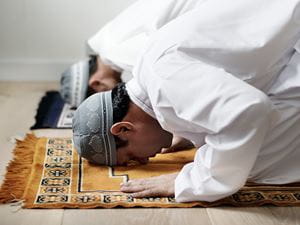
Only later did the explanation emerge that a Muslim traveler had set a reminder to pray during Ramadan. And just like that, a routine act of religious observance had been interpreted as a potential threat.
The incident, reported by multiple news outlets as a “security scare,” is not simply an anecdote about misunderstanding. It is an illustration of a deeper social condition, one in which being Muslim is primed to be read through suspicion.
The question is not merely why such incidents happen, but why they make sense within the cultural imagination of those who witness them.
In recent months, there has been increasing attention given to what is often described as a “rise” in anti-Muslim bigotry in the United States. That language is not entirely wrong, but it is incomplete. What appears as a surge is perhaps better understood as an intensification, a re-activation of long-standing patterns under new political and geopolitical conditions.
Contemporary Flashpoints, Familiar Patterns
Several recent developments have sharpened anti-Muslim rhetoric in the U.S.
The events of October 7, 2023 and their horrifying aftermath once again placed Muslim identification at the center of highly charged political discourse. For many Americans, distinctions between Palestinians, Arabs and Muslims collapsed under the weight of media framing and sharpened political rhetoric. The result has been the further deepening of a broad association of Muslimness with geopolitical conflict.
Similarly, the current U.S./Israel attacks in Iran have reactivated a well-worn habit of conflating foreign adversaries with domestic populations. Muslim Americans, who are diverse in background, practice and political orientation, are once again being folded into narratives of national security risk.
The emergence of Zohran Mamdani as a prominent political figure has added an additional domestic dimension. His visibility and popularity has prompted not only policy criticism but identity-based suspicion. Republican lawmakers and commentators have, in some instances, linked him implicitly or explicitly to Iran, suggesting that his religious identification raises questions about his political loyalties. Such rhetoric does not operate at the level of argument alone, but signals to broader audiences that Muslim participation in public life is inherently suspect.
These examples are not isolated. They exist alongside a steady stream of commentary that include social media posts advocating for bans on Muslim immigration, punditry describing such immigration as “national suicide,” and gubernatorial platform policies that frame Islam as incompatible with Western values. Taken together, they form an ecosystem in which suspicion is normalized rather than exceptional.
Dis-covering Islam
To understand the persistence of these patterns, it is useful to move beyond current headlines and consider Islamophobia as a structural phenomenon embedded in the U.S.’s national psyche and history.
In Covering Islam, Palestinian-American critic Edward Said argued that Western representations of Islam are shaped less by empirical reality than by inherited frameworks of misinterpretation. The term “covering,” he suggested, operates in two senses, to describe how media both report on Islam and obscure its realities, producing a simplified and often distorted image of nearly 2 billion people worldwide in the process.
This insight helps explain why contemporary flashpoints do not create suspicion from scratch. Instead, they activate existing frameworks of fear, ignorance and suspicion.
When a Muslim political figure is linked to a foreign state, or when a religious practice is misread as a threat, these interpretations feel perfectly plausible because they align with narratives that have been cultivated for decades (and, arguably, centuries).
The post-9/11 era intensified these dynamics, of course, embedding suspicion of Muslims within national (and transnational) security and societal conversations. Surveillance programs, travel restrictions and representations in the media continued to reinforce the idea that Muslims are an inherent danger. Over time, these associations became part of the background assumptions of public life — rarely questioned, sometimes implicit, always present.
Political Rhetoric and its Consequences
Looking back on my career in journalism and academia over the last 15 years, I sometimes grow frustrated over the lack of progress on public discourse concerning Muslims in the Americas. When I began, my hope was to contribute to widened understanding, more informed conversation and better policies to help us navigate the everyday realities of diversity and difference in public life.
And yet, here we are, perhaps worse off than before.
First and foremost, I recognize how media systems play a crucial role in amplifying these dynamics. Contemporary media environments reward content that provokes strong emotional reactions. Stories that evoke fear or outrage are more likely to be shared, liked, and algorithmically promoted. As a result, representations of Muslims are often skewed toward conflict and controversy.
This is not simply a matter of bias, or one media source over another. It is a matter of deeply rooted practices and assumptions. Journalistic practices that prioritize immediacy and impact can inadvertently reinforce negative narratives. Meanwhile, social media platforms enable the rapid publication and amplification of misinformation and inflammatory rhetoric, often without sufficient context or correction.
The cumulative effect is a narrowing of public understanding. Islam becomes visible most often, if not exclusively, in moments of crisis, while the ordinary realities of Muslim life remain largely unseen.
At the same time, the role of political actors in sustaining these narratives cannot be ignored.
In recent years, segments of the GOP have increasingly deployed rhetoric that frames Islam not merely as a religion but as a civilizational threat. To be fair, “liberal Islamophobia” is also deeply embedded in progressive political and social circles. But the pernicious, nationalistic framing that is gaining in popularity in contemporary conservative politics is particularly worrying given its increasing presence in legislative proposals targeting Muslim-majority countries, in public statements linking Muslims to extremism and in the treatment of Muslim citizens as “justified” objects of suspicion.
Such rhetoric is not without precedent. It echoes earlier moments in American history when minoritized groups were cast as threats to national identity. What distinguishes the current moment, perhaps, is the degree to which these ideas circulate openly within mainstream political discourse.
What to do with Frustration
There is, admittedly, something frustrating about the persistence of these patterns. The analytical tools to understand them are not new. The historical precedents are well documented. And yet the same cycles of suspicion and misrecognition continue.
For those engaged in the study of religion, this raises an important challenge. Academic scholarship has long emphasized the diversity and complexity of Islamic traditions, as well as the social and historical contexts in which they develop. Bridging the gap between that scholarship and public conversations is an urgent task we must continually commit to.
For journalists covering religion, the responsibility is equally — if not more — significant. Reporting that focuses exclusively on crisis risks reinforcing the very narratives it seeks to illuminate. A more balanced approach would attend not only to conflict but also to the everyday practices, ethical commitments and civic engagement that constitute Muslim life.
More broadly, there is a need to reconsider the assumptions that underlie public debate. Questions about whether Muslims “belong” in Western societies are not only analytically flawed, they are historically uninformed.
Muslims have been part of these societies for generations, contributing to their cultural, political, and religious landscapes.
The more pressing question is how those societies choose to represent and understand that presence in the years to come.
The Next Misunderstanding…
The diverted flight, in the end, was not about a timer or a threat or a government shutdown. It was about perception, about what people are prepared to see when they encounter Muslims in everyday life.
Over the years, I have found changing that perception requires more than correcting individual misunderstandings. It requires confronting the narratives, incentives and structures that make those misunderstandings possible.
For scholars, journalists and readers alike, the task is not simply to observe these patterns but to challenge them. To insist on a richer, more accurate account of what has too often been reported, unreported, under-reported and obscured.
Until then, the next “misunderstanding” will not be surprising. It will be frustratingly and yet all too predictably expected.
4/7/2026 10:10:08 PM
featured writer
more at patheos
1

Don’t Let The Term Christian Be Just Another Religious Label
2

To be Catholic is to be Yourself
3

4
God without Sin... for Children
About Ken Chitwood
Ken Chitwood is a religion nerd, writer and scholar of global Islam and American religion based in Germany. His work has appeared in Newsweek, Salon, The Los Angeles Times, The Washington Post, The Chicago Tribune, Religion News Service, Christianity Today, and numerous other publications. He is the author of The Muslims of Latin America and the Caribbean. Follow Ken on Twitter @kchitwood.
Patheos Explore the world's faith through different perspectives on religion and spirituality! Patheos has the views of the prevalent religions and spiritualities of the world.
Ad-Free & Subscriber Log-In Subscription Support
- About Us
- 2026 Calendar
- Videos
- Podcasts
- Library of World Religions
- Faith In Media Tracker
- Advertise With Us
- Write for Us
- Privacy Policy
- Terms of Service
- Do Not Sell My Data
- Contact Us
- Radiant Digital
- Manage Newsletter Subscriptions
- Unsubscribe From Notifications
- Sitemap
Copyright 2008-2026, Patheos. All rights reserved.
Subscription Support Ad-Free & Subscriber Log-In
Follow Patheos