
BuddhistCatholicContemplativeEvangelicalGeneral ChristianHinduJewishLatter-day SaintMuslimNew VisionsProgressive Christian
Beliefs
- Buddhist
- Catholic
- Contemplative
- Evangelical
- General Christian
- Hindu
- Jewish
- Latter-day Saint
- More Voices
- Muslim
- New Visions
- Pagan
- Progressive Christian
Topics
- Religion News
- Food and Religion
- Sports and Religion
- Religious Art
- Religious Music and Entertainment
- Religious Events
- History and Religion
- Style and Religion
- Politics and Religion
- Women in Religion
- Recreation Outdoors and Religion
- Business Finance and Religion
- Careers Workplace and Religion
- Education and Religion
- Family Parenting and Religion
- Health Fitness and Religion
- Home and Religion
- Relationships and Religion
- Technology and Religion
- Travel and Religion
Columnists
- Buddhist Columnists
- Business Finance and Religion Columnists
- Careers Workplace and Religion Columnists
- Catholic Columnists
- Contemplative Columnists
- Education and Religion Columnists
- Evangelists Columnists
- Family Parenting and Religion Columnists
- General Christian Columnists
- Health Fitness and Religion Columnists
- Hindu Columnists
- History and Religion Columnists
- Home and Religion Columnists
- Jewish Columnists
- More Voices Columnists
- Latter Day Columnists
- Muslim Columnists
- New Visions Columnists
- Nonreligious Columnists
- Pagan Columnists
- Politics and Religion Columnists
- Progressive Columnists
- Recreation Outdoors and Religion Columnists
- Relationships and Religion Columnists
- Religion News Columnists
- Religious Art Columnists
- Religious Events Columnists
- Religious Music and Entertainment Columnists
- Sports and Religion Columnists
- Style and Religion Columnists
- Technology and Religion Columnists
- Travel and Religion Columnists
- Women in Religion Columnists
Resource Library
- 2026 Calendar
- Library of World Religions
- The 100 Most Holy Places on Earth
- Patheos Answers
- Podcasts
- Videos
- Faith Leaders Database
- Anglican Episcopalian
- Bahai
- Baptist
- Buddhism
- Christianity
- Confucianism
- Eastern Orthodoxy
- Hinduism
- Holiness and Pentecostal
- ISKCON
- Islam
- Judaism
- Lutheran
- Methodist
- The Church of Jesus Christ of Latter-day Saints
- New Age
- Paganism
- Presbytarian and Reformed
- Protestantism
- Religion Behind the Scenes
- Roman Catholic
- Scientology
- Shia Islam
- Sikhism
- Sufism
- Sunni Islam
- Taoism
- Zen
- See all religions
Research Tools
 Ad-Free & Subscriber Log-In Subscription Support
Ad-Free & Subscriber Log-In Subscription Support
Follow Patheos 

- Trending:
- Forgiveness
- |
- Marriage
- |
- Consciousness
- |
- Death Penalty
- |
- Election
- |
- Halloween
Matthew 3: Divine Pantomime?
January 07, 2026 by Matthew Allen
Adobe Stock
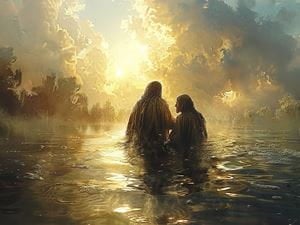
When Christ approaches John the Baptist for immersion in the River Jordan, the Baptist reacts with utter bemusement. Here he was – this lone preacher, hard at work – when, all of a sudden, the long-awaited Messiah stood before him, the Christ about whom John had preached. But little could have prepared him – least of all, the words of his own sermons – for that first encounter with Jesus.
But who was John the Baptist? Well, John had made a name for himself as a talented preacher, whose words, like those of Christ, irritated the religious elite. John’s message was too close to home, too subversive. ‘Repent, for the kingdom of heaven is at hand’, was his mantra. However, John’s work was pastoral as well: hearing confession; living within modest means; and, of course, performing innumerable baptisms. Perhaps we should remember him as Father John!
Life in John’s “parish” took a dramatic – if not unforeseen – turn, when Jesus heard about John’s work, upped sticks from Nazareth, and ventured into the wilderness to receive baptism. But, of course, Jesus was an unusual candidate for baptism, a fact which John recognises.
Matthew’s Gospel even claims that ‘John would have prevented him’, and this raises an important question: What reason did Christ have to travel so far from home and seek baptism? Remember, this is the first recorded action of Christ’s adult life. It has to be significant, in St. Matthew’s opinion, to have deserved so much attention.
Explanations for this text will often argue from a similar premise: that Christ’s baptism was performative, a bit of a pantomime. Christ knew full well that, as the Son of God, he didn’t need to be baptised, since baptism is for sinners. But he did it, regardless, to set an example for the rest of us. In other words, it was a well-intended charade.
I would like to take a different perspective: that something concrete, something real, happened when Christ was baptised; and it was this: Jesus added to the nature and purpose of baptism when he himself underwent it. Baptism continues to liberate us from inherent sin, the same as it did when John practised it. In the Nicene Creed, we confess ‘one baptism for the forgiveness of sins’. That much didn’t change. But, in the moment when Christ was baptised, it became far more than this.
Baptism was not associated with Christ until Our Lord stepped into the water. John, whose task was to roll the pitch for the Messiah, baptised those who turned from their sins – even while Jesus remained a little-known craftsman. Christ waded into the Jordan when the time was right; and his actions expanded the purpose of baptism. It had been Christened, remade in the likeness of Christ; and Christian baptism came with new benefits, over and above the forgiveness of sins.
Henceforth, baptism was to be the seal of our membership in the Church of Christ, and our adoption as God’s children. It was to nurture the seed of true faith in our hearts. It was to fill us with divine grace, which abides with us all of our lives. Baptism had become a sacrament.
No, the baptism of Our Lord was not a theatre skit or a calculated stunt. It had real implications for how the Church understands baptism and what it means. Baptism was reinvented as the first Gospel Sacrament, a shared experience that unites us as the Church of Christ. In time, Jesus would also transform the Jewish Passover into the second Gospel Sacrament, another provision for his Church after the work on earth was completed.
Pentecost, which occurs after the death and resurrection of Christ, is often pinpointed as the start of the Christian Church. But if another biblical moment earned this title, it would be the Baptism of Christ. Jesus, from the depths of the River Jordan, created the new baptism that would be central to his Church.
Christ approves of baptism, and all who receive it; and, as we read in Matthew 3, God approves of Christ. It’s as clear as a bell, from how the narrative concludes, that heaven is unfolded before us at our baptism. Salvation is at hand.
Baptism is a sacred occasion, but it has also fallen victim to the biases and whims of individual ministers in the Church. It’s a tale as old as time when a single mother, either separated or unmarried, seeks baptism for her child and is refused. It cannot be denied that such actions come from a sense of holier-than-thou, but also from the low value that some have placed on the sacraments. How could a minister who knows what baptism is, who would not have come to know God without it, be so blind as to snatch it from a child?
Christ, as we have seen, takes John’s baptism and reworks it, all the better to serve the Father’s will. He does the same with what he finds in our own hearts. Baptism is rooted, for all time, in God’s transformative power, his will to restore all things. In baptism, the Lord calls us out of darkness and welcomes us into his Church. It’s all to do with transformation.
So, let us remember our own baptism as we reflect on the baptism of Christ; and be thankful for all that God has done for us in his wonderful sacraments. In a world where the pace of life makes it hard to connect with others, let us cherish the sacred bonds we share and embrace the transformative love of God.
1/7/2026 10:25:53 PM
featured writer
more at patheos
1
Is the Church collapsing? And two questions on the Qur’an
2

3
Defense of 50 NT Passages Against “Faith Alone”
4
Are Christians Pro-Life or Pro-Birth? A Closer Look

About Matthew Allen
Matthew Allen is a writer and musician based in Northern Ireland. He is a graduate of Queen’s University, Belfast, where he studied Theology and Liberal Arts.
Patheos Explore the world's faith through different perspectives on religion and spirituality! Patheos has the views of the prevalent religions and spiritualities of the world.
Ad-Free & Subscriber Log-In Subscription Support
- About Us
- 2026 Calendar
- Videos
- Podcasts
- Library of World Religions
- Faith In Media Tracker
- Advertise With Us
- Write for Us
- Privacy Policy
- Terms of Service
- Do Not Sell My Data
- Contact Us
- Radiant Digital
- Manage Newsletter Subscriptions
- Unsubscribe From Notifications
- Sitemap
Copyright 2008-2026, Patheos. All rights reserved.
Subscription Support Ad-Free & Subscriber Log-In
Follow Patheos