
BuddhistCatholicContemplativeEvangelicalGeneral ChristianHinduJewishLatter-day SaintMuslimNew VisionsProgressive Christian
Beliefs
- Buddhist
- Catholic
- Contemplative
- Evangelical
- General Christian
- Hindu
- Jewish
- Latter-day Saint
- More Voices
- Muslim
- New Visions
- Pagan
- Progressive Christian
Topics
- Religion News
- Food and Religion
- Sports and Religion
- Religious Art
- Religious Music and Entertainment
- Religious Events
- History and Religion
- Style and Religion
- Politics and Religion
- Women in Religion
- Recreation Outdoors and Religion
- Business Finance and Religion
- Careers Workplace and Religion
- Education and Religion
- Family Parenting and Religion
- Health Fitness and Religion
- Home and Religion
- Relationships and Religion
- Technology and Religion
- Travel and Religion
Columnists
- Buddhist Columnists
- Business Finance and Religion Columnists
- Careers Workplace and Religion Columnists
- Catholic Columnists
- Contemplative Columnists
- Education and Religion Columnists
- Evangelists Columnists
- Family Parenting and Religion Columnists
- General Christian Columnists
- Health Fitness and Religion Columnists
- Hindu Columnists
- History and Religion Columnists
- Home and Religion Columnists
- Jewish Columnists
- More Voices Columnists
- Latter Day Columnists
- Muslim Columnists
- New Visions Columnists
- Nonreligious Columnists
- Pagan Columnists
- Politics and Religion Columnists
- Progressive Columnists
- Recreation Outdoors and Religion Columnists
- Relationships and Religion Columnists
- Religion News Columnists
- Religious Art Columnists
- Religious Events Columnists
- Religious Music and Entertainment Columnists
- Sports and Religion Columnists
- Style and Religion Columnists
- Technology and Religion Columnists
- Travel and Religion Columnists
- Women in Religion Columnists
Resource Library
- 2026 Calendar
- Library of World Religions
- The 100 Most Holy Places on Earth
- Patheos Answers
- Podcasts
- Videos
- Faith Leaders Database
- Anglican Episcopalian
- Bahai
- Baptist
- Buddhism
- Christianity
- Confucianism
- Eastern Orthodoxy
- Hinduism
- Holiness and Pentecostal
- ISKCON
- Islam
- Judaism
- Lutheran
- Methodist
- The Church of Jesus Christ of Latter-day Saints
- New Age
- Paganism
- Presbytarian and Reformed
- Protestantism
- Religion Behind the Scenes
- Roman Catholic
- Scientology
- Shia Islam
- Sikhism
- Sufism
- Sunni Islam
- Taoism
- Zen
- See all religions
Research Tools
 Ad-Free & Subscriber Log-In Subscription Support
Ad-Free & Subscriber Log-In Subscription Support
Follow Patheos 

- Trending:
- Forgiveness
- |
- Marriage
- |
- Consciousness
- |
- Death Penalty
- |
- Election
- |
- Halloween
Jesus and the Samaritan Woman: Living Water in Lent
March 06, 2026 by Matthew Allen
Adobe Stock
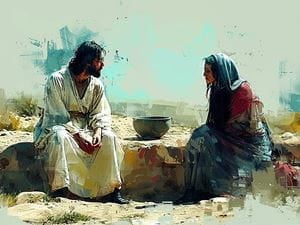
Three weeks into the Lenten journey, we find ourselves in the region of Samaria, located in what we would now call the West Bank. It’s 12 noon – 6 hours from 6 am, the traditional start of the Jewish day – when a road-weary Jesus enters the scene and sits down at Jacob’s Well.
Now, this location is not an incidental detail; so let’s take the measure of Jacob’s Well. It bottoms out 100 feet below the ground, the same distance there is between Carrick-a-Rede Rope Bridge and sea level. Imagine the gallons of water that would’ve held! Jacob’s Well was the heart of Sychar, the Samarian village formed around it; and hundreds depended on it for sustenance.
John’s Gospel is rich in symbolism, even by biblical standards. This is the same John, tradition has it, who gave us the Book of Revelation, where almost everything is a symbol. In the literary mind of St. John, then, Jacob’s well becomes a symbol of Christ: our source of abundant life, around whom the global village known as the Church is gathered.
In light of how the passage begins, the symbolism is ironic. It is Jesus, after all, not his disciples, who has come to Jacob’s Well to drink. He has come on his own. But, before too long, an unlikely companion joins him. In a climate of sectarianism, it was rare for Jews, like Jesus, to have dealings with Samaritans. Nevertheless, it is a Samaritan woman who draws near, a Samaritan whom Jesus asks for a drink.
It isn’t lost on her how strange this encounter is. Jews and Samaritans did not even converse, never mind ask one another for a drink. Both communities knew the social codes that were in force – codes that were centuries old but still dictated who could, and could not, associate with whom. But where there are lines in the sand which forbid one heart’s encounter with another, Jesus redraws them so that one circle includes us all.
John then starts to reveal the symbolism of his account, when he has Jesus mention the ‘living water’. It startles the woman, whose name we still don’t know, to hear that Jesus has these reserves of water, ‘living’ or otherwise. It was mere seconds ago that he had asked her for a drink. It seemed that he, not she, was the one who needed water. Now the tables have turned.
It isn’t some off-the-shelf, run-of-the-mill water, however, that Jesus has in store; it is access to the fountain of life itself, a constant source of strength and restoration. Even Jacob the Patriarch, who built a hundred-foot well, could not have left his descendants an inheritance like this. It is Christ alone who turns the valve and releases this miraculous water.
It is then that we learn a bit more about who the woman is, and that she has had five husbands. John’s Gospel doesn’t furnish us with details; but even if all her marriages were stable and fulfilled – which could have been so – nevertheless, it’s difficult when a long-term commitment ends. This is a woman who has endured a lot of heartache. She has ‘lived a life’, in the Belfast vernacular. But, as Ash Wednesday reminds us, God is not one to despise a broken heart.
What also stands out is the woman’s wealth of local insight. Earlier, she described the background of Jacob’s Well; and now she turns to the religious customs of her ancestors, who worshipped in the mountains. This contrasts with traditional Jewish belief, which demanded that God be worshipped in Jerusalem. But Jesus has come to challenge old certainties. God cannot be bound within the limits of a single culture, or a single moment in time.
It is after Jesus has revealed these things to the Samaritan woman that he discloses himself as the Messiah. Neither aggressive nor confrontational, Jesus leads her – one revelation at a time – into the knowledge of God. He listened to her and engaged her in a meaningful conversation. She wasn’t another faceless convert on the scorecard of conversions that week. No, this woman was flesh-and-blood, with real wounds and real dreams – like all of us.
Then comes the moment for action. The woman leaves the container she brought for the water; she no longer needs it because the font of living water, the Spirit of Christ, has been established in her heart. She returns to her home town and finds the words that ring true to her experience:
Come, see a man who told me all that I ever did.
In other words, come and meet one who knows all about me – the darkness and the light – and loves me, regardless.
The Samaritan Woman found her voice, and Samaria was changed in a heartbeat. On the strength of her witness, dozens – or even hundreds – of her neighbours turned to Christ and found salvation.
How does this link to the Season of Lent? Well, this is a time to refuse the things of this world and seek the things of God. Christ’s living water underlines this theme. Then there are those words in the Collect for Ash Wednesday, ‘God, you hate nothing that you have made’. Jesus, the Jewish man, demonstrated this when he declined to hate the Samaritans, whom he might have treated as enemies. Instead, he treated them as equals.
This Lenten Season, we reaffirm our faith in Jesus, in whom there is no hatred or division: the one who closes wounds and mends broken hearts. Let us drink the water that is the lifeblood of the Church, the water which flows in the rivers of Scripture and Sacrament; so that we, like the Samaritan Woman, would find refreshment for our souls and the will to share it with others.
3/6/2026 9:46:58 PM
featured writer
more at patheos
1

Top of the Country: 20 Cigarettes
2

OpenAI's Proposed "Industrial Policy"
3

New Book Affirms John's Gospel Is Historically Reliable
4

8 Rules for Effective Family Meetings

About Matthew Allen
Matthew Allen is a writer and musician based in Northern Ireland. He is a graduate of Queen’s University, Belfast, where he studied Theology and Liberal Arts.
Patheos Explore the world's faith through different perspectives on religion and spirituality! Patheos has the views of the prevalent religions and spiritualities of the world.
Ad-Free & Subscriber Log-In Subscription Support
- About Us
- 2026 Calendar
- Videos
- Podcasts
- Library of World Religions
- Faith In Media Tracker
- Advertise With Us
- Write for Us
- Privacy Policy
- Terms of Service
- Do Not Sell My Data
- Contact Us
- Radiant Digital
- Manage Newsletter Subscriptions
- Unsubscribe From Notifications
- Sitemap
Copyright 2008-2026, Patheos. All rights reserved.
Subscription Support Ad-Free & Subscriber Log-In
Follow Patheos