
BuddhistCatholicContemplativeEvangelicalGeneral ChristianHinduJewishLatter-day SaintMuslimNew VisionsProgressive Christian
Beliefs
- Buddhist
- Catholic
- Contemplative
- Evangelical
- General Christian
- Hindu
- Jewish
- Latter-day Saint
- More Voices
- Muslim
- New Visions
- Pagan
- Progressive Christian
Topics
- Religion News
- Food and Religion
- Sports and Religion
- Religious Art
- Religious Music and Entertainment
- Religious Events
- History and Religion
- Style and Religion
- Politics and Religion
- Women in Religion
- Recreation Outdoors and Religion
- Business Finance and Religion
- Careers Workplace and Religion
- Education and Religion
- Family Parenting and Religion
- Health Fitness and Religion
- Home and Religion
- Relationships and Religion
- Technology and Religion
- Travel and Religion
Columnists
- Buddhist Columnists
- Business Finance and Religion Columnists
- Careers Workplace and Religion Columnists
- Catholic Columnists
- Contemplative Columnists
- Education and Religion Columnists
- Evangelists Columnists
- Family Parenting and Religion Columnists
- General Christian Columnists
- Health Fitness and Religion Columnists
- Hindu Columnists
- History and Religion Columnists
- Home and Religion Columnists
- Jewish Columnists
- More Voices Columnists
- Latter Day Columnists
- Muslim Columnists
- New Visions Columnists
- Nonreligious Columnists
- Pagan Columnists
- Politics and Religion Columnists
- Progressive Columnists
- Recreation Outdoors and Religion Columnists
- Relationships and Religion Columnists
- Religion News Columnists
- Religious Art Columnists
- Religious Events Columnists
- Religious Music and Entertainment Columnists
- Sports and Religion Columnists
- Style and Religion Columnists
- Technology and Religion Columnists
- Travel and Religion Columnists
- Women in Religion Columnists
Resource Library
- 2026 Calendar
- Library of World Religions
- The 100 Most Holy Places on Earth
- Patheos Answers
- Podcasts
- Videos
- Faith Leaders Database
- Anglican Episcopalian
- Bahai
- Baptist
- Buddhism
- Christianity
- Confucianism
- Eastern Orthodoxy
- Hinduism
- Holiness and Pentecostal
- ISKCON
- Islam
- Judaism
- Lutheran
- Methodist
- The Church of Jesus Christ of Latter-day Saints
- New Age
- Paganism
- Presbytarian and Reformed
- Protestantism
- Religion Behind the Scenes
- Roman Catholic
- Scientology
- Shia Islam
- Sikhism
- Sufism
- Sunni Islam
- Taoism
- Zen
- See all religions
Research Tools
 Ad-Free & Subscriber Log-In Subscription Support
Ad-Free & Subscriber Log-In Subscription Support
Follow Patheos 

- Trending:
- Forgiveness
- |
- Marriage
- |
- Consciousness
- |
- Death Penalty
- |
- Election
- |
- Halloween
How Many Pints In A Whole Jesus?
February 10, 2026 by Matthew Allen
In Derry Girls, a Troubles-era sitcom set in the northwest of Ireland, Orla follows in the footsteps of Socrates with a question that has long baffled philosophers: what is the number of communion wafers, fragments of Christ’s body, needed to form “a whole Jesus”?
Despite centuries of research and clinical trials, even the best-equipped of laboratories (and subreddits) have not found an answer to this riddle, much to the detriment of human progress; and while I haven’t succeeded where the best and the brightest have failed, I do know how much blood there is in a single Jesus – or a generic adult male, for that matter.
It’s 10 pints. Adults have 10 pints of blood in circulation at a time. Suppose, then, that a communion chalice holds a half-pint of wine; 20 chalices would make a whole Jesus, on the blood front.
In spite of all appearances, this convoluted introduction does have an actual point… so, now to the point!
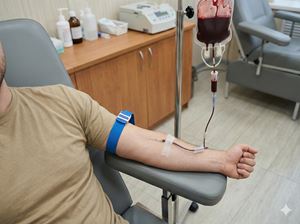
Since 2022, when I first wrote about blood donation, I have attended regular give-blood sessions; at each one, a single pint is taken. I have now managed, with 10 outings, to donate an amount of blood equal to one whole Jesus: 10 pints. (Not in a single afternoon!)
I know men and women who have donated over a dozen times more blood than I have, so this is a minuscule achievement in comparison. But I thought it was a good occasion to return to this topic in an article.
Cue tonal whiplash from a bonkers introduction…
Donors are a diverse bunch: we come from all ethnicities; most faiths (Jehovah’s Witnesses, due to their doctrinal beliefs, are a famous exception); all nationalities; and (after decades of exclusion, in the UK, for some) all sexual orientations. Donors are also diverse in the reasons behind our choice to become involved.
For me, the critical importance of blood transfusions landed when I lost an uncle to leukemia (there’s the tonal whiplash). It was the blood bank which kept him alive in his final months; and this would not have been possible without donors, for whom I will be forever grateful.
It was a bittersweet moment when, after the donation session last month, I wondered over to the refreshments table and found a basket full of his favourite biscuit. Uncle Alan loved a Club so much that I mentioned it in his funeral tribute. It was a nice affirmation. ‘Have one for me’.
The Universal Donor
Christ, as I mentioned when I first wrote about blood donation, is the most influential donor of all time. Whereas our blood offers medical benefits, the blood of Christ is medicine for the soul. It can be stored on the ‘blood bank’ that is a church’s altar – the correct word is ‘reserved’ – until a need for it arises.
Jesus is O-, in a spiritual sense: that is, a universal donor. St. Paul, in 2 Corinthians 5, is clear that Christ died and shed his blood for all (vv. 14-15). There are those, however, who conceive Our Lord as more of an AB+ donor — with all the love in the world to AB+ donors: his blood is for a small number of individuals, and them alone.
This attitude spawns much intolerance and sectarianism. There is a cart-before-horse idea that a clean bill of spiritual health makes one compatible with Christ’s blood – a matched recipient – as if a diagnostic test is required when someone comes to receive the sacrament. It’s an idea that ignores the role of Christ’s blood as medicine for the soul; because it is the sick, as Christ himself reminds us, who have the most need of a doctor (Mark 2.17).
In the case of ‘Jesus Christ, M.D.’, this doctor even sacrificed himself to make us whole. Christ is divine as well as human, far above our imagination. But still there are clerics who think of his blood, and the fellowship it represents, in human terms alone. Others, never themselves, have to be tested and found compatible to receive it – found, that is, to fit a respectable, folks-like-us mould; because that’s what faith consists of, in some circles – before their spiritual betters allow them into the club.
Christ, however, is the most universal of universal donors. There are no social categories, no outsiders, for whom Jesus does not care, and for whom he did not shed his blood. It is his being – regardless of the choices we make, or do not make – which sustains our being and regenerates us.
…and on that note, I’m off to regenerate some blood cells. I have a brand-new Jesus to start in 12 weeks! Please, if possible, consider donation. I find it such a positive aspect of life. It brings a sense of achievement and fulfilment, which lifts the soul. I cannot recommend it enough.
2/10/2026 12:13:18 AM
featured writer
more at patheos
1
Art of Living: Cardinal Virtues & the Resurrection
2
Ascension Day and the Sacraments
3

Trump Should Retake his Old Name Drumpf that Is Like Dump
4
INNER CIRCLE: Those Who Divide

About Matthew Allen
Matthew Allen is a writer and musician based in Northern Ireland. He is a graduate of Queen’s University, Belfast, where he studied Theology and Liberal Arts.
Patheos Explore the world's faith through different perspectives on religion and spirituality! Patheos has the views of the prevalent religions and spiritualities of the world.
Ad-Free & Subscriber Log-In Subscription Support
- About Us
- 2026 Calendar
- Videos
- Podcasts
- Library of World Religions
- Faith In Media Tracker
- Advertise With Us
- Write for Us
- Privacy Policy
- Terms of Service
- Do Not Sell My Data
- Contact Us
- Radiant Digital
- Manage Newsletter Subscriptions
- Unsubscribe From Notifications
- Sitemap
Copyright 2008-2026, Patheos. All rights reserved.
Subscription Support Ad-Free & Subscriber Log-In
Follow Patheos