
BuddhistCatholicContemplativeEvangelicalGeneral ChristianHinduJewishLatter-day SaintMuslimNew VisionsProgressive Christian
Beliefs
- Buddhist
- Catholic
- Contemplative
- Evangelical
- General Christian
- Hindu
- Jewish
- Latter-day Saint
- More Voices
- Muslim
- New Visions
- Pagan
- Progressive Christian
Topics
- Religion News
- Food and Religion
- Sports and Religion
- Religious Art
- Religious Music and Entertainment
- Religious Events
- History and Religion
- Style and Religion
- Politics and Religion
- Women in Religion
- Recreation Outdoors and Religion
- Business Finance and Religion
- Careers Workplace and Religion
- Education and Religion
- Family Parenting and Religion
- Health Fitness and Religion
- Home and Religion
- Relationships and Religion
- Technology and Religion
- Travel and Religion
Columnists
- Buddhist Columnists
- Business Finance and Religion Columnists
- Careers Workplace and Religion Columnists
- Catholic Columnists
- Contemplative Columnists
- Education and Religion Columnists
- Evangelists Columnists
- Family Parenting and Religion Columnists
- General Christian Columnists
- Health Fitness and Religion Columnists
- Hindu Columnists
- History and Religion Columnists
- Home and Religion Columnists
- Jewish Columnists
- More Voices Columnists
- Latter Day Columnists
- Muslim Columnists
- New Visions Columnists
- Nonreligious Columnists
- Pagan Columnists
- Politics and Religion Columnists
- Progressive Columnists
- Recreation Outdoors and Religion Columnists
- Relationships and Religion Columnists
- Religion News Columnists
- Religious Art Columnists
- Religious Events Columnists
- Religious Music and Entertainment Columnists
- Sports and Religion Columnists
- Style and Religion Columnists
- Technology and Religion Columnists
- Travel and Religion Columnists
- Women in Religion Columnists
Resource Library
- 2026 Calendar
- Library of World Religions
- The 100 Most Holy Places on Earth
- Patheos Answers
- Podcasts
- Videos
- Faith Leaders Database
- Anglican Episcopalian
- Bahai
- Baptist
- Buddhism
- Christianity
- Confucianism
- Eastern Orthodoxy
- Hinduism
- Holiness and Pentecostal
- ISKCON
- Islam
- Judaism
- Lutheran
- Methodist
- The Church of Jesus Christ of Latter-day Saints
- New Age
- Paganism
- Presbytarian and Reformed
- Protestantism
- Religion Behind the Scenes
- Roman Catholic
- Scientology
- Shia Islam
- Sikhism
- Sufism
- Sunni Islam
- Taoism
- Zen
- See all religions
Research Tools
 Ad-Free & Subscriber Log-In Subscription Support
Ad-Free & Subscriber Log-In Subscription Support
Follow Patheos 

- Trending:
- Forgiveness
- |
- Marriage
- |
- Consciousness
- |
- Death Penalty
- |
- Election
- |
- Halloween
How Does The Life of Christ Save Us?
April 05, 2025 by Matthew Allen
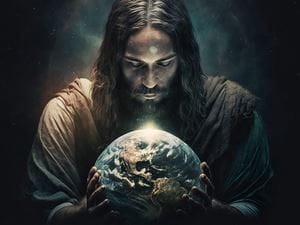
Adobe Stock
Everyone likes to know how things work. No sooner do we learn to pick up objects, like our childhood toys, than we hold them up to the light and look them over to see which bits do what. It’s only natural that we take a similar approach whenever it comes to faith.
There are books, running to hundreds upon hundreds of pages, attempting to describe (in excruciating detail) the works of God. For many things, however, there are no satisfying explanations to be found; and we must learn to live with mystery, while still having faith.
It’s hard, for instance, to pin down how Christ’s death on the Cross resulted in our salvation. Some have tried (their efforts are called theories of atonement, and some are more persuasive than others) but nobody has yet come up with an agreed-upon answer that’s accepted all over the Christian world. Many would fiercely defend a particular view.
Christ’s death, we must remember, was one part (albeit a significant part) of his earthly life. It certainly wasn’t his Crucifixion alone that saved us. In the Nicene Creed, the phrase ‘for us and for our salvation’ doesn’t come right before ‘he suffered death and was buried’. It comes, rather, before the whole section about Christ’s work on earth. It would clear up the matter, I think, if every sentence in this passage began, ‘for us and for our salvation’:
· For us and for our salvation, he came down from heaven.
· For us and for our salvation, he was incarnate by the Holy Spirit of the Virgin Mary and was made man.
· For us and for our salvation, he was crucified under Pontius Pilate.
· For us and for our salvation, he suffered death and was buried.
· For us and for our salvation, he rose again in accordance with the Scriptures.
· For us and for our salvation, he ascended into heaven and is seated at the right hand of the Father.
· For us and for our salvation, he will come again in glory to judge the living and the dead.
Together, the Incarnation, the Crucifixion, the Resurrection, the Ascension, the Second Coming, and the Final Judgement – in short, everything Christ has ever done and will ever do – throws open the door to salvation. St. Paul takes care to remind us, moreover, that salvation is an ongoing process; by God’s grace, we’re ‘being saved’ (1 Corinthians 1.18).
How, though, do these landmarks in the life of Christ work together to save us? In truth, we don’t really need to know. Consider your phone (or tablet), on which you’re likely reading this. You probably didn’t design it. You probably don’t have a Scooby-Doo how the tech works. This doesn’t matter in the slightest. You’re able to benefit from it anyway.
Similarly, we don’t have to know how the Incarnation, the Crucifixion, the Resurrection, the Ascension, the Second Coming, and the Final Judgement end up with our salvation; we simply need to trust what we believe – ‘that is all ye know on earth, and all ye need to know’. However, we’re welcome to ponder these mysteries until we see God face to face.
What we should refrain from doing is imposing our own ideas on other believers and labelling those we disagree with as heretics. Different stances prevail in different circles (evangelicals, for example, typically believe that Christ was punished instead of us for the sins we commit). Like I say, though, there are several views on how the Crucifixion saves.
It’s notable that, compared to the Crucifixion, there’s little debate around what role the Incarnation, the Resurrection, the Ascension, the Second Coming, and the Final Judgement have in saving us because the Crucifixion peels off so much of our attention. It’s as if we believe, mistakenly, that redemption is only to be found on the Cross – not in Bethlehem, in the Garden Tomb, on the Mount of Olives, or at the right hand of the Father.
There is a time in the Church’s year (a ‘season’, as the speaker in the Book of Ecclesiastes would say) to commemorate all the main events in the life of Christ: Advent for his Incarnation, Holy Week for his Passion… We should refrain from unfurling the calendar and planting a huge ‘X’ on any one day (writing, ‘this is the day that salvation happened!’), unless we make the time to put such a mark beside every day that Christ walked on earth.
And so, this Easter, let us not lose focus on the wider story, the Gospel of Salvation, that Christ lived out. For us, and in order to save us, Christ did many things. Yes, he died on the Cross and rose again (‘alleluia!’), but he had other, equally significant, achievements besides.
In light of these other achievements is the Crucifixion better understood; and in light of the Crucifixion, I would submit, are those other achievements more fully grasped.
4/5/2025 12:54:27 AM
featured writer
more at patheos
1
Racial Harmony After the Priesthood Ban
2
The Lenten Practices of Charity, Mortification, and Penance
3
God’s Word Bears Fruit and Brings New Life
4

About Matthew Allen
Matthew Allen is a writer and musician based in Northern Ireland. He is a graduate of Queen’s University, Belfast, where he studied Theology and Liberal Arts.
Patheos Explore the world's faith through different perspectives on religion and spirituality! Patheos has the views of the prevalent religions and spiritualities of the world.
Ad-Free & Subscriber Log-In Subscription Support
- About Us
- 2026 Calendar
- Videos
- Podcasts
- Library of World Religions
- Faith In Media Tracker
- Advertise With Us
- Write for Us
- Privacy Policy
- Terms of Service
- Do Not Sell My Data
- Contact Us
- Radiant Digital
- Manage Newsletter Subscriptions
- Unsubscribe From Notifications
- Sitemap
Copyright 2008-2026, Patheos. All rights reserved.
Subscription Support Ad-Free & Subscriber Log-In
Follow Patheos