
BuddhistCatholicContemplativeEvangelicalGeneral ChristianHinduJewishLatter-day SaintMuslimNew VisionsProgressive Christian
Beliefs
- Buddhist
- Catholic
- Contemplative
- Evangelical
- General Christian
- Hindu
- Jewish
- Latter-day Saint
- More Voices
- Muslim
- New Visions
- Pagan
- Progressive Christian
Topics
- Religion News
- Food and Religion
- Sports and Religion
- Religious Art
- Religious Music and Entertainment
- Religious Events
- History and Religion
- Style and Religion
- Politics and Religion
- Women in Religion
- Recreation Outdoors and Religion
- Business Finance and Religion
- Careers Workplace and Religion
- Education and Religion
- Family Parenting and Religion
- Health Fitness and Religion
- Home and Religion
- Relationships and Religion
- Technology and Religion
- Travel and Religion
Columnists
- Buddhist Columnists
- Business Finance and Religion Columnists
- Careers Workplace and Religion Columnists
- Catholic Columnists
- Contemplative Columnists
- Education and Religion Columnists
- Evangelists Columnists
- Family Parenting and Religion Columnists
- General Christian Columnists
- Health Fitness and Religion Columnists
- Hindu Columnists
- History and Religion Columnists
- Home and Religion Columnists
- Jewish Columnists
- More Voices Columnists
- Latter Day Columnists
- Muslim Columnists
- New Visions Columnists
- Nonreligious Columnists
- Pagan Columnists
- Politics and Religion Columnists
- Progressive Columnists
- Recreation Outdoors and Religion Columnists
- Relationships and Religion Columnists
- Religion News Columnists
- Religious Art Columnists
- Religious Events Columnists
- Religious Music and Entertainment Columnists
- Sports and Religion Columnists
- Style and Religion Columnists
- Technology and Religion Columnists
- Travel and Religion Columnists
- Women in Religion Columnists
Resource Library
- 2026 Calendar
- Library of World Religions
- The 100 Most Holy Places on Earth
- Patheos Answers
- Podcasts
- Videos
- Faith Leaders Database
- Anglican Episcopalian
- Bahai
- Baptist
- Buddhism
- Christianity
- Confucianism
- Eastern Orthodoxy
- Hinduism
- Holiness and Pentecostal
- ISKCON
- Islam
- Judaism
- Lutheran
- Methodist
- The Church of Jesus Christ of Latter-day Saints
- New Age
- Paganism
- Presbytarian and Reformed
- Protestantism
- Religion Behind the Scenes
- Roman Catholic
- Scientology
- Shia Islam
- Sikhism
- Sufism
- Sunni Islam
- Taoism
- Zen
- See all religions
Research Tools
 Ad-Free & Subscriber Log-In Subscription Support
Ad-Free & Subscriber Log-In Subscription Support
Follow Patheos 

- Trending:
- Forgiveness
- |
- Marriage
- |
- Consciousness
- |
- Death Penalty
- |
- Election
- |
- Halloween
Finding Rest in the Dwelling Place of God
March 08, 2022 by Matthew Allen
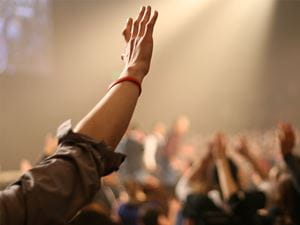
Twenty20
Psalm 91 has a very special place in my heart. It’s one of the first ever Psalms that I prayed with my boyfriend. We’re good Anglicans, you see, who video-call for daily compline! For those of other denominations, compline is the day’s final act of prayer, traditionally said at 9pm.
God uses his power to drive away fear, as perfect love always does (1 John 4:18). And in Psalm 91, heroic images abound of the Holy One scattering every horror before him. It’s a psalm all about finding rest in a turbulent world, even one of Russian warmongering – being safe in Christ, our ‘Light from Light.’
Read through the psalm and you may recognize the language from somewhere. It’s vivid stuff. You might remember expressions like the shield of God’s faithfulness (v. 4) and the attending angels (v. 11) from the song “On Eagle’s Wings.” Give it a listen on YouTube if it’s been a while.
President Biden quoted from this hymn in his 2020 victory speech, offering its portrait of a loving God as “comfort and solace” to American families bereaved by Covid-19. I confess that I hadn’t heard it before the President’s address. And it was only much later that I realized it was based on Psalm 91.
What sticks with me when I read Psalm 91 is that first verse, ‘Whoever dwells in the shelter of the Most High will rest in the shadow of the Almighty.’ The theme of God’s protection is clear from the beginning. And so, I meditated on what it is to abide in the secure citadel which is Our Lord.
A natural starting point, as a Northern Irishman thinking through the topic of refuge, was the Hibernian saying, ‘It is in the shelter of each other that the people live.’ I suppose this phrase came to mind because of how close the language is to Psalm 91. For comparison, re-read the verse I quoted in the previous paragraph.
Our potential as human beings to be a shelter for one another — Lord knows there are millions longing for shelter today — surely forms part of the mystery here in Psalm 91. The song is included in the scriptures of the Hebrew people, after all. It isn’t one person’s experience alone. Otherwise, it wouldn’t have endured in the prayer book of a religious community.
But it isn’t only the Jewish people with whom the psalm resonates. As Christians, we place our faith in the Holy Catholic Church. And in her, God extends us relief. In the same way that a Hebrew worshipper found a haven in the Temple, we have a safe dwelling in the Church.
Indeed, we see the same imagery from Psalm 91 in the New Testament. Luke records, in Acts 5:15 how people in Jerusalem carried their sick into St. Peter’s literal shadow – Peter being, as the first pope, the head of the Church back then – in the hopes of receiving some grace.
And we can always – whenever the hour of need arises — look to the Church as our life-raft. In verse five, the Psalmist affirms: ‘You will not fear the terror of night, nor the arrow that flies by day.’ This makes it a fitting psalm for compline before bed, encouraging us that our Church’s holy ministry continues while the world sleeps.
The Pope Emeritus, writing as Cardinal Joseph Ratzinger, explains why the Church is a perpetual sanctuary; ‘because the Lord is always giving himself, because the eucharistic mystery remains present, and because we, in approaching it, are always included in the worship of the whole believing, praying, and loving Church’ (Theology of the Liturgy, 281).
This, of course, is the Church at her best — doing what her Lord called her to do. My sympathies are with everyone whose religious experiences have been life-depleting rather than life-giving. I haven’t always had a smooth relationship with Church either. But I see the Church as a force for good in the world when under the guidance of a righteous clergy.
God is always at hand in the Sacrament as our spiritual protector, even when things in the world are dire. Psalm 91:7 captures this powerfully: ‘A thousand may fall at your side, ten thousand at your right hand, but it will not come near you.’ While Putin slithers into Ukraine, the Bride of Christ is tending the broken with a healing supper.
The holy presence is available for us all. ‘If you say, “The Lord is my refuge,” and you make the Most High your dwelling, no harm will overtake you’ (vv. 9-10a). Through the sacrament of confirmation, then, enters full membership of the Church in order to dwell with God in the gathering of his chosen people.
But receiving such a benediction is not an individualistic experience. As emblematized and enacted in the common cup of the Sacrament, obtaining a blessing entails the duty to pay forward what we receive. As we hold the cup in our hands, we hold the power to bless our neighbor with a supreme blessing. What a far cry from Putin’s campaign of terror.
‘It is in the shelter of each other that the people live.’ And Psalm 91 supplies a vision for the relationships we can build in order to show others the same care we obtain from God: ‘He will call on me, and I will answer him; I will be with him in trouble, I will deliver him and honor him’ (v. 15, NIV). As I prayed with my boyfriend, and as events in Ukraine assailed our screens, these words felt especially poignant.
And so, my final thoughts on Psalm 91… God wants to be the strong protector of a chosen people. Originally, this was the Jewish community. But in Christian teaching it includes all people baptized into the Church. In the fellowship of saints, God reveals His open-handedness through ministries and sacraments.
What’s more, believers are called, in our collective life as the Body of Christ and in our various relationships, to mirror this concern for those who need a home. And who doesn’t yearn for a spiritual home? All of us have a holy purpose in life, therefore: to make our parishes into the place where outsiders may receive a true welcome in the name of Christ.
3/8/2022 9:27:17 PM
featured writer
more at patheos
1
Bad Sermons, Political Violence, and Evil May Day of 1517
2
3
In the Beginning, Incest Was the Best
4
Magnifica Humanitas is Pope Leo, Repeating What Jesus Said.

About Matthew Allen
Matthew Allen is a writer and musician based in Northern Ireland. He is a graduate of Queen’s University, Belfast, where he studied Theology and Liberal Arts.
Patheos Explore the world's faith through different perspectives on religion and spirituality! Patheos has the views of the prevalent religions and spiritualities of the world.
Ad-Free & Subscriber Log-In Subscription Support
- About Us
- 2026 Calendar
- Videos
- Podcasts
- Library of World Religions
- Faith In Media Tracker
- Advertise With Us
- Write for Us
- Privacy Policy
- Terms of Service
- Do Not Sell My Data
- Contact Us
- Radiant Digital
- Manage Newsletter Subscriptions
- Unsubscribe From Notifications
- Sitemap
Copyright 2008-2026, Patheos. All rights reserved.
Subscription Support Ad-Free & Subscriber Log-In
Follow Patheos