
BuddhistCatholicContemplativeEvangelicalGeneral ChristianHinduJewishLatter-day SaintMuslimNew VisionsProgressive Christian
Beliefs
- Buddhist
- Catholic
- Contemplative
- Evangelical
- General Christian
- Hindu
- Jewish
- Latter-day Saint
- More Voices
- Muslim
- New Visions
- Pagan
- Progressive Christian
Topics
- Religion News
- Food and Religion
- Sports and Religion
- Religious Art
- Religious Music and Entertainment
- Religious Events
- History and Religion
- Style and Religion
- Politics and Religion
- Women in Religion
- Recreation Outdoors and Religion
- Business Finance and Religion
- Careers Workplace and Religion
- Education and Religion
- Family Parenting and Religion
- Health Fitness and Religion
- Home and Religion
- Relationships and Religion
- Technology and Religion
- Travel and Religion
Columnists
- Buddhist Columnists
- Business Finance and Religion Columnists
- Careers Workplace and Religion Columnists
- Catholic Columnists
- Contemplative Columnists
- Education and Religion Columnists
- Evangelists Columnists
- Family Parenting and Religion Columnists
- General Christian Columnists
- Health Fitness and Religion Columnists
- Hindu Columnists
- History and Religion Columnists
- Home and Religion Columnists
- Jewish Columnists
- More Voices Columnists
- Latter Day Columnists
- Muslim Columnists
- New Visions Columnists
- Nonreligious Columnists
- Pagan Columnists
- Politics and Religion Columnists
- Progressive Columnists
- Recreation Outdoors and Religion Columnists
- Relationships and Religion Columnists
- Religion News Columnists
- Religious Art Columnists
- Religious Events Columnists
- Religious Music and Entertainment Columnists
- Sports and Religion Columnists
- Style and Religion Columnists
- Technology and Religion Columnists
- Travel and Religion Columnists
- Women in Religion Columnists
Resource Library
- 2026 Calendar
- Library of World Religions
- The 100 Most Holy Places on Earth
- Patheos Answers
- Podcasts
- Videos
- Faith Leaders Database
- Anglican Episcopalian
- Bahai
- Baptist
- Buddhism
- Christianity
- Confucianism
- Eastern Orthodoxy
- Hinduism
- Holiness and Pentecostal
- ISKCON
- Islam
- Judaism
- Lutheran
- Methodist
- The Church of Jesus Christ of Latter-day Saints
- New Age
- Paganism
- Presbytarian and Reformed
- Protestantism
- Religion Behind the Scenes
- Roman Catholic
- Scientology
- Shia Islam
- Sikhism
- Sufism
- Sunni Islam
- Taoism
- Zen
- See all religions
Research Tools
 Ad-Free & Subscriber Log-In Subscription Support
Ad-Free & Subscriber Log-In Subscription Support
Follow Patheos 

- Trending:
- Forgiveness
- |
- Marriage
- |
- Consciousness
- |
- Death Penalty
- |
- Election
- |
- Halloween
Finding Hidden Beauty: Craig Detweiler on Faith, Film, and Hope
February 13, 2026 by Cara Meredith
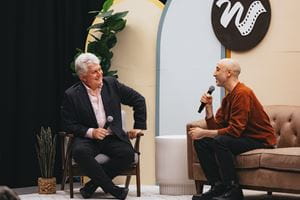
Craig, left, interviewing Daniel Solé, director of the award winning film, "Say As I Say" at the Windrider Summit at the Sundance Film Festival in February 2026. Photo by BK Koomler.
Editor's Note: At Patheos, we're highlighting Faith & Media Initiative (FAMI) Fellows whose work brings thoughtful, lived faith perspectives into today's public conversations. These profiles showcase leaders helping broaden understanding of belief, dignity, and community in the world we share.
To Craig Detweiler, beauty is found in the most unlikely of places.
Whether standing behind a camera directing shots, hunched over a worn wooden desk looping stories together in his mind, or teaching student screenwriters, producers, and media hopefuls, Detweiler is on an endless search for hidden beauty.
The award-winning filmmaker, writer, and professor’s work centers at the intersection of faith, storytelling, media and technology. Detweiler sees how “shrapnel,” as he calls it, is everywhere – both in the disparate worlds he calls home, and, in the world around him. Just as he often feels disconcerted on a daily basis, Detweiler’s blue eyes twinkle with the stuff of hope and possibility. He’s quick to point out that Hollywood’s greatest export is hope and just as quick to note how the industry can act as a great rehumanizing garden or a dehumanizing machine.
Even if his sights are set on the more positive of the two options, he can’t help but cast his eyes toward Tinseltown’s history as a place built by refugees and outsiders who believed in the promise of the American dream. To Detweiler, even when the dream factory fell short, “they still managed to craft bales of underdogs, including those on the margin – taking on the system and bringing us on that journey, that hard-won journey of hope.”
After all, being a hopemonger is exactly what led Craig Detweiler into the industry in the first place.
Growing up in North Carolina meant that the future award-winner felt far removed from the day-to-day realities of Hollywood. As Detweiler recounts, “It never occurred to me that I could be someone who was paid to write movies, like it was an actual job or something. The whole idea just didn’t seem possible, even though it was a passion of mine.”
From Seminary to Hollywood’s Margins
Craig Detweiler
But when the soft-spoken man, whose voice still echoes with southern rumbles of the Tar Heel State, moved to Southern California for seminary, he soon realized he had more passion and love for storytelling than many who were already in the entertainment business.
“Seminary’s a great place for sorting out your calling,” he notes, with a slight chuckle. One day, while sitting in a Theology and Pop Culture class, a grizzled television producer named Coleman Luck made an offer the young seminarian couldn’t refuse.
“He was just a guest speaker that day in class, but he offered an invitation for those who wanted to get into the ‘mess’ of Hollywood and follow him into the storytelling business, with all of its dreams and disappoints,” Detweiler says of the moment. As it goes, in a class of 75 people, he was the only one who raised his hand.
“I thought to myself, I don’t want to be a person with regrets. So, why not me?” Detweiler’s gamble paid off. For more than thirty years now, the filmmaker and author, who is also President of the cultural investment organization, the Wedgwood Circle, and Dean of the College of Arts and Media at Grand Canyon University, has lived without regrets and with a whole lot of hope.
In addition to earning both a Masters of Divinity and a Ph.D in Theology and Culture from Fuller Theological Seminary, Detweiler also graduated from USC’s School of Cinematic Arts. He went on to write screenplays for The Duke and Extreme Days, and directed the award-winning documentary Remand, which was narrated by Angela Bassett. The author of several books, including iGods, Selfies, Deep Focus, and his newest release, Honest Creativity, his cultural commentary has been featured in a number of major outlets. Not to be outdone, Variety honored Detweiler as their 2016 Mentor of the Year.
But the forward-thinking leader, who values interfaith cooperation and champions religious freedom, can’t help but see how film and music have always been a source of profound hope and possibility – especially when each one of us carries within us “unresolved questions and traumas from our lives.”
He recalls with fondness the cinematic heroes and role models he looked to for inspiration and touchpoints as a child, naming “the bruised but principled Humphrey Bogart in Casablanca, the depressed by defiant Jimmy Steward in It’s a Wonderful Life, or the befuddled Henry Fonda, wrapped around Barbara Stanwick’s finger, in The Lady Eve.” In all of these places, the movies were perhaps telling him “hidden truths about the world and about how things work.”
It's not so different for the film buff now, who says he watches at least 300 films a year.
“The challenge in a noisy and crowded marketplace is to find the still, small voices that prompt us to pause, reflect, and reclaim our humanity. There are so many, many great movies audiences just have no idea exists because the marketing apparatus can’t rise above the distraction,” he muses.
But challenge Detweiler to provide you with a list of movies that truly cause an audience to pause, reflect, and reclaim humanity, he’ll quickly spout off a personal “Best of 2025” list of eleven for you:
- Train Dreams
- Roofman
- One of Them Days
- The Baltimorons
- Left-Handed Girl
- The Testament of Ann Lee
- It was Just an Accident
- Sorry, Baby
- A Little Prayer
- Ballad of Wallis Island
- Sketch
Craig, left, interviewing Daniel Solé, director of the award winning film, "Say As I Say" at the Windrider Summit at the Sundance Film Festival in February 2026. Photo by BK Koomler.
A Quiet Rebellion of Fellowship and Faith
Detweiler may be watching films nearly every day of the week, but he’s also figuring out how to rebuild and rise from the proverbial ashes all of us are handing the next generation. That’s why, when he thinks about his contributions during the FAMI (Faith & Media Initiative) Fellowship, he believes we will need even more people conversant across religions, nations, and cultures to preserve sacred spaces in the 21st century.
Just as he sees it an incredible honor to be named an inaugural fellow at a time when polarization can seem so profitable.
“It’s a very rebellious act to gather and build bridges, especially during a time when others seem to prefer to destroy them,” he says. Their collective work of listening, seeing, and seeking to understand one another proved critical, even as he felt “regularly humbled by the brains and bounty of my fellow participants.”
In a way, the impact of their time together also bleeds into the work he wants to do in the future. He dreams of a book that invites angry young men “who just think everything is for the lulls,” into a space beyond anger, nihilism, and despair. He also thinks about pasting together a theology of memes, citing the visual shorthand and cynical satire with which humans use to fight one another.
Even though he hasn’t quite figured it all out yet, it seems to me that Craig Detweiler has figured out a host of other things with which to occupy his time, his brains, and his talent. In a hyper-accelerated world, he likes his religion low, quiet, and boring,” and appreciates how the liturgy of the Episcopal Church invites him to breathe and receive. He seeks moments of beauty in tending to his garden or riding his bike along the beach.
But were you to ask him what’s saving his life right now, his answer is simple: “The wisdom of Ecclesiastes, which is to say, to take comfort in a good meal with the people you love.”
Because for Craig Detweiler, beauty is always found in the most unlikely of places.
2/13/2026 10:32:18 PM
featured writer
more at patheos
1

Gambling Apps Are Exploiting Addiction, and It's a Sin
2
Your Story Isn’t Over: It’s Being Redeemed
3
Is Self Absorption The Brain Rot Of Our Culture?
4

50 Years Ago- Mark and Kristin Grew Up in the 70's

About Cara Meredith
Cara Meredith is a writer, speaker, and editor who writes at the intersection of spirituality and culture. A former high school English teacher and nonprofit outreach director, her writing has appeared in numerous print and online publications. The author of "Church Camp" (Broadleaf) and "The Color Of Life" (Zondervan), she holds a Masters of Theology and lives in Oakland, California with her family. She writes the Patheos column Coloring Outside the Lines.
Patheos Explore the world's faith through different perspectives on religion and spirituality! Patheos has the views of the prevalent religions and spiritualities of the world.
Ad-Free & Subscriber Log-In Subscription Support
- About Us
- 2026 Calendar
- Videos
- Podcasts
- Library of World Religions
- Faith In Media Tracker
- Advertise With Us
- Write for Us
- Privacy Policy
- Terms of Service
- Do Not Sell My Data
- Contact Us
- Radiant Digital
- Manage Newsletter Subscriptions
- Unsubscribe From Notifications
- Sitemap
Copyright 2008-2026, Patheos. All rights reserved.
Subscription Support Ad-Free & Subscriber Log-In
Follow Patheos