
BuddhistCatholicContemplativeEvangelicalGeneral ChristianHinduJewishLatter-day SaintMuslimNew VisionsProgressive Christian
Beliefs
- Buddhist
- Catholic
- Contemplative
- Evangelical
- General Christian
- Hindu
- Jewish
- Latter-day Saint
- More Voices
- Muslim
- New Visions
- Pagan
- Progressive Christian
Topics
- Religion News
- Food and Religion
- Sports and Religion
- Religious Art
- Religious Music and Entertainment
- Religious Events
- History and Religion
- Style and Religion
- Politics and Religion
- Women in Religion
- Recreation Outdoors and Religion
- Business Finance and Religion
- Careers Workplace and Religion
- Education and Religion
- Family Parenting and Religion
- Health Fitness and Religion
- Home and Religion
- Relationships and Religion
- Technology and Religion
- Travel and Religion
Columnists
- Buddhist Columnists
- Business Finance and Religion Columnists
- Careers Workplace and Religion Columnists
- Catholic Columnists
- Contemplative Columnists
- Education and Religion Columnists
- Evangelists Columnists
- Family Parenting and Religion Columnists
- General Christian Columnists
- Health Fitness and Religion Columnists
- Hindu Columnists
- History and Religion Columnists
- Home and Religion Columnists
- Jewish Columnists
- More Voices Columnists
- Latter Day Columnists
- Muslim Columnists
- New Visions Columnists
- Nonreligious Columnists
- Pagan Columnists
- Politics and Religion Columnists
- Progressive Columnists
- Recreation Outdoors and Religion Columnists
- Relationships and Religion Columnists
- Religion News Columnists
- Religious Art Columnists
- Religious Events Columnists
- Religious Music and Entertainment Columnists
- Sports and Religion Columnists
- Style and Religion Columnists
- Technology and Religion Columnists
- Travel and Religion Columnists
- Women in Religion Columnists
Resource Library
- 2026 Calendar
- Library of World Religions
- The 100 Most Holy Places on Earth
- Patheos Answers
- Podcasts
- Videos
- Faith Leaders Database
- Anglican Episcopalian
- Bahai
- Baptist
- Buddhism
- Christianity
- Confucianism
- Eastern Orthodoxy
- Hinduism
- Holiness and Pentecostal
- ISKCON
- Islam
- Judaism
- Lutheran
- Methodist
- The Church of Jesus Christ of Latter-day Saints
- New Age
- Paganism
- Presbytarian and Reformed
- Protestantism
- Religion Behind the Scenes
- Roman Catholic
- Scientology
- Shia Islam
- Sikhism
- Sufism
- Sunni Islam
- Taoism
- Zen
- See all religions
Research Tools
 Ad-Free & Subscriber Log-In Subscription Support
Ad-Free & Subscriber Log-In Subscription Support
Follow Patheos 

- Trending:
- Forgiveness
- |
- Marriage
- |
- Consciousness
- |
- Death Penalty
- |
- Election
- |
- Halloween
Faith and Flourishing: Why Media Must Tell the Wellness Story
December 18, 2025 by Ginny Baxter

Adobe Stock
How Faith Leaders Can Help the Media Better Explain Religion-Wellness Connection
Many journalists draw a blank when they are assigned to produce a faith-related story. They may know little about the subject, and they aren’t comfortable with it. This situation is problematic for several reasons, according to experts who participated in a recent forum called Faith and Flourishing: The Untold Story.
The Faith and Media Initiative (FAMI) hosted the LinkedIn live discussion, which brought together several renowned thought leaders to explore the often-untold story of how faith can positively affect wellness and how the media can better tell the story.
FAMI is a nonprofit organization that connects and provides resources for a global network of faith and community leaders, content creators and members of the media. Its mission is to “ensure accurate, balanced representation of all faiths in news and entertainment.”
Moderator Angela Redding, executive director of the Radiant Foundation and FAMI, noted that The Global Faith and News Study, which consisted of nearly 10,000 respondents from 18 countries, found that less than 20 percent of journalists feel comfortable talking about faith and were afraid of “getting it wrong.”
Joining Redding in the discussion were three panelists:
•Justin Dyer, PhD, a professor of religious education at Brigham Young University
•Lynn Swain, MSc, CEO of Symbiota Leadership Institute and global specialist on trust, resilience and the human condition
•Lipi Roy, MD, MPH, a nationally recognized addiction medicine physician, keynote speaker and writer on issues such as addiction, mental health and homelessness
Faith is a major topic of interest across the globe. About 75 percent of the world’s people are affiliated with some type of faith, according to the Pew Research Center. Consequently, journalists who shy away from the subject can easily leave out “a substantial amount of the human experience,” according to Dr. Dyer. “If we don’t engage with that, we’re not going to be telling the whole story.”
This fact raises several questions:
•What is the relationship between faith and wellness?
•How does faith positively impact well-being?
•Why is the faith-wellness relationship important?
•How can faith leaders help journalists tell accurate, nuanced faith-related stories?
What is the relationship between faith and wellness?
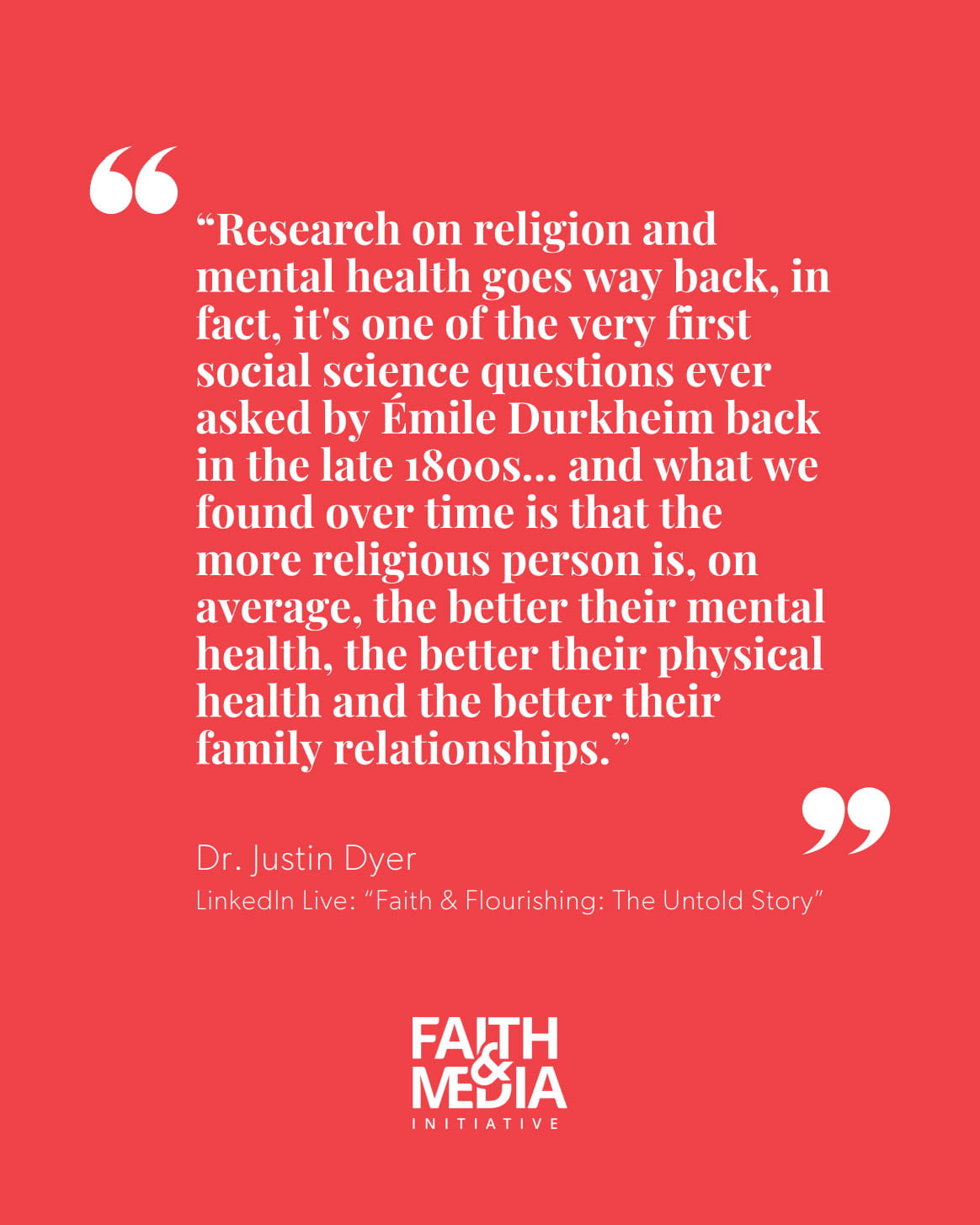
“Research on religion and mental health goes way back, in fact, it’s one of the very first social science questions ever asked by Emile Durkheim back in the late 1800s….” Dyer said. Durkheim (1858-1917) was a French sociologist who’s credited with being one of the founders of modern social science.
“…what we found over time, Dyer added, “is that the more religious (a) person is, on average, the better their mental health, the better their physical health and the better their family and relationships.”
A downside of the faith-wellness relationship is that religion and mental health have deteriorated over the last 30 years, Dyer explained. With the substantial decline in religious engagement, suicides and drug-related deaths have gone “way up.” The media tends to treat these types of negative stories as normal, even though they aren’t, he said.
Negative things happen despite religious teachings -- not because of them -- he stressed. He added that when the media brings up faith, it presents it as odd, restrictive and not particularly positive. Sadly, this recent observation came from Dyer’s 18-year-old, Gen-Z daughter rather than a world-weary adult.
How does faith positively impact well-being?
As a physician, Roy said she frequently sees patients with chronic illnesses. “Spirituality or faith can boost your immune system and reduce the risk of chronic disease… and improve physical functioning.”
Praying has a positive impact because it releases oxytocin - the so-called “love hormone” - which reduces stress, Swain noted.
The hormone also promotes:
•Bonding
•Feelings of safety, security, and trust
•A sense of well-being
•A deep connection to a higher power
“Oxytocin calms the entire system,” she explained. “Being part of church, being part of something that is higher than you…. That really helps us.”
Although the media is generally drawn to stories that are negative or exciting, “it doesn’t need to be that way,” Swain added.
Why is the faith-wellness relationship important?
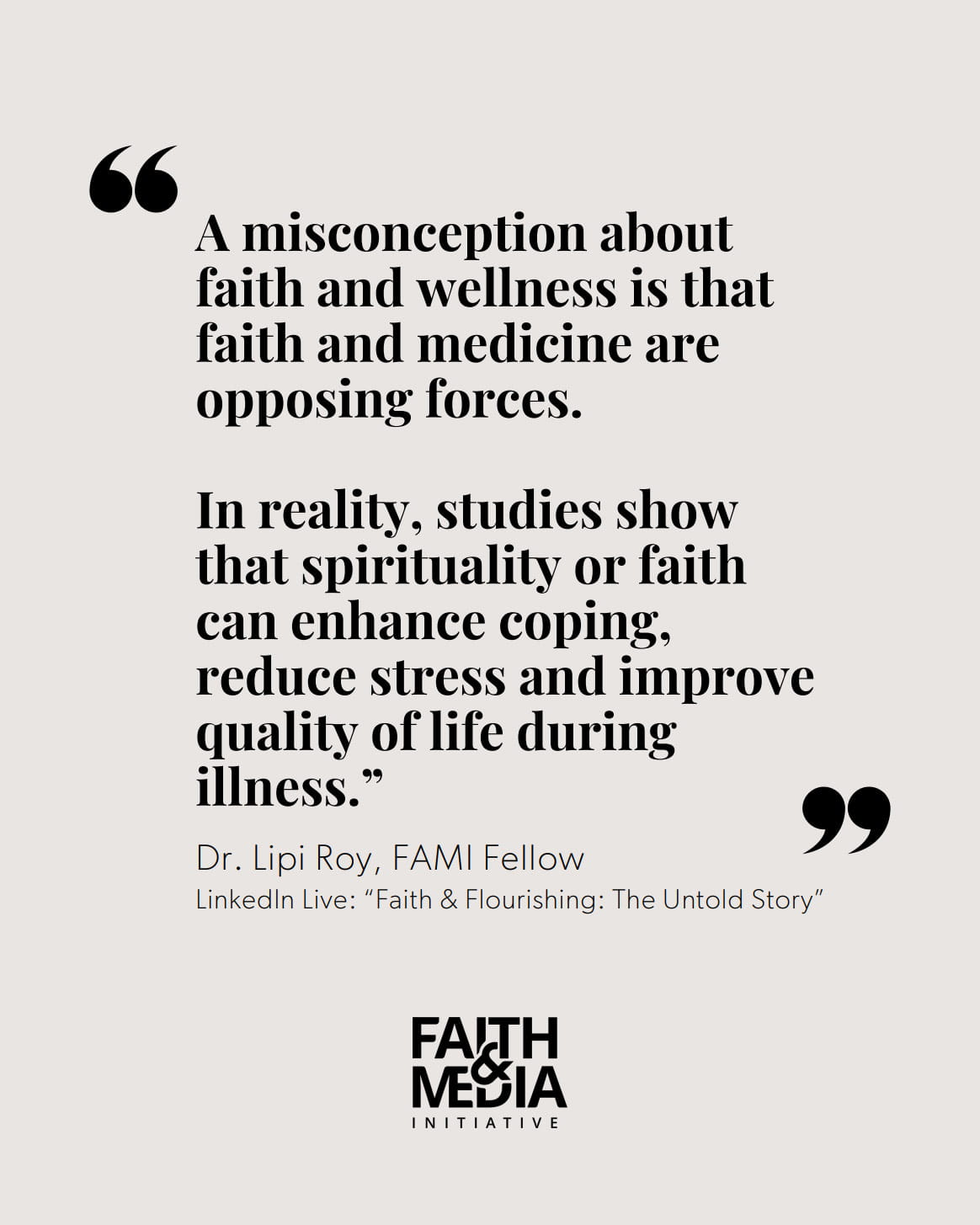
“A misconception about faith and wellness is that faith and medicine are opposing forces,” according to Roy. “In reality, studies show that spirituality or faith can enhance coping, reduce stress and improve quality of life during illness.”
Faith has been linked to several other positive outcomes such as:
•Improved well-being
•Stronger relationships
•Better health
•Lower rates of substance abuse
•Lower suicide risk
•Greater happiness
“Certain beliefs help reduce suffering,” Dyer pointed out. “Religion can give us meaning, purpose and context for why we experience suffering.”
How can faith leaders help journalists tell accurate, nuanced faith-related stories?
 Mistakes and misunderstandings can easily occur when a journalist isn’t familiar with the subject matter or the subject is complicated, as is the case with faith and flourishing. In truth, journalists are “curious and creative,” according to Redding. “They want to get things right,” but that’s challenging when “we can’t even talk about religion at the dinner table.”
Now, let’s consider a hypothetical news or feature story that illustrates ways the faith community can help journalists write better, more accurate stories. The subject of this “story” is Hindus, faith and happiness.
During the recent Faith and Flourishing panel discussion, Justin Dyer brought up the fact that Hindu families are generally very happy, and Dr. Roy mentioned that her parents immigrated from India, where Hinduism is the predominant religion.
A quick bit of research revealed that India has a population of roughly 1.5 billion people, and about 80 percent of them are Hindu. Despite the high numbers, Roy said she has seen very few depictions of Hindus in the media, and the depictions she has seen are caricatures rather than realistic portrayals.
Now, let’s suppose that a non-religious journalist decides to write, film or otherwise produce a story about Hindus, faith and happiness. Or suppose a Hindu faith leader decides to pitch the story idea to a reporter or editor.
Producing the story would be much easier if bridges between the media and faith leaders already existed. The faith leaders might provide information about Hindus, faith and happiness or provide the journalist with the names of organizations, religious leaders and even specific Hindu families who would talk to him or her.
Interviews often provide a wealth of information and context that the journalist wouldn’t otherwise get: What do the people at the center of the story say about their faith and happiness? Do they think there’s a connection? What is there about their faith that makes them happy?
Dyer suggested that faith leaders “get out there… build bridges with journalists.”
Religion is an essential part of humanity, he added.
“If we aren’t engaging with journalists, then we’re telling only part of the story. We’re missing the rich texture," he said. He added that he would like to see stories about how children and parents are using their faith to navigate life.
Media outlets are always looking for new content, Roy said. Journalists don’t always know about stories that need to be told. They rely on the community, experts in various fields and other sources to share story ideas – including faith-related stories.
“The onus is on us,” she stressed.
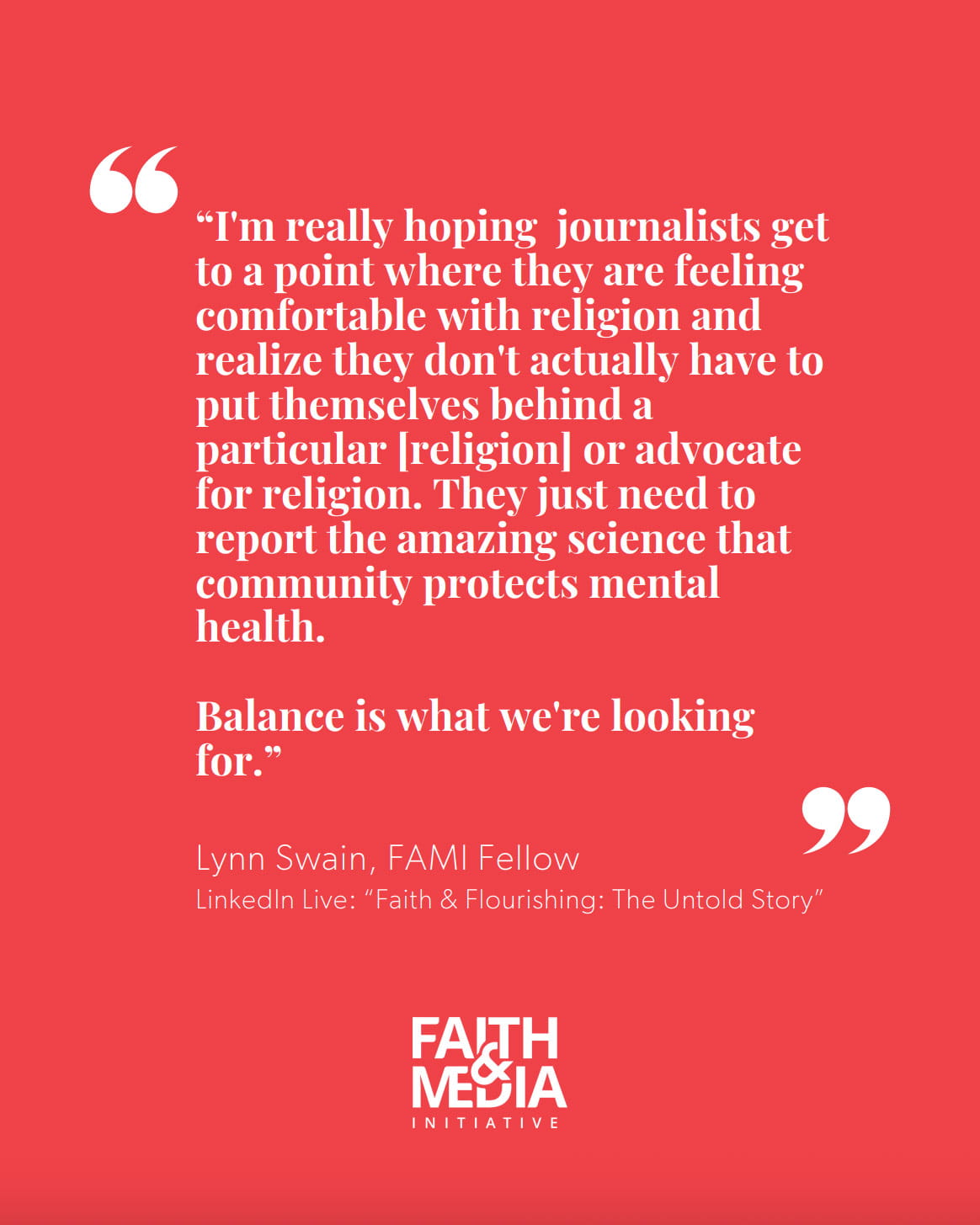
“I’m really hoping journalists get to a point where they are feeling comfortable with religion and realize they don’t actually have to put themselves behind a particular (religion) or advocate for religion,” Swain noted. “Balance is what we’re looking for.”
Explore More
Faith in the Valley: When Grief, Science, and Hope Meet
What Research Really Shows About Religion and Mental Health
12/19/2025 8:15:16 PM
featured writer
more at patheos
1
The Danger Of Defining Human Value By Material Wealth
2

Keizan Jokin: The Zen Master Ancestor You Don't Know
3

Scottie Scheffler Wins the FedEx St. Jude By Eight Strokes
4


About Writer
Ginny Baxter is a veteran journalist and public relations professional whose passion is writing. A graduate of Auburn University in Auburn, Alabama, Ginny majored in English with a focus on journalism. She later studied public relations at the University of Tennessee in Knoxville. She comes from a Christian family and has been an active church member since childhood. Her reflections in Woman to Woman are based on her experiences as a layperson who loves Christ. She has taught a women’s Sunday School class for several years and is collecting her lessons into book form.
Patheos Explore the world's faith through different perspectives on religion and spirituality! Patheos has the views of the prevalent religions and spiritualities of the world.
Ad-Free & Subscriber Log-In Subscription Support
- About Us
- 2026 Calendar
- Videos
- Podcasts
- Library of World Religions
- Faith In Media Tracker
- Advertise With Us
- Write for Us
- Privacy Policy
- Terms of Service
- Do Not Sell My Data
- Contact Us
- Radiant Digital
- Manage Newsletter Subscriptions
- Unsubscribe From Notifications
- Sitemap
Copyright 2008-2026, Patheos. All rights reserved.
Subscription Support Ad-Free & Subscriber Log-In
Follow Patheos