
BuddhistCatholicContemplativeEvangelicalGeneral ChristianHinduJewishLatter-day SaintMuslimNew VisionsProgressive Christian
Beliefs
- Buddhist
- Catholic
- Contemplative
- Evangelical
- General Christian
- Hindu
- Jewish
- Latter-day Saint
- More Voices
- Muslim
- New Visions
- Pagan
- Progressive Christian
Topics
- Religion News
- Food and Religion
- Sports and Religion
- Religious Art
- Religious Music and Entertainment
- Religious Events
- History and Religion
- Style and Religion
- Politics and Religion
- Women in Religion
- Recreation Outdoors and Religion
- Business Finance and Religion
- Careers Workplace and Religion
- Education and Religion
- Family Parenting and Religion
- Health Fitness and Religion
- Home and Religion
- Relationships and Religion
- Technology and Religion
- Travel and Religion
Columnists
- Buddhist Columnists
- Business Finance and Religion Columnists
- Careers Workplace and Religion Columnists
- Catholic Columnists
- Contemplative Columnists
- Education and Religion Columnists
- Evangelists Columnists
- Family Parenting and Religion Columnists
- General Christian Columnists
- Health Fitness and Religion Columnists
- Hindu Columnists
- History and Religion Columnists
- Home and Religion Columnists
- Jewish Columnists
- More Voices Columnists
- Latter Day Columnists
- Muslim Columnists
- New Visions Columnists
- Nonreligious Columnists
- Pagan Columnists
- Politics and Religion Columnists
- Progressive Columnists
- Recreation Outdoors and Religion Columnists
- Relationships and Religion Columnists
- Religion News Columnists
- Religious Art Columnists
- Religious Events Columnists
- Religious Music and Entertainment Columnists
- Sports and Religion Columnists
- Style and Religion Columnists
- Technology and Religion Columnists
- Travel and Religion Columnists
- Women in Religion Columnists
Resource Library
- 2026 Calendar
- Library of World Religions
- The 100 Most Holy Places on Earth
- Patheos Answers
- Podcasts
- Videos
- Faith Leaders Database
- Anglican Episcopalian
- Bahai
- Baptist
- Buddhism
- Christianity
- Confucianism
- Eastern Orthodoxy
- Hinduism
- Holiness and Pentecostal
- ISKCON
- Islam
- Judaism
- Lutheran
- Methodist
- The Church of Jesus Christ of Latter-day Saints
- New Age
- Paganism
- Presbytarian and Reformed
- Protestantism
- Religion Behind the Scenes
- Roman Catholic
- Scientology
- Shia Islam
- Sikhism
- Sufism
- Sunni Islam
- Taoism
- Zen
- See all religions
Research Tools
 Ad-Free & Subscriber Log-In Subscription Support
Ad-Free & Subscriber Log-In Subscription Support
Follow Patheos 

- Trending:
- Forgiveness
- |
- Marriage
- |
- Consciousness
- |
- Death Penalty
- |
- Election
- |
- Halloween
Churches as Learning Hubs
February 08, 2023 by Matthew Allen
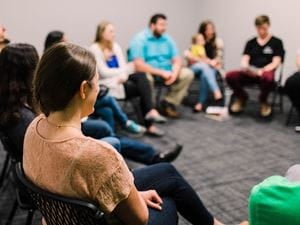
Lightstock
Community. Without it, our leisure time is deader than the dust under Tutankhamen’s toenails. Few things in life are more important. As a Patheos reader, you’ll no doubt agree. Most people who follow Christian blogs, I would suspect, require no persuasion as to the social benefits activities like public worship can offer.
Churches foster neighbourly bonds, too, when they facilitate open education, a profoundly Christlike act. In the Western World, a highly marketized education sector is now pervasive. Knowledge doesn’t come cheap under such a system. They say that everything, like yesterday’s catch at a coastal bazaar, is for sale when the price is right. Happily, countless churches are spots where one can obtain something of an education for free. More on this later…
On the UK National Health Service (NHS) website, you can find ‘5 steps to mental wellbeing’. The third, ‘learn new skills’, is the one that most interests us here. After all, ‘Research shows that learning new skills can also improve your mental wellbeing’. Even for those with a busy routine, the page assures us, ‘there are lots of different ways to bring learning into your life’.
Christians have given the world a lot when it comes to learning. Scores of educational institutions across the globe owe their existence to Christian ideals. To go no further than the United States, think of Baylor and Emory, Oberlin and Princeton, Wheaton and Yale. This article, though, deals not with tertiary-level study but with Christian churches as places where we gather to share knowledge.
So how do churches foster learning? Traditional Bible studies are an obvious way. These, where I’m from, are a dime a divine dozen. (You could, in any Northern Irish town, attend a Bible group every day for a fortnight, were you minded, with no repeat visits to the same place.) You cannot get a doctor’s appointment for love nor money, but you can take your pick where Christian home groups are concerned.
A good ol’ fashioned study sesh lets Bible fans discover lesser-known stories from Scripture. (Zelophehad’s daughters, anyone?) It’s also the place to reconsider firm favourites from fresh angles. Bible study leaders often do select a more obscure book, like Ruth (Old Testament) or James (New Testament), on which to focus.
For those not into biblical studies, our parish runs a history group on Tuesday nights. We meet in the Mitchell Room, a pleasant lounge in the parochial hall. Redecorated a while ago now, the wooden floor smell nevertheless wears more faithfully than Job’s patience. Our topics on these evenings have ranged from Irish patron saints, like St Columba, to significant events like Reverend Nangle’s Achill mission.
The gathering has a nice dynamic. We gel with each other fantastically, to the psychological boon of us all. As in any close-knit circle, there’s an incompleteness when someone can’t make it on a particular evening. Imagine van Gogh’s The Starry Night without its mustardy moon! The group’s popularity testifies to the role historical pursuits play within our parish. Feeling part of a church ecosystem, I find, arises from better knowledge of its heritage.
The present is never more than a single mid-PowerPoint excursus away, no matter how far into the past we may look. While we sit in our teal-fabric salon chairs, brows furrowed, what starts as a talk on Henry II’s dealings with Archbishop Thomas à Beckett might, via some circuitous route or other, veer towards contemporary church-state relations under Charles III.
That’s the view from Eglantine Parish. Another church, Kirkpatrick Memorial Presbyterian in East Belfast, has hosted lectures from accomplished local theologians, Professors David Livingstone and Stephen Williams, under the moniker ‘Faith Academy’. Tuition fees not required! Here was the programme: (wk. 1) Scientism, (wk. 2) Environmentalism, (wk. 3) Transhumanism, (wk. 4) Artificial Intelligence. It was heady stuff indeed!
We met in the church itself, an airy space whose pipe organ resembles a huge Ikea wardrobe. Those giant wooden panels! The format every week was a presentation, complete with Q&A session. What was missing, compared with certain classes I remember from university, was any pompous pontification. The professorial pair, Livingstone and Williams, were fellow pilgrims, unshod of academic airs and graces. That said, there were no mahogany pews, those diabolical spine-tormentors, in Queen’s University! Swings and roundabouts, I suppose…
Article Continued On Next Page
Page: 1 of 2
10/8/2024 7:28:53 PM
featured writer
more at patheos
1
Ecclesia Sola, Not Sola Ecclesia (What Jesus Left Us)
2

Yom Kippur : Is There Always Room for Forgiveness?
3
Renaming God: If God Is Love, Then Is Love God?
4

America at 250: Faith, Freedom and Our Future

About Matthew Allen
Matthew Allen is a writer and musician based in Northern Ireland. He is a graduate of Queen’s University, Belfast, where he studied Theology and Liberal Arts.
Patheos Explore the world's faith through different perspectives on religion and spirituality! Patheos has the views of the prevalent religions and spiritualities of the world.
Ad-Free & Subscriber Log-In Subscription Support
- About Us
- 2026 Calendar
- Videos
- Podcasts
- Library of World Religions
- Faith In Media Tracker
- Advertise With Us
- Write for Us
- Privacy Policy
- Terms of Service
- Do Not Sell My Data
- Contact Us
- Radiant Digital
- Manage Newsletter Subscriptions
- Unsubscribe From Notifications
- Sitemap
Copyright 2008-2026, Patheos. All rights reserved.
Subscription Support Ad-Free & Subscriber Log-In
Follow Patheos