
BuddhistCatholicContemplativeEvangelicalGeneral ChristianHinduJewishLatter-day SaintMuslimNew VisionsProgressive Christian
Beliefs
- Buddhist
- Catholic
- Contemplative
- Evangelical
- General Christian
- Hindu
- Jewish
- Latter-day Saint
- More Voices
- Muslim
- New Visions
- Pagan
- Progressive Christian
Topics
- Religion News
- Food and Religion
- Sports and Religion
- Religious Art
- Religious Music and Entertainment
- Religious Events
- History and Religion
- Style and Religion
- Politics and Religion
- Women in Religion
- Recreation Outdoors and Religion
- Business Finance and Religion
- Careers Workplace and Religion
- Education and Religion
- Family Parenting and Religion
- Health Fitness and Religion
- Home and Religion
- Relationships and Religion
- Technology and Religion
- Travel and Religion
Columnists
- Buddhist Columnists
- Business Finance and Religion Columnists
- Careers Workplace and Religion Columnists
- Catholic Columnists
- Contemplative Columnists
- Education and Religion Columnists
- Evangelists Columnists
- Family Parenting and Religion Columnists
- General Christian Columnists
- Health Fitness and Religion Columnists
- Hindu Columnists
- History and Religion Columnists
- Home and Religion Columnists
- Jewish Columnists
- More Voices Columnists
- Latter Day Columnists
- Muslim Columnists
- New Visions Columnists
- Nonreligious Columnists
- Pagan Columnists
- Politics and Religion Columnists
- Progressive Columnists
- Recreation Outdoors and Religion Columnists
- Relationships and Religion Columnists
- Religion News Columnists
- Religious Art Columnists
- Religious Events Columnists
- Religious Music and Entertainment Columnists
- Sports and Religion Columnists
- Style and Religion Columnists
- Technology and Religion Columnists
- Travel and Religion Columnists
- Women in Religion Columnists
Resource Library
- 2026 Calendar
- Library of World Religions
- The 100 Most Holy Places on Earth
- Patheos Answers
- Podcasts
- Videos
- Faith Leaders Database
- Anglican Episcopalian
- Bahai
- Baptist
- Buddhism
- Christianity
- Confucianism
- Eastern Orthodoxy
- Hinduism
- Holiness and Pentecostal
- ISKCON
- Islam
- Judaism
- Lutheran
- Methodist
- The Church of Jesus Christ of Latter-day Saints
- New Age
- Paganism
- Presbytarian and Reformed
- Protestantism
- Religion Behind the Scenes
- Roman Catholic
- Scientology
- Shia Islam
- Sikhism
- Sufism
- Sunni Islam
- Taoism
- Zen
- See all religions
Research Tools
 Ad-Free & Subscriber Log-In Subscription Support
Follow Patheos 

- Trending:
- Advent
- |
- Forgiveness
- |
- Thanksgiving
- |
- Election
- |
- Seasonal Holidays
- |
- Marriage
Changing the Narrative: How Vulnerability, Dignity, and Creativity Can Reframe Faith in Media
October 16, 2025 by Duncan Pile
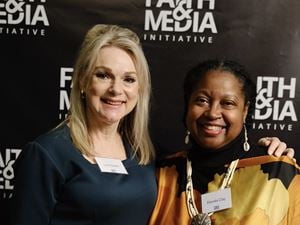
2025 Faith and Media Initiative Fellows Lynn Swain and Elonda Clay
At the Faith & Media Summit, hosted by the Faith and Media Initiative (FAMI) last month in Oxford, a diverse group of influential leaders gathered to confront the persistent misrepresentation of faith in mainstream media.
Naturally, this posed a question – how do we change the narrative?
The ultimate purpose of the Faith and Media Initiative Fellows, a new cohort created to advance the global mission of FAMI, is to create a framework that will enable rich, diverse, and nuanced representation of faith in the media. The fellows and delegates can take direct action in their roles as religious leaders, TV and film producers, directors of the arts, Youtubers, Ted speakers, and influential figures in academia and the world of business, but what about you and me?
For the purposes of this article, I want to focus on what the average person can do, along with what local religious and community leaders can do to engage with the media.
The catalyst of vulnerability
On the opening night of the summit, author Edmund de Waal delivered a short, highly personal talk, in which he shared his family’s story in an unguarded way. Inspired by the vulnerability he showed, artistic director Erica Whyman extended her talk to open a window on her own faith journey, and this approach was further reflected by FAMI executive director Angela Redding and Josie Bamford, executive producer for The Cultural Programme at the University of Oxford. The tone was set, and from the outset this meant that the discussions we held felt authentic and safe.
Throughout the summit, several panelists spoke of the importance of vulnerability when sharing about your faith, with a particular focus on social media. Most people have social media accounts, which means most of us have a platform to share our faith in the public sphere. Not out of obligation or religious observance, but to be our full, authentic selves. Some friends and followers might find faith intimidating, perhaps because of past negative experiences, but the key to sharing in a way that makes others feel safe is to do so vulnerably.
When a person talks authentically about their faith, shining a light on how it has helped them, perhaps through a difficult time, their openness invites curiosity and care. If someone talks openly about their positive experience of a practice of faith, sharing the joy it gives them, people tend to be interested rather than suspicious. Certainly, this is true of my own experience of social media.
Among the many revealing statistics shared with us by Rabbi Elan Babchuck, Executive Vice President at Clal, the National Jewish Center for Learning and Leadership, is the fact that 60% of Gen Z say that social media influences who they yearn to become, and 70% say that it influences how they shape their daily habits and make their choices.
In Saturday’s session on Faith, Media & Flourishing, FAMI Fellow and leadership expert Lynn Swain, founder and CEO of Symbiota Leadership Institute, spoke of the ways in which faith has enabled her to develop resilience in the face of extraordinarily difficult personal circumstances, not just to overcome the challenges before her but to flourish and thrive while facing them. I hope she won’t mind me saying, but Lynn’s faith shines from her like a beacon.
In the same session, FAMI fellow Dr. Lipi Roy, MD, founder of SITA MED, spoke of how faith can positively impact every aspect of physical, behavioral, mental, and social health. Spirituality can lower rates of depression, anxiety, and suicide, as well as improve cardiovascular and immune function. It promotes acts of service, volunteering, and creates social networks that reduce loneliness and improve connection.
There are so many reasons to be excited about faith! People don’t want to be targeted for conversion, or bashed around the head with a holy book, but as long as they feel safe, folk are inclined to listen to what an authentic person has to say. You and I, then, can show the world the nuance and positivity of our faith practices through simply letting our guard down and having the courage to be our full selves. We can be the light we want others to see.
A commitment to dignifying others
During Saturday’s session on Faith, Media & Human Dignity, Simran Jeet Singh, FAMI Fellow and Assistant Professor of Interreligious Histories at Union Theological Seminary, spoke of the divided nature of society and the hope of a world in which authentic, accurate, compassionate storytelling can be placed front and center. That hope has been a driving force behind the development of a new show he’s been working on called Undivided, about the stories of religious communities in the United States. Undivided will pose important questions – Can we become more empathetic? Can we get to know one another a little bit better? Can we model curiosity and humility?
Simran had invited Rhodes Scholar Serene Singh to the session, who brought wisdom and joy in equal measure. Serene is so many things – a Sikh American advocate and educator passionate about fostering justice through empathy, the first Sikh American to win the Rhodes Scholarship, founder and executive director of The Serenity Project, an international nonprofit organization dedicated to empowering marginalized women through runway fashion shows, and the author of The Queen Machine, a children's book inspiring youth. Serene spoke to us about maintaining dignity across difference, and how, as a storyteller, she wants to awaken new perspectives in readers’ hearts and minds.
In the same session, FAMI fellow Katrina Swett, President of the Lantos Foundation for Human Rights and Justice, spoke of the Universal Declaration of Human Rights (UDHR) and its insistence on ‘the inherent dignity and…the equal and inalienable rights of all members of the human family’ .
Katrina reflected that ‘inherent dignity’ is a statement of faith in humankind rather than a description of human behavior, which is often the opposite of dignified. It is an ideal we can cling to, a lens through which to view people, seeing their inherent worth regardless of their circumstances. Dignity, then, is how we choose to treat people, and that choice is made numerous times a day.
We can do this by becoming curious about other people’s lives, getting over our own judgement, and practicing humility. FAMI posed a challenge for all of us – can we listen more carefully, ask better questions, and disagree more respectfully? Are we willing to hold space for others who see things differently?
One of the most harmful human instincts is to adopt an ‘us versus them’ mentality, which, by definition, creates an in-group and an out-group. It forges cliques, erecting barriers between people who are different from each other in some measurable way.
Each of us can commit to resisting that instinct and fostering curiosity. Dialogue leads to understanding, and understanding leads to broader, richer, and more unified communities.
Religious and community leaders
Community leaders of all stripes have an important role to play when it comes to engaging with the media. Religious leaders can organize events that support the local community, for example, and invite the regional media to come along. The national media is unlikely to pay attention to such events, but local media groups are usually interested in what’s happening on their doorstep.
Events organized by a single group might be media-worthy, but when faith groups work together to serve the local community, media interest is even more likely. Interfaith events communicate a message of hope – that love matters more than theology, and that unity is possible.
In his 1733 work, “Letters on the English”, Voltaire wrote:
“If there were only one religion in England, there would be danger of tyranny; if there were two, they would cut each other's throats; but there are thirty, and they live happily together in peace.”
Interfaith initiatives build on this principle of a multiplicity of faiths living happily together in peace, and can do much good for local communities.
On Saturday afternoon, we were privileged by a surprise visit from Reverend Dr Liz Carmichael MBE, former Chaplain, Fellow, and Tutor in Theology at St John's, Oxford, who went on to write a comprehensive book on the South African Peace Accord of 1991-1994. She currently directs the ecumenical St Theosevia Centre for Christian Spirituality and is involved in interfaith encounters.
Liz spoke about the Three Faiths Encounter in Oxford, which is an interfaith initiative that grew from friendships between Islamic, Jewish, and Christian communities. Her advice to us was that faith and community leaders should build supportive relationships with each other and explore ways to serve the local community together.
If the media have preconceived notions of tension between the Abrahamic faiths, or indeed any faith groups, a positive collaboration such as the Three Faiths Encounter is eye-catching, especially if tantalizing keynote speakers are invited. If we, as people of faith, build friendships with each other and the media, we have every chance of shining the light we want the world to see.
Left to right, Faith and Media Initiative Fellows Rabbi Elan Babchuck, Katrina Lantos Swett, Craig Detweiler, and Elonda Clay
The importance of the arts
On the opening night of the summit, we were blessed to hear from Josie Bamford, who serves as the Executive Producer for The Cultural Programme at the University of Oxford. In the UK, the arts have been downplayed and underfunded in educational curricula, which often emphasize STEM subjects over creativity. Over time, this creates a dearth of storytelling in younger generations, robbing them of joy and self-expression. Storytelling is as old as humankind, enabling us to pass on wisdom and connect as communities.
Josie spoke of the importance of the arts and humanities, and of the work she does to promote them, urging us to do the same. Community leaders have the opportunity to fill this widening gap by hosting musical, artistic, and dramatic performances, engaging young people and creating a space for individuals from different backgrounds to meet and learn from each other. If done well, these are the kinds of events that can bring people of different faiths together and draw the attention of the local media, presenting an inclusive, nuanced expression of faith at work.
In summary
The inaugural Faith and Media summit was a think tank and a launch pad. The challenge of changing the media’s narrative on faith is huge, and no easy solutions were offered, but this is just the first step in creating a framework that can influence how faith is represented in TV, film, and the media in general.
Whether we’re influential figures in our peer groups, community leaders, or individuals who value faith, we all have a part to play, but the goal is too ambitious for any of us to manage on our own.
Rather than taking on too much, each of us can play our parts to the best of our abilities and trust the rest to God.
As for the FAMI Fellows, this is only the beginning!
Explore More
Faith & Media Initiative Fellows
The Global Faith and Entertainment Study
The Global Faith and News Study
Coalition For Faith and Media Patheos Column
Helping People of Faith Feel Seen: Inside the Inaugural Faith and Media Summit
The Faith Majority: Rethinking Secularism’s Reign in Culture and Coverage
10/21/2025 12:50:40 AM
more at patheos
1

2

Metal Magic and the Art of Relationships
3
4

¡Casa Bonita Mi Amor!: Gen-X Sends Its Best
About Duncan Pile
Duncan Pile is a writer, author and speaker, living in Derbyshire, England with his wife and stepson. His mystical approach to faith straddles the Evangelical/Progressive divide, and flowing from lived experience, he is passionate about the deconstruction and reconstruction of the Christian faith.
Patheos Explore the world's faith through different perspectives on religion and spirituality! Patheos has the views of the prevalent religions and spiritualities of the world.
Ad-Free & Subscriber Log-In Subscription Support
- About Us
- 2026 Calendar
- Videos
- Podcasts
- Library of World Religions
- Faith In Media Tracker
- Advertise With Us
- Write for Us
- Privacy Policy
- Terms of Service
- Do Not Sell My Data
- Contact Us
- Radiant Digital
- Manage Newsletter Subscriptions
- Unsubscribe From Notifications
- Sitemap
Copyright 2008-2026, Patheos, part of the Radiant Digital network of media brands. All rights reserved.
Subscription Support Ad-Free & Subscriber Log-In
Follow Patheos