
BuddhistCatholicContemplativeEvangelicalGeneral ChristianHinduJewishLatter-day SaintMuslimNew VisionsProgressive Christian
Beliefs
- Buddhist
- Catholic
- Contemplative
- Evangelical
- General Christian
- Hindu
- Jewish
- Latter-day Saint
- More Voices
- Muslim
- New Visions
- Pagan
- Progressive Christian
Topics
- Religion News
- Food and Religion
- Sports and Religion
- Religious Art
- Religious Music and Entertainment
- Religious Events
- History and Religion
- Style and Religion
- Politics and Religion
- Women in Religion
- Recreation Outdoors and Religion
- Business Finance and Religion
- Careers Workplace and Religion
- Education and Religion
- Family Parenting and Religion
- Health Fitness and Religion
- Home and Religion
- Relationships and Religion
- Technology and Religion
- Travel and Religion
Columnists
- Buddhist Columnists
- Business Finance and Religion Columnists
- Careers Workplace and Religion Columnists
- Catholic Columnists
- Contemplative Columnists
- Education and Religion Columnists
- Evangelists Columnists
- Family Parenting and Religion Columnists
- General Christian Columnists
- Health Fitness and Religion Columnists
- Hindu Columnists
- History and Religion Columnists
- Home and Religion Columnists
- Jewish Columnists
- More Voices Columnists
- Latter Day Columnists
- Muslim Columnists
- New Visions Columnists
- Nonreligious Columnists
- Pagan Columnists
- Politics and Religion Columnists
- Progressive Columnists
- Recreation Outdoors and Religion Columnists
- Relationships and Religion Columnists
- Religion News Columnists
- Religious Art Columnists
- Religious Events Columnists
- Religious Music and Entertainment Columnists
- Sports and Religion Columnists
- Style and Religion Columnists
- Technology and Religion Columnists
- Travel and Religion Columnists
- Women in Religion Columnists
Resource Library
- 2026 Calendar
- Library of World Religions
- The 100 Most Holy Places on Earth
- Patheos Answers
- Podcasts
- Videos
- Faith Leaders Database
- Anglican Episcopalian
- Bahai
- Baptist
- Buddhism
- Christianity
- Confucianism
- Eastern Orthodoxy
- Hinduism
- Holiness and Pentecostal
- ISKCON
- Islam
- Judaism
- Lutheran
- Methodist
- The Church of Jesus Christ of Latter-day Saints
- New Age
- Paganism
- Presbytarian and Reformed
- Protestantism
- Religion Behind the Scenes
- Roman Catholic
- Scientology
- Shia Islam
- Sikhism
- Sufism
- Sunni Islam
- Taoism
- Zen
- See all religions
Research Tools
 Ad-Free & Subscriber Log-In Subscription Support
Ad-Free & Subscriber Log-In Subscription Support
Follow Patheos 

- Trending:
- Forgiveness
- |
- Marriage
- |
- Consciousness
- |
- Death Penalty
- |
- Election
- |
- Halloween
Anglican Reflections on Benedict: Ratzinger’s Eschatology
February 04, 2023 by Matthew Allen
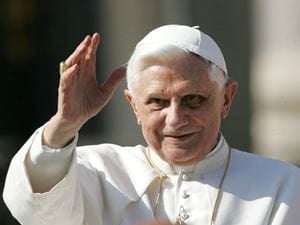
giulio napolitano / Shutterstock.com
Before the late pope’s passing, I had only read one volume from Benedict’s mammoth bibliography: his Eschatology (1977), written the year he became Archbishop Joseph Ratzinger of Munich and Freising, and a cardinal just a month later. This, my first article written after His late Holiness’s departure from this world, will consider his insights on death.
To begin with, Ratzinger is astute on social customs around end of life within his own cultural experience. ‘Bourgeois society hides death away,’ the then-cardinal remarks (p. 69). It’s an apt observation but it’s a post-war, Central European solipsism. In Ireland, for instance, death is handled rather candidly. See the famous tradition of wakes: holy water, social drinking, open coffin.
To be fair, urban Ireland only became a bourgeois society during the Celtic Tiger economic boom, culminating in Dublin’s vibey Facebook HQ. This was two decades after Eschatology first appeared, so time will tell if Éire proves Ratzinger’s thesis correct…
Why refuse to face the fact of death? According to Benedict, ‘Death is rendered banal so as to quell the unsettling questions which arise from it’ (p. 70). Foremost among these questions has to be: Why? Ten thousand times: Why? Rather than try to respond, it’s easier to trivialise dying, to try to make it as normal as catching a bus. A funeral becomes a rushed affair, a sprint-race with no time for contemplation.
A healthy conception of death is important because, as His late Holiness posits, ‘Attitudes to dying determine attitudes to living’ (p. 72). It’s inspiring to see someone live a life to the full, come what may. There are few people with more stout resolve than the patient who responds to their terminal diagnosis with amazing feats they wouldn’t have otherwise undertaken. This instead of embittered resignation.
‘The sting of death is extinguished in Christ in whom the victory was gained through the plenary power of love unlimited,’ Ratzinger assures us. Death’s power is formidable, but God’s love is a greater power still. ‘Death is vanquished where people die with Christ and into him’ (p. 97). How does this happen? There is a way to capitalise, to use too crude a term, on the Lord’s earthly heroics: namely, baptism.
‘By baptism we enter on a common destiny with that of Jesus and so with the death which was his fate’ (p. 115). When we receive Holy Baptism in God’s name, our fate is henceforth as fixed as the bright North Star – with our conscious assent in adult baptism, without it in infant baptism. The christening of infants, or paedobaptism, serves to counterbalance our contemporary hyper-individualism.
This credo, postmodern autonomous individualism, glorifies the choosing self over inherited identity. Never did a poem epitomise this outlook more thoroughly, to my mind, than “Invictus” by William Ernest Henley, which rhapsodises: ‘I am the master of my fate, / I am the captain of my soul.’ My life is whatever I make of it. I design the mould into which I pour, like runny plastic, the sovereign spirit I design. Solidarity with others be damned!
Here is a countervailing view from Jordan Peterson on identity formation: ‘it’s a set of complex compromises between the individual and society as to how the former and the latter might mutually support one another in a sustainable, long-term manner.’
Seductive as it may be, there’s one problem with individual agency: nobody can opt out of dying – not even, so the Gospels claim, the Messiah! Death is a refutation of our notions that we can write our own destinies. In this light, our hope, as Christian believers, is to turn in faith to Christ. ‘Faith, which is the contact between Jesus and myself, vouchsafes here and now the crossing of death’s frontier’ (p. 117).
We may be doomed to die, though the story doesn’t have to stop there. 1 Thessalonians 4 is the classic text here: ‘For we believe that Jesus died and rose again, and so we believe that God will bring with Jesus those who have fallen asleep in him’ (v. 14). Faith is harder to pin down than Christians usually think. If ever there were a theological idea which is open to competing definitions, it’s faith. Whatever faith is, though, Christian faith is the golden thread which binds our lives to that of Our Saviour.
Article Continued On Next Page
Page: 1 of 2
2/4/2023 12:22:56 AM
featured writer
more at patheos
1

Mexico's Soccer Baby Jesus: Praying for a World Cup Miracle
2
3

Revelation 5 & 8 (Intercession of Saints & Angels)
4
Bible in a Year Podcast Hits 1 Billion Downloads

About Matthew Allen
Matthew Allen is a writer and musician based in Northern Ireland. He is a graduate of Queen’s University, Belfast, where he studied Theology and Liberal Arts.
Patheos Explore the world's faith through different perspectives on religion and spirituality! Patheos has the views of the prevalent religions and spiritualities of the world.
Ad-Free & Subscriber Log-In Subscription Support
- About Us
- 2026 Calendar
- Videos
- Podcasts
- Library of World Religions
- Faith In Media Tracker
- Advertise With Us
- Write for Us
- Privacy Policy
- Terms of Service
- Do Not Sell My Data
- Contact Us
- Radiant Digital
- Manage Newsletter Subscriptions
- Unsubscribe From Notifications
- Sitemap
Copyright 2008-2026, Patheos. All rights reserved.
Subscription Support Ad-Free & Subscriber Log-In
Follow Patheos