
BuddhistCatholicContemplativeEvangelicalGeneral ChristianHinduJewishLatter-day SaintMuslimNew VisionsProgressive Christian
Beliefs
- Buddhist
- Catholic
- Contemplative
- Evangelical
- General Christian
- Hindu
- Jewish
- Latter-day Saint
- More Voices
- Muslim
- New Visions
- Pagan
- Progressive Christian
Topics
- Religion News
- Food and Religion
- Sports and Religion
- Religious Art
- Religious Music and Entertainment
- Religious Events
- History and Religion
- Style and Religion
- Politics and Religion
- Women in Religion
- Recreation Outdoors and Religion
- Business Finance and Religion
- Careers Workplace and Religion
- Education and Religion
- Family Parenting and Religion
- Health Fitness and Religion
- Home and Religion
- Relationships and Religion
- Technology and Religion
- Travel and Religion
Columnists
- Buddhist Columnists
- Business Finance and Religion Columnists
- Careers Workplace and Religion Columnists
- Catholic Columnists
- Contemplative Columnists
- Education and Religion Columnists
- Evangelists Columnists
- Family Parenting and Religion Columnists
- General Christian Columnists
- Health Fitness and Religion Columnists
- Hindu Columnists
- History and Religion Columnists
- Home and Religion Columnists
- Jewish Columnists
- More Voices Columnists
- Latter Day Columnists
- Muslim Columnists
- New Visions Columnists
- Nonreligious Columnists
- Pagan Columnists
- Politics and Religion Columnists
- Progressive Columnists
- Recreation Outdoors and Religion Columnists
- Relationships and Religion Columnists
- Religion News Columnists
- Religious Art Columnists
- Religious Events Columnists
- Religious Music and Entertainment Columnists
- Sports and Religion Columnists
- Style and Religion Columnists
- Technology and Religion Columnists
- Travel and Religion Columnists
- Women in Religion Columnists
Resource Library
- 2026 Calendar
- Library of World Religions
- The 100 Most Holy Places on Earth
- Patheos Answers
- Podcasts
- Videos
- Faith Leaders Database
- Anglican Episcopalian
- Bahai
- Baptist
- Buddhism
- Christianity
- Confucianism
- Eastern Orthodoxy
- Hinduism
- Holiness and Pentecostal
- ISKCON
- Islam
- Judaism
- Lutheran
- Methodist
- The Church of Jesus Christ of Latter-day Saints
- New Age
- Paganism
- Presbytarian and Reformed
- Protestantism
- Religion Behind the Scenes
- Roman Catholic
- Scientology
- Shia Islam
- Sikhism
- Sufism
- Sunni Islam
- Taoism
- Zen
- See all religions
Research Tools
 Ad-Free & Subscriber Log-In Subscription Support
Ad-Free & Subscriber Log-In Subscription Support
Follow Patheos 

- Trending:
- Forgiveness
- |
- Marriage
- |
- Consciousness
- |
- Death Penalty
- |
- Election
- |
- Halloween
When America Turned on Its Own: The Truth About Executive Order 9066
February 05, 2026 by Tom Sugimura
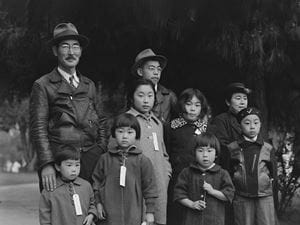
Public Domain
On February 19, 1942, President Franklin D. Roosevelt authorized Executive Order 9066 just ten weeks after the bombing of Pearl Harbor, resulting in the forcible removal and incarceration of almost 120,000 Japanese Americans from the Pacific Coast.[1] Evacuation orders were soon posted in public places, giving all those of Japanese descent just days to pack up their entire lives. Government officials initially claimed that the “evacuation” was for reasons of public safety, but history now affirms that this unjust course of action was rooted in fear, ignorance, and hatred. Forty years later, an independent commission authorized by the U.S. Congress would conclude that “the broad historical causes which shaped these decisions were race prejudice, war hysteria, and a failure of political leadership.[2]
As First Lady, Eleanor Roosevelt, would admit,
[Japanese Americans] were marked as different from other races and they were not treated on an equal basis. This happened because in one part of our country they were feared as competitors, and the rest of our country knew them so little and cared so little about them that they did not even think about the principle that we in this country believe in—that of equal rights for all human beings.[3]
Milton Eisenhower, the War Relocation Authority (WRA) director responsible for the incarceration, also expressed his regret in a memoir:
The evacuation of Japanese Americans from their homes on the coast to hastily constructed assembly centers and then to inland relocation centers was an inhuman mistake. Thousands of American citizens of Japanese ancestry were stripped of their rights and freedoms and treated almost like enemy prisoners of war. Many lost their homes, their businesses, and their savings. For the 120,000 Japanese the evacuation was a bad dream come to pass. How could such a tragedy have occurred in a democratic society that prides itself on individual rights and freedoms? How could responsible leaders make such a fateful decision?[4]
The hindsight of history often reveals when such “mistakes have been made.” Some, like the President, were directly responsible for the injustice. Others, like the WRA, claimed simply to be following orders. Many, like the Christian church at the time, were guilty for their silence when they failed to act on behalf of the defenseless or to speak up for those who had no voice (Proverbs 31:8-9).
Sadly, we too often fall short of what the Lord requires: “to do justice, and to love kindness, and to walk humbly with [our] God” (Micah 6:8). We may realize this grave injustice after a season of reflection, but God often uses hardships to convict us (Proverbs 22:8). Thankfully, God’s remedy for our sin is clearly laid out in Scripture.
Repent of Injustice
When we realize we’ve done wrong, God calls us to repent: “‘Return to me with all your heart, with fasting, with weeping, and with mourning; and rend your hearts and not your garments.’ Return to the Lord your God, for he is gracious and merciful, slow to anger, and abounding in steadfast love; and he relents over disaster” (Joel 2:12-13). So, we turn from our sin before God and before all those whom we have wronged.
Receive God’s Forgiveness
Once we humbly repent, God promises to “forgive us our sins and to cleanse us from all unrighteousness” (1 John 1:9). For “whoever conceals his transgressions will not prosper, but he who confesses and forsakes them will obtain mercy” (Proverbs 28:13). Our secular world tries to erase its wrongs by simply doing right. Those without a Savior try to save themselves by works and make penance to earn their pardon. Yet only God can grant us true forgiveness.
Resolve to Change
Genuine repentance also results in the divinely empowered desire to change: “For godly grief produces a repentance that leads to salvation without regret, whereas worldly grief produces death. For see what earnestness this godly grief has produced in you, but also what eagerness to clear yourselves, what indignation, what fear, what longing, what zeal, what punishment! At every point you have proved yourselves innocent in the matter” (2 Corinthians 7:10-11). Those who have been forgiven sins do not desire to repeat them. For anyone who follows Christ is now a “new creation” being transformed into the very likeness of Christ (Romans 12:2; 2 Corinthians 5:17).
Remember God’s Justice
The events of history cannot be changed, yet our God remains sovereign over both past and present. And he will surely punish injustice either in this life or in the next. For he hates man’s sin so much that he sent his beloved Son to bear the penalty for our guilt (Romans 5:8-11; 6:23). In Christ Jesus, then, we are saved from the wrath of God (1 Thessalonians 1:10; 5:9-10). And in Christ Jesus, we await God’s final justice to be fully displayed (2 Peter 3:13; Revelation 11:16-18).
So, as we lament injustice in the world around us, we call upon the Lord in faith: “Let justice roll down like waters, and righteousness like an ever-flowing stream” (Amos 5:24).
- Although Roosevelt’s order did not specify that the Japanese be singled out, it gave the Army unprecedented control over civilians and effectively resulted in the removal of any person with one-sixteenth or greater Japanese ancestry from the Pacific Coast. Some German and Italian aliens would also be interned, but nothing like the wholesale incarceration of the Japanese. Two-thirds of the Nikkei internees were American citizens and “no Japanese, citizen or alien, were indicted or convicted of sabotage, espionage, or any major violation of wartime security laws” (Jacobus tenBroek, Edward N. Barnhart, and Floyd M. Matson, _Prejudice, War, and the Constitution: Causes and Consequences of the Evacuation of the Japanese Americans in World War II_ [Berkeley, CA: University of California Press, 1970], 101). ↩︎
- Commission on Wartime Relocation and Internment of Citizens, _Personal Justice Denied_ (Washington, D.C.: U.S. Government Printing Office, 1982), 18. ↩︎
- Eleanor Roosevelt, “To Undo a Mistake Is Always Harder Than Not to Create One Originally,” _Collier’s_ (10 October 1943), Eleanor Roosevelt Papers, FDRL. Although her husband had signed Executive Order 9066, Mrs. Roosevelt consistently spoke out on behalf of Japanese Americans. Just one week after the bombing of Pearl Harbor, she wrote, “The great mass of our people, stemming from these various national ties, must not feel that they have suddenly ceased to be Americans. This is, perhaps, the greatest test this country has ever met. Perhaps it is the test which is going to show whether the United States can furnish a pattern for the rest of the world for the future. Our citizens come from all the nations of the world. Some of us have said from time to time, that we were the only proof that different nationalities could live together in peace and understanding, each bringing his own contribution, different though it may be, to the final unity which is the United States. . . . Perhaps, on us today, lies the obligation to prove that such a vision may be a practical possibility. If we can not meet the challenge of fairness to our citizens of every nationality, of really believing in the Bill of Rights and making it a reality for all loyal American citizens, regardless of race, creed or color; if we can not keep in check anti-Semitism, anti-racial feelings as well as anti-religious feelings, then we shall have removed from the world, the one real hope for the future on which all humanity must now rely” (Eleanor Roosevelt, “My Day,” syndicated column \[16 December 1941\], Eleanor Roosevelt Papers, FDRL)↩︎
- Milton S. Eisenhower, _The President is Calling_ (Garden City, NY: Doubleday, 1974), 124-25. ↩︎
2/5/2026 5:01:36 AM
featured writer
more at patheos
1

The Samaritan Woman at the Well
2
3

4

New Standard for the Shelf: ESV Expository Commentary Vol. 8
About Tom Sugimura
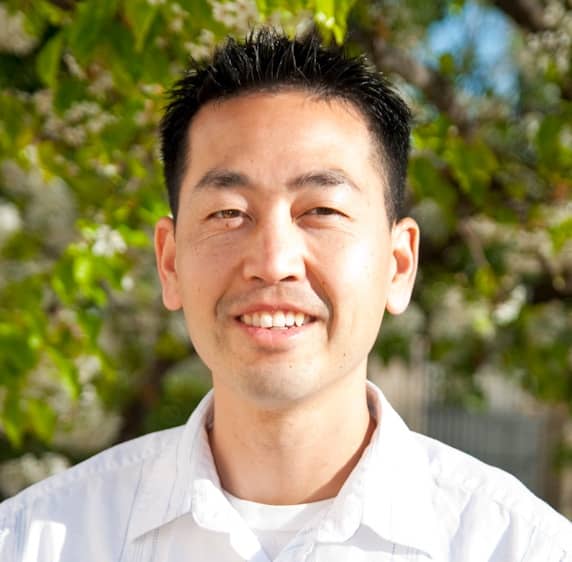
Tom Sugimura is a pastor-writer, church planting coach, and professor of biblical counseling. He writes at tomsugi.com, ministers the gospel at New Life Church, and hosts the Every Peoples Podcast. He and his wife cherish the moments as they raise their four kids in Southern California.
Patheos Explore the world's faith through different perspectives on religion and spirituality! Patheos has the views of the prevalent religions and spiritualities of the world.
Ad-Free & Subscriber Log-In Subscription Support
- About Us
- 2026 Calendar
- Videos
- Podcasts
- Library of World Religions
- Faith In Media Tracker
- Advertise With Us
- Write for Us
- Privacy Policy
- Terms of Service
- Do Not Sell My Data
- Contact Us
- Radiant Digital
- Manage Newsletter Subscriptions
- Unsubscribe From Notifications
- Sitemap
Copyright 2008-2026, Patheos. All rights reserved.
Subscription Support Ad-Free & Subscriber Log-In
Follow Patheos