
BuddhistCatholicContemplativeEvangelicalGeneral ChristianHinduJewishLatter-day SaintMuslimNew VisionsProgressive Christian
Beliefs
- Buddhist
- Catholic
- Contemplative
- Evangelical
- General Christian
- Hindu
- Jewish
- Latter-day Saint
- More Voices
- Muslim
- New Visions
- Pagan
- Progressive Christian
Topics
- Religion News
- Food and Religion
- Sports and Religion
- Religious Art
- Religious Music and Entertainment
- Religious Events
- History and Religion
- Style and Religion
- Politics and Religion
- Women in Religion
- Recreation Outdoors and Religion
- Business Finance and Religion
- Careers Workplace and Religion
- Education and Religion
- Family Parenting and Religion
- Health Fitness and Religion
- Home and Religion
- Relationships and Religion
- Technology and Religion
- Travel and Religion
Columnists
- Buddhist Columnists
- Business Finance and Religion Columnists
- Careers Workplace and Religion Columnists
- Catholic Columnists
- Contemplative Columnists
- Education and Religion Columnists
- Evangelists Columnists
- Family Parenting and Religion Columnists
- General Christian Columnists
- Health Fitness and Religion Columnists
- Hindu Columnists
- History and Religion Columnists
- Home and Religion Columnists
- Jewish Columnists
- More Voices Columnists
- Latter Day Columnists
- Muslim Columnists
- New Visions Columnists
- Nonreligious Columnists
- Pagan Columnists
- Politics and Religion Columnists
- Progressive Columnists
- Recreation Outdoors and Religion Columnists
- Relationships and Religion Columnists
- Religion News Columnists
- Religious Art Columnists
- Religious Events Columnists
- Religious Music and Entertainment Columnists
- Sports and Religion Columnists
- Style and Religion Columnists
- Technology and Religion Columnists
- Travel and Religion Columnists
- Women in Religion Columnists
Resource Library
- 2026 Calendar
- Library of World Religions
- The 100 Most Holy Places on Earth
- Patheos Answers
- Podcasts
- Videos
- Faith Leaders Database
- Anglican Episcopalian
- Bahai
- Baptist
- Buddhism
- Christianity
- Confucianism
- Eastern Orthodoxy
- Hinduism
- Holiness and Pentecostal
- ISKCON
- Islam
- Judaism
- Lutheran
- Methodist
- The Church of Jesus Christ of Latter-day Saints
- New Age
- Paganism
- Presbytarian and Reformed
- Protestantism
- Religion Behind the Scenes
- Roman Catholic
- Scientology
- Shia Islam
- Sikhism
- Sufism
- Sunni Islam
- Taoism
- Zen
- See all religions
Research Tools
 Ad-Free & Subscriber Log-In Subscription Support
Follow Patheos 

- Trending:
- Advent
- |
- Forgiveness
- |
- Thanksgiving
- |
- Election
- |
- Seasonal Holidays
- |
- Marriage
General Christian
A Critical Look at Luther Country
October 05, 2023 by Ken Chitwood
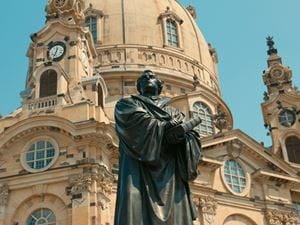
Igor Banaszczyk/Shutterstock.com
It’s pretty boujee, but I have two stained glass windows in my office.
I know, I know.
But one of them is pretty much tailor made for a religion nerd like me. It’s a bright and beautiful, stained-glass representation of the Wartburg Castle.
Perched at a height of some 400m above delightful countryside and rich central German forest, south of the city of Eisenach in Thuringia, the Wartburg is “a magnet for memory, tradition, and pilgrimage,” a “monument to the cultural history of Germany, Europe, and beyond.” Christians the world over also know the castle as where Martin Luther made his momentous translation of the Bible over the course of eleven weeks in the winter of 1520-21.
Since moving to Eisenach, I’ve watched out my windows — the non-stained ones — as busloads of tourists from places like South Korea, the U.S., and Brazil arrive on the square outside my apartment, where a prominent statue of Luther awaits them. They are here, in Luther Country, to walk in the Reformer’s footsteps and learn from his life in towns like Wittenberg and locales like the Wartburg.
A lot of these tours lavish praise on Luther, lauding the 16th-century rebel monk and cantankerous theologian for birthing the Reformation, and shaping Germany and the wider world’s theological, linguistic, historical, psychological and political self-image in the process.
And rightly so. Luther’s legacy is long and important to understand. But I can’t help but wonder what these tours would look like if they were a bit more critical of the man and his consequence. What, I often muse, would a more critical Luther tour look like?
Who said anything about an apple tree?
As the annual Reformation Day approaches (October 31) and I get ready to host a group of college students in Eisenach here to learn about Luther and his impact, I’ve been thinking about how our vision of Luther can be skewed by the superficial stereotypes that are typically trotted out for people on the usual tours.
It’s not that I blame the tourists, travelers, and pilgrims themselves. It’s hard to see past the Luther-inspired gin, “Here I Stand” socks, and cute Playmobil toys to disrupt the narrative around the Reformator.
But the resources are there, if we care to see them, to startle and awaken our appreciation for who Luther was in critical fashion – to move beyond the myths we know we are making to (re)evaluate Luther and the ways in which we’ve made him into a caricature for our own purposes.
We all make claims about ourselves and others, doing so from within practical, historical, and social contexts. Stories around Luther are no different. When we talk about Luther, it is less about the man, his thought, and his supposed authority over theology and history itself. Instead, it is much more about the ongoing process by which we humans ascribe certain things to people like him: certain acts, certain status, certain deference.
Many of the stories and claims about Luther have calcified over time, produced and reproduced in books and movies, within theological writings and on tours in central Germany.
The good news is, they have also been contested, undermined, and — in some instances — replaced.
Some of these have been relatively simple things, like the fact that Luther was no simple monk, but a trained philosopher and theologian. Or, that he never nailed ninety-five theses to a church door in Wittenberg or said, “Here I stand!” or anything about planting an apple tree. These are, as Dutch church historian Herman Selderhuis wrote, fine sentiments and sayings, but just not true or attributable to Luther himself.
Luther: Wart(burg)s and all.
There are also darker and more difficult subjects in need of revisiting in our retellings of Luther’s life — issues that bear relevance to contemporary conversations around race and class, diversity and difference.
As PRI reported, appreciating who Luther was also means coming to terms with how he “wrote and preached some vicious things about Jews.” In his infamous 1543 diatribe “Against the Jews and Their Lies," Luther called for the burning of Jewish synagogues, the confiscation of Jewish prayer books and Talmudic writings, and their expulsion from cities. It is possible that these directives were immediately applied, as evidence suggests that Jews were expelled from the town of his birth, Eisleben, after he preached a sermon on the “obdurate Jews” just three days before his death at age 62.
Dr. Christopher Probst, author of said that while Luther’s “sociopolitical suggestions were largely ignored by political leaders of his day,” during the Third Reich “a large number of Protestant pastors, bishops, and theologians of varying theological persuasions utilized Luther’s writings about Jews and Judaism with great effectiveness to reinforce the antisemitism already present in substantial degrees.”
Probst said that one theologian in particular, Jena theologian Wolf Meyer-Erlach, “explicitly regarded National Socialism as the ‘fulfillment’ of Luther’s designs against Jewry.”
Today, far-right parties continue to use Luther’s image and ascribed sayings to prop up their own political positions.
Beyond his tirades against Jewish people and their sordid use in German history, we might also take a critical look at the class dynamics at work in Luther’s life. Historically, his family were peasant farmers. However, his father Hans met success as a miner, ore smelter and mine owner allowing the Luthers to move to the town of Mansfeld and send Martin to law school before his dramatic turn to the study of theology. How might that have shaped the young Luther and later, his response to the Peasants War in 1524-25? How might it influence our understanding of who he was and what he wrote?,
There are also critical gems to be found in his writings on Islam and Muslims, his encounters with Ethiopian clergyman Abba Mika’el or the shifting gender dynamics at work in his relationship with Katharina von Bora, a former nun who married Luther in 1525.
Reimagining Luther Country.
Thankfully, I am far from the first person to point these things out. Museum exhibits, books, and documentaries have covered these topics in detail, doing a much more thorough job than I have above.
The problem is that gleanings from these resources can struggle to trickle down to the common tour or typical Luther pilgrimage. Or, they’re ignored in favor of just-so stories.
In Learning from the Germans, Susan Neiman wrote about the power of a country coming to terms with its past. In her exploration of how Germans faced their historical crimes, Neiman urges readers to consider recognizing the darker aspects of historical narratives and personages, so that we can bring those learnings to bear on contemporary cultural and political debates.
We might consider doing the same as we take a tour of Luther Country — whether in person or from afar. By injecting a bit of restlessness into our explorations, stirring constantly to break up the stereotypes, being critical and curious and exploring outside the safe confines of the familiar, we might discover more than we bargained for. But that, I suggest, would be a very good thing.
By telling different stories about Luther — and by demanding that we be told about them — I believe we might better know ourselves. How might we relate to a Luther who is not only the champion of the Reformation, but a disagreeable man made into a hero for political and theological purposes? How might that Luther speak to our times and the matters of faith and politics, society and common life, today?
As we come up on Reformation Day — and I welcome that group of students to my hometown and all its Luther-themed fanfare — I hope we might lean into such conversations and recognize how a critical take on Luther might prove a pressing priority for our time.
10/9/2023 4:25:55 AM
featured writer
more at patheos
1
2
Review: 'The Uprising' Asks: 'Is There Not a Cause?'
3

How Does Pāṯâ Connect Meta & Imported Meat?
4

The Parable of the Sower: The Divine Cycle of Reciprocity

About Ken Chitwood
Ken Chitwood is a religion nerd, writer and scholar of global Islam and American religion based in Germany. His work has appeared in Newsweek, Salon, The Los Angeles Times, The Washington Post, The Chicago Tribune, Religion News Service, Christianity Today, and numerous other publications. He is the author of The Muslims of Latin America and the Caribbean. Follow Ken on Twitter @kchitwood.
Patheos Explore the world's faith through different perspectives on religion and spirituality! Patheos has the views of the prevalent religions and spiritualities of the world.
Ad-Free & Subscriber Log-In Subscription Support
- About Us
- 2026 Calendar
- Videos
- Podcasts
- Library of World Religions
- Faith In Media Tracker
- Advertise With Us
- Write for Us
- Privacy Policy
- Terms of Service
- Do Not Sell My Data
- Contact Us
- Radiant Digital
- Manage Newsletter Subscriptions
- Unsubscribe From Notifications
- Sitemap
Copyright 2008-2026, Patheos, part of the Radiant Digital network of media brands. All rights reserved.
Subscription Support Ad-Free & Subscriber Log-In
Follow Patheos