
BuddhistCatholicContemplativeEvangelicalGeneral ChristianHinduJewishLatter-day SaintMuslimNew VisionsProgressive Christian
Beliefs
- Buddhist
- Catholic
- Contemplative
- Evangelical
- General Christian
- Hindu
- Jewish
- Latter-day Saint
- More Voices
- Muslim
- New Visions
- Pagan
- Progressive Christian
Topics
- Religion News
- Food and Religion
- Sports and Religion
- Religious Art
- Religious Music and Entertainment
- Religious Events
- History and Religion
- Style and Religion
- Politics and Religion
- Women in Religion
- Recreation Outdoors and Religion
- Business Finance and Religion
- Careers Workplace and Religion
- Education and Religion
- Family Parenting and Religion
- Health Fitness and Religion
- Home and Religion
- Relationships and Religion
- Technology and Religion
- Travel and Religion
Columnists
- Buddhist Columnists
- Business Finance and Religion Columnists
- Careers Workplace and Religion Columnists
- Catholic Columnists
- Contemplative Columnists
- Education and Religion Columnists
- Evangelists Columnists
- Family Parenting and Religion Columnists
- General Christian Columnists
- Health Fitness and Religion Columnists
- Hindu Columnists
- History and Religion Columnists
- Home and Religion Columnists
- Jewish Columnists
- More Voices Columnists
- Latter Day Columnists
- Muslim Columnists
- New Visions Columnists
- Nonreligious Columnists
- Pagan Columnists
- Politics and Religion Columnists
- Progressive Columnists
- Recreation Outdoors and Religion Columnists
- Relationships and Religion Columnists
- Religion News Columnists
- Religious Art Columnists
- Religious Events Columnists
- Religious Music and Entertainment Columnists
- Sports and Religion Columnists
- Style and Religion Columnists
- Technology and Religion Columnists
- Travel and Religion Columnists
- Women in Religion Columnists
Resource Library
- 2026 Calendar
- Library of World Religions
- The 100 Most Holy Places on Earth
- Patheos Answers
- Podcasts
- Videos
- Faith Leaders Database
- Anglican Episcopalian
- Bahai
- Baptist
- Buddhism
- Christianity
- Confucianism
- Eastern Orthodoxy
- Hinduism
- Holiness and Pentecostal
- ISKCON
- Islam
- Judaism
- Lutheran
- Methodist
- The Church of Jesus Christ of Latter-day Saints
- New Age
- Paganism
- Presbytarian and Reformed
- Protestantism
- Religion Behind the Scenes
- Roman Catholic
- Scientology
- Shia Islam
- Sikhism
- Sufism
- Sunni Islam
- Taoism
- Zen
- See all religions
Research Tools
 Ad-Free & Subscriber Log-In Subscription Support
Ad-Free & Subscriber Log-In Subscription Support
Follow Patheos 

- Trending:
- Forgiveness
- |
- Marriage
- |
- Consciousness
- |
- Death Penalty
- |
- Election
- |
- Halloween
- Home
- More Voices
- Answers
- Who is the Founder of Scientology?
More Voices
Patheos answers the question:
Who is the Founder of Scientology?
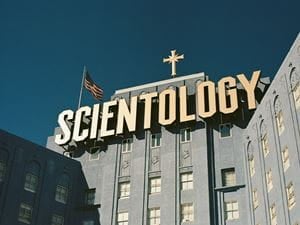
The Church of Scientology was founded in the 1950s by L. Ron Hubbard (1911-1986), a graduate of George Washington University and author of sci-fi and fantasy literature. Between 1934 and 1940, Hubbard published hundreds of short stories and novels. In addition to his various works of fiction, Hubbard also authored a semi-philosophical text known as Dianetics—the content of which he indicated he had drawn not only from his personal life experience, but also from the teachings of Sigmund Freud combined with aspects of Eastern religion/philosophy. First published in 1950, Dianetics was written prior to Hubbard’s founding of the Church of Scientology. Nevertheless, the text became influential in the Church once organized.
The date of the founding of Scientology has been variously reported as 1952, 1954, or 1956. In actuality, it was officially incorporated in December of 1953 (in Camden, New Jersey), but the Church’s first branch (which was in Los Angeles) wasn’t opened until 1954. However, because Hubbard had organized what he called the “Association of Scientologists International” (or “HASI”) in 1952, some have erroneously assumed that the Church of Scientology had been founded earlier than it actually was.
At the time Hubbard wrote and published Dianetics, it doesn’t appear that he was interested in Scientology as a religion or a religious organization. Rather, Hubbard seems to have initially envisioned the movement as a detailed theory about how the human mind functions, and how one could be equipped to prevent the “clouding” of one’s “analytic mind”—a clouding which Hubbard believed was caused by “traumas” (in this life or in previous existences). The “clouding” of the mind prevents one from experiencing or seeking “reality,” according to Hubbard. This teaching strongly mirrors “maya” (or “illusion”) in many of the East Asian traditions—and Hubbard, by his own admission, may have drawn the teaching from his study of the dharmic traditions.
It wasn’t until 1953 that Hubbard first openly contemplated Scientology as a religion, though he may have toyed with the idea prior to expressing his interest (in April of 1953) in a letter to the manager of HASI (Helen O’Brien). In his letter, Hubbard requested that O’Brien look into the religious “angle” of Scientology. Though she is said to have been skeptical, Hubbard was convinced of its viability as a religion and, as a result, later that same year he incorporated the Church of Scientology, and officially began the transition from a philosophical-psychological movement to what some describe as a “New-Age Religion.”
The religious side of Dianetics may have been latent in the original text, even before Hubbard founded the “faith.” According to Hubbard, on January 1, 1938, during an oral surgery, he had a “near-death experience” (while under anesthesia). During this experience, he received the “inspiration” to write a book which he called “Excalibur.” Though he tried to get the manuscript published, but to no avail, “Excalibur” essentially became the basis for Dianetics. Thus, a pseudo-religious experience was Hubbard’s stimulus for writing his non-religious Dianetics text, which would eventually find its way into the “canon” of the Church of Scientology. In time, Hubbard himself would read the text less through a purely psychological perspective, and more through a spiritual-religious set of lenses.
Hubbard eventually lost the rights to Dianetics (supposedly because of bankruptcy). Not long after that, he stated that he had “discovered” a “science beyond Dianetics,” which (for obvious reasons) he named “Scientology.” The purpose of Dianetics was to facilitate the practitioner’s move beyond the “clouded” mind to a state of “clear” (allowing the practitioner to become “refamiliarized with his capabilities” or potential). However, Scientology would take the “believer” beyond what Dianetics could offer—providing practitioners with the potential to achieve an “operating thetan,” a condition of comprehensive “spiritual freedom” in which the practitioner is a “willing and knowing cause over life, thought, matter, energy, space and time.” This latter state has been described as a “state of godliness,” because the Scientologist is now in control of all things… omnipotent, in some sense of the word.
Hubbard turned out to be a somewhat controversial figure, not only because some questioned the religious nature of Scientology, but also because of several criminal charges brought against him, and because of his engagement in bigamy. Detractors of Hubbard and Scientology often raise these issues to discount the validity of the Church, though many Scientologists argue that the validity of Hubbard’s theology cannot be dismissed simply because of his human failings; something all of us exhibit.
Because of the various controversies which swirled around Hubbard and his Church, he left the United States, living for a time in Rhodesia, Greece, Morocco, the Canary Islands, and on a yacht which traveled from place to place looking for refuge from those who sought his arrest. Having returned to the United States (in 1975), Hubbard was forced into hiding (in February of 1980) in an effort to evade authorities who were pursuing him. Though, in 1967, he claimed he had relinquished his control over the Church of Scientology, it is believed that he was secretly running the organization until his death (in 1986).
Whether rightfully or not, nearly forty years after his death, L. Ron Hubbard remains a controversial figure. The Church of Scientology has certainly suffered because of Hubbard’s various controversial acts, through a sort of “guilt by association.” However, in addition to Hubbard’s persona, which has brought challenges to his movement, his unique doctrines—which lay at the core of Scientology—have also caused many to question the validity of the movement he started nearly 75 years ago.
6/3/2024 3:26:23 AM
Do Scientologists Believe in God?
For Scientologists, God is typically understood less as a...
How Did Confucianism Impact China?
Although only a very small percentage of Chinese...
Where Did Confucianism Originate?
It was born in China but, more importantly, originated in...

Is Confucianism Monotheistic or Polytheistic?
Many scholars of Confucianism erroneously believe that...

Does the Baháʼí Believe in God?
While emphatically believing in the existence of God,...
Does the Baháʼí Believe in Reincarnation?
The Baháʼí religion is sometimes compared to universalism,...

About Alonzo L. Gaskill, PhD
Alonzo L. Gaskill is a Professor of Church history and doctrine. He holds a bachelor's degree in philosophy, a masters in theology, and a PhD in biblical studies.
Most Popular

- Home
- More Voices
- Answers
- Who is the Founder of Scientology?
Evangelical
How the author of the world's best hymn became a Christian

- Home
- More Voices
- Answers
- Who is the Founder of Scientology?
INNER CIRCLE: Profound Mystery (Of Christ In All Of Us)

- Home
- More Voices
- Answers
- Who is the Founder of Scientology?
General Christian
What Does Gêvâh Mean For Kimberley Guifoyle & Pete...

- Home
- More Voices
- Answers
- Who is the Founder of Scientology?
General Christian

- Home
- More Voices
- Answers
- Who is the Founder of Scientology?
Evangelical
Do Not Rejoice When Your Enemy Falls: The Cheers for Death

- Home
- More Voices
- Answers
- Who is the Founder of Scientology?
Progressive Christian
The purpose-driven labor priest
- Home
- More Voices
- Answers
- Who is the Founder of Scientology?
The Golden Rule Demands More than We Think

- Home
- More Voices
- Answers
- Who is the Founder of Scientology?
‘Conceivable’ Opens Friday: Faith, Family & a Surprise at...

- Home
- More Voices
- Answers
- Who is the Founder of Scientology?
Catholic
'The Chosen' S6 Trailer: The Passion Gets Very Real

- Home
- More Voices
- Answers
- Who is the Founder of Scientology?
Evangelical
What Will We Be Able to do on the New Earth?

- Home
- More Voices
- Answers
- Who is the Founder of Scientology?
Catholic
On Protestant Explanations of Catholic Conversion
- Home
- More Voices
- Answers
- Who is the Founder of Scientology?
Catholic
Pope Leo has Lung Cancer. We Need Him in this Dangerous...
Patheos Explore the world's faith through different perspectives on religion and spirituality! Patheos has the views of the prevalent religions and spiritualities of the world.
Ad-Free & Subscriber Log-In Subscription Support
- About Us
- 2026 Calendar
- Videos
- Podcasts
- Library of World Religions
- Faith In Media Tracker
- Advertise With Us
- Write for Us
- Privacy Policy
- Terms of Service
- Do Not Sell My Data
- Contact Us
- Radiant Digital
- Manage Newsletter Subscriptions
- Unsubscribe From Notifications
- Sitemap
Copyright 2008-2026, Patheos. All rights reserved.
Subscription Support Ad-Free & Subscriber Log-In
Follow Patheos