
BuddhistCatholicContemplativeEvangelicalGeneral ChristianHinduJewishLatter-day SaintMuslimNew VisionsProgressive Christian
Beliefs
- Buddhist
- Catholic
- Contemplative
- Evangelical
- General Christian
- Hindu
- Jewish
- Latter-day Saint
- More Voices
- Muslim
- New Visions
- Pagan
- Progressive Christian
Topics
- Religion News
- Food and Religion
- Sports and Religion
- Religious Art
- Religious Music and Entertainment
- Religious Events
- History and Religion
- Style and Religion
- Politics and Religion
- Women in Religion
- Recreation Outdoors and Religion
- Business Finance and Religion
- Careers Workplace and Religion
- Education and Religion
- Family Parenting and Religion
- Health Fitness and Religion
- Home and Religion
- Relationships and Religion
- Technology and Religion
- Travel and Religion
Columnists
- Buddhist Columnists
- Business Finance and Religion Columnists
- Careers Workplace and Religion Columnists
- Catholic Columnists
- Contemplative Columnists
- Education and Religion Columnists
- Evangelists Columnists
- Family Parenting and Religion Columnists
- General Christian Columnists
- Health Fitness and Religion Columnists
- Hindu Columnists
- History and Religion Columnists
- Home and Religion Columnists
- Jewish Columnists
- More Voices Columnists
- Latter Day Columnists
- Muslim Columnists
- New Visions Columnists
- Nonreligious Columnists
- Pagan Columnists
- Politics and Religion Columnists
- Progressive Columnists
- Recreation Outdoors and Religion Columnists
- Relationships and Religion Columnists
- Religion News Columnists
- Religious Art Columnists
- Religious Events Columnists
- Religious Music and Entertainment Columnists
- Sports and Religion Columnists
- Style and Religion Columnists
- Technology and Religion Columnists
- Travel and Religion Columnists
- Women in Religion Columnists
Resource Library
- 2026 Calendar
- Library of World Religions
- The 100 Most Holy Places on Earth
- Patheos Answers
- Podcasts
- Videos
- Faith Leaders Database
- Anglican Episcopalian
- Bahai
- Baptist
- Buddhism
- Christianity
- Confucianism
- Eastern Orthodoxy
- Hinduism
- Holiness and Pentecostal
- ISKCON
- Islam
- Judaism
- Lutheran
- Methodist
- The Church of Jesus Christ of Latter-day Saints
- New Age
- Paganism
- Presbytarian and Reformed
- Protestantism
- Religion Behind the Scenes
- Roman Catholic
- Scientology
- Shia Islam
- Sikhism
- Sufism
- Sunni Islam
- Taoism
- Zen
- See all religions
Research Tools
 Ad-Free & Subscriber Log-In Subscription Support
Ad-Free & Subscriber Log-In Subscription Support
Follow Patheos 

- Trending:
- Forgiveness
- |
- Marriage
- |
- Consciousness
- |
- Death Penalty
- |
- Election
- |
- Halloween
- Home
- Catholic
- History and Religion
- Answers
- Who Chooses The New Pope
Catholic
Patheos answers the question:
Who Chooses the New Pope? Is It God?
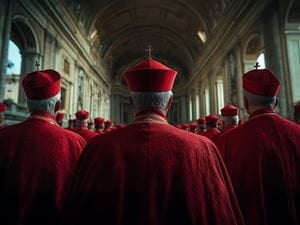
The process for choosing a new pope has evolved throughout the history of the Church. From a Roman Catholic perspective, Christ Himself selected and ordained St. Peter as the first pope when He declared, “I give you the keys of the kingdom of heaven” (Matthew 16:19). However, after Jesus’ death, the process of selecting a new pope has looked different in Christianity’s various stages, and the process today is an outgrowth of centuries of evolving tradition.
- In the first through fourth centuries, local Roman clergy—in consultation with Christians residing in Rome—selected the successor to the Throne of St. Peter. There was no formalized process in those early years, and some government officials exhibited a measure of influence over the selection of a new pope, though it was mostly the decision of local leaders of the Church.
- In the fourth through ninth centuries, when Christianity was the official religion of the Roman Empire, emperors were heavily involved in the process, sometimes choosing the new pope themselves; while, at other times, allowing for bishops of the surrounding regions to participate in an electoral process (moderately akin to what we have today). Thus, nearly 1,000 years after Peter, the pope was being elected by locals rather than representatives from throughout the globe.
- During the Middle Ages (9th through 11th centuries), influential Roman families sought to manipulate the process, seeking to get a pope installed who would facilitate their economic or political agendas. In the eleventh century, the College of Cardinals was officially established (AD 1059). This body would have the assignment to elect a new pope from that time down to today. With the creation of this body of “advisors” to the pope, the process for election became formalized for the first time in Catholicism’s history, and outside political influences became less of an issue in the process. In addition, with the creation of the College of Cardinals, the process of election began to receive input from leaders outside of the immediate area surrounding Rome.
- During the Later Middle Ages down through the Renaissance (12th through 16th centuries) the sequestered Conclave was created (AD 1274), helping to speed up the process of election. (Prior to this, some elections of a new pope took several years to accomplish.) It was during this era that rules were added, such as the need for a 2/3 majority vote to elect a pope, and an oath of secrecy to be observed (during and after the conclave) by all who participated.
- During the Modern Era (17th through 19th centuries), the process has become more ritualized than in previous centuries, with layers of formalities being added. For example, the use of smoke rising from the chapel’s chimney (to signal the decision of a vote) was first employed during this era. Many of the rules and pomp we think of today when we contemplate the appointing of a new pope can only be found in modern times.
- Finally, in the twentieth through twenty-first centuries (or Postmodern Era), age limits were added (making Cardinals 80 years of age or older ineligible to vote). A strict 2/3 vote was required for the election of a new pope. (Though this rule was already in place, between 1996 and 2007 there was some flexibility if, after multiple votes, there was still not a successor elected. By 2007, any flexibility on this rule had been removed.) Additionally, during this period of the Church’s history, the pope was required to choose the name by which he would be known prior to the announcement that a new Bishop of Rome had been elected.
Today, the process of electing a pope is very structured, with few surprises. While a given pope may alter the process for choosing his successor, on the most significant points of the process, very little evolution is likely. Today, there are three main phases of electing a new pope.
The first phase is the confirmation of the passing of the outgoing Holy Father. A physician officially examines him and declares him deceased. After which, the Camerlengo (or fiscal administrator) of the Roman Catholic Church—who is a senior cardinal appointed by the pope—enters the room which houses the pope’s body and formally confirms that he has died. As part of that process, the Camerlengo three times calls out the deceased pope’s baptismal name (not his papal name), essentially asking if he is deceased or merely sleeping. At this point, the pope’s signet ring is removed from his hand and ceremonially destroyed (in the presence of several witnesses), the body is removed, and his private residence is sealed shut.
In the second phase, as quickly after the passing of the pope as possible, members of the College of Cardinals gather in Rome to participate in the funeral of the deceased Holy Father. Between fifteen and twenty days after the pope’s passing, the sequestered Conclave begins, with cardinals under the age of 80 meeting in the Sistine Chapel to cast their votes. During the time between the pope’s passing and the election of the new pope, there is certainly a measure of politicking that takes place, particularly by those who seek a specific direction for the Church and who hope to get elected a pope who will take Catholicism down that road. As votes are cast, it becomes evident to the cardinals present who the most likely candidates are, and the field traditionally narrows fairly quickly.
In the third and final phase, the Dean of the College of Cardinals asks (in Latin) the person who has won the vote if he accepts his election as pope. When he confirms that he does, he is then asked, “By what name do you wish to be called?” White smoke is then released from the chimney of the Sistine Chapel, letting the world know that a new pope has been elected. The successor to Peter is then led to the “Room of Tears” where he dresses in white papal vestments, receives the “Fisherman’s Ring” from the Camerlengo, and then the new Holy Father is announced and presented at the balcony of St. Peter’s Basilica, where he gives his first apostolic blessing to the world and those gathered below.
So, Does God Choose The Pope?
Some might ask, “Is it God or a group of men who select the new pope?”
A faithful Roman Catholic would likely say “Both.” In other words, while there is a measure of politicking in the process, and flawed human beings are the ones who vote, nonetheless, Catholicism teaches that the Holy Spirit guides the deliberations and the outcome of the conclave.
Thus, the Church holds that God chooses the new pope by inspiring those seeking to know His will. Through a series of conversations and votes, the Cardinals discover who it is that God has already chosen and, via that process, allow God’s selection to be discovered by them and known by the whole world.
While non-Roman Catholics might question God’s involvement in this process, since Christianity is the largest religion in the world, and since the Roman Catholic Church is its largest denomination, regardless of what religion you identify with, one should hope God is in the details of electing a new pope, as the Pontiff's impact upon the world is undeniably significant, and having the “right man for the job” is something that impacts us all of us, Catholic and non-Catholic alike!
4/24/2025 2:30:05 PM
Most Popular
- Home
- Catholic
- History and Religion
- Answers
- Who Chooses The New Pope
Catholic
Who Are The Most Controversial Popes In History?
- Home
- Catholic
- History and Religion
- Answers
- Who Chooses The New Pope
Muslim
Islam Growing Fast In America And World
- Home
- Catholic
- History and Religion
- Answers
- Who Chooses The New Pope
Jewish
Why Is Judaism Struggling In The United States?
- Home
- Catholic
- History and Religion
- Answers
- Who Chooses The New Pope
General Christian
Are There Books Missing from the Bible?
- Home
- Catholic
- History and Religion
- Answers
- Who Chooses The New Pope
Why Do Christians Celebrate Lent?
Kathleen Mulhern, Ph.D.
Patheos Explore the world's faith through different perspectives on religion and spirituality! Patheos has the views of the prevalent religions and spiritualities of the world.
Ad-Free & Subscriber Log-In Subscription Support
- About Us
- 2026 Calendar
- Videos
- Podcasts
- Library of World Religions
- Faith In Media Tracker
- Advertise With Us
- Write for Us
- Privacy Policy
- Terms of Service
- Do Not Sell My Data
- Contact Us
- Radiant Digital
- Manage Newsletter Subscriptions
- Unsubscribe From Notifications
- Sitemap
Copyright 2008-2026, Patheos. All rights reserved.
Subscription Support Ad-Free & Subscriber Log-In
Follow Patheos