
BuddhistCatholicContemplativeEvangelicalGeneral ChristianHinduJewishLatter-day SaintMuslimNew VisionsProgressive Christian
Beliefs
- Buddhist
- Catholic
- Contemplative
- Evangelical
- General Christian
- Hindu
- Jewish
- Latter-day Saint
- More Voices
- Muslim
- New Visions
- Pagan
- Progressive Christian
Topics
- Religion News
- Food and Religion
- Sports and Religion
- Religious Art
- Religious Music and Entertainment
- Religious Events
- History and Religion
- Style and Religion
- Politics and Religion
- Women in Religion
- Recreation Outdoors and Religion
- Business Finance and Religion
- Careers Workplace and Religion
- Education and Religion
- Family Parenting and Religion
- Health Fitness and Religion
- Home and Religion
- Relationships and Religion
- Technology and Religion
- Travel and Religion
Columnists
- Buddhist Columnists
- Business Finance and Religion Columnists
- Careers Workplace and Religion Columnists
- Catholic Columnists
- Contemplative Columnists
- Education and Religion Columnists
- Evangelists Columnists
- Family Parenting and Religion Columnists
- General Christian Columnists
- Health Fitness and Religion Columnists
- Hindu Columnists
- History and Religion Columnists
- Home and Religion Columnists
- Jewish Columnists
- More Voices Columnists
- Latter Day Columnists
- Muslim Columnists
- New Visions Columnists
- Nonreligious Columnists
- Pagan Columnists
- Politics and Religion Columnists
- Progressive Columnists
- Recreation Outdoors and Religion Columnists
- Relationships and Religion Columnists
- Religion News Columnists
- Religious Art Columnists
- Religious Events Columnists
- Religious Music and Entertainment Columnists
- Sports and Religion Columnists
- Style and Religion Columnists
- Technology and Religion Columnists
- Travel and Religion Columnists
- Women in Religion Columnists
Resource Library
- 2026 Calendar
- Library of World Religions
- The 100 Most Holy Places on Earth
- Patheos Answers
- Podcasts
- Videos
- Faith Leaders Database
- Anglican Episcopalian
- Bahai
- Baptist
- Buddhism
- Christianity
- Confucianism
- Eastern Orthodoxy
- Hinduism
- Holiness and Pentecostal
- ISKCON
- Islam
- Judaism
- Lutheran
- Methodist
- The Church of Jesus Christ of Latter-day Saints
- New Age
- Paganism
- Presbytarian and Reformed
- Protestantism
- Religion Behind the Scenes
- Roman Catholic
- Scientology
- Shia Islam
- Sikhism
- Sufism
- Sunni Islam
- Taoism
- Zen
- See all religions
Research Tools
 Ad-Free & Subscriber Log-In Subscription Support
Ad-Free & Subscriber Log-In Subscription Support
Follow Patheos 

- Trending:
- Forgiveness
- |
- Marriage
- |
- Consciousness
- |
- Death Penalty
- |
- Election
- |
- Halloween
- Home
- More Voices
- Answers
- Where Did Confucianism Originate
More Voices
Patheos answers the question:
Where Did Confucianism Originate?
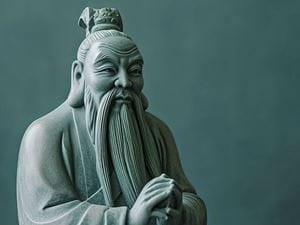
Scholarly sources suggest that that the founder of Confucianism (551-479 BCE)—anciently referred to as “K’ung Fu-tzu” or “Master Kong”—was born in China in the fifth century BCE. Though technically born into what we might call an “aristocratic family” (his father being a military hero and then governor over a region in China); Confucious had a rather rough childhood. His father died when K’ung Fu-tzu was only three years old. Because he was born to the concubine of his father, Confucius and his mother were seen as a drain on the family’s strained resources and, consequently, they were banished by his father’s two surviving wives and their children. As a result, Confucius was raised in poverty.
Tradition says that, by the age of fifteen, he knew that he wanted to become a scholar. In his twenties, he began teaching. He was quite charismatic (in spite of being inordinately tall and, according to tradition, rather unattractive). He developed a large following in an era when “education” was something you got and the knee of your mother or father. Many believe that Confucious may have been the first “professional” teacher—convincing thousands to give him some form of pay to convey to them his philosophy about life and the wisdom he could impart.
Technically, Confucius saw himself as a “transmitter of traditions” which already existed in his day, rather than as the “inventor” of the truths he propagated. Indeed, Confucious and his closest disciples venerated the teachings and person of various sages who predated them by hundreds of years. Those sages included the Emperors Yau and Shun (who are said to have lived in the 3rd millennium BCE); the rulers of the Zhou Dynasty (circa 1050-256 BCE); the Kings of Zhou, Wen (d. 1056 BCE) and Wu (d. circa 1043 BCE); and Duke Huan of Zhou (711-694 BCE). Confucious had access to teachings attributed to these ancient sages, and he taught and expanded upon those ideas—creating a philosophy, ethic, and even view of education that remains largely unmatched in the modern world.
What Confucious founded was not a “formal” religion. Rather, the Confucianism we are familiar with today is the outgrowth of the slow evolution of Master Kong’s teachings; an evolution which took place well after his death. Essentially, his many disciples took the things he taught them, and those diffused throughout China, slowly permeating various already existing social structures (such as the government, family life, and even other religions). From China, it eventually made its way to Vietnam, Korea, and Japan, where it became heavily influential.
Part of what facilitated Confucianism’s diffusion into these other parts of the world was the spread of Chinese governmental practices, along with China’s familial, philosophical, linguistic, and artistic structures. Because Confucianism so heavily impacted each of these elements of Chinese culture, when that country’s influence spread, so did Confucianism—into and throughout most of East Asian society. Thus, today, Confucianism is largely inseparable from (and even synonymous) with East Asian culture.
Another component which has facilitated the wide-spread nature of Confucianism has to do with its ritual observances. Because Confucious didn’t emphasize belief in God but stressed more the importance of moral or ethical living, its rites are largely about human relations—rather than the relationship between people and their God. As odd as that may sound, many of these rites (associated with marriage, death, puberty, etc.) have existed for some 2,000 years. In an era when belief in God seems to be dying, Confucian rites have remained strong and influential because, while some may lose their need for a God, humans always need human relationship. Thus, the focus of these rites and even Confucian teachings have remained germane (and kept Confucianism relevant) even in a post-religious world.
5/10/2024 4:31:05 PM

Who is the Founder of Scientology?
The Church of Scientology was founded in the 1950s by L....

Do Scientologists Believe in God?
For Scientologists, God is typically understood less as a...
How Did Confucianism Impact China?
Although only a very small percentage of Chinese...
Is Confucianism Monotheistic or Polytheistic?
Many scholars of Confucianism erroneously believe that...

Does the Baháʼí Believe in God?
While emphatically believing in the existence of God,...
Does the Baháʼí Believe in Reincarnation?
The Baháʼí religion is sometimes compared to universalism,...

About Alonzo L. Gaskill, PhD
Alonzo L. Gaskill is a Professor of Church history and doctrine. He holds a bachelor's degree in philosophy, a masters in theology, and a PhD in biblical studies.
Most Popular

- Home
- More Voices
- Answers
- Where Did Confucianism Originate
Evangelical
How the author of the world's best hymn became a Christian

- Home
- More Voices
- Answers
- Where Did Confucianism Originate
INNER CIRCLE: Profound Mystery (Of Christ In All Of Us)

- Home
- More Voices
- Answers
- Where Did Confucianism Originate
General Christian
What Does Gêvâh Mean For Kimberley Guifoyle & Pete...

- Home
- More Voices
- Answers
- Where Did Confucianism Originate
General Christian

- Home
- More Voices
- Answers
- Where Did Confucianism Originate
Evangelical
Do Not Rejoice When Your Enemy Falls: The Cheers for Death

- Home
- More Voices
- Answers
- Where Did Confucianism Originate
Progressive Christian
The purpose-driven labor priest

- Home
- More Voices
- Answers
- Where Did Confucianism Originate
The Golden Rule Demands More than We Think

- Home
- More Voices
- Answers
- Where Did Confucianism Originate
‘Conceivable’ Opens Friday: Faith, Family & a Surprise at...

- Home
- More Voices
- Answers
- Where Did Confucianism Originate
Catholic
'The Chosen' S6 Trailer: The Passion Gets Very Real

- Home
- More Voices
- Answers
- Where Did Confucianism Originate
Evangelical
What Will We Be Able to do on the New Earth?

- Home
- More Voices
- Answers
- Where Did Confucianism Originate
Catholic
On Protestant Explanations of Catholic Conversion
- Home
- More Voices
- Answers
- Where Did Confucianism Originate
Catholic
Pope Leo has Lung Cancer. We Need Him in this Dangerous...
Patheos Explore the world's faith through different perspectives on religion and spirituality! Patheos has the views of the prevalent religions and spiritualities of the world.
Ad-Free & Subscriber Log-In Subscription Support
- About Us
- 2026 Calendar
- Videos
- Podcasts
- Library of World Religions
- Faith In Media Tracker
- Advertise With Us
- Write for Us
- Privacy Policy
- Terms of Service
- Do Not Sell My Data
- Contact Us
- Radiant Digital
- Manage Newsletter Subscriptions
- Unsubscribe From Notifications
- Sitemap
Copyright 2008-2026, Patheos. All rights reserved.
Subscription Support Ad-Free & Subscriber Log-In
Follow Patheos