
BuddhistCatholicContemplativeEvangelicalGeneral ChristianHinduJewishLatter-day SaintMuslimNew VisionsProgressive Christian
Beliefs
- Buddhist
- Catholic
- Contemplative
- Evangelical
- General Christian
- Hindu
- Jewish
- Latter-day Saint
- More Voices
- Muslim
- New Visions
- Pagan
- Progressive Christian
Topics
- Religion News
- Food and Religion
- Sports and Religion
- Religious Art
- Religious Music and Entertainment
- Religious Events
- History and Religion
- Style and Religion
- Politics and Religion
- Women in Religion
- Recreation Outdoors and Religion
- Business Finance and Religion
- Careers Workplace and Religion
- Education and Religion
- Family Parenting and Religion
- Health Fitness and Religion
- Home and Religion
- Relationships and Religion
- Technology and Religion
- Travel and Religion
Columnists
- Buddhist Columnists
- Business Finance and Religion Columnists
- Careers Workplace and Religion Columnists
- Catholic Columnists
- Contemplative Columnists
- Education and Religion Columnists
- Evangelists Columnists
- Family Parenting and Religion Columnists
- General Christian Columnists
- Health Fitness and Religion Columnists
- Hindu Columnists
- History and Religion Columnists
- Home and Religion Columnists
- Jewish Columnists
- More Voices Columnists
- Latter Day Columnists
- Muslim Columnists
- New Visions Columnists
- Nonreligious Columnists
- Pagan Columnists
- Politics and Religion Columnists
- Progressive Columnists
- Recreation Outdoors and Religion Columnists
- Relationships and Religion Columnists
- Religion News Columnists
- Religious Art Columnists
- Religious Events Columnists
- Religious Music and Entertainment Columnists
- Sports and Religion Columnists
- Style and Religion Columnists
- Technology and Religion Columnists
- Travel and Religion Columnists
- Women in Religion Columnists
Resource Library
- 2026 Calendar
- Library of World Religions
- The 100 Most Holy Places on Earth
- Patheos Answers
- Podcasts
- Videos
- Faith Leaders Database
- Anglican Episcopalian
- Bahai
- Baptist
- Buddhism
- Christianity
- Confucianism
- Eastern Orthodoxy
- Hinduism
- Holiness and Pentecostal
- ISKCON
- Islam
- Judaism
- Lutheran
- Methodist
- The Church of Jesus Christ of Latter-day Saints
- New Age
- Paganism
- Presbytarian and Reformed
- Protestantism
- Religion Behind the Scenes
- Roman Catholic
- Scientology
- Shia Islam
- Sikhism
- Sufism
- Sunni Islam
- Taoism
- Zen
- See all religions
Research Tools
 Ad-Free & Subscriber Log-In Subscription Support
Follow Patheos 

- Trending:
- Advent
- |
- Forgiveness
- |
- Thanksgiving
- |
- Election
- |
- Seasonal Holidays
- |
- Marriage
Patheos answers the question:
When Was Jesus Born?
by Kathleen Mulhern, Ph.D.
Shutterstock.com
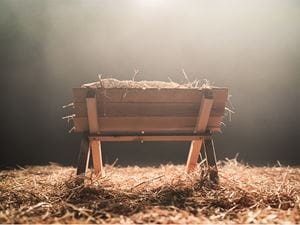
It is always difficult to be exact with ancient dates, but most scholars believe that Jesus was born around 6-4 B.C. The calendar as it is known today recognizes history before and after the life of Jesus Christ by separating dates accordingly. Years count down before his birth and start to count forward after. [Years before his life were called B.C.: Before Christ. Years after his life were referred to as A.D., or years Anno Domini, which means “Year of our Lord.” In recognition of the pluralist reality of religious beliefs, these are sometimes changed to BCE (Before the Common Era) and CE (Common Era).] Early historians calculated Jesus’ birth as year one, but today scholars recognize that, according to all historical references to his birth and lifespan, he was probably born before “year one.”
Only two of the gospels refer to Jesus’ birth, and the details they provide give clues to the date of his birth. Matthew places the birth during the reign of Herod the Great, a vassal king of Judea under the Roman rule. Since Herod died in 4 B.C., Jesus had to have been born before that. Matthew also tells about the magi, or wise men, coming to find the baby Jesus because of an extraordinary star in the sky (Matthew 2.1-11) that was a sign to them of an auspicious birth. These eastern astrologers believed it indicated the birth of the king of the Jews, and they sought him out to worship him and give him honorific gifts. Historians have considered a variety of astronomical phenomena that could be the event Matthew describes, including the appearance of Halley’s comet, which was visible in 12 B.C., and different rare conjunctions of Jupiter and Saturn.
The Gospel of Luke says that Jesus was born during the reign of Caesar Augustus (27 B.C.-A.D. 14), and that there was a Roman census at the time that required Joseph and Mary, Jesus’ parents, to go to Bethlehem to register (Luke 2.1-5). Luke says the census took place during the tenure of Quirinius, who was the Roman governor of Syria at the time. History records a Roman census in A.D. 6, which would have been too late for Jesus’ birth according to Matthew’s account. Luke also mentions that Jesus started his public ministry when he was about 30 years old (Luke 3.23), and the gospels indicate that he preached and healed for three years before he was executed.
Extrabiblical sources recognize the existence of a man called Jesus who was executed by order of Pontius Pilate, the Roman governor of Judea during Tiberius Caesar’s reign. Pilate governed from A.D. 26-36/37, so for Jesus to be approximately 33 years old at the time of his death and alive before Herod’s death, he had to have been born no earlier than 7 B.C. and no later than A.D. 4.
Christians celebrate Jesus’ birth on 25 December every year, which is the origin of Christmas. This date, though, is almost certainly not the exact day of his birth. It was chosen strategically to coincide with the winter solstice, the shortest day of the year, to celebrate Jesus as the Light of the world, the light that comes into our darkness.
Read more about Jesus’ birth here.
3/23/2021 6:32:41 PM
About About Kathleen Mulhern, Ph.D
Kathleen Mulhern is a writer, editor, historian, speaker, and professor. She teaches courses in world history, European history, and history of Christianity. She has taught at Colorado School of Mines and Regis University, and is currently an adjunct professor at Denver Seminary in the areas of Church History and Spiritual Formation. Kathleen graduated with a B.A. from Wheaton College, earned an M.A. in French Literature from the University of Denver, an M.A. degree in Church History from Denver Seminary, and a Ph.D. in History from the University of Colorado.
More From Patheos About the Birth of Jesus Christ
When Was Jesus Really Born? When Is His True Birthday?
Why the Details of Jesus' Birth Don't Matter
History or Not? Discrepancies in Jesus' Birth Stories
Where Was Jesus Born? It Might Not Be Where You Think
What Were the Sources For the Bible’s Accounts of Jesus’ Birth?
The Year Jesus Was Born
Most Popular

Catholic
Sunday Readings: Stay Awake and Hope

Progressive Christian
Let Matthew 25 Guide You to a Greater Sense of...
Catholic
How Discretion Guides Us Away From Extremes
Evangelical
Don’t Miss the Parents: A Creative Christmas Meditation

Family
Are You a Scrooge or an Ebenezer?

Evangelical
Noah’s Ark Archaeologists: Gopher Wood or Should We Go...

Progressive Christian
Smart people saying smart things (11.24.26)

The Contingency of Our Technology

Progressive Christian
Progressive Christian
Reasons for Restraint: Ricardo Gonzalez, Florida and Dec 1

General Christian
Psalm 5: David Pleads His Case
Progressive Christian
It All Counts: A Conversation With Natalia Terfa
Patheos Explore the world's faith through different perspectives on religion and spirituality! Patheos has the views of the prevalent religions and spiritualities of the world.
Ad-Free & Subscriber Log-In Subscription Support
- About Us
- 2026 Calendar
- Videos
- Podcasts
- Library of World Religions
- Faith In Media Tracker
- Advertise With Us
- Write for Us
- Privacy Policy
- Terms of Service
- Do Not Sell My Data
- Contact Us
- Radiant Digital
- Manage Newsletter Subscriptions
- Unsubscribe From Notifications
- Sitemap
Copyright 2008-2026, Patheos, part of the Radiant Digital network of media brands. All rights reserved.
Subscription Support Ad-Free & Subscriber Log-In
Follow Patheos