
BuddhistCatholicContemplativeEvangelicalGeneral ChristianHinduJewishLatter-day SaintMuslimNew VisionsProgressive Christian
Beliefs
- Buddhist
- Catholic
- Contemplative
- Evangelical
- General Christian
- Hindu
- Jewish
- Latter-day Saint
- More Voices
- Muslim
- New Visions
- Pagan
- Progressive Christian
Topics
- Religion News
- Food and Religion
- Sports and Religion
- Religious Art
- Religious Music and Entertainment
- Religious Events
- History and Religion
- Style and Religion
- Politics and Religion
- Women in Religion
- Recreation Outdoors and Religion
- Business Finance and Religion
- Careers Workplace and Religion
- Education and Religion
- Family Parenting and Religion
- Health Fitness and Religion
- Home and Religion
- Relationships and Religion
- Technology and Religion
- Travel and Religion
Columnists
- Buddhist Columnists
- Business Finance and Religion Columnists
- Careers Workplace and Religion Columnists
- Catholic Columnists
- Contemplative Columnists
- Education and Religion Columnists
- Evangelists Columnists
- Family Parenting and Religion Columnists
- General Christian Columnists
- Health Fitness and Religion Columnists
- Hindu Columnists
- History and Religion Columnists
- Home and Religion Columnists
- Jewish Columnists
- More Voices Columnists
- Latter Day Columnists
- Muslim Columnists
- New Visions Columnists
- Nonreligious Columnists
- Pagan Columnists
- Politics and Religion Columnists
- Progressive Columnists
- Recreation Outdoors and Religion Columnists
- Relationships and Religion Columnists
- Religion News Columnists
- Religious Art Columnists
- Religious Events Columnists
- Religious Music and Entertainment Columnists
- Sports and Religion Columnists
- Style and Religion Columnists
- Technology and Religion Columnists
- Travel and Religion Columnists
- Women in Religion Columnists
Resource Library
- 2026 Calendar
- Library of World Religions
- The 100 Most Holy Places on Earth
- Patheos Answers
- Podcasts
- Videos
- Faith Leaders Database
- Anglican Episcopalian
- Bahai
- Baptist
- Buddhism
- Christianity
- Confucianism
- Eastern Orthodoxy
- Hinduism
- Holiness and Pentecostal
- ISKCON
- Islam
- Judaism
- Lutheran
- Methodist
- The Church of Jesus Christ of Latter-day Saints
- New Age
- Paganism
- Presbytarian and Reformed
- Protestantism
- Religion Behind the Scenes
- Roman Catholic
- Scientology
- Shia Islam
- Sikhism
- Sufism
- Sunni Islam
- Taoism
- Zen
- See all religions
Research Tools
 Ad-Free & Subscriber Log-In Subscription Support
Ad-Free & Subscriber Log-In Subscription Support
Follow Patheos 

- Trending:
- Forgiveness
- |
- Marriage
- |
- Consciousness
- |
- Death Penalty
- |
- Election
- |
- Halloween
Patheos answers the question:
What Vows Do Buddhists Take and Why?
by Kathleen Mulhern, PH.D.
Shutterstock.com
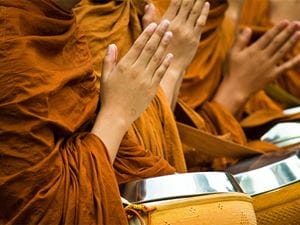
The vows individual Buddhists take vary greatly depending on both the particular school of Buddhism to which they belong as well as their reason for taking their vows and what position they aspire to by taking vows. There are many branches of Buddhism, and while they share a common core, each has its own unique traditions. Within all of these branches, there are both lay people and monks and nuns. The vows that monks and nuns take are not always applicable to lay Buddhists. The first step, however, for most followers of Buddhist traditions is to “take refuge” in the Triratna, the three-fold source of Buddhism: the Buddha, the dharma (the teachings), and the sangha (the community). These are referred to as the Three Jewels. At that point, particularly devout Buddhists, even lay ones, might wish to take further vows.
The Five Precepts are the most common vows among lay Buddhists. The Five Precepts come together to create a distilled version of Buddhist ethics, rather like the most basic teachings of the Old Testament that could be distilled into the Ten Commandments. In Buddhism, the Five Precepts are to abstain from killing living things, abstain from taking what has not been given, abstain from sexual misconduct, abstain from false speech, and abstain from intoxicating substances. Lay Buddhists may vow to follow all five precepts, or they may vow to follow a few at a time as they move along their path until they have mastered themselves well enough to follow all five faithfully. A person who takes on all five precepts is called an upasaka (male) or upasika (female).
The Pratimoksha vows are the most basic vows for Buddhists entering monastic life, though some lay members may also wish to take them. As novices, an aspiring nun or monk will take 36 vows that are pulled from the Vinaya, a collection of Buddha’s teachings on monastic discipline. Fully ordained bhikshus and bhikshunis, monks and nuns, may be governed by anywhere from 227 to 354 vows depending on the tradition and school of Buddhism.
The Eighteen Bodhisattva Vows are taken by those who wish to walk the path of a bodhisattva. Bodhisattvas are awakened beings who seek to attain full enlightenment in order to help and eventually liberate all sentient beings. Those who embrace this desire are called bodhichitta. Many traditions teach that bodhisattvas are those who choose to be reincarnated instead of achieving nirvana so that they may continue helping others to find liberation. In Mahayana Buddhism, there are eighteen basic (“root”) bodhisattva vows and forty-six subsequent (“branch”) vows that train practitioners in the behavior of a bodhisattva and guide them along their path.
Mahayana Buddhism also contains the Eight Mahayana Precepts. These vows are taken during special holy days and retreats and are to be followed for 24 hours with the option to take them again the next day. The Eight Mahayana Precepts are comprised of the main Five Precepts and further restrictions on food (a form of fasting), on excessive comfort (luxury), and on distractions, such as entertainment, personal ornamentation, perfume, or jewelry.
All of these vows, and many others, facilitate the Buddhist in the pursuit of enlightenment and the avoidance of karma, with the hope of nirvana, the release from the endless cycle of reincarnation.
Learn more about Buddhism here
3/14/2023 7:19:59 PM
About About Kathleen Mulhern, PH.D.
Kathleen Mulhern is a writer, editor, historian, speaker, and professor. She teaches courses in world history, European history, and history of Christianity. She has taught at Colorado School of Mines and Regis University, and is currently an adjunct professor at Denver Seminary in the areas of Church History and Spiritual Formation. Kathleen graduated with a B.A. from Wheaton College, earned an M.A. in French Literature from the University of Denver, an M.A. degree in Church History from Denver Seminary, and a Ph.D. in History from the University of Colorado.
More from Patheos about Buddhist Vows
Understanding the Noble Quest
They Say the Buddha Said
Attaining Nirvana - Complete Liberation
Most Popular

Catholic
The Dangers of Gradual Accommodation (Winking at Sin)

Jewish
Building a Little Ark in a Frightening World

Dolly Parton’s Last Song Wins Dove Award with Grascals

Latter-day Saint
The Iron Gates and the Lion of the Lord

Evangelical
Progressive Christian
The Image: On the Horror of Capitalism and Matthew...

Progressive Christian
Why Christians Have a Sacred Duty to Vote: Biblical...

General Christian
Seventy and Five Years Old: God Still Starts New Chapters

Evangelical
Letters on Living the Faith by C.S. Lewis

General Christian
When Halloween Unmasks Married Hearts

Evangelical

Evangelical
The REST of Your Life: A Creative Wrestles With Sabbath
Patheos Explore the world's faith through different perspectives on religion and spirituality! Patheos has the views of the prevalent religions and spiritualities of the world.
Ad-Free & Subscriber Log-In Subscription Support
- About Us
- 2026 Calendar
- Videos
- Podcasts
- Library of World Religions
- Faith In Media Tracker
- Advertise With Us
- Write for Us
- Privacy Policy
- Terms of Service
- Do Not Sell My Data
- Contact Us
- Radiant Digital
- Manage Newsletter Subscriptions
- Unsubscribe From Notifications
- Sitemap
Copyright 2008-2026, Patheos. All rights reserved.
Subscription Support Ad-Free & Subscriber Log-In
Follow Patheos