
BuddhistCatholicContemplativeEvangelicalGeneral ChristianHinduJewishLatter-day SaintMuslimNew VisionsProgressive Christian
Beliefs
- Buddhist
- Catholic
- Contemplative
- Evangelical
- General Christian
- Hindu
- Jewish
- Latter-day Saint
- More Voices
- Muslim
- New Visions
- Pagan
- Progressive Christian
Topics
- Religion News
- Food and Religion
- Sports and Religion
- Religious Art
- Religious Music and Entertainment
- Religious Events
- History and Religion
- Style and Religion
- Politics and Religion
- Women in Religion
- Recreation Outdoors and Religion
- Business Finance and Religion
- Careers Workplace and Religion
- Education and Religion
- Family Parenting and Religion
- Health Fitness and Religion
- Home and Religion
- Relationships and Religion
- Technology and Religion
- Travel and Religion
Columnists
- Buddhist Columnists
- Business Finance and Religion Columnists
- Careers Workplace and Religion Columnists
- Catholic Columnists
- Contemplative Columnists
- Education and Religion Columnists
- Evangelists Columnists
- Family Parenting and Religion Columnists
- General Christian Columnists
- Health Fitness and Religion Columnists
- Hindu Columnists
- History and Religion Columnists
- Home and Religion Columnists
- Jewish Columnists
- More Voices Columnists
- Latter Day Columnists
- Muslim Columnists
- New Visions Columnists
- Nonreligious Columnists
- Pagan Columnists
- Politics and Religion Columnists
- Progressive Columnists
- Recreation Outdoors and Religion Columnists
- Relationships and Religion Columnists
- Religion News Columnists
- Religious Art Columnists
- Religious Events Columnists
- Religious Music and Entertainment Columnists
- Sports and Religion Columnists
- Style and Religion Columnists
- Technology and Religion Columnists
- Travel and Religion Columnists
- Women in Religion Columnists
Resource Library
- 2026 Calendar
- Library of World Religions
- The 100 Most Holy Places on Earth
- Patheos Answers
- Podcasts
- Videos
- Faith Leaders Database
- Anglican Episcopalian
- Bahai
- Baptist
- Buddhism
- Christianity
- Confucianism
- Eastern Orthodoxy
- Hinduism
- Holiness and Pentecostal
- ISKCON
- Islam
- Judaism
- Lutheran
- Methodist
- The Church of Jesus Christ of Latter-day Saints
- New Age
- Paganism
- Presbytarian and Reformed
- Protestantism
- Religion Behind the Scenes
- Roman Catholic
- Scientology
- Shia Islam
- Sikhism
- Sufism
- Sunni Islam
- Taoism
- Zen
- See all religions
Research Tools
 Ad-Free & Subscriber Log-In Subscription Support
Ad-Free & Subscriber Log-In Subscription Support
Follow Patheos 

- Trending:
- Forgiveness
- |
- Marriage
- |
- Consciousness
- |
- Death Penalty
- |
- Election
- |
- Halloween
- Home
- Buddhism
- Religious Events
- Answers
- What Religions Dont Celebrate Christmas
General Christian
Patheos answers the question:
What Religions Don’t Celebrate Christmas?
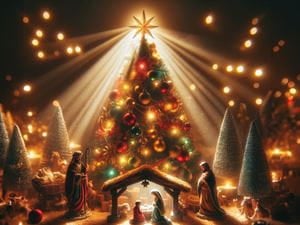
Image made with Dall-E and altered with Adobe Firefly
Introduction to Christmas Celebrations
Christmas is technically a Christian holiday, originally established to commemorate the birth of Jesus Christ—the central figure of the Christian faith. First celebrated in Rome (in AD 336), it quickly spread throughout the world, becoming an official “feast day” in Roman Catholicism and Eastern Orthodoxy, and one of the most important holidays in the various Christian denominations.
Who Celebrates Christmas?
Because it is formally a Christian religious holiday, rather than asking “What religions don’t celebrate Christmas?” it might be more appropriate to ask, “Which ones do celebrate it?” As a religious holiday, Christmas only has historic and theological meaning in the various Christian traditions. However, because of the many popular (and even secular) components of this holiday, people from various religious traditions tend to celebrate it for secular reasons and, for a few, even for spiritual reasons unrelated to Christian doctrine.
Christian Denominations and Christmas
Perhaps it is worth noting that not all Christians do commemorate Christmas. For example, Jehovah’s Witnesses don’t celebrate any holidays—other than the annual commemoration of Christ’s death, which they call the “Memorial” or “Evening Meal.” They see biblical precedent for rejecting any holiday that serves to exalt a human being or any human organization (which is why they avoid commemorating birthdays and various national holidays). As to Christmas, they hold that any holiday—religious or secular—which has traceable ties to paganism would be inappropriate for true Christians to celebrate; and much of contemporary Christmas commemorations are wrapped up in ancient pagan symbols and practices.
Jewish Observance and Christmas
Though Jesus was a practicing Jew, the vast majority of Jews do not accept Him as their messiah or even as a true prophet of God. Consequently, commemorating Christmas is not something most Jews would feel comfortable engaging in. In actuality, Jews have their own holiday (around the same time as Christmas) known as Hanukkah (or Chanukah). In many ways, this has become the equivalent of the “Jewish Christmas”—with the giving of gifts, festive lights, family gatherings, seasonal foods, and even “Hanukah Harry,” a Jewish figure who looks strikingly similar to Santa Claus, and who drops in on the homes of Jewish families each of the eight nights of Hanukkah to deliver gifts to children. While there are some Jews who will have an annual “Hanukkah Bush”—that looks like a Christmas tree, but with Jewish decorations—this is not something that most Jews would have in their homes during Hanukkah. That being said, Messianic Jews—those who believe Jesus was the Messiah of the Jewish people and of the world, but who incorporate elements of Judaism into their Christianity—will traditionally celebrate the birth of Yeshua (or Jesus), though typically during Hanukkah, rather than on Christmas. However, there has been a growing trend in recent years among some Messianic Jews to commemorate Christmas along with Hanukkah. Nonetheless, Jews who celebrate Jesus in any way could not be considered “mainstream” or “orthodox.”
Christmas and Islam
Jesus is a very significant figure in Islam. He is considered one of the most important of Allah’s Messengers, and Muslims generally accept the various miracles of Jesus (including His virgin birth and His pending second coming). And yet, Christmas is not an Islamic holiday. However, as one Muslim, who celebrates Christmas, pointed out: “Celebrating Christmas is not really a contradiction to Islam because Jesus is our prophet, too.” Of course, not all Muslims would agree. That being said, during the month of December, it is common for sermons about Jesus and His important role in Islam to be given in mosques, and for additional emphasis to be placed upon Jesus by practicing Muslims. Thus, Christmas has no “official” place in Islam, but it has unquestionably influenced Islamic practice during the month of December, and a significant percentage of Muslims—particularly those living in Western nations (where Christianity prevails)—place additional emphasis on Jesus during this Christian holiday.
Secular Christmas Celebrations
It will be no surprise that many non-Christians celebrate Christmas as a secular (rather than religious) holiday. Indeed, in 2013, the Pew Research Center released a study, noting that “81% of non-Christians in the United States celebrate Christmas.” The study added:“…roughly three-quarters of Asian-American Buddhists (76%) and Hindus (73%) celebrate Christmas. In addition, [a] recent survey of U.S. Jews found that about a third (32%) had a Christmas tree in their home last year. And some American Muslims celebrate both the religious and cultural aspects of Christmas, according to news reports.” So, an enormous number of people throughout the world celebrate this holiday because of its fun and festive nature, without engaging in (or even understanding) its religious components. Frankly, many Christians celebrate Christmas without attaching any religious meaning to it as well.
Pagan Roots
Many religions have holidays that look pretty Christmas like—some in December and some not. While some have borrowed from Christianity to craft their holiday, in many cases Christianity has borrowed from those other traditions, influencing the way Christmas is celebrated. For example, it is well known that several Christmas symbols have their roots in paganism—and particularly the pagan holiday of Yule. The use of mistletoe, the lighting of candles (or a yule log), the colors red and green, the holiday tree—each of these were drawn by early Christians from paganism. Even certain holiday treats, like gingerbread, wassail, and yule-log cakes, all have their roots in paganism.
Christmas' Influence on Other Religions
In addition to pagan influence on Christianity, examples of holidays that have likely been influenced by Christmas would include Diwali, commonly celebrated by many in India (though it is technically originally a Hindu holiday). Among other things, Diwali (like Christmas) is commemorated by giving gifts. Lighting the home with special lamps (or lights) is also a common component in both traditions. Indeed, both are seen as a “festival of lights.” Like Christmas that has crept into traditions other than Christianity, Diwali has become common among non-Hindu faiths, such as Jainism, Buddhism, Sikhism, and the Hare Krishna tradition (or ISKCON).
Christmas is a Mix of Religious and Secular Worlds
So, what religions don’t celebrate Christmas? Well, no major religions—other than Christianity—“officially” celebrate it. However, beyond the two billion plus Christians who do celebrate the birth of Jesus each year, a remarkably high percentage of the world commemorate this holiday as a secular celebration; a time for sharing love, gifts, and time with those most dear. And though Christmas is celebrated in many different ways in various countries and cultures, it has had significant influence on various non-Christian holidays, who have found benefit in the ways in which Christians have celebrated this most popular of its holidays, just as Christians early on found benefit in how pagans celebrated Yule.
11/15/2023 5:05:08 PM

About Alonzo L. Gaskill, PhD
Alonzo L. Gaskill is a Professor of Church history and doctrine. He holds a bachelor's degree in philosophy, a masters in theology, and a PhD in biblical studies.
Most Popular
- Home
- Buddhism
- Religious Events
- Answers
- What Religions Dont Celebrate Christmas
Evangelical
Letters on Living the Faith by C.S. Lewis
- Home
- Buddhism
- Religious Events
- Answers
- What Religions Dont Celebrate Christmas
General Christian
When Halloween Unmasks Married Hearts
- Home
- Buddhism
- Religious Events
- Answers
- What Religions Dont Celebrate Christmas
Evangelical
- Home
- Buddhism
- Religious Events
- Answers
- What Religions Dont Celebrate Christmas
Evangelical
The REST of Your Life: A Creative Wrestles With Sabbath

- Home
- Buddhism
- Religious Events
- Answers
- What Religions Dont Celebrate Christmas
#107: Cast of Character(s): This Weeks Episode of The...
- Home
- Buddhism
- Religious Events
- Answers
- What Religions Dont Celebrate Christmas
Progressive Christian
BONUS SHOW: Autism and RFK Jr.'s Cameo
- Home
- Buddhism
- Religious Events
- Answers
- What Religions Dont Celebrate Christmas
57th Dove Awards Honor Dolly Parton, Crown New Voices
- Home
- Buddhism
- Religious Events
- Answers
- What Religions Dont Celebrate Christmas
General Christian
A Biblical Vision of Success in Christian Life and...
- Home
- Buddhism
- Religious Events
- Answers
- What Religions Dont Celebrate Christmas
General Christian
What a Stop Sign Can Teach Us About God’s Will
- Home
- Buddhism
- Religious Events
- Answers
- What Religions Dont Celebrate Christmas
Catholic
What If You Are God’s Currency?
- Home
- Buddhism
- Religious Events
- Answers
- What Religions Dont Celebrate Christmas
The Real AI Story Is Adoption Without Trust
- Home
- Buddhism
- Religious Events
- Answers
- What Religions Dont Celebrate Christmas
The First Eucharistic Controversy: Christ’s Real Presence
Patheos Explore the world's faith through different perspectives on religion and spirituality! Patheos has the views of the prevalent religions and spiritualities of the world.
Ad-Free & Subscriber Log-In Subscription Support
- About Us
- 2026 Calendar
- Videos
- Podcasts
- Library of World Religions
- Faith In Media Tracker
- Advertise With Us
- Write for Us
- Privacy Policy
- Terms of Service
- Do Not Sell My Data
- Contact Us
- Radiant Digital
- Manage Newsletter Subscriptions
- Unsubscribe From Notifications
- Sitemap
Copyright 2008-2026, Patheos. All rights reserved.
Subscription Support Ad-Free & Subscriber Log-In
Follow Patheos