
BuddhistCatholicContemplativeEvangelicalGeneral ChristianHinduJewishLatter-day SaintMuslimNew VisionsProgressive Christian
Beliefs
- Buddhist
- Catholic
- Contemplative
- Evangelical
- General Christian
- Hindu
- Jewish
- Latter-day Saint
- More Voices
- Muslim
- New Visions
- Pagan
- Progressive Christian
Topics
- Religion News
- Food and Religion
- Sports and Religion
- Religious Art
- Religious Music and Entertainment
- Religious Events
- History and Religion
- Style and Religion
- Politics and Religion
- Women in Religion
- Recreation Outdoors and Religion
- Business Finance and Religion
- Careers Workplace and Religion
- Education and Religion
- Family Parenting and Religion
- Health Fitness and Religion
- Home and Religion
- Relationships and Religion
- Technology and Religion
- Travel and Religion
Columnists
- Buddhist Columnists
- Business Finance and Religion Columnists
- Careers Workplace and Religion Columnists
- Catholic Columnists
- Contemplative Columnists
- Education and Religion Columnists
- Evangelists Columnists
- Family Parenting and Religion Columnists
- General Christian Columnists
- Health Fitness and Religion Columnists
- Hindu Columnists
- History and Religion Columnists
- Home and Religion Columnists
- Jewish Columnists
- More Voices Columnists
- Latter Day Columnists
- Muslim Columnists
- New Visions Columnists
- Nonreligious Columnists
- Pagan Columnists
- Politics and Religion Columnists
- Progressive Columnists
- Recreation Outdoors and Religion Columnists
- Relationships and Religion Columnists
- Religion News Columnists
- Religious Art Columnists
- Religious Events Columnists
- Religious Music and Entertainment Columnists
- Sports and Religion Columnists
- Style and Religion Columnists
- Technology and Religion Columnists
- Travel and Religion Columnists
- Women in Religion Columnists
Resource Library
- 2026 Calendar
- Library of World Religions
- The 100 Most Holy Places on Earth
- Patheos Answers
- Podcasts
- Videos
- Faith Leaders Database
- Anglican Episcopalian
- Bahai
- Baptist
- Buddhism
- Christianity
- Confucianism
- Eastern Orthodoxy
- Hinduism
- Holiness and Pentecostal
- ISKCON
- Islam
- Judaism
- Lutheran
- Methodist
- The Church of Jesus Christ of Latter-day Saints
- New Age
- Paganism
- Presbytarian and Reformed
- Protestantism
- Religion Behind the Scenes
- Roman Catholic
- Scientology
- Shia Islam
- Sikhism
- Sufism
- Sunni Islam
- Taoism
- Zen
- See all religions
Research Tools
 Ad-Free & Subscriber Log-In Subscription Support
Follow Patheos 

- Trending:
- Advent
- |
- Forgiveness
- |
- Thanksgiving
- |
- Election
- |
- Seasonal Holidays
- |
- Marriage
- Home
- Catholic
- History and Religion
- Answers
- What Other Religions Have a Leader Like the Pope
Patheos answers the question:
What Other Religions Have a Leader Like the Pope?
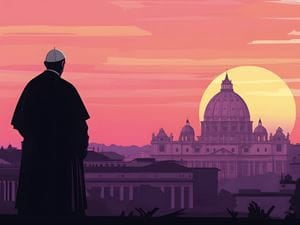
Adobe Stock
The term “Catholic” means “universal” and, as the head of the Roman Catholic Church, the pope is seen as the “universal head” of Christianity. Of course, those in the various Protestant and Eastern Orthodox traditions do not accept the pope as their head. Nevertheless, Christians and non-Christians alike recognize the leader of the Catholic Church as the man who presides over most Christians, and as a symbol of Christian leadership and piety, even if “outsiders” reject the pope’s “authority” or teachings.
So, what other Christian and non-Christian religions have the leader akin to the Catholic pope? Well, the answer requires some nuance. Not all Catholics perceive the pope’s authority in the same way, and many in the various religions of the world have their own views on their faith tradition’s leader and authority. However, what follows are the closest parallels to a leader perceived like the Roman Catholic Pontiff.
Eastern Orthodox Christianity
The Eastern Orthodox Church has more than a dozen autocephalous (or self-governing) denominations, with each having its own patriarch (e.g., Greek Orthodox, Russian Orthodox, Serbian Orthodox, etc.). The titular head of all of Eastern Orthodoxy is a man referred to as the “Eccumenical Patriarch.” He symbolically represents the reality that the various Eastern Orthodox denominations are united as one Church, and are in communion with each other. However, while the Catholic Pope and the Orthodox Eccumenical Patriarch are both referred to as “first among equals,” the Bishop of Rome unquestionably has authority and powers over the entire Catholic Church that the Eccumenical Patriarch does not hold over all of Eastern Orthodoxy.
Thus, whereas the Pope can rightly be said to be the most powerful man in Catholicism, it may be fair to say that Orthodoxy’s head patriarch is more of a symbolic office—and he does not hold actual authority over the National Patriarchs who preside over their individual denominations.
Oriental Orthodox Christianity
The Oriental Orthodox Church—not to be confused with the Eastern Orthodox tradition—is made up of six main sub-denominations, each having its own head. The various branches (i.e., Coptic, Syrian, Armenian, Ethiopian, Eritrean, and Malankara or Indian) are part of a “council of Patriarchs” who, in communion with each other, seek to unitedly make decisions that affect all branches of Oriental Orthodoxy.
While the Coptic Orthodox Church refers to its head as the “Pope of Alexandria” (“pope” coming from the Greek word for “father”), the Coptic Church’s head is not a “pope” in the same sense as the leader of the Roman Catholic Church, and he has no universal authority over Oriental Orthodoxy.
The Latter-day Saint Prophet
The leader of The Church of Jesus Christ of Latter-day Saints is called the “prophet” and “president” of the Church. Like the Catholic pope, the Latter-day Saint prophet leads the whole Church. While fourteen other men traditionally share in the prophet’s authority—and all fifteen of them are sustained by their membership as “prophets, seers, and revelators”—the Saints hold that only the prophet or president of the Church can exercise “all priesthood” (or priesthood “keys”).
Thus, for Latter-day Saint Christians, their president is more than “first among equals.” He literally has universal authority and presides over all other apostles, leaders, and members of the Church.
The Anglican Communion
The head of the Anglican tradition is technically the reigning monarch of England and, beneath him, the Church is run by the Archbishop of Canterbury. Strictly speaking, both of these figures are symbolic heads. The monarch doesn’t actually run the Church of England, and the Archbishop is the representational head of the worldwide Anglican community, but holds no authority over the various national Anglican Churches.
Thus, while the leader of the Anglican tradition may look akin to the Catholic pope in power and position, he is more of a figurehead than the actual universal “leader” of Anglicanism.
Non-Christian Traditions With Similar Leadership Models
Outside of Christianity, there are a few faith traditions that have ecclesiastical heads who appear to mirror the Catholic pope in their position, power, or prominence. However, each is parallel mostly in appearance, but not in actuality.
Islam’s Leadership Structure
Islam’s largest branches (Sunni and Shia Islam) have no singular world leader. Indeed, the Ottoman Caliphate, which existed from 1517 to 1924, was the last time Muslims could be said to have had a singular world leader. Mehmed VI, the last Ottoman Sultan, claimed authority over all Sunni Muslims. However, this caliphate was formally abolished in 1924. Today, Ismaili Islam (a small branch of the Shia tradition) is led by a singular figure, the Aga Khan (also known as the Imām of the Nizari Ismāʿīli Shias). He is the worldwide leader of approximately 15 million Muslims (mostly in East Africa, Central and South Asia, Europe and North America).
For the largest body of Ismaili Muslims, the Aga Khan is a “manifestation of divine guidance” on the earth, his lineal authority can be traced back to Ali (the Prophet Muhammad’s son-in-law), and he holds both spiritual and temporal power. Thus, in certain ways, he parallels the Roman Catholic pope, though his scope of influence is decidedly small, and he is rejected by the vast majority of Muslims. Other Islamic leaders, such as Iran’s Ayatollah, lead their portion of Shia Islam, and are perceived more as theologians and scholars of Islamic law than they are prophetic leaders. In Iran, the Ayatollah is the Supreme Leader of the country and, thus, like the Catholic pope (who runs the Vatican State), holds both spiritual and temporal power.
The Dalai Lama in Tibetan Buddhism
While many will recognize the title of the leader of Gelug school of Tibetan Buddhism, the Dalai Lama, many non-Buddhists assume he has a position of authority or prominence in all of Buddhism. In reality, the Dalai Lama is the head of a singular branch of Vajrayana Buddhism and is not universally accepted among Buddhists. Considered a reincarnation of Avalokiteshvara, the bodhisattva of compassion, he is seen by many as a divine being.
In that regard, his position is not truly akin to that of the pope. The Dalai Lama does not preside over other monks or over practitioners of Buddhism. Rather, his position is largely as the moral and spiritual exemplar to his people. He does not, however, hold a hierarchical or administrative position akin to the Catholic pontiff.
Which Leaders Most Closely Parallel the Pope?
Though there are other faith traditions who have worldwide leaders, the aforementioned are the ones with the closest parallels to the Roman Catholic pope. Out of those we’ve discussed, the leaders most closely viewed by their practitioners in ways similar to the pontiff’s power and authority would be the Latter-day Saint prophet and the Ismaili Kahn. Both have universal authority over their worldwide faith tradition, both are seen as enjoying a measure of inspiration beyond what normal humans would have, and both are believed to have been called by God to “manifest” His will to His people and the world.
Though the number of practitioners who acknowledge the prophet or the khan as God’s “messenger” is relatively small when compared to the pope, nonetheless, the importance of those two men for their people is not only akin to the pontiff’s, but these two figures presiding over these smaller religions actually enjoy a measure of reverence and respect that many modern popes no longer enjoy.
1/7/2026 10:26:08 PM
Most Popular
- Home
- Catholic
- History and Religion
- Answers
- What Other Religions Have a Leader Like the Pope
Progressive Christian
Smart people saying smart things (11.24.26)
- Home
- Catholic
- History and Religion
- Answers
- What Other Religions Have a Leader Like the Pope
The Contingency of Our Technology
- Home
- Catholic
- History and Religion
- Answers
- What Other Religions Have a Leader Like the Pope
Progressive Christian
- Home
- Catholic
- History and Religion
- Answers
- What Other Religions Have a Leader Like the Pope
Progressive Christian
Reasons for Restraint: Ricardo Gonzalez, Florida and Dec 1

- Home
- Catholic
- History and Religion
- Answers
- What Other Religions Have a Leader Like the Pope
General Christian
Psalm 5: David Pleads His Case

- Home
- Catholic
- History and Religion
- Answers
- What Other Religions Have a Leader Like the Pope
Progressive Christian
It All Counts: A Conversation With Natalia Terfa
- Home
- Catholic
- History and Religion
- Answers
- What Other Religions Have a Leader Like the Pope
General Christian
Reflections of a Recovered Evangelical: Honoring the...
- Home
- Catholic
- History and Religion
- Answers
- What Other Religions Have a Leader Like the Pope
Latter-day Saint
- Home
- Catholic
- History and Religion
- Answers
- What Other Religions Have a Leader Like the Pope
- Home
- Catholic
- History and Religion
- Answers
- What Other Religions Have a Leader Like the Pope
Progressive Christian
'Statements of Faith' never get shorter
- Home
- Catholic
- History and Religion
- Answers
- What Other Religions Have a Leader Like the Pope
Evangelical
Michele's Reviews - Future Grace by John Piper
- Home
- Catholic
- History and Religion
- Answers
- What Other Religions Have a Leader Like the Pope
Evangelical
Bama Gramma's Blackout Christmas: the Power of Light...
Patheos Explore the world's faith through different perspectives on religion and spirituality! Patheos has the views of the prevalent religions and spiritualities of the world.
Ad-Free & Subscriber Log-In Subscription Support
- About Us
- 2026 Calendar
- Videos
- Podcasts
- Library of World Religions
- Faith In Media Tracker
- Advertise With Us
- Write for Us
- Privacy Policy
- Terms of Service
- Do Not Sell My Data
- Contact Us
- Radiant Digital
- Manage Newsletter Subscriptions
- Unsubscribe From Notifications
- Sitemap
Copyright 2008-2026, Patheos, part of the Radiant Digital network of media brands. All rights reserved.
Subscription Support Ad-Free & Subscriber Log-In
Follow Patheos