
BuddhistCatholicContemplativeEvangelicalGeneral ChristianHinduJewishLatter-day SaintMuslimNew VisionsProgressive Christian
Beliefs
- Buddhist
- Catholic
- Contemplative
- Evangelical
- General Christian
- Hindu
- Jewish
- Latter-day Saint
- More Voices
- Muslim
- New Visions
- Pagan
- Progressive Christian
Topics
- Religion News
- Food and Religion
- Sports and Religion
- Religious Art
- Religious Music and Entertainment
- Religious Events
- History and Religion
- Style and Religion
- Politics and Religion
- Women in Religion
- Recreation Outdoors and Religion
- Business Finance and Religion
- Careers Workplace and Religion
- Education and Religion
- Family Parenting and Religion
- Health Fitness and Religion
- Home and Religion
- Relationships and Religion
- Technology and Religion
- Travel and Religion
Columnists
- Buddhist Columnists
- Business Finance and Religion Columnists
- Careers Workplace and Religion Columnists
- Catholic Columnists
- Contemplative Columnists
- Education and Religion Columnists
- Evangelists Columnists
- Family Parenting and Religion Columnists
- General Christian Columnists
- Health Fitness and Religion Columnists
- Hindu Columnists
- History and Religion Columnists
- Home and Religion Columnists
- Jewish Columnists
- More Voices Columnists
- Latter Day Columnists
- Muslim Columnists
- New Visions Columnists
- Nonreligious Columnists
- Pagan Columnists
- Politics and Religion Columnists
- Progressive Columnists
- Recreation Outdoors and Religion Columnists
- Relationships and Religion Columnists
- Religion News Columnists
- Religious Art Columnists
- Religious Events Columnists
- Religious Music and Entertainment Columnists
- Sports and Religion Columnists
- Style and Religion Columnists
- Technology and Religion Columnists
- Travel and Religion Columnists
- Women in Religion Columnists
Resource Library
- 2026 Calendar
- Library of World Religions
- The 100 Most Holy Places on Earth
- Patheos Answers
- Podcasts
- Videos
- Faith Leaders Database
- Anglican Episcopalian
- Bahai
- Baptist
- Buddhism
- Christianity
- Confucianism
- Eastern Orthodoxy
- Hinduism
- Holiness and Pentecostal
- ISKCON
- Islam
- Judaism
- Lutheran
- Methodist
- The Church of Jesus Christ of Latter-day Saints
- New Age
- Paganism
- Presbytarian and Reformed
- Protestantism
- Religion Behind the Scenes
- Roman Catholic
- Scientology
- Shia Islam
- Sikhism
- Sufism
- Sunni Islam
- Taoism
- Zen
- See all religions
Research Tools
 Ad-Free & Subscriber Log-In Subscription Support
Ad-Free & Subscriber Log-In Subscription Support
Follow Patheos 

- Trending:
- Forgiveness
- |
- Marriage
- |
- Consciousness
- |
- Death Penalty
- |
- Election
- |
- Halloween
Jewish
Patheos answers the question:
What Language Do Jewish People Speak?
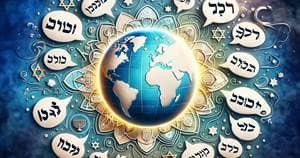
Made with Dalle and edited with adobe firefly
The Significance of Hebrew to Judaism
The Hebrew language is commonly associated with Judaism as a religion, and with the Jewish people as a race. Indeed, scripturally and liturgically speaking, the Hebrew language has been central to Judaism as a religion for millennia. Ancient or Biblical Hebrew, Mishnaic Hebrew, and Modern Hebrew, have all had their place in various stages of Jewish history—and all three exist in certain branches of Judaism today. However, not all Jews speak Hebrew, and the language of the people and the religion have evolved during the thousands of years since God introduced His covenant to Abrahm, and since Moses received God’s law on Mount Sinai.
Hebrew: The Language of Abraham
Abraham is traditionally seen as the “founder of the faith,” and is believed to have lived around 1,800 BCE. By that time, Hebrew had become a distinct language from other Semitic languages (like Canaanite and Ugaritic). As a Hebrew speaker, and as the father of covenant Israel, the language of Abraham was passed through his family line—and became the original language of Judaism.
Linguistic Shifts After Captivities
In the 8th century BCE, the kingdom of Israel was destroyed (in what is known as the “Assyrian Captivity”). Then, in the 6th century BCE, the kingdom of Judah was conquered and taken captive (in what is often called the “Babylonian Captivity”). As a consequence, Aramaic became the common language of the Jewish people (during the Intertestamental period), and it was found in Jewish texts by the 5th century BCE. When the Persians allowed the Jews to return to Jerusalem to rebuild the temple (which had been destroyed during the Babylonian Captivity), Aramaic remained the common language of Jews living in northern Israel, though an Aramaic influenced Hebrew was fairly common in places like Samaria or Galilee.
The Hellenistic Influence and Loss of Hebrew
When Alexander the Great conquered Judah (in the 4th century BCE), Hellenistic influence resulted in the creation of the Septuagint—a Greek translation of the Hebrew Bible. During that same era, fewer and fewer Jews could speak or read Hebrew. Aramaic and Koine Greek had become the most common languages among the Jewish people, and Hebrew (for a time) largely lost its footing in Judaism.
Diaspora and Language Diversification
In 70 CE, the Romans destroyed Herod’s Temple (commonly called the “Second Temple”). As a result, the Jewish people were scattered throughout various parts of the world. During this diaspora, Jews adopted the languages of the locations in which they settled. In many cases, the common languages of their new “neighbors” mixed with their own language (e.g., Hebrew, Aramaic, Greek, etc.), resulting in unique Jewish dialects or languages. So, for example, Yiddish—commonly spoken by Ashkenazi Jews—developed in Central Europe in the 9th century CE and is a synthesis of elements of Hebrew with High German and Aramaic. Thus, a number of commonly used terms—like “chutzpah,” “klutz,” “putz,” “schmooze,” and “touché” (or “toosh”)—are all Yiddish words that have made their way into the English language, but which grew out of a Jewish dialect developed during the diaspora. .
Jewish Languages Today
Today, about 41% of Jews live in the United States, and approximately the same percentage lives in Israel. The remaining 18% are scattered throughout the world, including in countries like Russia, Germany, the U.K. and France. Consequently, the most commonly spoken languages among Jews today are English, followed by modern Hebrew, and then Russian. However, during synagogue services, the language spoken is typically influence by both the part of the world in which one lives, and also the denomination to which one belongs. So, for example, Haredi and Modern Orthodox Jews tend to rely heavily on Hebrew as the language of their liturgy. However, more progressive denominations—like Conservative and Reform Judaism—are often inclined to use the common language of the local in which the congregation is located (for their liturgy), sprinkled with Hebrew or (in some cases) with no Hebrew at all.
Liturgy and Language in Modern Practice
Currently, there are more than seventy Jewish diaspora languages. Thus, common stereotypes in movies or literature which depict all Jews as Hebrew speakers who dress alike, and share a common diet or way of living, are mostly inaccurate. There are multiple denominations of Judaism, a variety of ways to practice this ancient tradition, multiple dialects of Hebrew, and dozens of commonly spoken languages among the Jewish people. Linguistically speaking, the 16 million Jews alive today have many languages and many cultures and are remarkably diverse considering how small this tradition is.
11/28/2023 6:17:10 PM
How Does One Become Jewish?
What Are The Abrahamic Religions?
What Are the Origins of Judaism?
What is the Jewish Holiday of Simchat Torah?

About Alonzo L. Gaskill, PhD
Alonzo L. Gaskill is a Professor of Church history and doctrine. He holds a bachelor's degree in philosophy, a masters in theology, and a PhD in biblical studies.
Most Popular

General Christian
A Biblical Vision of Success in Christian Life and...

Catholic
Swimfan: Forgotten Aughts Pleasures

Catholic
Top Three Anti-Catholic Lies About Catholicism

Catholic
Pope Leo Celebrates Mass for Nurses & Docs While in...

Catholic
The Sermon on the Mount, Part I: Matthew 4:12-5:12

Catholic
Janie Learns the Way of the Cross: A Catholic Review

Entertainment

Evangelical
How the author of the world's best hymn became a Christian

Catholic
Looking For Good Catholic Writing - October 2026


INNER CIRCLE: Profound Mystery (Of Christ In All Of Us)

General Christian
What Does Gêvâh Mean For Kimberley Guifoyle & Pete...
Patheos Explore the world's faith through different perspectives on religion and spirituality! Patheos has the views of the prevalent religions and spiritualities of the world.
Ad-Free & Subscriber Log-In Subscription Support
- About Us
- 2026 Calendar
- Videos
- Podcasts
- Library of World Religions
- Faith In Media Tracker
- Advertise With Us
- Write for Us
- Privacy Policy
- Terms of Service
- Do Not Sell My Data
- Contact Us
- Radiant Digital
- Manage Newsletter Subscriptions
- Unsubscribe From Notifications
- Sitemap
Copyright 2008-2026, Patheos. All rights reserved.
Subscription Support Ad-Free & Subscriber Log-In
Follow Patheos